Detail of Hunefer: Papyrus of Hunefer. British Museum, EA9901. © The Trustees of the British Museum. Shared under a Creative Commons Attribution-NonCommercial-ShareAlike 4.0 International (CC BY-NC-SA 4.0) licence.
Hybrid Lecture March 11 6:00pm EST Rune Nyord "The Future of the Ancient Egyptian Afterlife" @harvardmuseums.bsky.social hmsc.harvard.edu/calendar_eve...
@runenyord.bsky.social
02.03.2026 15:32 —
👍 7
🔁 3
💬 0
📌 0

journal cover
Interdisciplinary Egyptology Vol. 2 No. 2 (2025) journals.univie.ac.at/index.php/in... #openaccess Egyptology in Dialogue: Historical bodies in relations, comparisons, and negotiations @runenyord.bsky.social @leireolabarria.bsky.social @edwardscrivens.bsky.social @emilywhitehead.bsky.social
07.01.2026 02:19 —
👍 3
🔁 2
💬 0
📌 1
During my visit to California this weekend, this lecture at Berkeley was recorded and is now up on YouTube. In it, I present an overview of the argument in my book “Yearning for Immortality” along with some pointers for new directions for studies of Egyptian mortuary religion.
13.11.2025 14:23 —
👍 6
🔁 0
💬 0
📌 0

Double sided icon (Athens, Greece)
A double sided icon from Egypt with St Paul on one side and an unidentified saint on the other. 7th-8th c. Housed in the Benaki Museum, Athens. For more photos, travel, and religion, follow me on Blu...
A double sided icon from Egypt with St Paul on one side and an unidentified saint on the other. (honestly, I'm not sure which side this is.). 7th-8th c. Housed in the Benaki Museum, #Athens.
📷🇬🇷 flic.kr/p/2rvYZMo
#photography
#Byzantine
#Greece
#saints
#museum
28.09.2025 03:56 —
👍 16
🔁 5
💬 2
📌 0
Yes, he does indeed look very unusual. As you can see, Drandaki does cite a couple of parallels, suggesting that the scrolls are a reference to the Pauline epistles. But if it wasn’t for the inscription, I probably wouldn’t have guessed this identity!
28.09.2025 21:24 —
👍 0
🔁 0
💬 0
📌 0
Two early icons from Egypt in the Benaki Museum | Drandaki | Athens University Review of Archaeology (AURA)
Two early icons from Egypt in the Benaki Museum
Thank you for sharing this piece! The inscription on the side shown here identifies the figure as St Apa Stephanos, so St Paul must be on the other side. There is more information on the icon in this article: dx.doi.org/10.26247/aur...
28.09.2025 17:00 —
👍 2
🔁 1
💬 1
📌 0

The full woodcut of 1529 of the cruciform sundial can be seen.

A finished version of the cruciform sundial.
In 1529, Georg Hartmann of Nuremberg made this woodcut, a cruciform #sundial, establishing a market for #DIY paper instruments.
For those interested in assembling Hartmann's paper cruciform sundial at home or in a history seminar, here is a link:
www.kartonmodellbau.org/cgi-bin/boge...
10.07.2025 08:27 —
👍 77
🔁 29
💬 7
📌 5

Ancient Egyptian Epigraphy and Palaeography - The Metropolitan Museum of Art
The Met presents over 5,000 years of art from around the world for everyone to experience and enjoy.
Have you looked at Ricardo Caminos’s overview of 19th- and 20th-century methods in Egyptological epigraphy in this book? www.metmuseum.org/met-publicat... — it probably doesn’t mention eyebrow pencils, though!
26.06.2025 21:53 —
👍 2
🔁 0
💬 1
📌 0

Stories that are out of this world: Books in brief
Andrew Robinson reviews five of the best science picks.
Delighted to see Yearning for Immortality featured in Nature’s “Books in brief” this morning: doi.org/10.1038/d415...
20.06.2025 16:50 —
👍 2
🔁 0
💬 0
📌 0
@yaelrice.bsky.social and I co-authored this piece precisely to combat misguided work like this so people don't have to constantly rehearse the arguments about why it's specious. We laid it all out here for you!
hyperallergic.com/604897/how-s...
05.04.2025 17:54 —
👍 529
🔁 220
💬 27
📌 21
Happening today at 4pm! RSVP now to join us in celebrating "Yearning for Immortality" by @runenyord.bsky.social: forms.office.com/r/D6eAJ7vtAm
03.04.2025 15:31 —
👍 1
🔁 1
💬 0
📌 0
Rune Nyord, "Yearning for Immortality: The European Invention of the Ancient Egyptian Afterlife" (U Chicago Press, 2025) - New Books Network
In this @newbooksnetwork.bsky.social interview, I had the pleasure of speaking with Miranda Melcher about my book “Yearning for Immortality: The European Invention of the Ancient Egyptian Afterlife”. You can listen to it at newbooksnetwork.com/yearning-for...
29.03.2025 16:11 —
👍 4
🔁 1
💬 0
📌 0
For those in Atlanta, the Fox Center is organising a book launch next week where I will be discussing “Yearning for Immortality” with two brilliant colleagues:
26.03.2025 23:52 —
👍 4
🔁 0
💬 0
📌 0
I might be able to help with this (depending on precise timing, etc.)
15.03.2025 23:01 —
👍 2
🔁 0
💬 1
📌 0
Yes, though I wonder just how much that impacted the European discourse directly - I would be curious to hear your thoughts on this when you’ve had a chance to read the book. Internal European schisms such as the Reformation or the rise of the anthropocentric afterlife seem more influential.
02.03.2025 13:52 —
👍 2
🔁 0
💬 1
📌 0
The book deals with the early modern and 19th-century European discourse on interpreting ancient Egyptian mortuary religion, which ends up feeding directly into the modern (Egyptological and popular) understanding. This is the context in which I use the notion of “colonisation”.
02.03.2025 13:38 —
👍 0
🔁 0
💬 2
📌 0
Ah, I understand. I am using the language here to contrast with the conceptual colonisation of the ancient religion by Christian concepts and frameworks. I don’t think the call to return to the sources here aligns particularly with nationalist agendas, but thank you for pointing out this issue.
02.03.2025 13:25 —
👍 0
🔁 0
💬 1
📌 0
Thank you! Since the core issue of the discourse is ancient Egyptian ideas, “indigenous” is used here to designate sources and concepts from that context (as opposed both to ancient Greek or Roman and later European ones). “Indigenous and coeval” might have been more precise, if a little unwieldy.
02.03.2025 12:17 —
👍 0
🔁 0
💬 2
📌 0
Thank you!
01.03.2025 18:23 —
👍 0
🔁 0
💬 0
📌 0
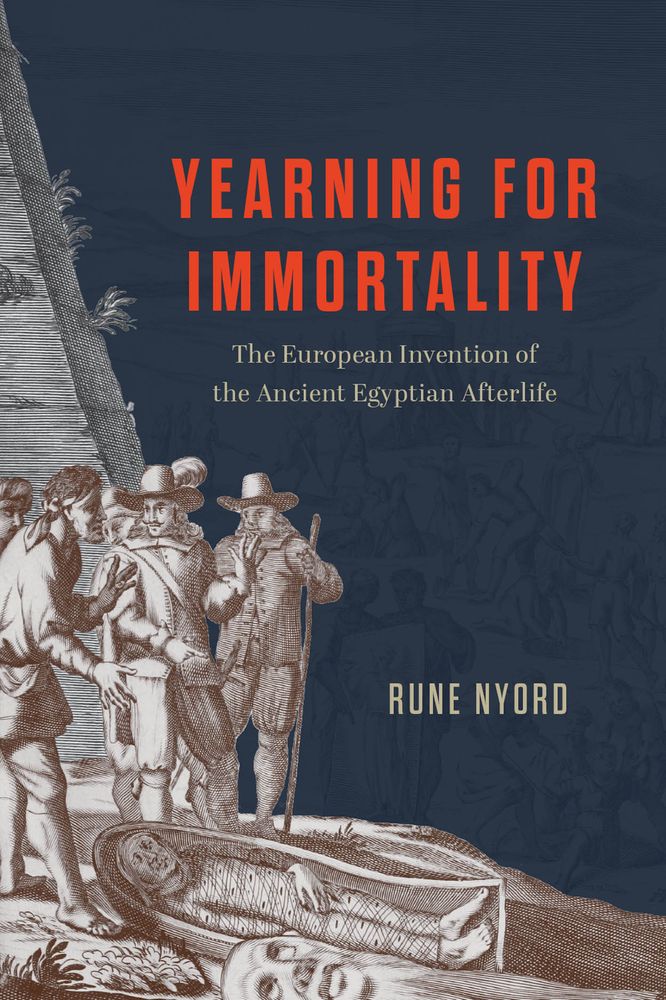
It is a great pleasure to announce that my book Yearning for Immortality: The European Invention of the Ancient Egyptian Afterlife is now available in Open Access: bit.ly/3Xn9HfB
Please download, read, and share with anyone who might be interested in new ways of thinking about Egyptian religion.
01.03.2025 14:59 —
👍 191
🔁 69
💬 15
📌 5

Screenshot from The Guardian's UK website this morning, under the category 'Egypt', a headline reading 'Smell like an Egyptian: researchers sniff ancient mummies to study preservation'
Hello @theguardian.com, this isn't news about Egypt, as your website categorizes it: it's news about Western scientists using colonial collections in Western museums to do to the ancestral Egyptian dead what they have done for centuries: promote themselves and grab headlines. 🧵📜🏺🗃️
14.02.2025 08:37 —
👍 33
🔁 6
💬 1
📌 0

An open cardboard box containing copies of Rune Nyord’s book Yearning for Immortality.
It’s here! Thrilled to have just received a stack of copies of my new book Yearning for Immortality: The European Invention of the Ancient Egyptian Afterlife. The official publication date (also for the Open Access version) is March 5, but UCP is already filling preorders: bit.ly/41cbSVO. #acrel
14.02.2025 14:45 —
👍 28
🔁 4
💬 1
📌 1
In which I question the oft-repeated claim that artistic intervention puts the past and present into dialogue. But which pasts? To what ends? Based on interviews with curators & artists, and reflections on not the end product but the process.
16.01.2025 10:42 —
👍 16
🔁 7
💬 1
📌 0
But by the time the Book of the Dead entered the picture, there was already a deeply entrenched tradition of understanding Egyptian mortuary religion as focused on judgement with resulting rewards and punishments in the afterlife, based on creative readings of authors like Herodotus and Diodorus.
13.01.2025 18:35 —
👍 1
🔁 0
💬 1
📌 0
Exactly, the weighing motif looked (and still looks!) a lot like the psychostasis familiar from Christian art with St. Michael weighing the souls at the Last Judgement, so it stood to reason that the rest of the Book of the Dead similarly depicted episodes of a personal, transcendent afterlife.
13.01.2025 18:31 —
👍 1
🔁 0
💬 1
📌 0
*certainly
13.01.2025 17:55 —
👍 0
🔁 0
💬 0
📌 0
(as shown also by the fact that it was taken long before the decipherment of hieroglyphs)
13.01.2025 17:54 —
👍 1
🔁 0
💬 1
📌 0