

Small-scale fishing in the Peruvian desert
To health and food security for small-scale fishers...
19.11.2025 09:09 — 👍 0 🔁 0 💬 0 📌 0
Small-scale fishing in the Peruvian desert
To health and food security for small-scale fishers...
19.11.2025 09:09 — 👍 0 🔁 0 💬 0 📌 0
A peat-forming forest, Peru
To forests...
19.11.2025 09:06 — 👍 0 🔁 0 💬 0 📌 0
Conceptual schematic of water inflows and outflows in the Kangerlussuaq Trough, Southeastern Greenland
From glaciers...
19.11.2025 09:05 — 👍 0 🔁 0 💬 0 📌 0
Study for a PhD in St Andrews!
We have several fully funded PhD opportunities available: see here for details and how to apply : www.st-andrews.ac.uk/geography-su...
#PhDfunding

🎓 Today we celebrate success! It’s graduation day for our amazing graduates, from Bachelor’s to PhDs. Congratulations to our entire Class of 2025! Here’s our brilliant PhD cohort ready to take on the world. 🌟 #GraduationDay #ProudSchool #ClassOf2025
04.07.2025 12:47 — 👍 4 🔁 2 💬 0 📌 0
St Andrews SGSD @standrewssgsd.bsky.social seeks to appoint a Post-doc to work on family and housing projections using microsimulation as part of 2 programmes: @migrantlife.bsky.social and @cpc-cg.bsky.social. Closing Date: 8 July 2025. For details:
www.vacancies.st-andrews.ac.uk/Vacancies/W/....

🎓 Another fantastic postgrad opportunity in our School!
Fully funded MSc(Res) in Blue Carbon Science
Start: Sept 2025 | Tuition + stipend
Supervised by Prof. Bill Austin
📩 wena@st-andrews.ac.uk
🔗More info under “Current funded opportunities” tab: www.st-andrews.ac.uk/geography-su...

🎓 We’re Hiring! 🌍
Post-Doctoral Research Fellow
🗓️ Starting: Sept 15, 2025 | Duration: 16–18 months, 4 days/week
Join to explore environmental governance and natural resource management in the Amazon Rainforest & the Gulf of Guinea.
🔗Learn more www.vacancies.st-andrews.ac.uk/V2/ViewVacan...

📻 David McCollum @standrewssgsd.bsky.social was on BBC Radio Wales yesterday discussing recent research on #workingfromhome in relation to the government's plans to relocate senior #civilservice jobs - it could help rejuvenate regional economies and encourage private sector follow-through. Listen ⬇️
19.05.2025 08:29 — 👍 0 🔁 1 💬 0 📌 0
🚨Fully funded PhD opportunity!
Apply now for joint St Andrews–Max Planck project on fertility trends in high-income countries.
📍Rostock & St. Andrews
🗓️ Deadline: 10 June 2025
📢 More info: www.st-andrews.ac.uk/geography-su...
#PhD #Demography #FertilityResearch

Image shows front cover of the ESRC Centre for Population Change Report: Working from home: Impacts on residential mobility and spatial inequality The report cover has an image of Birmingham Centenary Square, Image credit istock.com/holgs 2022. EXECUTIVE SUMMARY The propensity of individuals to work from home (WFH) all or some of the time (known as remote and hybrid working respectively) has proliferated since the onset of the Covid-19 pandemic in early 2020. The growth of WFH has been particularly pronounced amongst skilled workers. The rise of WFH, in effectively decoupling the geography of home and work, in theory presents opportunities for addressing regional inequalities. In the UK case this would involve the redistribution of human capital and economic activity from areas with ‘overheating’ property markets to other relatively affordable parts of the country, thus producing a more equitable distribution of human capital and productive economic activity. The main objective of this research is to elucidate the relationship between WFH and residential mobility amongst skilled workers and to consider its implications for spatial inequalities. The analysis draws on the UK Household Longitudinal Study (UKHLS) and a three-city case study approach to assess how the rise of WFH has influenced residential mobilities and the distribution of human capital in the UK. The investigation concludes that the types of places that were doing relatively well pre-pandemic have continued to do so post-pandemic in terms of their ability to attract and retain human capital. The residential mobility of skilled human capital has not been drastically changed by the rise in WFH. The potential for WFH to transform spatial inequalities is thus limited. This paper also contains critical reflections on the availability of secondary quantitative data to address these important policy topics and offers some recommendations in this respect.
And for the full analysis and findings, explore the #workingfromhome project report
www.cpc.ac.uk/docs/2025_Wo...
@standrewssgsd.bsky.social @dmuleicester.bsky.social
@anne-e-green.bsky.social @unibirmingham.bsky.social
@jackiewahba.bsky.social @arminegh.bsky.social @unisouthampton.bsky.social

CPC-CG Policy Briefing 84 front cover, published May 2025. Working from home: Implications for residential mobility and spatial inequalities Since the Covid-19 pandemic began in early 2020, more people have started working from home either all of the time (working remotely) or some of the time (hybrid working). In the UK, this rapid increase has been particularly noticeable among high-skill workers. This presents opportunities for addressing regional inequalities. For example, it could lead to people and businesses moving from expensive areas with overheating property markets to other relatively affordable ones, spreading skills and economic activity more evenly across the country. This briefing assesses who works from home and where, and what this means for residential mobility and the distribution of skilled human capital across the country. The analysis finds little evidence that the rise in working from home is reshaping residential mobilities. However, limited data makes it hard to tell if the changes are simply not being captured in the available data.
📗 In the 2nd #workingfromhome project policy briefing, David McCollum @standrewssgsd.bsky.social assesses who works from home and where, and what this means for residential mobility and the distribution of skilled human capital across the country @rgsibg.bsky.social
www.cpc.ac.uk/docs/PB84_Wo...
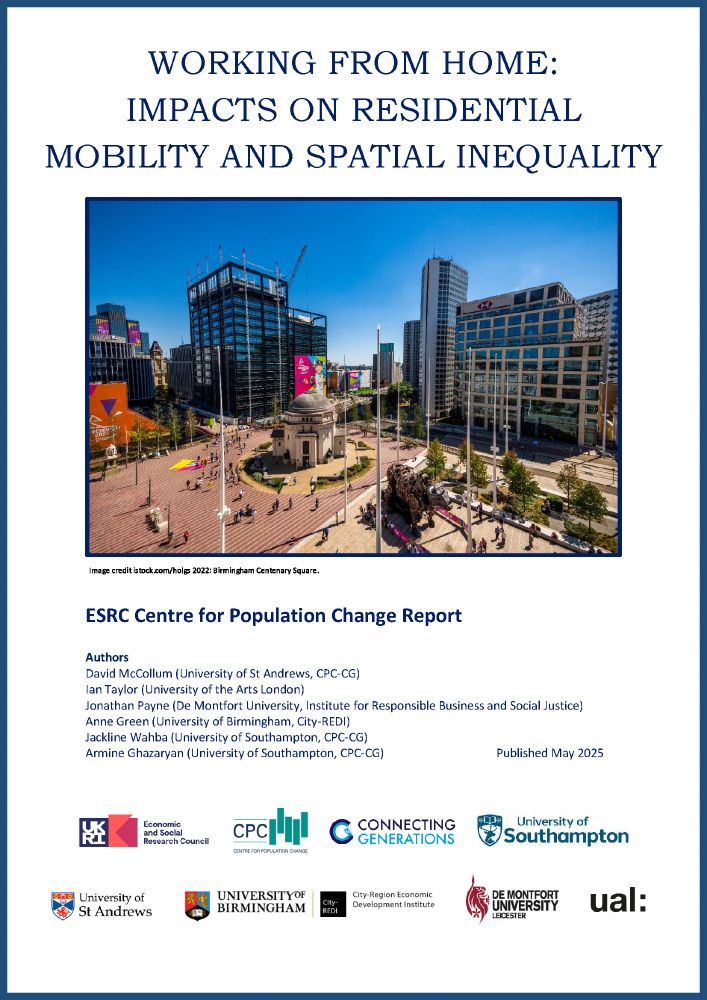
Image shows front cover of the ESRC Centre for Population Change Report: Working from home: Impacts on residential mobility and spatial inequality The report cover has an image of Birmingham Centenary Square, Image credit istock.com/holgs 2022. With logos from the ESRC, CPC, Connecting Generations, University of Southampton, University of St Andrews, University of Birmingham, City-REDI, De Montfort University and UAL. Authors list: David McCollum (University of St Andrews, CPC-CG) Ian Taylor (University of the Arts London) Jonathan Payne (De Montfort University, Institute for Responsible Business and Social Justice) Anne Green (University of Birmingham, City-REDI) Jackline Wahba (University of Southampton, CPC-CG) Armine Ghazaryan (University of Southampton, CPC-CG) Published May 2025
🔖 #Workingfromhome has not meant greater geographical spread of talent to level up #economy
Findings from CPC-CG's @jackiewahba.bsky.social @unisouthampton.bsky.social & McCollum @standrewssgsd.bsky.social + @unibirmingham.bsky.social, @dmuleicester.bsky.social, UAL
▶️ www.cpc.ac.uk/news/latest_...
4/ 🧠 The event sparked rich discussion and pointed to the need for evidence-based, inclusive policy on the future of work.
Read the full story now on our website 👇
www.st-andrews.ac.uk/geography-su...
#ESRC #FutureOfWork #GeographicalInequality #EconomicDevelopment #WFH
3/ The team highlighted 3 key priorities for future research:
1️⃣ Better geographic data on WFH
2️⃣ Deeper insight into employer preferences
3️⃣ New thinking on WFH & local economic development
2/ A key takeaway: Although #WFH is now widespread, it remains concentrated among graduates and those in higher-status occupations. As such, it is unlikely to significantly reduce geographical inequalities. 📉 #RemoteWork
07.04.2025 14:12 — 👍 0 🔁 1 💬 1 📌 01/ 📢 New on the School website! On 14 March, David McCollum & colleagues held an ESRC Working From Home & Levelling Up workshop in Birmingham, bringing together 36 policymakers, business leaders & academics. 🧵 #WFH #LevellingUp
07.04.2025 14:12 — 👍 1 🔁 1 💬 1 📌 0

We’re delighted to host Global Fellow Sanna Ala-Mantila this month! She’s been sharing insights on sustainability, air pollution, and segregation in Helsinki. Sanna is here until the end of next week if you’d like to chat before she returns to Helsinki.
04.04.2025 13:48 — 👍 0 🔁 0 💬 0 📌 0

Dr. Antje Brown & Green Politics students hosted Prof. Stephen Gethins MP & Prof. Kevin Dunion for insights on policy in practice! Students explored how theory meets reality & the role of key players in driving change.
🔗 Read more: st-andrews.ac.uk/geography-su...

Check out how our colleagues are supporting India's #BlueCarbon initiatives and climate action.
Alex Houston, Lauren South & Elina Apine have recently returned from fieldwork studying mangrove soil carbon storage in Gujarat, India.
🔗 Read more: www.st-andrews.ac.uk/geography-su...

For more information, including eligibility criteria, how to apply, and funding arrangements, please see: www.findaphd.com/phds/program...
17.03.2025 15:47 — 👍 0 🔁 0 💬 0 📌 0Based at @uniofstandrews.bsky.social and working with @edinburgh-uni.bsky.social and @hutton.ac.uk, the successful student will get to work with van dwellers to #design new, #creative #culturalprobes to capture #vandwelling experiences.
17.03.2025 15:47 — 👍 0 🔁 0 💬 1 📌 0
📢 New #phdfunding opportunity on Van Dwelling in Scotland. Do you want to explore people’s experiences of #vanlife and investigate how it relates to questions of #sustainability? If yes, this #phdproject is for you.
🧵

📢 Our news page is back—& we’re kicking off with an inspiring feature!
PhD student Winifred Maduko recently spoke at a UK Parliament roundtable on global health partnerships, contributing to vital discussions on international collaboration.
Read more: www.st-andrews.ac.uk/geography-su...

Hello, BlueSky!
#Geography #SustainableDevelopment #StAndrews