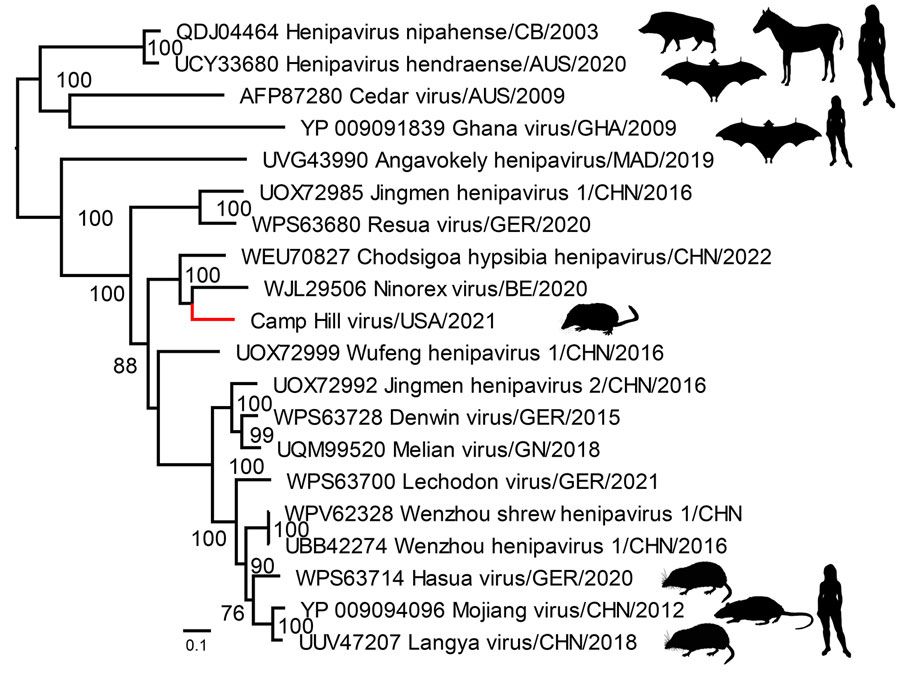
Here we provide evidence of henipaviruses in North America with the discovery of Camp hill virus in the Northern Short-Tailed Shrew, Alabama. Early release article available from EID
wwwnc.cdc.gov/eid/article/... #virology
18.01.2025 23:39 — 👍 71 🔁 28 💬 1 📌 2
Yeah! The nidos are a bit weird because the Mesoniviridae (insect-infecting) are the only known invert group to use Class I, and their sister group (Medioniviridae- tunicates and marine inverts) use Class II/"toga-like". I don't know what that means for the Mesonis.
17.12.2024 20:00 — 👍 1 🔁 0 💬 0 📌 0
Oh wow, thank you!
17.12.2024 07:43 — 👍 0 🔁 0 💬 0 📌 0
Tl;dr Tunicates are amazing, and you should care about them or at the very least care about their viruses.
They teach us about the ancient evolutionary history of our own viruses through virus-host co-divergence and demonstrate the role that recombination has played throughout that history.
17.12.2024 04:10 — 👍 20 🔁 4 💬 1 📌 0

What’s more is that glycoprotein usage is not congruent with our Nidovirales polymerase (RdRp) phylogeny, suggesting a complex history of glycoprotein switching throughout this order.
17.12.2024 04:10 — 👍 11 🔁 3 💬 1 📌 0

Our patchyvirus is not alone in its propensity for glycoprotein switching. We knew that some tunicate nidoviruses had toga-like glycoproteins (“Tognidoviruses”, Buck, et al., eLife, 2024). We found even more nido-like viruses with Class II (C-II) fusion proteins. The heat map shows FoldSeek probs.
17.12.2024 04:10 — 👍 12 🔁 3 💬 1 📌 0

But it’s not always so straightforward. We found a (-ssRNA) paramyxo-like virus that has a (+ssRNA) toga-like glycoprotein (blast results in table).
I have unofficially named this (maybe) new family the Patchyviridae after Patchy the Pirate from Spongebob. Thanks to my cousin David for that one.
17.12.2024 04:10 — 👍 16 🔁 1 💬 1 📌 0

We also observed this pattern in the novirhabdoviruses (which can make fish sick) and alphaviruses, again in red:
17.12.2024 04:10 — 👍 7 🔁 1 💬 1 📌 0
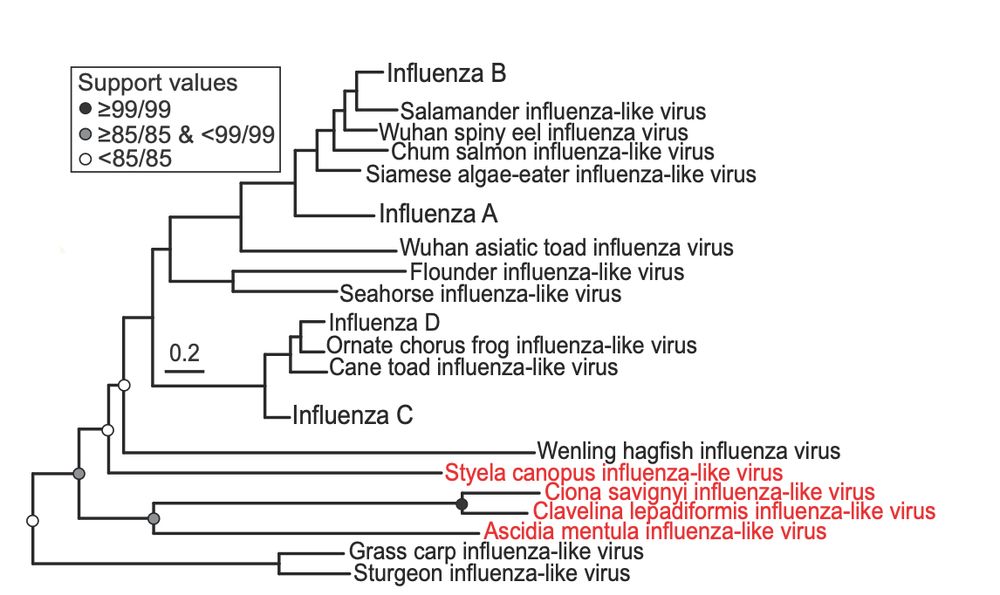
Phylogenetic tree of influenza PB1 segments
Answer: yes, and we think so.
We found multiple instances of influenza-like viruses in tunicate metatranscriptomes (shown in red) that fell towards the base of the clade. Here is the phylogeny for PB1, but the pattern held up for the other segments, too.
17.12.2024 04:10 — 👍 13 🔁 0 💬 2 📌 1
It turns out that not much is known about tunicate viruses.
And so we asked: Can we find relatives of vertebrate-infecting viruses in tunicate metatranscriptomes? That is, could the history of some vertebrate-infecting lineages actually date back to basal (invertebrate) chordates?
17.12.2024 04:10 — 👍 9 🔁 1 💬 1 📌 0
They might not look like much on the outside, but these guys can have a full complement of organs (and even friends!) inside. Importantly, as larvae they are free-swimming “tadpoles” that have a notochord, which makes them basal chordates.
17.12.2024 04:10 — 👍 8 🔁 1 💬 1 📌 0

Some background. We, along with every other vertebrate, are members of the Chordata – we have a spinal cord. But not all chordates are vertebrates! Meet: tunicates, our closest invertebrate chordate relatives.
17.12.2024 04:10 — 👍 12 🔁 2 💬 1 📌 0
This was another great collaboration with @grovearmada.bsky.social, @rhyshparry.bsky.social, the USyd team @eddieholmes.bsky.social and @jonathonmifsud.bsky.social, and non-bluesky users
17.12.2024 04:10 — 👍 5 🔁 1 💬 1 📌 0
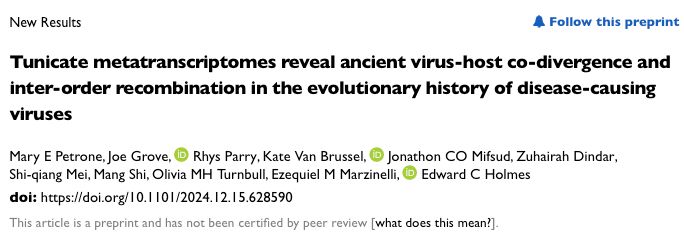
Screen grab of title page from BioRxiv website
New preprint out now! The history of some RNA virus lineages that infect vertebrates might date back to our invertebrate ancestors.
Read more here: biorxiv.org/cgi/content/...
17.12.2024 04:10 — 👍 91 🔁 37 💬 3 📌 6


Next up is Mary Petrone @marypetrone.bsky.social who is Extending the evolutionary history of disease-causing RNA viruses. Mary has been sampling marine invertebrates and makes a compelling case that sponges and tunicates are exciting hot beds of virus evolution. #AVS12
04.12.2024 21:46 — 👍 19 🔁 5 💬 1 📌 0

I have been so impressed by the @ausvirologysoc.bsky.social meeting.
EXCELLENT talks, across all career stages. Amazing sense of community. Really positive and supportive meeting.
Plus, I beat @robull.bsky.social at the double-gloved tube capping challenge.
Thank you so much for hosting me!
05.12.2024 06:23 — 👍 43 🔁 4 💬 1 📌 1
Virologist | Canada Research Chair in Zoonotic Viruses and Animal Reservoirs | Co-Lead, One Health, USask | My team investigates how highly pathogenic zoonotic viruses make us sick #LZCI | My views
Laboratory website: https://banerjeelab.ca/
Mosquito-borne and emerging viruses. Group Leader at The Pirbright Institute. Working hard to break down barriers to access to the sciences.
Italian virologist, studying viruses and cells at AreaSciencePark and ICGEB (Trieste - IT), previously Research Associate at the Centre for Virus Research (Glasgow - UK)
https://areasciencepark-rit.gitlab.io/virology/giuditta.delorenzo/#about
Rock and Roll Hall of Fame Inductee
GRAMMYS Lifetime Achievement Award
Questions or complaints,,, harass my management:
FlavorFlavMgmt@gmail.com
Group leader in the Virology Department at Institut Pasteur
Senior Editor at Nature Microbiology 💻📄 | handling mycology, parasitology, AMR and phage therapy | https://www.nature.com/nmicrobiol/
Med student @Yaleschoolofmed and researcher @YaleEMD | into public health, pathogen genomics, field hockey, rock climbing, and Wikipedia rabbit holes
Researcher on drivers of epidemic dynamics
Postdoc at @nathangrubaugh.bsky.social & @colincarlson.bsky.social labs
PhD in Physics
Opinions are my own.
DEFENSOR DO SUS!
Professor at University of Otago, NZ; Webster Chair in Virology; Rutherford Discovery Fellow. I like viruses and evolution.
DECRA fellow at the University of Melbourne @pearg.bsky.social | Mosquitoes | Wolbachia | Endosymbionts | Evolutionary Adaptation
Virologist - Influenza and Coronaviruses
Influenza virologist in ViralVaxLab at TheDohertyInst
https://www.viralvaxlab.com/
Influenza immunity, evolution & vaccines.
Incoming PI at Institut Pasteur 🇫🇷
Current: Evolutionary Virologist based at the University of Tokyo 🇯🇵
💻🦠🏳️🌈
Postdoc in Eddie’s lab @ USYD | Virology | Evolution
Molecular and Structural Virology
Arboviruses 🦟 🦠
The University of Queensland
Australia
Scientist. Lecturer in Virology at RVC. Likes experimental evolution, influenza, coronaviruses, desserts. Main life goal: never running a western blot.
Postdoc in the Sabeti Lab. Interested in the genomic epidemiology, evolution, and pathogenicity of RNA viruses 🦠🏳️🌈
Structural Virologist. Post doctoral research fellow in the Watterson Lab.
Virology PhD student | UQ