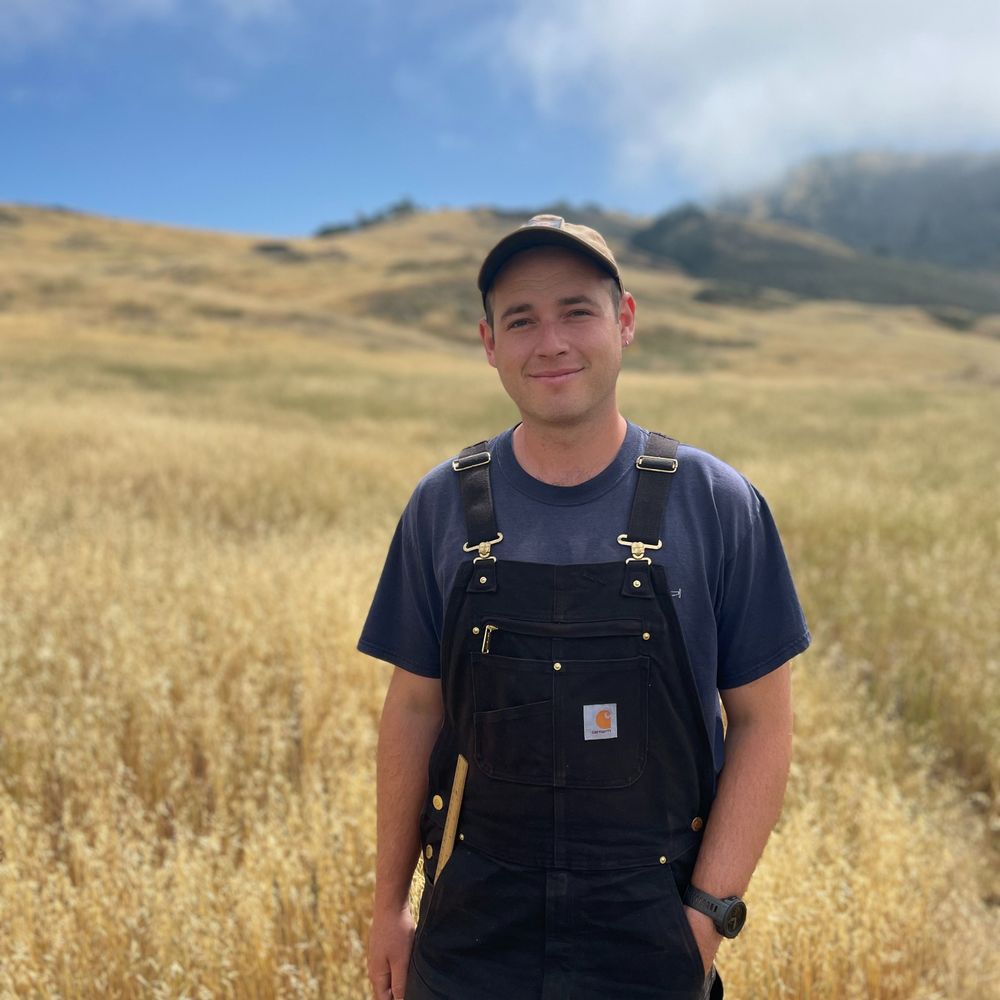
The postdoc will be advised by myself (primary) as well as Tong Qiu, Nate Chaney, and Martin Doyle, all at Duke. Funding is for up to three years and includes a professional development stipend. Priority will be given to applicants who apply before 2/15. Please reach out if you have any questions!
26.01.2026 19:07 —
👍 1
🔁 0
💬 0
📌 0
Duke University, Biology
Job #AJO31549, Postdoctoral Associate, Biology, Duke University, Durham, North Carolina, US
🔥🔬🌲 Postdoc Opportunity at Duke! to study the drivers and impacts of post-fire forest loss in the western U.S.
Position is part of the inaugural SCALES fellowship, an exciting program funding interdisciplinary research addressing key climate challenges. academicjobsonline.org/ajo/jobs/31549
26.01.2026 19:07 —
👍 11
🔁 7
💬 1
📌 0

Application Process
Image
Woman behind a podium presenting.
Jessie Golding, BBCS postdoc, presenting at ICCB 2025.
Apply to become a Lovejoy Fellow by submitting your resume, cover letter, and contact information for three references through the University of Arizona Talent Portal (link upcoming) by the first review date of January 30, 2026.
Your cover letter should:
Identify 1-2 Lovejoy BBCS faculty you would be interested in working with and explain the primary research directions you would want to pursue in collaboration with this faculty member. You are strongly encouraged to reach out to faculty before submitting your application.
Describe your experience with or interest in inter- or transdisciplinary research.
Explain how this experience will positively impact your career trajectory.

New postdoctoral fellowship opportunity! Please pass along. Excited to announce the launch of the Tom Lovejoy Fellowship Program at the University of Arizona for innovative research to protect species, sustain ecosystems, and promote a thriving planet lovejoycenter.arizona.edu/lovejoy-fell... 🧪🌐🌾
19.12.2025 18:11 —
👍 50
🔁 48
💬 3
📌 2

I am advertising a postdoctoral position in my new lab at Duke, to start as early as August 2026. If you are interested in how plant communities respond to climate change, please consider applying!
academicjobsonline.org/ajo/jobs/30614
24.09.2025 20:44 —
👍 73
🔁 35
💬 1
📌 1

Private land used for logging is more prone to severe fire than public lands. A new study shows why
New research explains why forests planted for logging purposes fuel devastating wildfires more often than untouched land.
A new study led by alum @jacoblevine.bsky.social, BS '18 Forestry and EEP, and co-authored by Professor Scott Stephens and research scientist Brandon Collins explores why forests planted for logging purposes fuel devastating wildfires more often than untouched land. www.latimes.com/environment/...
29.08.2025 18:03 —
👍 11
🔁 4
💬 0
📌 1
It’s in our paper that just came out. See figure 4, positive interaction between tree height and HDW index causes sign to flip. Like I said, I’d want to understand it more, but this is just about the most detailed data we’ve ever had on these dynamics so I’d be surprised if it’s a total artifact
22.08.2025 23:32 —
👍 0
🔁 0
💬 0
📌 0
My hope is that this research can help us better balance the goals of providing a sustainable source of timber and reducing fire risk.
Fire is ultimately a contagious process. That means we need broad cooperation across ownerships to get on top of it. Logging is a part of the solution!
22.08.2025 13:53 —
👍 1
🔁 0
💬 0
📌 0
The real issue for me is that logging=bad ignores all the nuance. Sure, some logging is bad for fire, but other types of logging are critical for reducing severity. The timber industry has a clear fire problem (so does USFS, just a slightly smaller one), it also provides enormous value.
22.08.2025 13:53 —
👍 3
🔁 0
💬 2
📌 0
We also find that while big trees reduce the prob. of high-severity fire in mild weather conditions, they become a liability in extreme ones, increasing fire severity. I would want to understand that result more before basing policy on it, but nevertheless it suggests some complications.
22.08.2025 13:53 —
👍 1
🔁 0
💬 2
📌 0
Its complicated. We show conclusively that the increased risk of high-severity fire in industrial forests is the result of plantation-type structures, too many trees spaced too regularly. This suggests thinning (i.e. logging) and rx fire are needed across both private and public land.
22.08.2025 13:53 —
👍 2
🔁 0
💬 1
📌 0
@latimes.com
21.08.2025 19:36 —
👍 1
🔁 0
💬 0
📌 0

Private land used for logging is more prone to severe fire than public lands. A new study shows why
New research explains why forests planted for logging purposes fuel devastating wildfires more often than untouched land.
Great to see our work in my hometown paper!
Its not logging itself thats the issue, its what happens after -- dense plantations are responsible for elevated fire severity in industrial forests.
Excellent story by @nohaggerty.bsky.social.
www.latimes.com/environment/...
21.08.2025 19:35 —
👍 24
🔁 7
💬 4
📌 1
Hopefully, this research will help us strike a better balance between the sustainable production of critical wood products and the mitigation of fire severity risk in plantations.
20.08.2025 15:54 —
👍 2
🔁 0
💬 0
📌 0
Mitigating the severity of future fires requires a coordinated effort across ownership boundaries. In particular, strategies like mechanical thinning which reduce the density of trees and foster structural variability are critical.
20.08.2025 15:54 —
👍 1
🔁 0
💬 1
📌 0
Overall, the paper suggests that the forest structures created through plantation forestry -- dense, homogenous stands with high ladder fuels -- elevate the risk of high-severity fire. However, although public lands fared better in our dataset, they still have a massive fire severity problem.
20.08.2025 15:54 —
👍 1
🔁 0
💬 1
📌 0
This is an important result because it indicates that management practices which reduce tree density and ladder fuels, and increase variability, will remain effective even as extreme weather conditions become more prevalent under climate change. Indeed, these efforts will only become more urgent.
20.08.2025 15:54 —
👍 2
🔁 0
💬 1
📌 0
Critically, we also found that the effects of forest structure on fire severity were amplified in extreme weather conditions!
20.08.2025 15:54 —
👍 2
🔁 0
💬 1
📌 0

We found that fires were more severe in dense, spatially homogenous forests with high ladder fuels – characteristics more common on private industrial than adjacent public land.
20.08.2025 15:54 —
👍 2
🔁 0
💬 1
📌 0
Using this data, we examined: (i) which forest structures are most associated with high-severity fire; (ii) whether these forest structures are more common on private industrial land; and (iii) how extreme fire weather driven by climate change mediates the effect of management.
20.08.2025 15:54 —
👍 2
🔁 0
💬 1
📌 0

Using a unique airborne LiDAR dataset, we identified and mapped individual trees across 460,000 hectares in the Sierra Nevada, an area which subsequently burned in five large wildfires including the Dixie Fire, the largest single fire in California’s recorded history.
20.08.2025 15:54 —
👍 1
🔁 0
💬 1
📌 0

Brandon Collins, Michelle Coppoletta, Scott Stephens and I have been working for the past three years to understand a consistent, puzzling pattern in wildfire data: that fires are more severe on land owned by industrial timber companies than on land managed by public agencies.
20.08.2025 15:54 —
👍 2
🔁 0
💬 1
📌 0
Thrilled to announce that next year I will be joining @DukeBiology as an assistant professor!
I am excited to recruit postdocs and PhD students to start as early as Fall 2026. If you are interested in plant community dynamics, global change, and/or wildfire, please see details below.
18.08.2025 19:41 —
👍 52
🔁 17
💬 3
📌 1

The model we develop therefore explains the amazing diversity of plant hydraulic traits observed in plant communities across the globe, and replicates patterns across precipitation gradients.
14.04.2025 18:50 —
👍 2
🔁 0
💬 1
📌 0