thanks to Sunil Dogga who led this work and the rest of the folks here at Sanger and in Mali who contributed in lots of important ways.
18.02.2026 17:07 —
👍 1
🔁 0
💬 0
📌 0
when we compare a couple different long read assemblies within each species. this started out as a Malaria Cell Atlas side project as we had remaining material after doing single cell RNAseq on these samples (more on that to come soon)...
18.02.2026 17:07 —
👍 0
🔁 0
💬 1
📌 0
new reference genomes for Plasmodium ovale wallikeri and Plasmodium malariae (& Pf too) direct from blood taken from children carrying these parasites -- this was done with as little as 2 ng of DNA. all sorts of craziness going on in the subtelomeric regions ...
18.02.2026 17:07 —
👍 8
🔁 4
💬 1
📌 0

Preprints of pandemic potential - new historical piece from me on the history of bioRxiv/medRxiv, their role in the pandemic, and the way forward. 1/n journals.asm.org/doi/10.1128/...
12.01.2026 14:33 —
👍 74
🔁 39
💬 3
📌 5
i do believe that is anders carlson.
12.01.2026 21:48 —
👍 2
🔁 0
💬 1
📌 0

Join our Tree of Life Programme as a Group Leader in Biodiversity Genomics at the Wellcome Sanger Institute. Lead ambitious, large-scale genomics research to understand life’s diversity on Earth.
🔗 Learn more and apply: sanger.wd103.myworkdayjobs.com/en-US/Wellco...
📅 Closing date: 8 February 2026
15.12.2025 13:51 —
👍 3
🔁 5
💬 0
📌 0

🧐 Looking for a #PhD? University of Glasgow @glasgow.ac.uk @sbohvm.gla.ac.uk is offering two fully funded PhD positions within the new VectorGrid-Africa network!🦟
More details: www.gla.ac.uk/colleges/mvl...
📆Application deadline: 12 January 2026.
10.12.2025 20:21 —
👍 10
🔁 9
💬 0
📌 0

Pangenomics transforms evolutionary biology | Royal Society
This Theo Murphy meeting organised by Dr Joana Meier, Dr Henry North and Dr Charlotte Wright, will showcase cutting-edge pangenome tools, applied uses of pangenomes which are transforming health and a...
Are you excited about pangenomics? If so, join us in Edinburgh on 8-9th June to discuss the latest methods & insights from using these approaches across biodiversity! More details here:
royalsociety.org/science-even...
Organised together with @henrylnorth.bsky.social & @joanameier.bsky.social!
10.12.2025 21:14 —
👍 20
🔁 15
💬 0
📌 1
a life changing opportunity made possible by the Nobel Prize funds awarded to John Sulston -- the @sangerinstitute.bsky.social runs the Sanger Prize scheme, open to an undergrad from any LMIC to spend 3 months here learning all about genomics. more details here www.sanger.ac.uk/about/study/...
20.11.2025 17:39 —
👍 9
🔁 16
💬 1
📌 1
a life changing opportunity made possible by the Nobel Prize funds awarded to John Sulston -- the @sangerinstitute.bsky.social runs the Sanger Prize scheme, open to an undergrad from any LMIC to spend 3 months here learning all about genomics. more details here www.sanger.ac.uk/about/study/...
20.11.2025 17:39 —
👍 9
🔁 16
💬 1
📌 1
final week to apply for @sangerinstitute.bsky.social PhD programme (due Nov 27th) -- free to apply, open to anyone anywhere, and a superb training opportunity for students interested in genomic approaches applied to biodiversity, pathogens, vectors, and of course us pesky humans.
20.11.2025 12:07 —
👍 8
🔁 10
💬 1
📌 0

Top: Prevalence of Microsporidia in DToL insect genomes. Microsporidian genomes recovered from insect hosts, split by taxonomic order. F: female, M: male, U: unspecified sex. Bottom: Simplified proposed generalized lifecycle for Microsporidia. This proposed model posits that each nucleus is a diploid, and that microsporidian reproduction mirrors reproduction in Fungi with stages similar to karyogamy, plasmogamy, and a stable “heterokaryon” (known as a diplokaryon in Microsporidia). Importantly, both the diplokaryotic and monokaryotic phases are parasitic, and species may spend most of their lifecycle in one or the other phase, giving rise to “diploid” and “tetraploid” lineages.
#Microsporidia are #parasites of growing importance. @amjadkhalaf.bsky.social @mblaxter.bsky.social @marakat.bsky.social &co present 40 new genomes from #DarwinTreeofLife sequencing of their arthropod hosts, revealing insights into #tetraploidy & #reproduction @plosbiology.org 🧪 plos.io/48HsAQJ
22.10.2025 13:07 —
👍 7
🔁 2
💬 0
📌 1
new publication by @amjadkhalaf.bsky.social who mined arthropod reference genome data for hidden microsporidia reads and then did a whole lot of assembling and sleuthing! great job @amjadkhalaf.bsky.social !
22.10.2025 13:33 —
👍 3
🔁 2
💬 0
📌 0

Science for Biodiversity
Synthetic biology: Hope for conservation requires keeping all options on the table.
The fight against #malaria is at a crossroads.
Together with colleagues worldwide, I’ve signed an Open Letter urging #IUCN members to keep the door open to responsible research and new tools that could help reverse stalled progress and save lives.
Add your voice here scienceforbiodiversity.org
08.10.2025 08:30 —
👍 1
🔁 1
💬 0
📌 0
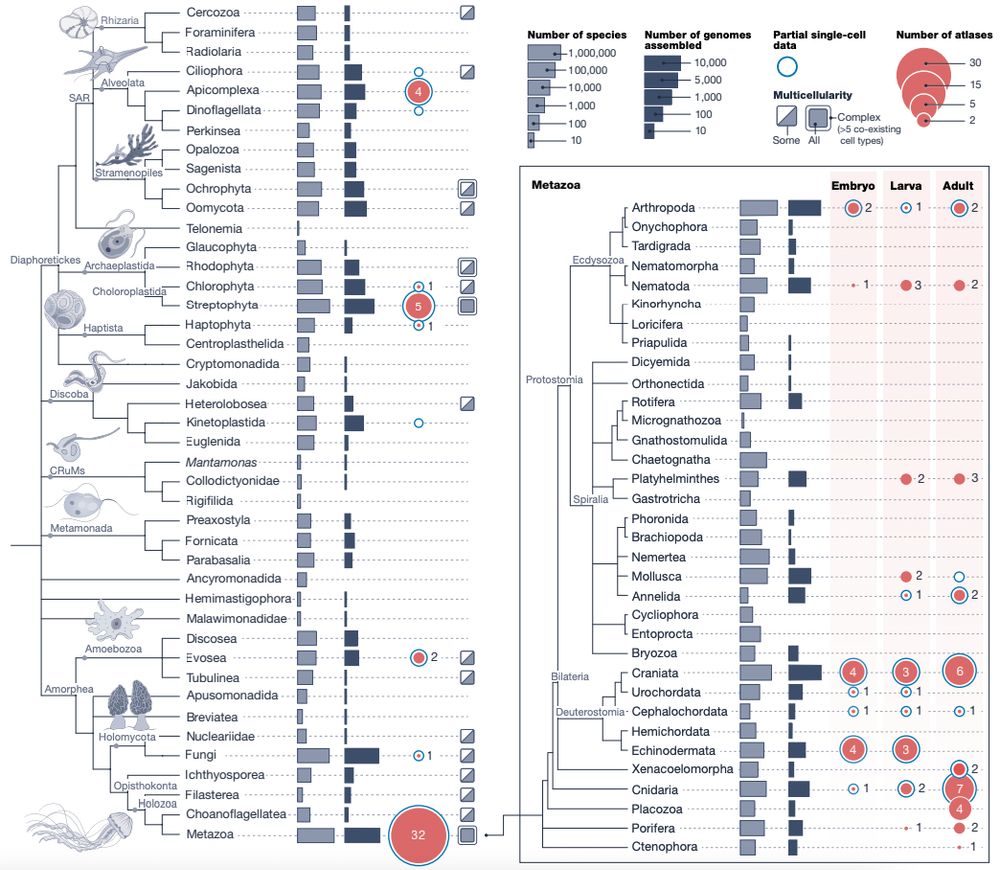
Happy to share the Biodiversity Cell Atlas white paper, out today in @nature.com. We look at the possibilities, challenges, and potential impacts of molecularly mapping cells across the tree of life.
www.nature.com/articles/s41...
24.09.2025 15:12 —
👍 228
🔁 106
💬 4
📌 10

Genetic study of malaria-carrying mosquitoes tracks evolution of insecticide resistance | Natural History Museum
It crucially also reveals promising genetic targets for potential control.
www.nhm.ac.uk/discover/new...
Mosquitoes that have been in the collection for nearly a hundred years are helping us in dealing with an even older but also current problem - malaria
@sangerinstitute.bsky.social @nhm-london.bsky.social
19.09.2025 11:53 —
👍 26
🔁 10
💬 0
📌 0

Genomic evolution of major malaria-transmitting mosquito species uncovered
Sequencing hundreds of Anopheles funestus mosquitoes provides new insights into the evolutionary patterns of this important human malaria-transmitting species.
One of the most dangerous malaria-carrying mosquitoes is rapidly evolving in response to control efforts, genetics has revealed.
Findings could inform smarter tools to monitor for and fight malaria. 🦟
Read more here ⤵️
http://bit.ly/4pwQKDv
19.09.2025 09:46 —
👍 7
🔁 7
💬 1
📌 2
Our paper Genomic diversity of the African malaria vector Anopheles funestus was published in Science today! It features inversions, selection in action, museum specimens and putative new ecotypes. doi.org/10.1126/scie...
18.09.2025 18:45 —
👍 63
🔁 33
💬 3
📌 3
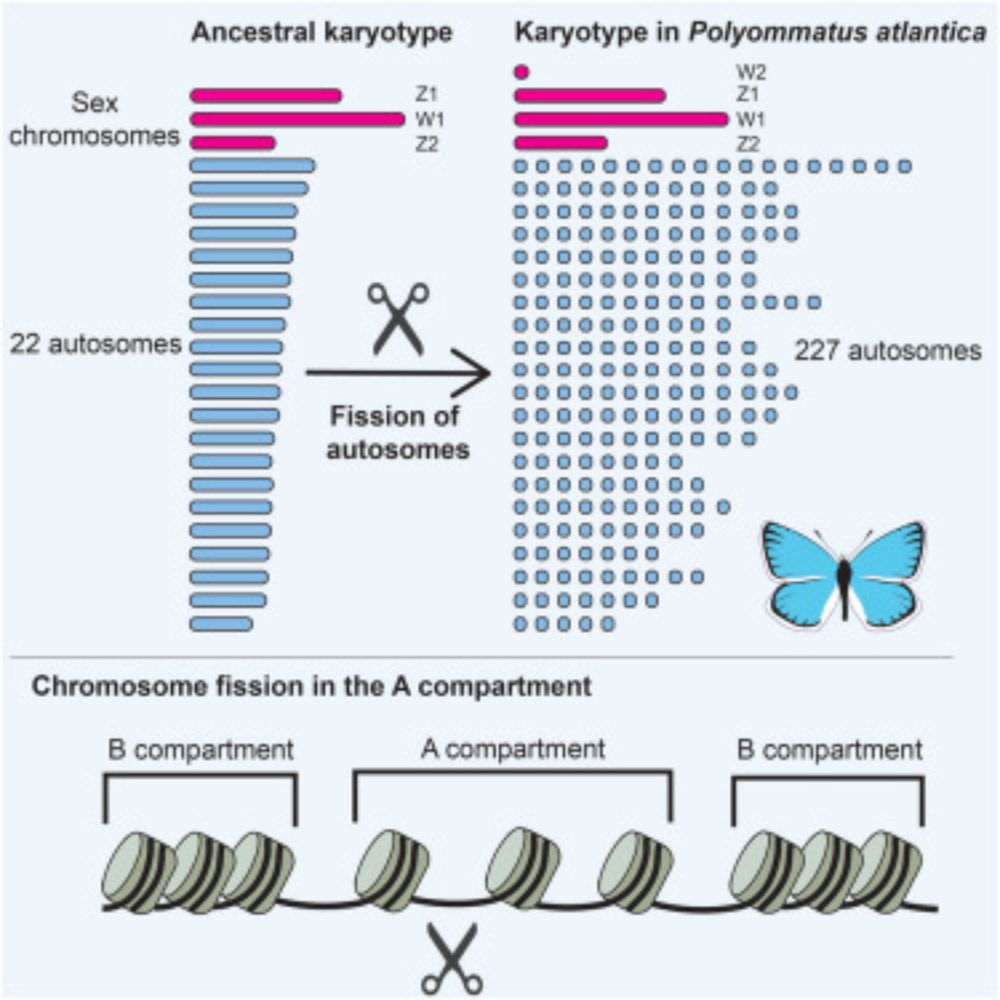
Constraints on chromosome evolution revealed by the 229 chromosome pairs of the Atlas blue butterfly
The genome of the Atlas blue butterfly contains ten times more chromosomes than most
butterflies, and more than any other known diploid animal. Wright et al. show that
this extraordinary karyotype is ...
How many chromosomes can an animal have?
In our paper out now in @currentbiology.bsky.social we show that the Atlas blue butterfly has 229 chromosome pairs- the highest in diploid Metazoa! These arose by rapid autosome fragmentation while sex chromosomes stayed intact.
www.cell.com/current-biol...
11.09.2025 15:21 —
👍 214
🔁 99
💬 4
📌 6
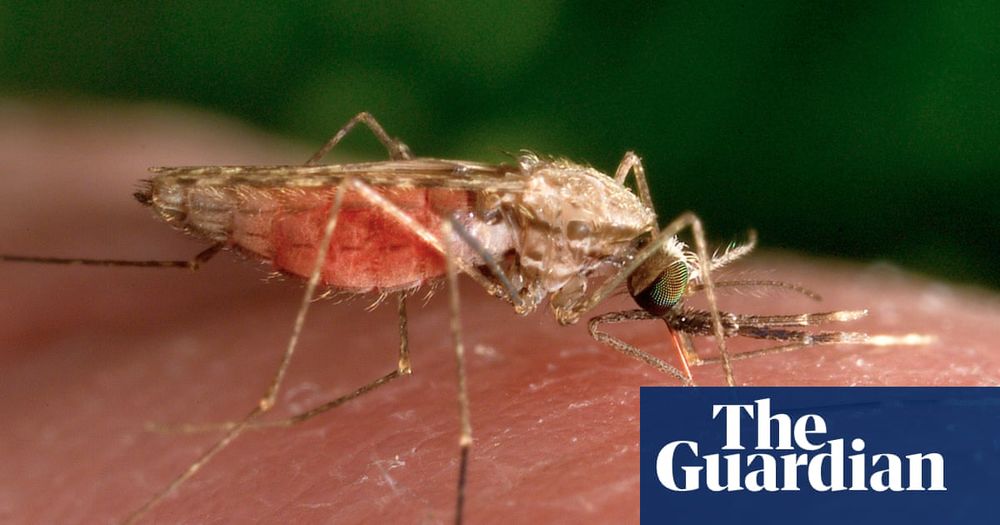
Malaria ‘back with a vengeance’ in Zimbabwe as number of deaths from the disease triple
Withdrawal of USAID funds threatens decades of progress, say experts, with cuts to research and shortage of mosquito nets putting thousands at risk across the country
Malaria cases surge in Zimbabwe largely due to abrupt cut in USAID that affected mosquito net provision and surveillance measures. The Zimbabwean government trying to step up but can’t make up for the damage the sudden cessation. Climate change further increases mosquito burden too
19.07.2025 07:56 —
👍 228
🔁 128
💬 10
📌 8
Postdoc position opening in my group! Research projects: pangenomes for diverse organisms, genome evolution, biocomputing, language models. Please reach out if interested!
17.07.2025 07:53 —
👍 28
🔁 30
💬 1
📌 1