

💘 Love at first Type
Over the past two years, the Fungarium Sequencing Project team have analysed thousands of beautiful fungal Type specimens - the original references used to describe a species.
This #ValentinesDay, we’re sharing one very special Type, from us to you 🍄💖
13.02.2026 14:13 —
👍 9
🔁 1
💬 1
📌 0


On his famous H.M.S. Beagle voyage, Charles Darwin collected this fungal specimen, which would later be used to describe the new species Daedalea erubescens. It was on this same voyage that Darwin began developing his emerging hypotheses on the theory of evolution and natural selection.
23.01.2026 11:58 —
👍 24
🔁 6
💬 0
📌 0


Spot the difference! This Gymnopus foetidus specimen from Madingley Wood is impressively well-preserved and closey resembles its original illustration. It is also one of Kew’s oldest sampled fungal holotypes, having been collected in 1795. That makes this mushroom 230 years old!
23.01.2026 11:58 —
👍 24
🔁 3
💬 1
📌 0

Did you know that Kew has the first ever scientifically described shiitake mushroom? Author of the species, the Reverend Berkeley’s 1875 notes on the specimen, show the Japanese name “Shi-taki” and highlight it being “commonly eaten in Japan and exposed for sale in large quantities in shops”.
23.01.2026 11:58 —
👍 7
🔁 2
💬 1
📌 0

This year, the taxonomists on the Fungarium Sequencing Project had a goal to review 10,000 specimens. They hit their target an impressive three months ahead of schedule, so to celebrate their hard work, here are some of the stories they’ve uncovered!
23.01.2026 11:58 —
👍 35
🔁 8
💬 1
📌 0

Hand-drawn botanical illustration of red-capped mushrooms labeled Amanitopsis pulchella, with additional dried mushroom specimens and handwritten notes on a beige paper background.
Ever seen fungal illustrations? 🍄 Our Fungarium Sequencing Project Team is thrilled to show some of the original illustrations that were created when the species were first described as new to science. In some cases, this is the only visual reference material of the original fungus that we have! 🧵👇
02.12.2025 11:07 —
👍 44
🔁 13
💬 1
📌 1

White mycelium of cordyceps farinosa paracitising a moth

Above ground fruiting bodies are visible emerging from a paracitised moth pupa
Another spooky species is Cordyceps farinosa, parasitising a moth pupa. The white mycelium of this specimen covers the grub, giving it a mummy-like appearance, while the above ground fruiting structure puffs out spores, spreading it to other potential hosts.
Happy Halloween from Kew Mycology 🧟🍄
31.10.2025 14:22 —
👍 10
🔁 1
💬 0
📌 0

Cordyceps miniralis fungi emerging from a moth beneath moss
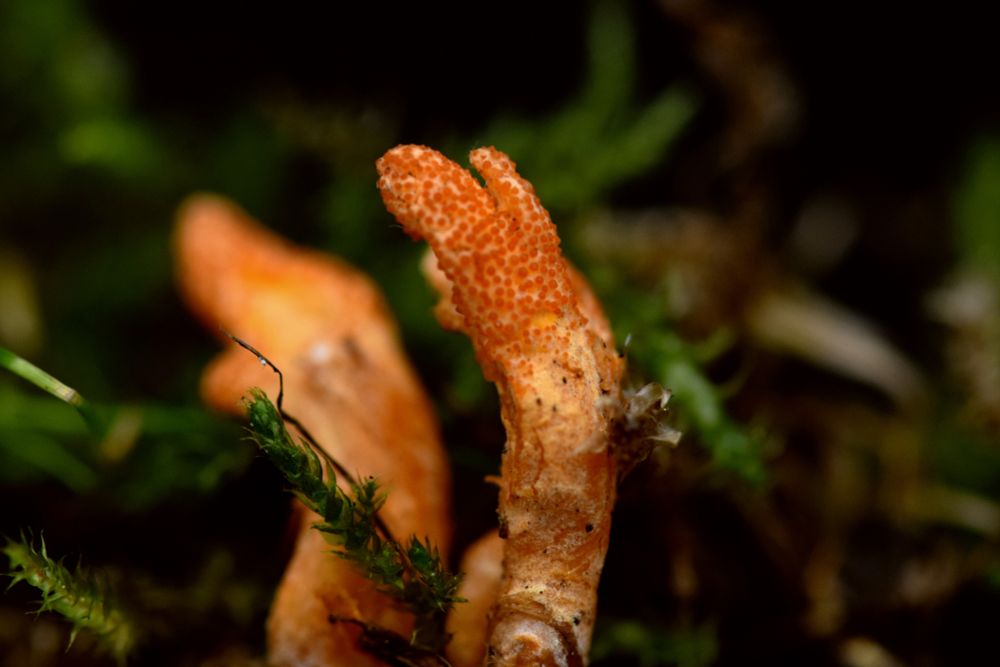
Closeup of Cordyceps militaris fruiting body
Happy Halloween! We’re showing off two spooky fungi from Kew. First up, found by a Fungarium Sequencing Project team member, this Cordyceps militaris is parasitising a moth larva!
The beautiful jack-o-lantern orange fruiting body is visible above ground, while the larva is buried beneath the dirt 🪦
31.10.2025 14:22 —
👍 27
🔁 4
💬 1
📌 1

A kew scientist talking about plants and pollinators for community open week
🧪 Are you doing a PhD at a UK university and looking for a 3-month placement that makes a real impact?
✔ Open to PIPS and other externally funded placements
✔ Build new skills, expand your network, support world-class biodiversity work
✔ Apply: ow.ly/65wF50WLXa8
🗓️ Deadline: 31 October 2025 🌾
23.09.2025 14:03 —
👍 6
🔁 8
💬 0
📌 0
@rbgkew.bsky.social
29.09.2025 15:07 —
👍 1
🔁 0
💬 0
📌 0
Was a pleasure to contribute a small part to this massive WGS effort of Kew's fungarium! @estergaya.bsky.social @rbgkew.bsky.social
Check out the paper @newphyt.bsky.social 👉 doi.org/10.1111/nph.70472
16.09.2025 12:37 —
👍 11
🔁 7
💬 0
📌 1

A researcher explains a poster titled “Fungarium Sequencing Project: Sampling Progress and Outputs” to a small group, featuring charts and maps of specimen data and global distribution.

Two researchers stand in front of a poster titled “Developing large-scale lab methodologies for whole genome sequencing of ancient fungal material”, showing lab protocols, results and charts.

A speaker presents to an audience in a lecture room, with a slide showing large blue circles and the text “Data gap”, highlighting that 97% of extracted species have no sequences on NCBI.
We showcased progress across sampling, taxonomy, lab work, and bioinformatics - and loved connecting with fellow mycologists to exchange ideas, spark collaborations, and celebrate the science of fungi.
Find out what we’re uncovering as part of our Fungarium Sequencing Project 👉 ow.ly/R1p950WywCq
01.08.2025 11:30 —
👍 10
🔁 2
💬 1
📌 0

Another researcher smiles beside the same poster on specimens of interest from the Kew Fungarium, displayed at the BMS conference.

Two researchers stand by a poster titled “Fungarium Sequencing Project: Type Specimen Sampling Methodologies”, which includes a detailed workflow diagram and images of fungal specimens.
From Darwin-collected specimens to fungi with deep cultural and economic value, our posters highlighted the incredible stories locked in Kew’s Fungarium.
01.08.2025 11:30 —
👍 5
🔁 1
💬 1
📌 0
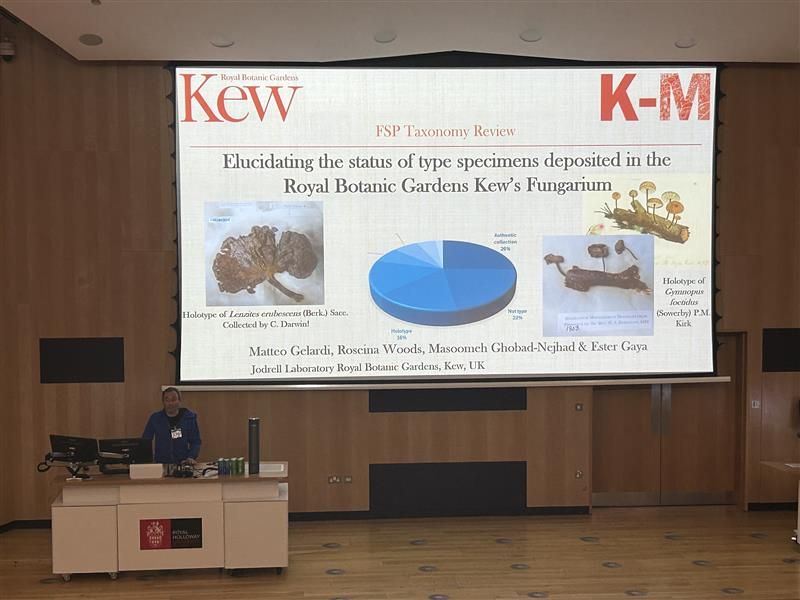
A speaker presents in a large lecture theatre with a slide titled “Elucidating the status of type specimens deposited in the Royal Botanic Gardens Kew’s Fungarium”, showing a pie chart and images of fungal specimens including one collected by Charles Darwin.
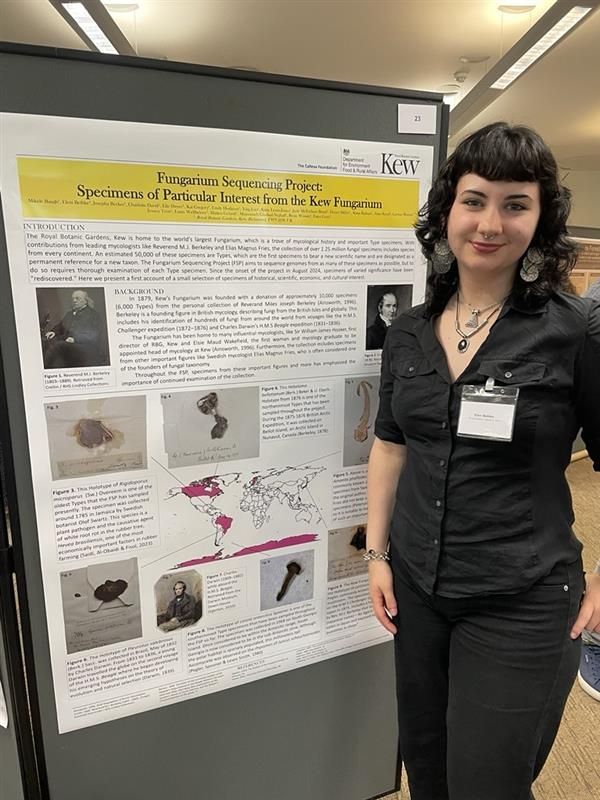
A researcher stands next to a poster titled “Fungarium Sequencing Project: Specimens of Particular Interest from the Kew Fungarium”, featuring specimen images, a world map, and historical figures including Darwin.
What do you find when you sequence 7,000 fungi? We’re starting to find out… 🍄🔬
At this year’s British Mycological Society conference - a key meeting point for the UK’s fungal research community - we shared some of the first discoveries from our Fungarium Sequencing Project.
01.08.2025 11:30 —
👍 34
🔁 11
💬 2
📌 0

statue at Kew.
Happy #FungiFriday! 🍄 Recent rain has sparked a late-summer flush at Kew. First up, Chicken of the woods Laetiporus sulphureus on a carved badger, spotted by Kew mycologist Ben Blades. Seen any yourself? Tag us or log it on iNaturalist. 🧪
22.08.2025 15:00 —
👍 43
🔁 1
💬 3
📌 0

Dried plant specimen, one of more than 7 million in the Herbarium at Kew.
From fungal medicine to climate-proof crops - Kew’s digitised collections are packed with solutions for today’s biggest challenges! 🌍🌾
Dive into the Data Portal and show us how you’re putting Kew data to work! 🧑🔬⬇️
bit.ly/4oc5bMC
26.08.2025 15:49 —
👍 18
🔁 4
💬 0
📌 0

Four people surveying grassy ground in the Forest of Dean, searching for fungi during a mycological field trip.
What’s it really like to head out on a fungal collecting trip? 🍄 Here’s Finn’s story:
As part of Kew’s Mycology team, we joined the British Mycological Society for a week in the Forest of Dean - hunting fungi, puzzling over IDs & collecting specimens for our fungarium. Come with me into the field…
05.09.2025 13:08 —
👍 25
🔁 3
💬 2
📌 0
Fungal Futures: Conservation news and views
| Field Mycology
Our Fungal Conservation column is out in Field Mycology 26 (2).
www.fieldmycology.org/index.php/jo...
🍄 Fungi and the Planning and Infrastructure Bill
🍄 British fungi on the Global Red List
🍄 An audit of nationally important fungal assemblages in Welsh SSSIs
#fungi #fungalconservation #PIB
17.08.2025 20:38 —
👍 12
🔁 7
💬 0
📌 0
@rbgkew.bsky.social
25.06.2025 10:59 —
👍 0
🔁 1
💬 0
📌 0

🚨 Job Alert at RBG Kew! We are looking for Lab Research Assistants in genomics to join our Fungarium Sequencing Project! Do you like Fungi? Do you want to develop new -omics techniques? Interested in historical collections? Join the team! Posts to start ASAP. Apply here:https://lnkd.in/e2BpWJpA
25.06.2025 10:58 —
👍 2
🔁 5
💬 1
📌 0

Frontend Developer
We are looking for a talented frontend developer to join the Chemical Biology team at the European Bioinformatics Institute (EMBL-EBI) located on the Wellcome Genome Campus near Cambridge in the UK. T...
Opportunity for frontend developer at European Bioinformatics Institute (Hinxton UK) ref: JR970 | duration: 3 years | closing: 01-Jun-2025 #CompSci #DataScience #cheminformatics #bioinformatics #ChemBiol #ChEMBL #SureChEMBL #UniChem #chemsky 🧪
embl.wd103.myworkdayjobs.com/en-US/EMBL/d...
06.05.2025 06:23 —
👍 6
🔁 3
💬 0
📌 0

Instagram post from the Polar Geospatial Center about how they have to shut down. The photos at the top are black and white, organized in a grid, with Instagram post below.
This one hurts. I wouldn’t have a PhD, or have had some of the best experiences in my life, or made some of my best friends #WithoutNSF & without the PGC. I was employee #1 of an organization that grew into an indispensable part of Polar Programs. And it’s being dismantled for literally no reason
🧪🌎
06.05.2025 06:25 —
👍 76
🔁 14
💬 2
📌 1

Symbiotic synergy: How Arbuscular Mycorrhizal Fungi enhance nutrient uptake, stress tolerance, and soil health through molecular mechanisms and hormonal regulation
Arbuscular Mycorrhizal (AM) symbiosis is integral to sustainable agriculture and enhances plant resilience to abiotic and biotic stressors. Through their symbiotic association with plant roots, AM improves nutrient and water uptake, activates antioxidant defenses, and facilitates hormonal regulation, contributing to improved plant health and productivity. Plants release strigolactones, which trigger AM spore germination and hyphal branching, a process regulated by genes, such as D27, CCD7, CCD8, and MAX1. AM recognition by plants is mediated by receptor-like kinases (RLKs) and LysM domains, leading to the formation of arbuscules that optimize nutrient exchange. Hormonal regulation plays a pivotal role in this symbiosis; cytokinins enhance AM colonization, auxins support arbuscule formation, and brassinosteroids regulate root growth. Other hormones, such as salicylic acid, gibberellins, ethylene, jasmonic acid, and abscisic acid, also influence AM colonization and stress responses, further bolstering plant resilience. In addition to plant health, AM enhances soil health by improving microbial diversity, soil structure, nutrient cycling, and carbon sequestration. This symbiosis supports soil pH regulation and pathogen suppression, offering a sustainable alternative to chemical fertilizers and improving soil fertility. To maximize AM ’s potential of AM in agriculture, future research should focus on refining inoculation strategies, enhancing compatibility with different crops, and assessing the long-term ecological and economic benefits. Optimizing AM applications is critical for improving agricultural resilience, food security, and sustainable farming practices.
Symbiotic synergy: How Arbuscular Mycorrhizal Fungi enhance nutrient uptake, stress tolerance, and soil health through molecular mechanisms and hormonal regulation
16.04.2025 20:43 —
👍 4
🔁 1
💬 0
📌 0

Women, minorities fired in purge of NIH science review boards
Scientists, with expertise in fields that include mental health, cancer and infectious disease, typically serve five-year terms and were not given a reason for their dismissal.
Thirty-eight of 43 experts cut last month from the boards that review the science and research that happens in laboratories at the National Institutes of Health are female, Black or Hispanic, according to an analysis by the chairs of a dozen of the boards.
16.04.2025 18:46 —
👍 10250
🔁 5256
💬 645
📌 638


