
 07.07.2025 23:44 —
👍 22
🔁 3
💬 1
📌 0
07.07.2025 23:44 —
👍 22
🔁 3
💬 1
📌 0
07.07.2025 23:44 —
👍 22
🔁 3
💬 1
📌 0
07.07.2025 23:44 —
👍 22
🔁 3
💬 1
📌 0
On our latest episode "Null Neutrophils," @tonybreu.bsky.social asks a fascinating physiologic question:
Why is Duffy Null status associated with lower neutrophil counts?
podcasts.apple.com/us/podcast/1...
open.spotify.com/episode/3SdI...
 27.06.2025 15:23 —
👍 5
🔁 1
💬 0
📌 0
27.06.2025 15:23 —
👍 5
🔁 1
💬 0
📌 0

If you think you’re tough, consider the tardigrade…
In 2007, 3,000 of these tiny animals orbited the Earth OUTSIDE a space rocket for 12 days.
>2/3 of them survived the vacuum of space and being blasted with solar radiation.
www.esa.int/Science_Expl...
 19.06.2025 01:21 —
👍 3
🔁 0
💬 0
📌 0
19.06.2025 01:21 —
👍 3
🔁 0
💬 0
📌 0
First bladder transplant in history!
So cool 😎
t.co/Mvyf1Qw7bK

This really feels like science fiction- a bespoke CRISPR gene editing treatment for a baby with a urea cycle disorder
www.nejm.org/doi/full/10....

Thank you so much to @corewellhealth.bsky.social and Dr Steve Doyle for the invitation to speak on the art of medicine at their annual education and research day!
09.05.2025 21:05 — 👍 5 🔁 0 💬 0 📌 0
Yeesh - if Pseudomonas wasn’t a bad enough actor already, it also apparently secretes an enzyme that degrades plastic
www.cell.com/cell-reports...

Each episode, producer @gbuonomomed puts together a paired show notes blog post. For our latest episode, 'Alpha-gal again', we tackle the question: how could alpha-gal be used to treat cancer?
curiousclinicians.com/2025/04/24/e...
open.substack.com/pub/thecurio...
On our latest episode, Alpha-gal Again, we
share new insights on how alpha-gal could potentially be used to treat cancer!
podcasts.apple.com/us/podcast/t...
open.spotify.com/episode/1GpK...
This story really blew my mind - that alpha-gal could be an entirely new way to treat cancer using immunotherapy
28.04.2025 11:19 — 👍 3 🔁 0 💬 0 📌 0
This week, @avrahamcoopermd.bsky.social shares new insights on the topic of a previous episode: alpha-gal!
We tackle the question: How could alpha-gal be used to treat cancer?
podcasts.apple.com/us/podcast/t...
open.spotify.com/episode/1GpK...
This is such a good album and a monumental achievement!!!
18.04.2025 19:15 — 👍 2 🔁 1 💬 0 📌 0
Check it out, new album just dropped 🤩 open.spotify.com/album/5orTSx...
18.04.2025 12:40 — 👍 1 🔁 1 💬 0 📌 1
15/SUMMARY
Salt in wounds causes pain by multiple probable mechanisms.
These include:
🧂Increasing local osmolarity, which stimulates osmo-sensitive TRPV nociceptive neurons (the same neurons through which capsaicin signals)
🧂Osmotic stress leading to cellular injury/death

14/
Another mechanism seems to be that the local hyperosmolar state induced by salt in wounds also creates osmotic stress on cells, leading to cellular injury and death.
This independently activates nociceptive neurons in the skin.
pubmed.ncbi.nlm.nih.gov/29675710/

13/
TRPV/capsaicin signaling likely isn't the whole story, though, because in the same study as #11, TRPV4 knockout mice had equivalent (and intense) pain responses to a 10% saline solution.
pubmed.ncbi.nlm.nih.gov/16213085/

12/
Glutamate may be a key mediator of salt-induced pain, as it is known to be released after TRPV 1 and 4 activation (pubmed.ncbi.nlm.nih.gov/39626870/), and injection of 5.8% hypertonic saline into the biceps muscle leads to spikes in glutamate production.
pubmed.ncbi.nlm.nih.gov/26485281/
11/
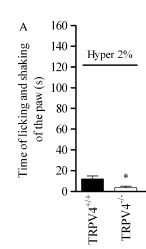
In a mouse model, mild increases in osmolarity (eg w/ 2% saline) in paw wounds also activated a different nociceptive capsaicin-sensitive receptor from the same family called TRPV4.
pubmed.ncbi.nlm.nih.gov/16213085/

10/
This dramatic ⬆️ in local osmolarity stimulates osmosensitive' cation pain receptor channels called TRPV (transient receptor potential vanilloid), similar to how these receptors respond to capsaicin.
Example of activation of TRPV1 is shown below.
pubmed.ncbi.nlm.nih.gov/21779403/

9/
So why does salt in a wound hurt so much?
One key clue is that salt in tissue causes significant increases in local osmolarity. For example, a 10% NaCl solution has an osmolarity of 3250 mOSM (>10x physiologic osmolarity).
pubmed.ncbi.nlm.nih.gov/16213085/

8/
The degree to which NaCl can induce painful responses in the body has been studied in physiology experiments dating back to the 1930s.
In this 1997 study, infusing hypertonic saline into a muscle induced significantly more pain than normal saline.
pubmed.ncbi.nlm.nih.gov/9060024/

7/
One of the earliest references I came across for salt causing pain in wounds was from Pliny the Elder in the 1st century CE.
He recommended adding salt to beef fat to cure boils, but to avoid using salt if the combination caused pain.
www.perseus.tufts.edu/hopper/text?...

6/
The Hippocratic authors in ancient Greece endorsed sea water as a wound healing treatment, observing that it helped heal wounds on the hands of fishermen.
A few centuries later, Galen similarly recommended salt to aid in wound healing.
pmc.ncbi.nlm.nih.gov/articles/PMC...

5/
This granted great value to salt throughout the ancient world.
Ex: in ancient China, wars were fought thousands of years ago over control of salt flats at Lake Yuncheng, and salt later became a form of traded currency.
historycooperative.org/the-history-...

4/
Likewise, because of its antiseptic and desiccating properties, salt has been used to preserve fresh food going back at least 5,000 years ago in places including China, Egypt, Mesopotamia, and southern Europe.
pubmed.ncbi.nlm.nih.gov/31721796

3/
Going back millenia, salt has been used as an antiseptic to prevent decay of organic material.
For example, the ancient Egyptians used salt in their mummification solutions.
pubmed.ncbi.nlm.nih.gov/11677605/
2/
First, where did the phrase "rubbing/pouring salt in an open wound" originate?
It seems to date back at least to the 19th century, if not centuries before, with some proximity to the phrase "rubbing it in".
But the observation that salt (NaCl) has physiologic effects began in ancient times.

1/THREAD
As the old idiom goes, one deliberately causes additional pain by "pouring/rubbing salt in an open wound".
But this is also literally true. Physiologically, why would it hurt so much to have salt poured into a wound?

