
Sad to see that leadership didn’t approve of my suggested post language (assuming since this is what is posted) that I submitted on my last day in May as the social media manager.
Allow me share some of our team’s kind words here instead:
Sad to see that leadership didn’t approve of my suggested post language (assuming since this is what is posted) that I submitted on my last day in May as the social media manager.
Allow me share some of our team’s kind words here instead:

"Österreich hat sein CO2-Budget für das 1,5-Grad-Ziel bereits 2022 verbraucht."
www.derstandard.at/story/300000...
Despite how easy it is to lose hope with news like this, I think the main take-away should not be that it will be hard to step up and take action to limit the impacts of climate change, but that it is possible: We have agency. One of the clearest messages of our work is that our choices matter.
02.06.2025 10:39 — 👍 9 🔁 1 💬 0 📌 2
Just out: Our new paper addressing urgently needed clarity for the Paris Goals, given the imminence of the 1.5°C-crossing of the long-term global surface temperature anomaly.
These results further underscore the need for deep & rapid emission reductions worldwide.
#Train2EGU 🚄
#EGU25
The NOAA layoffs aren't just crude, they're a direct attack on US capacity to do climate science by firing highly productive young researchers. @zachlabe.com has an insanely strong publication history, part of the Fresh eyes CMIP team, WMO task teams etc. /1 www.gfdl.noaa.gov/zachary-labe/
28.02.2025 07:19 — 👍 281 🔁 87 💬 9 📌 5
Figure 2 of Merchant et al. showing how an acceleration in Earth's energy accumulation trumps other natural drivers in explaing ocean warming

Earth's energy imbalance that is driving climate change is increasing, particularly so since 2010 and this accumulation of energy is accelerating global warmimg (Fig. 1 of Merchant et al.)
Level of global warmth in 2023/24 can only be explained by an acceleration of human caused #climate change based on @ioppublishing.bsky.social statistical analysis of multiple drivers: doi.org/10.1088/1748...
28.01.2025 09:10 — 👍 60 🔁 28 💬 4 📌 4
Chart showing 2024 temperatures across various temperature monitoring groups.
Now that everyone has their annual temperature data out, here is a quick summary across groups.
In addition to record warmth in every dataset, it's the first year where most estimates are at least 1.5 °C (2.7 °F) warmer than the 1850-1900 baseline.
berkeleyearth.org/global-tempe...
🧪
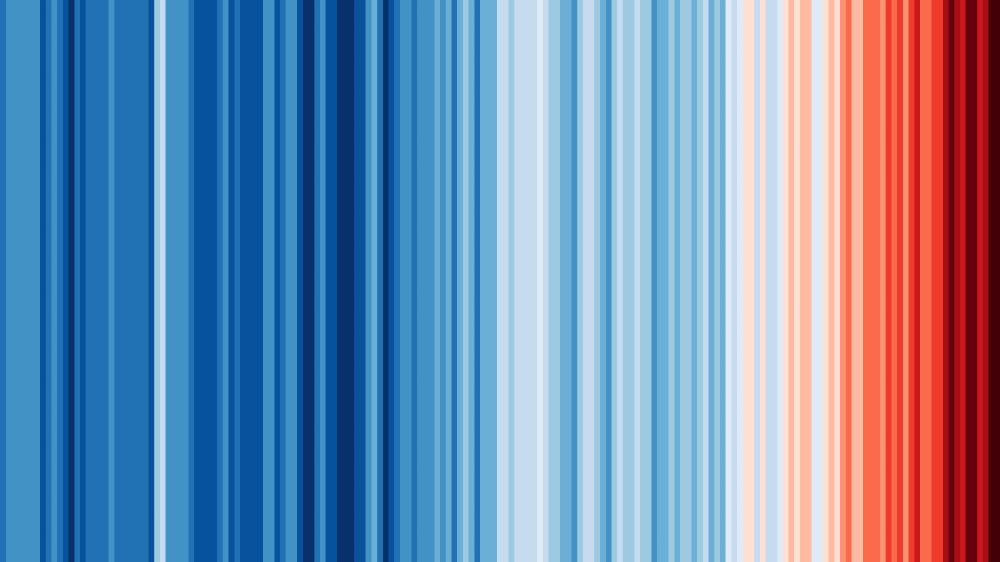
Warming stripes for 1850-2024, changing from blues to reds as the world rapidly warms up
The data is in. 2024 was the warmest year on record, and probably in the whole of human history – about 1.6°C warmer than the pre-industrial period.
More than 1 billion individual thermometer measurements, made by thousands of people over many decades, have been condensed into a single number.
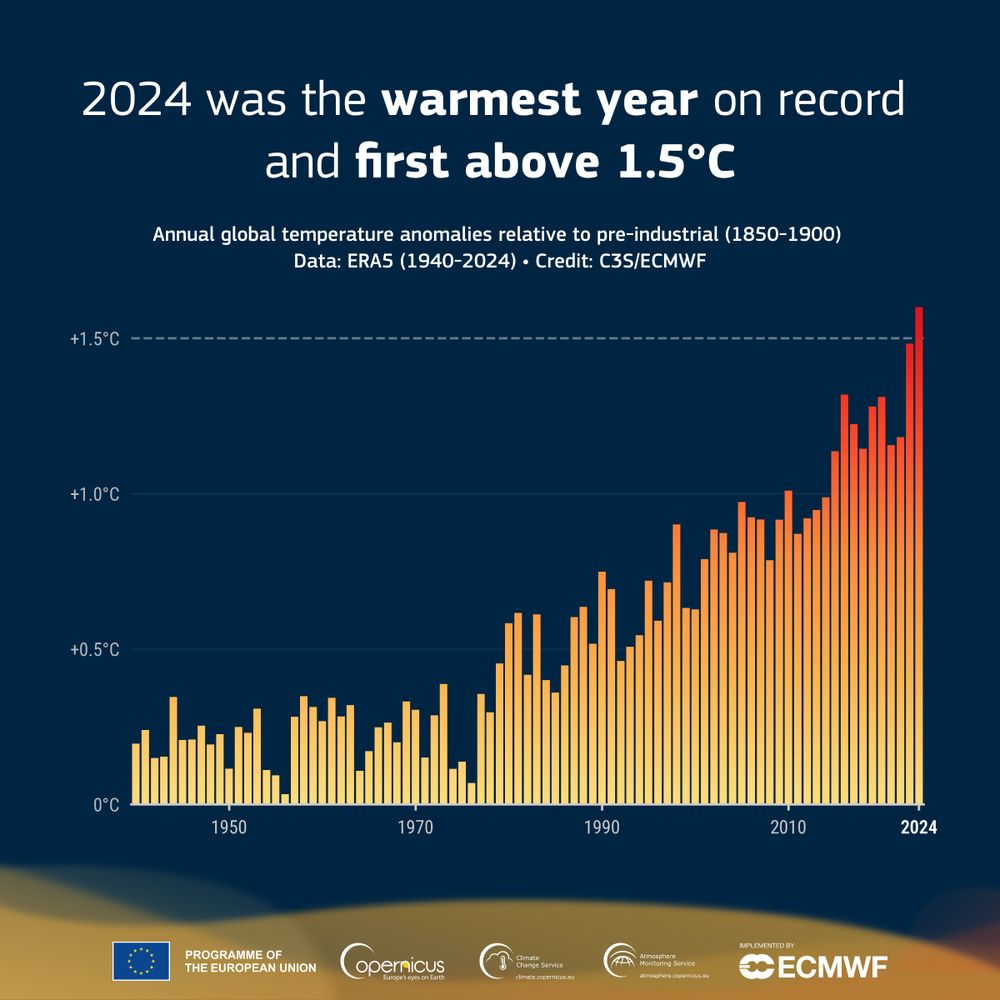
main message
The Global Climate Highlights 2024 report is now online.
Delve in the analysis and access all the charts, information, and data on temperature, sea ice, precipitation, and greenhouse gas concentrations. Explore the data that defined 2024: https://bit.ly/40kQpcz
#C3S #GCH2024

2024 was the first year above 1.5°C. This does not mean that the 1.5°C level has been broken through. What remains to be seen is whether this is a continuation of 2023's trend, and what the causes are.
www.theguardian.com/environment/...
@kleinezeitung.at follow-up zu den 1.6+°C (und rund doppelt so viel in Ö), insb. interessant re. "Technologieoffenheit" etc...
www.kleinezeitung.at/meinung/denk...

Die globale Temperatur in den Messdaten von 5 Instituten verglichen mit den Projektionen von Klimamodellen laut #IPCC-Bericht (schwarz, Unsicherheit grau).
2024 ist das wärmste Jahr seit Beginn der Messungen; nach paläoklimatischen Daten wahrscheinlich sogar seit 120.000 Jahren.

IATA projects a 6% increase in air passengers in 2025 !
Not one single word on environmental impact. Except in the cost section. Cost of carbon credits and « sustainable « fuel will be about 0.5% of revenues 🤬
www.iata.org/en/pressroom...
Very strongly related to the whole surface temperature issue:
11.12.2024 11:15 — 👍 0 🔁 1 💬 0 📌 02b. However, it will not be long before this long-term signal also exceeds the 1.5°C mark. This is no reason for defeatism and apathy - if anything, it should increase our sense of urgency to change course and prevent even worse things. Every tenth of a degree matters, regardless of Paris goals.
11.12.2024 09:48 — 👍 0 🔁 0 💬 0 📌 02a. One annual average crossing of 1.5°C does not mean "game over" for the Paris goals. In fact, the long-term human-made temperature increase contributed "only" about 1.4°C, and the rest is natural variability (mainly El Niño - albeit a rather untypical one).
11.12.2024 09:48 — 👍 0 🔁 0 💬 1 📌 01b. We do not know (yet) if this was mainly due to 2024 being an inherently more predictable year, or if this is something that would in principle have worked so well in any year, but we absolutely intend to find out.
11.12.2024 09:48 — 👍 0 🔁 0 💬 1 📌 01a. What's really interesting about this is that when we first made a prediction in September, we arrived at almost the exact same number (with greater uncertainty). We were unsure about the stability of this estimate, but it turns out, it didn't change much at all over the remaining months.
11.12.2024 09:48 — 👍 0 🔁 0 💬 1 📌 0
[dramatic first bluesky post] Gottfried Kirchengast and I here at the @wegenercenter.bsky.social have predicted that the global annual average 2-metre air temperature will be (1.62 +/- 0.05)°C above the pre-industrial level.
Some additional thoughts: