
LPSN becomes an ELIXIR Core Data Resource! This database tracks bacterial names, aiding scientists worldwide. Easier microbe research ahead.
Press release: tinyurl.com/fuud42xk
#ScienceNews #Microbiology #Innovation #BioData
LPSN becomes an ELIXIR Core Data Resource! This database tracks bacterial names, aiding scientists worldwide. Easier microbe research ahead.
Press release: tinyurl.com/fuud42xk
#ScienceNews #Microbiology #Innovation #BioData

A quick microbio present before the holidays 🎁 >150 years after their first description, filamentous "Crenothrix bacteria" are now in stable laboratory culture! In our pre-print, we probe the unique physiology & ecology of the "lacustrine" group of these enigmatic methane-oxidizing microbes... 1/2
19.12.2025 10:21 — 👍 12 🔁 9 💬 2 📌 0My article on aeonophiles (ultra-long lived organisms) came out in Aeon Magazine today!
18.12.2025 23:19 — 👍 83 🔁 26 💬 6 📌 1An Asgard Archaeon (Lokiarchaeum ossiferum) growing and retracting its arms
03.12.2025 20:32 — 👍 79 🔁 26 💬 3 📌 7In particular, Philipp’s dedication and hard work in establishing anaerobic live-cell imaging truly deserve heartfelt admiration.
04.12.2025 00:18 — 👍 3 🔁 0 💬 0 📌 0
Thank you for your comments!
This study was led by Philipp Radler (@radler92.bsky.social) from Christa Schleper’s lab (@christaschleper.bsky.social), and almost all of the key experiments were carried out by the Austrian team centered at the University of Vienna.

Wow, our AEM paper on a new methane-oxidizing bacterium just got a Commentary! 🎉
Congrats Kambara-san—so happy to see the work getting recognized!
journals.asm.org/doi/10.1128/...
“Isolation of a new methanotroph belonging to Mycobacterium” is now out! Awesome work by my former postdoc Hiromi Kambara, who led this project all the way.
journals.asm.org/doi/10.1128/...
Would you like to work with us?
At JAMSTEC, we are recruiting postdoctoral researchers through the Young Research Fellow program.
This program allows fellows to independently pursue their own research projects.
www.jamstec.go.jp/recruit/e/jy...
New paper out!
We discovered a tiny archaeon with the smallest known archaeal genome — only 238 kbp!
Candidatus Sukunaarchaeum mirabile has almost no recognizable metabolic pathways and may rely heavily on a host to survive.
It also represents a novel, deep-branching lineage in the archaeal tree.
schaechter.asmblog.org/schaechter/2...
#MicroSky #Archaea #ArchaeaSky #SymbioSky
HC1 is capable of tolerating low oxygen levels. In contrast, SC1 appears unable to do so, likely because it lacks genes related to oxygen metabolism. We believe this difference stems from the fact that SC1 was cultured from the beginning under strictly anaerobic conditions with reducing agents.
01.05.2025 07:28 — 👍 1 🔁 0 💬 1 📌 0
Thank you again for introducing our work!
I'd greatly appreciate it if you could correct one point in episode #4.
schaechter.asmblog.org/schaechter/2...
#MicroSky #Archaea #ArchaeaSky #SymbioSky
Lokiarchaeia is MBG-B, not MBG-D.
15.04.2025 03:26 — 👍 1 🔁 0 💬 0 📌 0
We have also published a paper on how to construct and operate a DHS bioreactor and isolate anaerobic microorganisms.
www.nature.com/articles/s41...

MK-D1 was not isolated from this bioreactor. The correct reference is as follows.
journals.plos.org/plosone/arti...
MK-D1 was isolated from marine sediment collected from a methane seep approximately 2500 meters deep in the Nankai Trough off the Kii Peninsula in Japan, not from a drill core sample collected off the Shimokita Peninsula.
15.04.2025 03:26 — 👍 2 🔁 0 💬 2 📌 0
Thank you so much for introducing our work!
Could you kindly make the following corrections to story #1?
The genomic information for our strains, which belong to the ‘Hodarchaeales', has been released. Due to a large-scale server replacement at DDBJ (DNA Database of Japan), the release has been delayed.
14.04.2025 01:10 — 👍 11 🔁 0 💬 0 📌 0
New isolates from eukaryote's closest archaeal relative: ‘Hodarchaeales’!! Syntrophic microaerotolerant peptide-degrading anaerobic archaea w/ simple cell structure & protrusions. Features conserved across the phylum provide new insight into our ancestor’s biology!
www.biorxiv.org/content/10.1...
Thank you for the kind comments!
03.03.2025 01:54 — 👍 0 🔁 0 💬 0 📌 0Thank you for the kind comment!
03.03.2025 01:49 — 👍 0 🔁 0 💬 0 📌 0Thank you!
03.03.2025 01:47 — 👍 0 🔁 0 💬 0 📌 0
Isolated in just 3 years! (previously, 12 years). We obtained two strains from 'Hodarchaeales', proposed to be closest to our archaeal ancestor. Our analysis suggests the ancestor was an anaerobic, syntrophic, peptidotrophic, archaeon with a simple intracellular structure and possible aerotolerance.
27.02.2025 03:58 — 👍 99 🔁 35 💬 7 📌 3
New bacterial phylum Minisyncoccota (formerly Ca. Patescibacteria or CPR) in the kingdom Bacillati.
Congratulations, Kuroda-san, Narihiro-san, and Nobu (@masarunobu.bsky.social)!
www.microbiologyresearch.org/content/jour...
Methanol syntrophy!
A new form of syntrophic relationship between bacteria and archaea in the underground.
Congratulations, Huang-san and Nobu!
Why did an engineer become a researcher in biological evolution? My esteemed research partner, colleague, and friend, Masaru K. Nobu, is sharing some side stories about strain MK-D1 research.
www.nature.com/articles/s41...
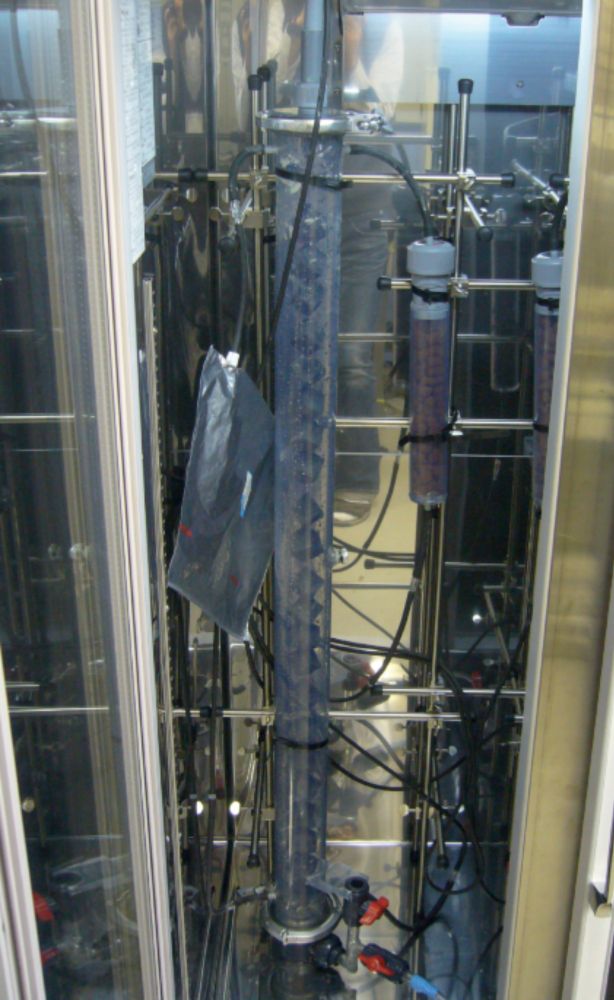
I’m currently trying to isolate uncultivated deep-sea sedimentary microorganisms using the reactor enrichment as an inoculum. If you happen to have time, I would be honored if you could take a look at a paper I published two years ago, where I provide more details about the reactor.
30.11.2024 00:09 — 👍 4 🔁 0 💬 0 📌 0
I’m truly grateful for the warm welcome—thank you so much!
I apologize for the confusion. To clarify, I’ve been supplying 0.57L of anaerobic medium to the reactor each day, which brings the total to 3733L so far. Also, my reactor will be turning 18 on December 28th.
