's Avatar

@chipotlab.bsky.social

Official Bluesky account of the Christophe Chipot workgroup at Université de Lorraine.

31 Followers  |  53 Following  |  5 Posts  |  Joined: 20.08.2025
Posts Following

Posts by (@chipotlab.bsky.social)

Preview
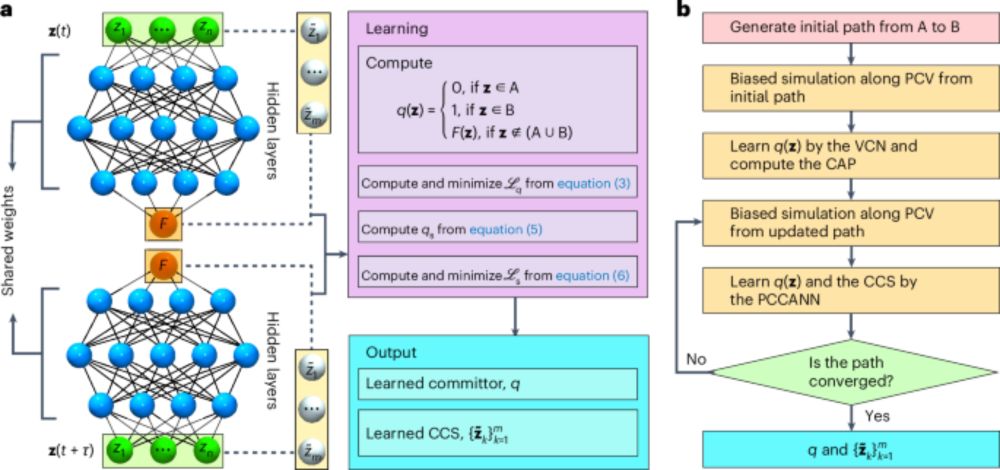
Learning the committor without collective variables - Nature Computational Science By learning directly from atomic motion, without the need for handcrafted descriptors, a graph neural network reveals how molecular systems change state, delivering accurate kinetics and atom-level in...

📢Out now! Work from @chipotlab.bsky.social and colleagues presents a method that learns from atomic motion without the need for handcrafted descriptors, allowing for accurate kinetics and atom-level insights. www.nature.com/articles/s43...

🔓 rdcu.be/e4p3B

17.02.2026 15:58 — 👍 6    🔁 4    💬 0    📌 0
Preview
Following the Committor Flow: A Data-Driven Discovery of Transition Pathways The discovery of transition pathways to unravel distinct reaction mechanisms and, in general, rare events that occur in molecular systems is still a challenge. Recent advances have focused on analyzin...

Rare molecular events can often follow several competing pathways. Our new work introduces an iterative framework that can disentangle these pathways and identifies the dominant transition routes.
pubs.acs.org/doi/10.1021/...

@pubs.acs.org @giuseppe-chen.bsky.social @radutalmazan.bsky.social

30.01.2026 17:45 — 👍 2    🔁 2    💬 0    📌 0
Preview
From Static Pathways to Dynamic Mechanisms: A Committor-Based Data-Driven Approach to Chemical Reactions As computational chemistry methods evolve, dynamic effects have been increasingly recognized to govern chemical reaction pathways in both organic and inorganic systems. Here, we introduce a committor-...

"From Static Pathways to Dynamic Mechanisms: A Committor-Based Data-Driven Approach to Chemical Reactions"
Check out our work using a committor‑based workflow coupled with a high‑level MLIP to reveal dynamic effects in chemical reactions.
pubs.acs.org/doi/10.1021/...
@pubs.acs.org

12.01.2026 13:35 — 👍 2    🔁 2    💬 0    📌 0

GPU‑accelerated constant‑pH MD/MC is now available in NAMD!
pubs.acs.org/doi/10.1021/...
@pubs.acs.org

09.01.2026 14:37 — 👍 2    🔁 2    💬 0    📌 0

"One for All, All for One: A Unified Framework for Free-Energy Calculations"
Introducing Well-tempered metadynamics-xABF (WTM-xABF) for geometrical, alchemical & generalized‑ensemble sampling—faster, robust, minimal tuning.
pubs.acs.org/doi/10.1021/...
@pubs.acs.org

09.01.2026 14:35 — 👍 3    🔁 2    💬 0    📌 0

Preview
Calculating Free-Energy Differences Using an Average Force: A Tutorial for Adaptive Biasing Force Simulations The purpose of this tutorial is to get the reader familiarized with the calculation of a free-energy change along a reaction-coordinate (RC) model through a number of applications of variants of the importance-sampling adaptive biasing force algorithm. The reversible sodium-chloride ion pairing in aqueous solution serves as an introductory example, wherein the RC model is defined as the distance separating the ions. For the reversible folding of the short peptide deca-alanine, alternative collective variables are considered to map the conformational free-energy landscape. The importance-sampling algorithm is then applied to the transfer of an ethanol molecule across the water liquid–vapor interface to estimate its hydration free energy. The results are compared to those of an alchemical transformation using free-energy perturbation calculations. In the final application, the Ramachandran free-energy surface underlying the conformational equilibrium of N-methyl-N′-acetylalanylamide is determined in two dimensions, comparing single- and multiple-walker strategies.

Did you ever want to try out enhanced sampling with ABF? Have a look at our newest tutorial to get started!
doi.org/10.1021/acs....

@radutalmazan.bsky.social, Haohao Fu, Mengchen Zhou, Jérôme Hénin, James C. Gumbart and Christophe Chipot

30.09.2025 11:49 — 👍 4    🔁 3    💬 0    📌 0
Preview
Iterative variational learning of committor-consistent transition pathways using artificial neural networks - Nature Computational Science A neural network approach grounded in transition-path theory is shown to uncover committor-consistent transition pathways, resolving competing mechanisms across dynamical regimes and advancing the mod...

Out now! Chrisophe Chipot and colleagues develop a neural-network approach for committor-consistent enhanced-sampling simulations of rare events.
www.nature.com/articles/s43...
🔓https://rdcu.be/evcjW

07.07.2025 17:08 — 👍 6    🔁 3    💬 1    📌 0
White and grey topography

White and grey topography

🚨Our July issue is now live and includes research on adverse drug reactions, multi-fidelity Bayesian optimization, rare event sampling, and much more!
t.co/myy3LVRjGO

25.07.2025 11:37 — 👍 7    🔁 2    💬 0    📌 0