
Congrats @nbes.bsky.social 🎉
27.02.2026 19:54 — 👍 2 🔁 0 💬 0 📌 0Congrats @nbes.bsky.social 🎉
27.02.2026 19:54 — 👍 2 🔁 0 💬 0 📌 0

What is emergence, after all?
New PNAS Nexus paper: academic.oup.com/pnasnexus/ar....
In this paper, I clarify the scientific meaning of emergence as a measurable and physically grounded phenomenon through concrete examples, such as temperature, magnetism, and herd immunity in social networks.
If you have an Iranian colleague or friend, this is likely how they feel theses days:
27.01.2026 16:17 — 👍 3 🔁 1 💬 0 📌 0We're already in the phase that each of us (Iranians) by now know someone killed/injured in our circle of friends/family. And this is despite the continued internet blackout, when millions haven't still managed to hear from their family/friends since Thursday, January 8th. This tells a lot ... 😥😥
14.01.2026 21:18 — 👍 42 🔁 13 💬 0 📌 0
How did we decide to call a tree “tree”? A bird “bird”? Not now, but in the early days, when there could have been different ways to name or define something.
On Language & Poetry | A short post I wrote over the Christmas holidays; abbas.sitpor.org/2025/12/28/o...

Pokec (Slovak Facebook) is a clearer example of how aggregate homophily can be misleading, as mixing patterns change systematically with group size.
with @bolozna.bsky.social @clarastegehuis.bsky.social and Riccardo Michielan

What if birds of a feather flock together, but only at specific group sizes?
www.nature.com/articles/s41...
This is the focus of our new paper, now published in Nature Communications. We introduce a new network model and show how to model and measure homophily to incorporate group variations.
But we keep calling the same things by different names in practice, sometimes it’s jargon, sometimes it’s marketing, but what do you think is the worst way this ends up misleading people?
PS: We even renamed “graphs” to “networks” for marketing, and that was fine… right?
Science is supposed to know no borders, until every major conference in my field picks the most hostile country to travel to as its venue 💆🏼
#Epidemics10 #NetSci2026 #CCS2026 #IC2S2 🇺🇸
“I have always tried to live in an ivory tower; but a tide of shit is beating at its walls, threatening to undermine it.”
Doing science in contemporary academia, with its endless pressure to please grant committees, often feels like this Flaubert’s complaint in an 1872 letter to Turgenev.
What you expect the least from the reviewers and the editor is exactly checking for the main claims!
14.11.2025 16:40 — 👍 1 🔁 0 💬 0 📌 0
Being in #academia as someone not from the global north be like:
#phdchat #phdlife
Hmm, this isn’t a cumulative curve, so the interpretation should consider the entire trajectory, not only the late stages of the pandemic. I also wonder whether trust in Sweden stayed constant throughout.
10.11.2025 10:36 — 👍 1 🔁 0 💬 1 📌 0
“Physicists are very good and famous for getting the right answers for the wrong reasons.” Why? Here’s a clue: noisy philosophizing!
Sean commenting on Nima's talk, Two Cheers for Shut Up and Calculate, at the Natural Philosophy Symposium 2025
@pholme.bsky.social's feed
19.09.2025 23:27 — 👍 2 🔁 0 💬 0 📌 0
We are hiring multiple PhD and postdocs for two newly funded projects at the intersection of mental health and political polarization at the CS Dept at Aalto, Finland. The PIs are Juhi Kulshrestha, Talayeh Aledavood, and Mikko Kivelä.
Full call text and link to apply: www.aalto.fi/en/open-posi...
We should switch from paper to screen posters—more eco-friendly and far more engaging. Elisa’s poster already showed us how creative this can be.
@elisamurators.bsky.social @cssociety.bsky.social
Thank you for this opportunity. The slides of my talk & the preprint are available at abbas.sitpor.org
05.09.2025 15:09 — 👍 5 🔁 0 💬 0 📌 0

Excited to present 2 of our recent works at @css-conference.bsky.social
“Social & Special Landscape of Covid-19 Immunity in Denmark”
- Tue at 15:30, Room 13
- Thu at 12:30, Old Chapel Room
“Homophily Within and Across Groups”
- Thu at 10:30, Room 13, CSS Satellite
PNAS: Strength and weakness of disease-induced herd immunity in networks
https://www.pnas.org/doi/abs/10.1073/pnas.2421460122?af=R

@jsaramak.bsky.social you will love this!
Permanent link to this comic: xkcd.com/833/
I also love Lobachevsky. So sad to hear that Lehrer is gone!
28.07.2025 09:07 — 👍 0 🔁 0 💬 0 📌 0
All the keynote recordings are available now, enjoy! www.youtube.com/playlist?lis...
25.07.2025 15:49 — 👍 45 🔁 19 💬 1 📌 1Yaaay! Tnx 😄
24.07.2025 11:05 — 👍 1 🔁 0 💬 1 📌 0Cool logo, BRAN Lab!
24.07.2025 09:12 — 👍 0 🔁 0 💬 0 📌 0Has this talk been recorded, by any chance?
24.07.2025 09:08 — 👍 0 🔁 0 💬 1 📌 0Sam works at the intersection of artificial intelligence and public health, leveraging AI to enhance our understanding and management of infectious diseases. He is Prof. of Machine Learning & Public Health at the Uni. Copenhagen and Prof. of Statistics & Public Health at Imperial College London.
23.07.2025 12:41 — 👍 0 🔁 0 💬 0 📌 0
AI & Public Health: Between Hype and Hope — Interview with Samir Bahtt
youtu.be/L-_pFPOZvV0
From outbreak forecasting to shaping public policy, AI promises transformative impacts—but what are its true capabilities and limitations?
@sjbhatt.bsky.social
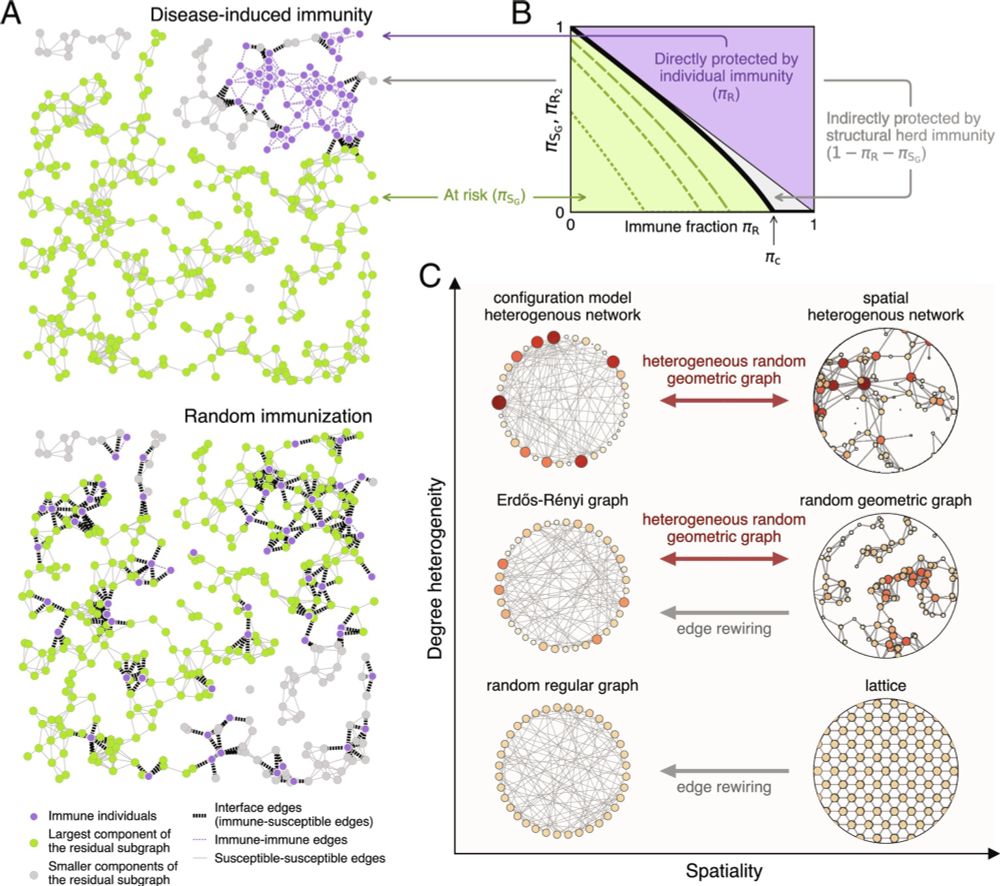
New paper in PNAS!🎉 doi.org/10.1073/pnas...
Is herd immunity to infectious diseases effective when induced by natural infection? Earlier studies have suggested that population heterogeneity makes disease-induced herd immunity more effective than previously thought. Our work challenges this notion.

Read the paper here for free: pnas.org/doi/10.1073/pnas.2421460122
And here is a less technical blog post for a more general reader:
abbas.sitpor.org/2025/07/10/t...
Kudos to @takayukihir.bsky.social, @bolozna.bsky.social, @jsaramak.bsky.social, and our one-and-only Zahra Ghadiri.
2/2
