Dr. Craske demonstrated that exposure therapy works best when it creates new learning rather than simply reducing fear. Expectancy change predicts better outcomes, highlighting the power of the inhibitory retrieval model to refine and strengthen exposure-based treatments #2025SPR
18.10.2025 16:12 — 👍 0 🔁 0 💬 0 📌 0

Exceptional keynote from the legendary Dr. Michelle Craske🌟She highlighted her ongoing work on mechanistic insights into threat and reward systems, which continues to be instrumental for advancing precise & effective interventions for depression and anxiety #2025SPR
@therealspr.bsky.social
18.10.2025 16:07 — 👍 7 🔁 1 💬 1 📌 0


A really interesting closing talk on behalf of Linhao Zhang showed that sleep duration and physiological regulation (RSA) jointly predict teen mental health💤 Among teens with higher RSA, shorter sleep duration was linked to greater internalizing problems.
#2025SPR
18.10.2025 13:53 — 👍 0 🔁 0 💬 0 📌 0

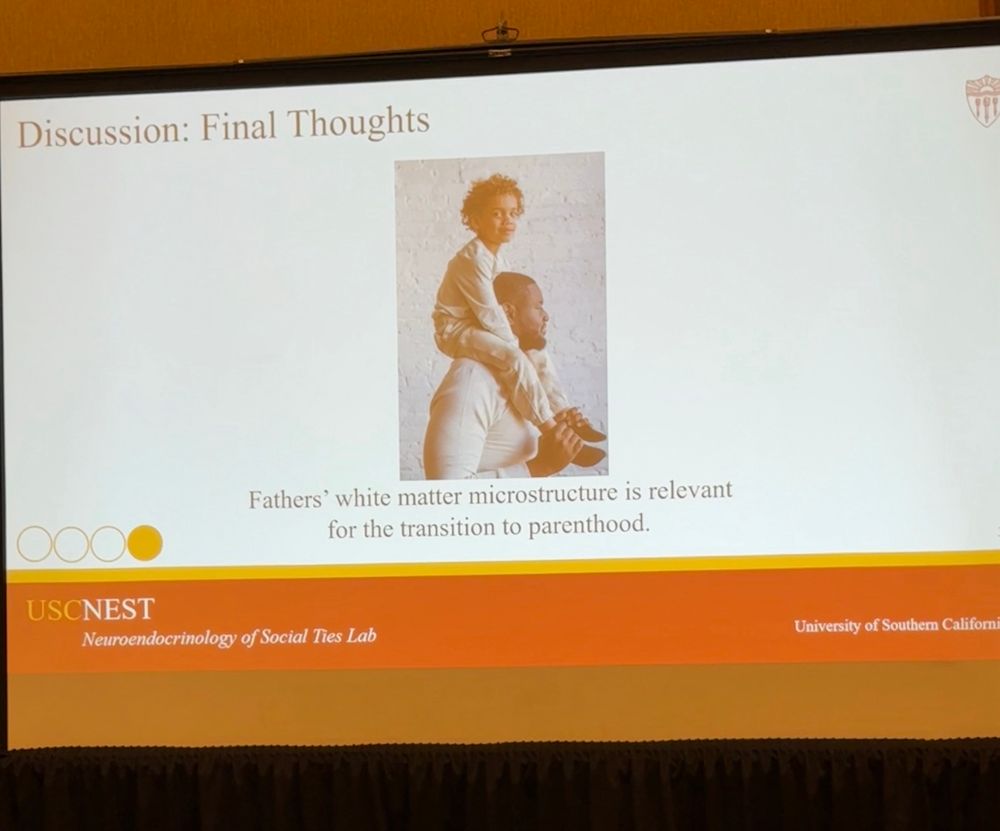
Sofia Cardenas presented fascinating work on sleep & brain connectivity in first time fathers 🧠 Poorer sleep quality & changes in testosterone after birth were linked to differences in white matter organization in regions important for cognition and emotion processing
#2025SPR
18.10.2025 13:30 — 👍 0 🔁 0 💬 1 📌 0


Kicking off an interesting symposium on sleep and physiology: Emily Cardenas shared fascinating work on the peripartum period, showing that in women with a more reduced reward response (RewP) sleep problems were more strongly linked to depressive symptoms 💤 #2025SPR
@therealspr.bsky.social
18.10.2025 13:06 — 👍 5 🔁 1 💬 1 📌 0


Fascinating to see how blunted reward learning appears across those with depression, in remission, and even at family risk. Dr. Pizzagalli’s work highlights how reward-related markers may help match patients to the most effective treatment, like bupropion vs. sertraline. #2025SPR
16.10.2025 17:05 — 👍 1 🔁 0 💬 0 📌 0

Such an incredible and inspiring keynote by Dr. Diego Pizzagalli at #2025SPR 🧠 He shared decades of translational, multi-method work on anhedonia and reward learning, illustrating how neuroscience can meaningfully inform clinical understanding of treatment for depression @therealspr.bsky.social
16.10.2025 16:29 — 👍 15 🔁 1 💬 1 📌 0
Assistant Professor @ UNC Psychiatry
adolescent depression | stress exposure | affective mechanisms | neurobiology
Associate Professor of clinical psychology at McGill University
Clinical Psychology PhD student @BinghamtonU
From first-generation college student to Distinguished Professor, studying impulsivity and its relationship to addictions
Posts are my individual opinions and do not reflect my professional roles or responsibilities
Emotion scientist and professor of psychology with a particular interest in social robotics and human-robot interaction. Pop-culture nerd. Sci-Fi fan. Trekkie. Owner of guitars.
Professor of Psychology at Binghamton University (SUNY) studying risk for depression and related outcomes across the lifespan
Associate Professor of Psychology, Penn State University, Director, Families, Affective Neuroscience, and Mood Disorders (FAM) lab. https://famlab.la.psu.edu/
Clinical scientists translating affective neuroscience to improve depression treatment/prevention. PI: Autumn Kujawa (posts by Autumn or Georgia Moon)
Clinical neuroscientist at Texas A&M
Clinical psychologist and affective neuroscientist studying risk for and prevention of mood disorders in youth and families with @MEDVanderbilt and EEG methods 🧠
Mom to 2 kids, 1 dog
https://moodemotionlab.com/
Clinical Scientist interested in autism, neurodiversity, emotion regulation, and psychophysiology.
Currently at the University of Pennsylvania Perelman School of Medicine, Autism Spectrum Program of Excellence
Previously at Virginia Tech
Dad, scientist, clinical psychologist. Professor of Psychological Sciences. Third-generation anti-fascist.
sprweb.org
Join us in Montréal for #2025SPR - registration is now open!
https://spr.joynmeeting.com/v2/
official Bluesky account (check username👆)
Bugs, feature requests, feedback: support@bsky.app