TLDR:
Good news: Voters and non-voters are usually more similar than we assume. Differences between them are relatively rare.
Bad news: When they do differ, low turnout can amplify these differences and elections can end up reflecting regular voters more than citizens at large.
2/2
02.03.2026 02:34 —
👍 0
🔁 1
💬 0
📌 0
Does Low Voter Turnout Matter? Evidence from Europe |
Voters and non-voters in European democracies often hold similar views. But when gaps emerge, they are not trivial and their impact depends on turnout.
🚨New blog post 🚨
If fewer people vote, do elections still represent what policies citizens want?
I summarize research using data from 29 European democracies on whether voters and non-voters actually differ in their policy preferences and when turnout matters for representation.
1/2
02.03.2026 02:34 —
👍 2
🔁 0
💬 1
📌 0

After 3 years and 5,322 emails (and counting) our Encyclopedia of Political Communication is finally out at @elgarpublishing.bsky.social
📚 Three volumes
⭐ 431 entries
🎓 581 wonderful authors from across the world
A very short 🧵
10.12.2025 16:05 —
👍 174
🔁 63
💬 7
📌 18
OSF
Excited to share a new preprint with @bnbakker.bsky.social, @ylelkes.bsky.social & @gijsschumacher.bsky.social!
doi.org/10.31234/osf...
Affective polarization research focuses almost exclusively on valence, despite affect having at least two core dimensions. We show that emotional arousal matters!
01.12.2025 14:28 —
👍 23
🔁 8
💬 1
📌 0

Cover page of the article. "Affective States: Cultural and Affective Polarization in a Multilevel-Multiparty System" by Dylan Paltra, Marius Sältzer and Christian Stecker. "Affective Polarization—the growing mutual dislike among partisan groups—has been identified as a major concern in democracies. Although both economic and cultural ideological divides contribute to ideological polarization, their affective consequences can differ. This paper argues that cultural polarization becomes especially consequential when mobilized by far-right parties. Using data from 116 elections in Germany’s 16 states (1990-2023), we combine more than 550 state-level manifestos with more than 150,000 survey responses to examine how party polarization translates into voter affect. Our analyses show that both economic and cultural polarization increase affective divides, but cultural disagreements fuel hostility only in the presence of the Alternative for Germany (AfD). Acting as a cultural entrepreneur, the AfD amplifies the emotional impact of cultural divisions such as immigration, employing affective rhetoric and provoking strong rejection from other parties and voters. These findings highlight the catalytic role of far-right parties in transforming ideological competition into affective polarization."
🚨Publication Alert!
My first first-author publication with @msaeltzer.bsky.social and @pluggedchris.bsky.social is out in @polbehavior.bsky.social, which began as my bachelor's thesis. We study how party polarization shapes affective polarization—with a particularly important role of the AfD. (1/7)🧵
01.12.2025 12:07 —
👍 83
🔁 19
💬 7
📌 0
Congrats Dylan, this is great! 👏🏻
01.12.2025 13:25 —
👍 1
🔁 0
💬 1
📌 0

Do voters and non-voters differ in their policy preferences? | European Journal of Political Research | Cambridge Core
Do voters and non-voters differ in their policy preferences?
Who speaks🔉for Europe? 🌍
@mascakir.bsky.social finds that with low turnout, regular voters dominate but could boosting participation could reduce bias in #PolicyRepresentation?
27.11.2025 16:30 —
👍 7
🔁 3
💬 0
📌 0

With @elisadeisshelbig.bsky.social, @theresmatthiess.bsky.social, we are designing a survey experiment with low-income Germans 🇩🇪 Survey folks: any tips on reliable institutes, good practices, or any useful approach for harder-to-reach groups? We are really grateful for any hint or experience 🙏
24.11.2025 10:31 —
👍 12
🔁 12
💬 2
📌 1
Thank you Jennifer!
20.11.2025 09:52 —
👍 0
🔁 0
💬 0
📌 0
Thank you and glad you love it!
19.11.2025 15:47 —
👍 1
🔁 0
💬 0
📌 0
Congratulations! 🎉 Looking forward to the outputs already!
19.11.2025 15:44 —
👍 1
🔁 1
💬 1
📌 0
So what's the takeaway?
✅Good news: Voters and non-voters usually share similar policy preferences.
⚠️Bad news: When turnout is low, even small differences can introduce bias.
🗳️Overall: Low turnout isn't always a disaster for this specific question, but it is far from ideal.
10/10
19.11.2025 13:39 —
👍 5
🔁 0
💬 1
📌 0
When turnout is low, the electorate reflects regular voters' preferences.
Higher turnout brings peripheral voters into the mix and reduces this bias.
Perpetual non-voters also differ, but they are usually a smaller group, so they introduce less bias overall.
9/10
19.11.2025 13:39 —
👍 3
🔁 0
💬 1
📌 0

Moreover, using panel data from the UK (@britishelectionstudy.com), I examine policy preferences of three voter types:
1️⃣Regular voters: they vote consistently
2️⃣Peripheral voters: they vote intermittently
3️⃣Perpetual non-voters: they almost never vote
They differ in their policy preferences. 8/10
19.11.2025 13:39 —
👍 3
🔁 0
💬 1
📌 0

Bias that disparities induce ultimately depends on turnout level. Biases are stronger when turnout is lower.
This is also why compulsory voting might make sense! 7/10
19.11.2025 13:39 —
👍 5
🔁 0
💬 1
📌 0

Nevertheless, when differences *do* emerge, they are not trivial.
Using Cohen's d, most significant differences (in black) can be considered small but meaningful. 6/10
19.11.2025 13:39 —
👍 3
🔁 0
💬 2
📌 0
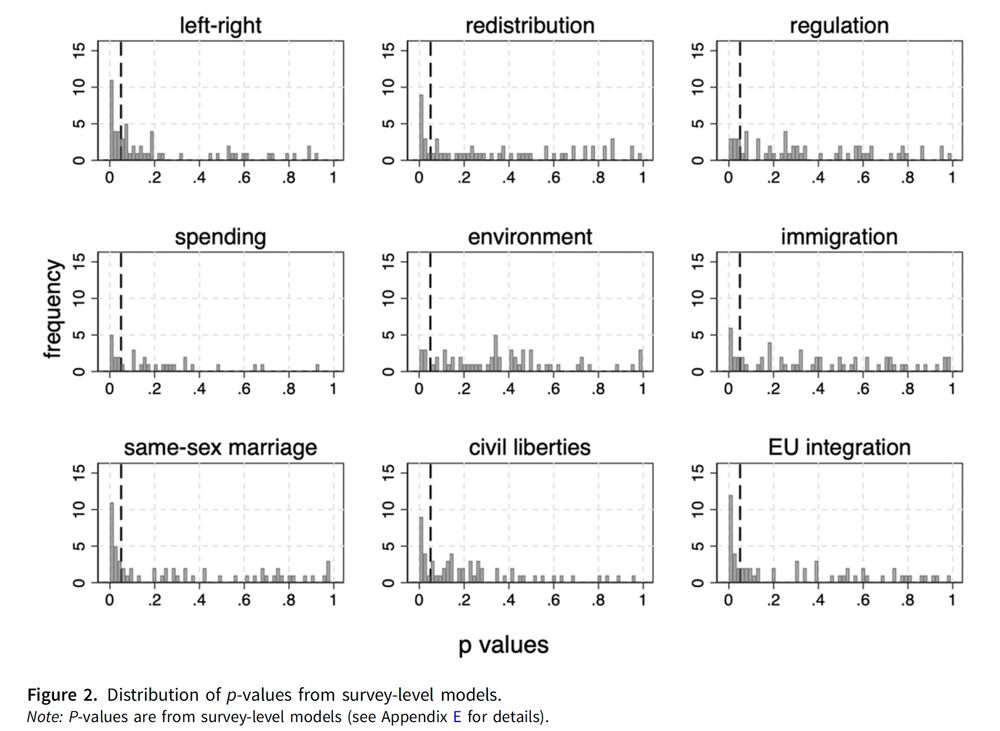
But, here's the thing: Disparities are not the norm.
At the survey level, voters and non-voters usually hold similar policy views. Most differences are sporadic and do not reach statistical significance. 5/10
19.11.2025 13:39 —
👍 4
🔁 0
💬 1
📌 0
In the pooled analysis, voters are:
🔵 more right-wing
🔵 less in favour of redistribution
🔵 more supportive of state intervention and spending
🔵 less supportive of same-sex marriage
🔵 more restrictive on immigration
🔵 more willing to restrict privacy rights to combat crimes
🔵 more pro-Europe
4/10
19.11.2025 13:39 —
👍 4
🔁 1
💬 1
📌 0
Using data from 29 European democracies, I examine differences across the left-right spectrum, economic issues (redistribution, state intervention, spending), social issues (immigration, same-sex marriage, environment, and civil liberties), and European integration.
3/10
19.11.2025 13:39 —
👍 4
🔁 0
💬 1
📌 0
First, why do we care?
Turnout has declined across democracies. If voters and non-voters have different policy preferences, then low turnout means elections may not accurately represent what the broader public wants. This would be problematic for representation.
2/10
19.11.2025 13:39 —
👍 4
🔁 0
💬 1
📌 0

Do policy preferences of voters and non-voters differ in European democracies?
My new article in @ejprjournal.bsky.social finds: Yes, sometimes, but this is not the norm.
Let's break it down. 🧵 1/10
19.11.2025 13:39 —
👍 83
🔁 27
💬 2
📌 1

🚨New paper out in @jeppjournal.bsky.social: doi.org/10.1080/1350...
@manuelwagner.bsky.social & I re-conceptualize class representation to take into account social mobility between classes and variation in how individuals enter politics.
29.10.2025 09:55 —
👍 107
🔁 49
💬 1
📌 0

a man with glasses says look can 't you see it 's obvious netflix
ALT: a man with glasses says look can 't you see it 's obvious netflix
Still confused about EPSA vs. EPSS? Which conference should you go to? Here is a link to clarify things: epssnet.org/uncategorize... TL;DR: "EPSA" community will be in Belfast. Same community, new organisation, bigger mission; slightly new name; and a very different foundation @epssnet.bsky.social
30.09.2025 14:45 —
👍 29
🔁 16
💬 0
📌 0
@jmaycas.bsky.social
15.09.2025 01:59 —
👍 0
🔁 0
💬 0
📌 0
@johnkenny.bsky.social @fdelacuesta.bsky.social @alexanderdalheimer.bsky.social @beatrizlasherasmas.bsky.social @christinagahn.bsky.social @bseisl.bsky.social @elenaheinz.bsky.social @martav.bsky.social @frawin.bsky.social
15.09.2025 01:31 —
👍 0
🔁 0
💬 1
📌 0

Proof that political scientists do leave the conference center. Granville Island, Vancouver - APSA 2025 🇨🇦🍁
15.09.2025 01:31 —
👍 36
🔁 5
💬 1
📌 0
Very happy to share that this paper from my PhD dissertation is now published in print.
It tackles a question central to my research: How much can parties actually shape the opinions of their supporters? Results suggest their leeway might be more limited than often assumed!
28.08.2025 19:50 —
👍 8
🔁 0
💬 0
📌 0
The lowest point of my research career? Not impostor syndrome. Not rejection letters. Not even Reviewer 2. It’s Qualtrics hiking fees, my uni pulling the plug… and QuestionPro.
26.08.2025 23:23 —
👍 4
🔁 1
💬 1
📌 0