The sizable negative impact of techno-optimist beliefs on willingness to contribute to addressing climate change highlights the importance of discussing the role of technology in addressing climate change without implying that socio-economic and behavioral transformations are not necessary.
05.03.2026 13:59 —
👍 6
🔁 1
💬 0
📌 0
The causal effect differed considerably depending on the political leaning of voters. The effect was smallest for far-right voters (2.7% reduction), since their baseline willingness to contribute is already extremely low. The largest causal effect was found for center-left voters (29.4% reduction).
05.03.2026 13:57 —
👍 3
🔁 0
💬 1
📌 0

Adjusting for covariates including political orientation, trust in politics, education, sex, and age, we find that having techno-optimist beliefs reduces the probability of being willing to contribute to addressing climate change by 18.7% on average.
05.03.2026 13:57 —
👍 2
🔁 1
💬 1
📌 0
We then used a structural causal model to estimate the causal effect of holding techno-optimist beliefs on the willingness to contribute 1% of monthly household income to address climate change.
05.03.2026 13:56 —
👍 1
🔁 0
💬 1
📌 0
We operationalize techno-optimism as the belief that technological innovation is required to address climate change, paired with believing that social and behavioral changes are *not* required.
05.03.2026 13:56 —
👍 1
🔁 0
💬 1
📌 1
The analysis is based on a population-weighted sample from the Netherlands (N = 23,395) from the Kieskompas Large Citizen Panel in late 2025.
05.03.2026 13:55 —
👍 0
🔁 0
💬 1
📌 0

🚨 Techno-optimism reduces willingness to address climate change 🚨
In a new preprint, @maiensachis.bsky.social, @fdabl.bsky.social, and I examined the causal effect of techno-optimist beliefs on the willingness to contribute to addressing climate change.
🔗 Read the paper: lnkd.in/eE847_jK
05.03.2026 13:53 —
👍 64
🔁 31
💬 3
📌 5
📢 Call for Papers:
We’re excited to announce an upcoming Psychometrika Special Issue on Data Intensive Methods in Psychometrics (think of using many datasets for methodological development), guest edited by @klint.bsky.social, @kyliegorney.bsky.social, @jmbh.bsky.social, Ben Domingue, and me.
15.01.2026 17:26 —
👍 5
🔁 5
💬 0
📌 0

🌟📝 Just out in World Psychiatry:
Our new piece demonstrates the added value of dynamic symptom networks for predicting treatment outcomes beyond baseline severity & common covariates, with an added explained variance of 9-22% at post-treatment & follow-up.
onlinelibrary.wiley.com/doi/10.1002/...
15.01.2026 11:36 —
👍 52
🔁 18
💬 1
📌 0

WARN-D machine learning competition is live » Eiko Fried
If you share one single thing of our team in 2026—on social media or per email with your colleagues—please let it be this machine learning competition. It was half a decade of work to get here, especi...
After 5 years of data collection, our WARN-D machine learning competition to forecast depression onset is now LIVE! We hope many of you will participate—we have incredibly rich data.
If you share a single thing of my lab this year, please make it this competition.
eiko-fried.com/warn-d-machi...
07.01.2026 19:39 —
👍 187
🔁 159
💬 5
📌 5

screenshot of my post
Big new blogpost!
My guide to data visualization, which includes a very long table of contents, tons of charts, and more.
--> Why data visualization matters and how to make charts more effective, clear, transparent, and sometimes, beautiful.
www.scientificdiscovery.dev/p/salonis-gu...
09.12.2025 20:28 —
👍 799
🔁 316
💬 22
📌 50


I forgot to mention that we also apply the suggested diagnostics to perform model checks for a multilevel VAR model in a typical empirical dataset of emotion time series of 179 persons.
03.12.2025 07:33 —
👍 0
🔁 0
💬 0
📌 0

The preprint is available here: osf.io/preprints/ps... and we provide materials to fully reproduce everything in the paper here: github.com/jmbh/ModelCh...
03.12.2025 06:59 —
👍 2
🔁 1
💬 1
📌 0
We end by discussing how to improve psychological time series analysis by improving measurement, iterative model building, and theory development.
03.12.2025 06:58 —
👍 0
🔁 0
💬 1
📌 0

In our tutorial, we explain the theory behind model checking, discuss the most common types of VAR model misspecification in the context of psychological time series, and introduce diagnostics for them, using both plots and simulations.
03.12.2025 06:56 —
👍 2
🔁 0
💬 1
📌 0

Checking model fit is critical, both because it might reveal additional structure in the data that might be theoretically meaningful, and because it prevents us from incorrectly interpreting the parameters of misspecified models.
03.12.2025 06:55 —
👍 0
🔁 0
💬 1
📌 0

Time series analysis is surging in psychological research and VAR models have become a popular choice to model these data yet, our review of 43 published VAR papers shows that only 4 (9,3%) perform any form of residual analysis.
03.12.2025 06:54 —
👍 0
🔁 0
💬 1
📌 0
🚨Model Checking for Vector Autoregressive Models 🚨
In a new preprint, @joranjongerling.bsky.social, @bsiepe.bsky.social, @sachaepskamp.bsky.social, Lourens Waldorp and I provide a tutorial on model checking for Vector Autoregressive (VAR) models: osf.io/preprints/ps...
03.12.2025 06:52 —
👍 15
🔁 5
💬 1
📌 0

Title page of our paper
🚨 Mapping climate change coverage
In a new preprint, Simon Wimmer, @jmbh.bsky.social, and I analyzed over 50,000 articles about climate change from major German newspapers across the political spectrum (2010-2024) using large language models 🧵
🔗 Link: osf.io/preprints/so...
02.12.2025 09:37 —
👍 25
🔁 9
💬 2
📌 1

Announcement that the applications are open for the third Amsterdam Complexity School on Climate Change, with speakers including Clare Farrell, Ben Franta, Julia Steinberger, Vítor Vasconcelos, and Rachel Donald, with more to come!
We are beyond excited to announce that the applications are now open for the third Amsterdam Complexity School on Climate Change!
Come visit a beautiful city, hear from world-renowned experts, and work with passionate individuals on challenges related to climate change.
More info: acscc.nl
17.11.2025 09:02 —
👍 9
🔁 6
💬 0
📌 0

Title page of the paper "Techno-optimistic scientists take fewer climate action"
🚨Techno-optimistic scientists take fewer climate actions
In a new preprint, @colognaviktoria.bsky.social, @maiensachis.bsky.social, @jmbh.bsky.social & I examine techno-optimism among 9,199 scientists and how it relates to their civic engagement and lifestyle choices🧵
🔗 Link: tinyurl.com/hh94huzv
14.11.2025 09:20 —
👍 74
🔁 31
💬 2
📌 6
We built the openESM database:
▶️60 openly available experience sampling datasets (16K+ participants, 740K+ obs.) in one place
▶️Harmonized (meta-)data, fully open-source software
▶️Filter & search all data, simply download via R/Python
Find out more:
🌐 openesmdata.org
📝 doi.org/10.31234/osf...
22.10.2025 19:34 —
👍 277
🔁 144
💬 14
📌 14
Happy to share that our large-scale network analysis is now out in @nathumbehav.nature.com
We show that networks are often supported by too little evidence from the data for results to be reported with confidence, not meaning that results are flawed but rather suggests caution in interpretation.
13.10.2025 08:36 —
👍 7
🔁 3
💬 0
📌 0
 22.09.2025 11:14 —
👍 1
🔁 0
💬 1
📌 0
22.09.2025 11:14 —
👍 1
🔁 0
💬 1
📌 0

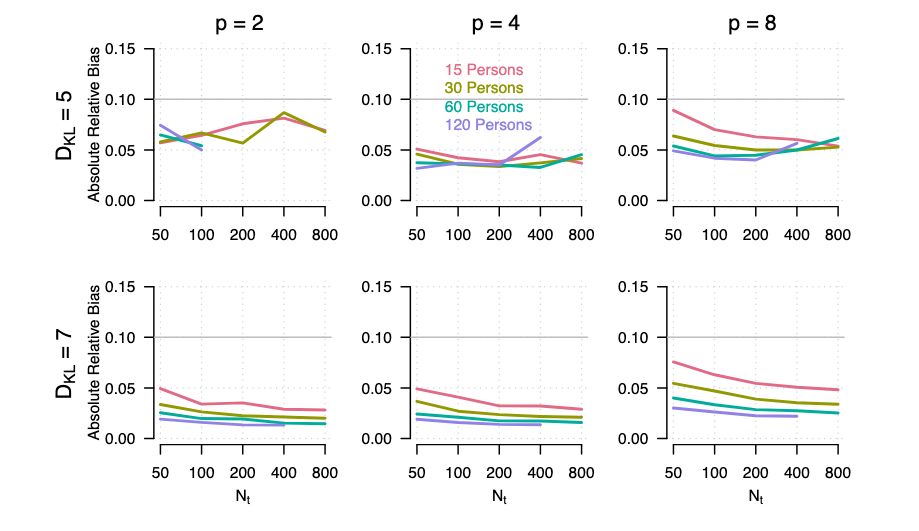
We found that model selection was successful for state separations similar to the ones we found in empirical data and estimation error was satisfactory for realistic numbers of observations and subjects.
22.09.2025 11:13 —
👍 1
🔁 0
💬 1
📌 0

Going beyond existing simulations, we independently varied the number of true states, the state separation, the number of variables, the number of time points, and the number of subjects.
22.09.2025 11:13 —
👍 0
🔁 0
💬 1
📌 0
OSF
In the second paper (osf.io/preprints/ps...) we conduct an extensive simulation study to evaluate whether existing software works as intended and how well multilevel HMMs can be estimated in typical time series designs in psychology.
22.09.2025 11:13 —
👍 2
🔁 1
💬 1
📌 0


In the first paper with Emmeke Aarts (osf.io/preprints/ps...) we provide a gentle introduction to (multilevel) HMMs and walk the reader through a fully reproducible tutorial on model specification, estimation, selection, and interpretation by analyzing a typical EMA emotion time series dataset.
22.09.2025 11:12 —
👍 2
🔁 1
💬 1
📌 0
While Emmeke Aart's R-package mHMMbayes already allows estimating multilevel HMMs, there has been no easily accessible tutorial on how to use these models and no evaluation of how well these models can be estimated in situations typical for psychology research.
22.09.2025 11:11 —
👍 0
🔁 0
💬 1
📌 0

Two new preprints on multilevel HMMs! Time series data is now pervasive in psychology and new methods are needed to model the dynamics in such data. Hidden Markov Models (HHMs) are powerful models for dynamics in which a system is switching between a number of discrete states.
22.09.2025 11:10 —
👍 69
🔁 21
💬 2
📌 0