Bsky thread here bsky.app/profile/kspo...
24.12.2024 00:00 —
👍 3
🔁 0
💬 0
📌 0
OSF
In a follow-up study of the same participants we found that women report the devaluation they experience in academia is exacerbated when institutional leadership fails to respond, leading many to leave their jobs
A combo of *both* top-down and bottom-up change is necessary osf.io/preprints/so...
19.12.2024 15:46 —
👍 1
🔁 1
💬 1
📌 0
Bsky thread here! bsky.app/profile/kspo...
10.12.2024 23:17 —
👍 1
🔁 1
💬 0
📌 0

Women faculty feel ‘pushed’ from academia by poor workplace climate
The gender gap in faculty attrition worsens after tenure, according to a new study
Research from @kspoon.bsky.social & ...
"“People don’t want to be in a workplace if they feel disrespected, if they feel like their work isn’t valued, if they feel like they’re not seen,” she notes. “And I do think that in many, many academic workplaces, that is the experience that women have.”"
09.12.2024 22:45 —
👍 63
🔁 20
💬 2
📌 1
If you're a researcher (including grad students!), our lab wants to know where you prefer to publish your work 📚 My labmate designed a game to rank your preferences - it is super fun and only takes a few minutes!
14.09.2024 13:46 —
👍 4
🔁 0
💬 0
📌 0
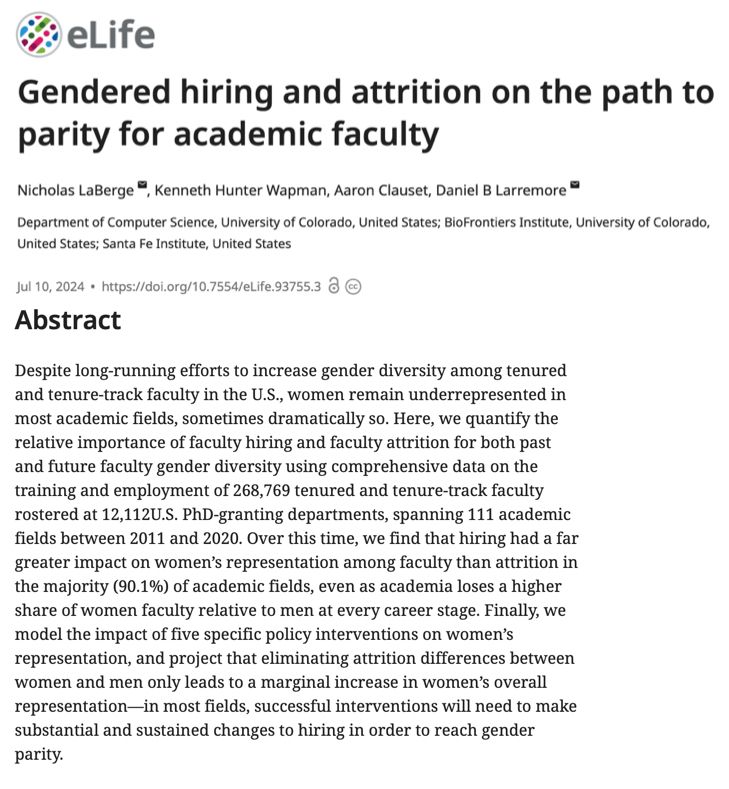
1/ I’m excited to share our article "Gendered hiring and attrition on the path to parity for academic faculty" with Hunter Wapman @aaronclauset.bsky.social @danlarremore.bsky.social , now published @elife.bsky.social : elifesciences.org/articles/93755
19.07.2024 17:04 —
👍 28
🔁 18
💬 1
📌 1
Adding to relevant feeds polisci #AcademicSky #EduSky 💙📚
11.06.2024 16:57 —
👍 2
🔁 0
💬 0
📌 0
9/ Finally, this work started at #SICSS 2022 and would not have been possible without @chrisbail.bsky.social bringing us together to learn about computational social science!
We also thank:
📚 PEN America & ALA for monitoring book bans
📚 SSRC for funding
📚 Bookshop.org for generously providing data
11.06.2024 14:52 —
👍 4
🔁 0
💬 0
📌 0

8/ We also urge attention toward the children's books that make up the majority of the bans! We were surprised by the titles and stories that populate banned books lists.
11.06.2024 14:49 —
👍 3
🔁 0
💬 1
📌 0
7/ What does this mean?
As censorship campaigns, book bans are not that effective! But while they might not be effective at information suppression, they play an under-examined role in political mobilization (especially in electorally contentious districts)
11.06.2024 14:48 —
👍 1
🔁 0
💬 1
📌 0

6/ Do bans work at suppressing interest in books? Or do they inspire a backlash?
Across two different levels of interest indicators we find that interest in banned books stays consistently low over time. Most people just aren’t reading banned books, before or after bans occur.
11.06.2024 14:47 —
👍 1
🔁 0
💬 1
📌 0

5/ What counties ban books?
We find that one of the strongest predictors that a county bans books is a *decreasing* republican vote share over the past 20 years. Precarious conservative majorities, not Republican strongholds, are the most likely to ban books.
11.06.2024 14:46 —
👍 1
🔁 0
💬 1
📌 0

4/ And which authors write banned books?
Women and LGBTQ+ authors are slightly overrepresented, but authors of color are strongly overrepresented among banned authors.
The odds that an author of color is banned is:
4x a white author (among all authors)
12x a white author (among popular authors)
11.06.2024 14:44 —
👍 1
🔁 0
💬 1
📌 0

3/ First, what books get banned?
We find most banned books are children’s books featuring diverse characters, such as LGBTQ+ characters and characters of color. In contrast, popularly discussed banned books such as young adult queer romance novels only made up a small proportion of banned books.
11.06.2024 14:38 —
👍 1
🔁 0
💬 1
📌 0
2/ We combine data on books banned in the 2021-2022 school year with data on school districts and counties, book metadata, a crowdsourced author demographic dataset, and several measures of public interest in books (book sales and Google searches) to systematically describe this recent phenomenon
11.06.2024 14:34 —
👍 1
🔁 0
💬 1
📌 0

1/ New paper out today in PNAS Nexus! This large-scale study of U.S. book bans started at a summer school 2 yrs ago with @msoligon.bsky.social @isarock.bsky.social Jack LaViolette. This has been such a fun and meaningful project!
🔓Open access paper: academic.oup.com/pnasnexus/ar...
🧵thread below...
11.06.2024 14:29 —
👍 18
🔁 8
💬 2
📌 2
15/ Finally, we want to thank Academic Analytics Research Center for the employment data and all survey participants for their valuable time.
20.10.2023 18:42 —
👍 18
🔁 0
💬 2
📌 0
14/ Big takeaway: it’s a mistake to observe equal rates of attrition and believe gender equity has been achieved. Focus instead on the reasons for leaving, which vary by career age, field, and prestige. There’s a lot of work left to do, and climate deserves our attention 🎤
20.10.2023 18:41 —
👍 36
🔁 4
💬 1
📌 0
13/ Our study is limited in several ways: our data don’t span the COVID pandemic, we study only tenured & tenure-track faculty, and our data don’t support strong intersectional analyses so the results mostly reflect the experiences of white women.
20.10.2023 18:41 —
👍 24
🔁 0
💬 2
📌 0
12/ To sum up:
- Women faculty universally leave academia at higher rates than men
- Effect is stronger for tenured women in non-STEM at lower-prestige schools
- BUT regardless of rates, women leave for different reasons - they feel pushed out, esp. by their workplace climates
20.10.2023 18:41 —
👍 71
🔁 20
💬 2
📌 2
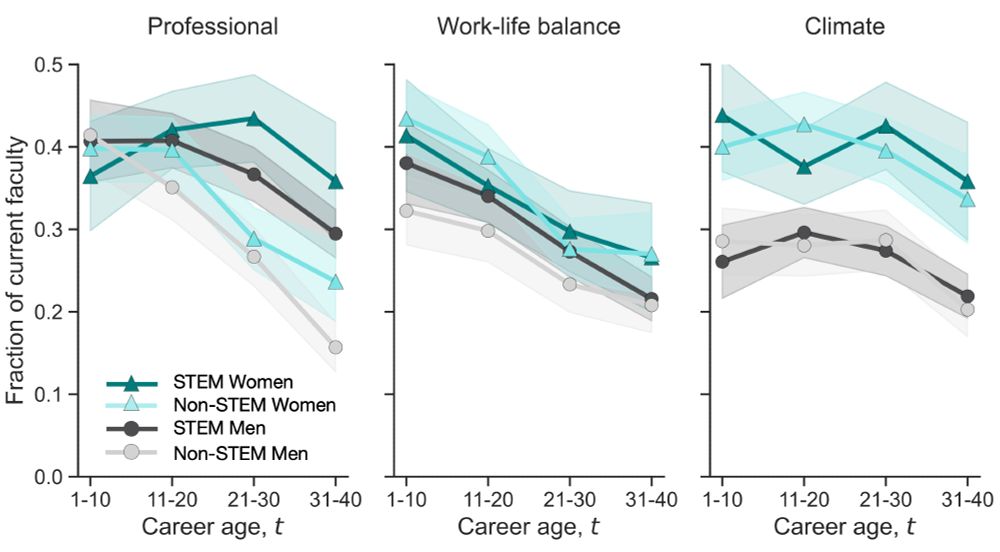
11/ And current faculty report a very similar pattern: women cite climate reasons at much higher rates than men, and do so at all career ages. Work-life reasons are more common in the early career, and do show a gendered effect but not as large as we see for climate.
20.10.2023 18:41 —
👍 26
🔁 4
💬 2
📌 2
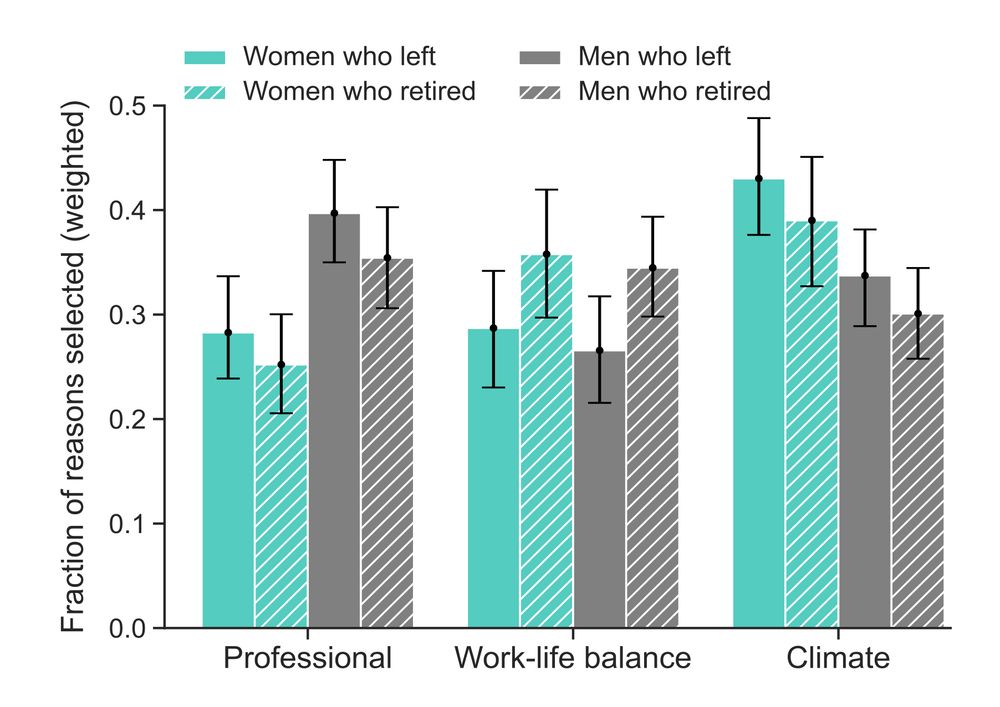
10/ Second, are faculty’s reasons for leaving gendered? Yes. Women former faculty most often cited climate-related reasons, while men cited professional reasons 📈📉 Women and men former faculty selected work-life balance reasons equally often.
20.10.2023 18:40 —
👍 53
🔁 15
💬 1
📌 1
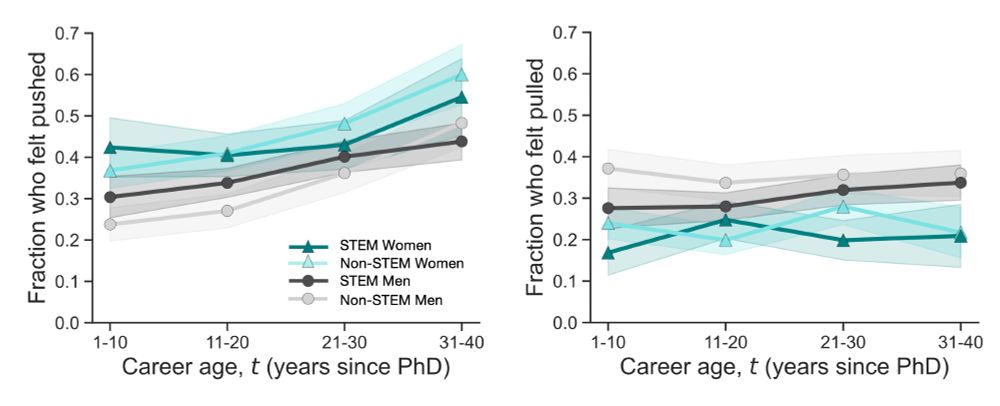

9/ First, feeling “pushed out” increased with career age for everyone. But women (STEM & non-STEM) were more likely to feel pushed out & less likely to feel pulled towards better jobs, than men, at every career age – gender was the strongest predictor of feeling pushed vs pulled.
20.10.2023 18:40 —
👍 77
🔁 27
💬 1
📌 3

8/ More than 10K faculty responded to our attrition survey, answering (1) did they feel pushed out or pulled towards better opportunities? and (2) were their pushes related to work, work-life balance, or workplace climate?
20.10.2023 18:40 —
👍 31
🔁 2
💬 1
📌 0
7/ But we should not forget: attrition rates are limited – they can’t say if the reasons that women and men leave a faculty position are gendered. Women & men may leave at similar rates, but for different reasons! To know, we need to ask faculty directly why 🤔
20.10.2023 18:39 —
👍 38
🔁 3
💬 1
📌 0

6/ But gendered attrition is not distributed uniformly, which is perhaps why smaller-scale studies can be confusing. We find larger gendered rates among:
- tenured faculty (esp full profs)
- faculty in non-STEM domains
- faculty at lower-prestige institutions
20.10.2023 18:39 —
👍 53
🔁 14
💬 2
📌 1

5/ Far from disappearing after tenure, gendered attrition is actually largest among tenured faculty, especially among full professors. Here, we’re showing odds ratios between women and men faculty, adjusting for career age, employer prestige, and PhD training.
20.10.2023 18:38 —
👍 89
🔁 42
💬 1
📌 3

4/ First, at every career age, we find that women are more likely to leave than men 👉 gender parity at hiring won’t persist. These empirical rates imply a hypothetical 50-50 cohort would fall to 40% women over 35 yrs — both hiring and retention are critical for achieving parity.
20.10.2023 18:38 —
👍 79
🔁 32
💬 2
📌 6

3/ We answer such questions at scale, with
1) census-level U.S. faculty employment data [ht @aarcresearch] to estimate “all-cause” gendered attrition rates across career ages & fields, and
2) large-scale multi-field survey data to elucidate the gendered reasons that faculty leave
20.10.2023 18:38 —
👍 32
🔁 3
💬 2
📌 0