Measles requires 95% vaccination rates for herd immunity.
It has a 16.2% case fatality rate for unvaccinated children under 5 years and 24% for children under 9 months (who are unable to be vaccinated).
30% of the survivors experience severe complications like blindness, deafness, or encephalitis.
16.11.2024 17:02 — 👍 2493 🔁 1291 💬 106 📌 91
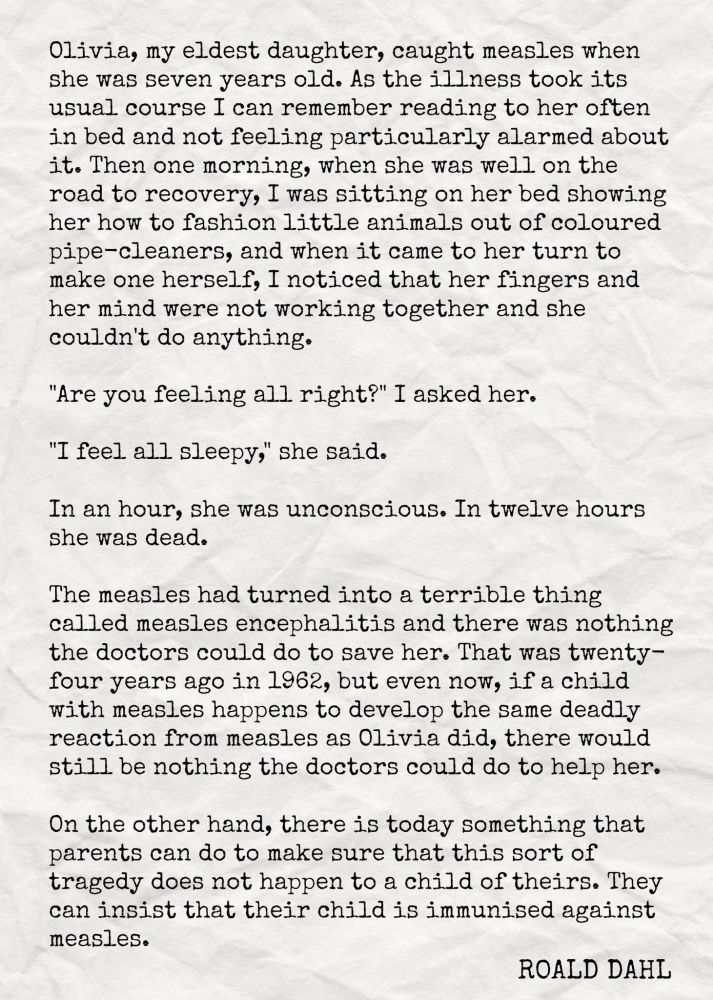
Excerpt from a public letter Roald Dahl wrote encouraging people to vaccinate their children.
Olivia, my eldest daughter, caught measles when she was seven years old. As the illness took its usual course I can remember reading to her often in bed and not feeling particularly alarmed about it. Then one morning, when she was well on the road to recovery, I was sitting on her bed showing her how to fashion little animals out of coloured pipe-cleaners, and when it came to her turn to make one herself, I noticed that her fingers and her mind were not working together and she couldn’t do anything.
“Are you feeling all right?” I asked her.
“I feel all sleepy,” she said.
In an hour, she was unconscious. In twelve hours she was dead.
The measles had turned into a terrible thing called measles encephalitis and there was nothing the doctors could do to save her. That was twenty-four years ago in 1962, but even now, if a child with measles happens to develop the same deadly reaction from measles as Olivia did, there would still be nothing the doctors could do to help her.
On the other hand, there is today something that parents can do to make sure that this sort of tragedy does not happen to a child of theirs. They can insist that their child is immunized against measles. I was unable to do that for Olivia in 1962 because in those days a reliable measles vaccine had not been discovered. Today a good and safe vaccine is available to every family and all you have to do is to ask your doctor to administer it.
The measles outbreak in Texas is reminding me of the public letter Roald Dahl wrote about losing his daughter to measles in 1962, just before the vaccine was publicly available.
15.02.2025 17:48 — 👍 26804 🔁 11797 💬 407 📌 548


Reminder for the new semester that you can’t detect AI
Researchers secretly added AI-created papers to the exam pool: “We found that 94% of our AI submissions were undetected. The grades awarded to our AI submissions were on average half a grade boundary higher than that achieved by real students”
06.01.2025 14:04 — 👍 115 🔁 47 💬 9 📌 13
@sabetilab.bsky.social just joined!
20.12.2024 01:36 — 👍 1 🔁 0 💬 1 📌 0
(To be completely clear I love my job. It brings me joy, it's rewarding, and it's an honor to get to do this work and get paid to do it—and I had fun at work today. Some days are just some days.)
18.12.2024 22:38 — 👍 0 🔁 0 💬 0 📌 0
Losing flexibility has been by far the hardest thing about transitioning to a non-academic job. Proud to say that today, like I'm sure many adults, I woke up miserable, cried on the orange line, and then did my job anyway.
18.12.2024 22:38 — 👍 0 🔁 0 💬 1 📌 0
I'm seeing some (entirely justified) concern about the possibility of the US no longer having a polio vaccination program given the threat posed by the incoming administration and I feel like this is a really good opportunity to explain some things about polio to clarify what the risks are 🧵
15.12.2024 23:22 — 👍 270 🔁 105 💬 15 📌 19
Data | Centers for Disease Control and Prevention
Data published by CDC public health programs to help save lives and protect people from health, safety, and security threats.
I thought it might be worthwhile to do a quick primer on CDC.gov datasets and public data resources.
1. DATA.CDC.GOV (data.cdc.gov/browse)
Datasets from across the agency, in browsable, machine readable format (Socrata system). Other/older collections are on:
2. WONDER.CDC.GOV (wonder.cdc.gov)
20.11.2024 19:23 — 👍 63 🔁 19 💬 4 📌 2
65. Good luck.
19.11.2024 02:05 — 👍 0 🔁 0 💬 0 📌 0
64. If you are going to quit, quit early. This applies to projects, this applies to classes, and this applies to grad school.
19.11.2024 02:05 — 👍 0 🔁 0 💬 1 📌 0
62. If your lab pits trainees against each other, find another lab.
63. If the people in your lab stress you out enough that it is hard to focus on your work, find another lab.
19.11.2024 02:05 — 👍 0 🔁 0 💬 1 📌 0
61. To the extent that you have control over authorship, be extremely generous with authorship.
19.11.2024 02:05 — 👍 0 🔁 0 💬 1 📌 0
60 (cont.). It also helps you to get to know your colleagues, which leads to friendship, collaboration, and helpful feedback and new ideas as you share what you are each working on.
19.11.2024 02:05 — 👍 0 🔁 0 💬 1 📌 0
60. Even if you have the flexibility to work remote, show up to the office at least twice a week. I’ve found that I am much more productive and take fewer breaks and procrastinate less when I am physically in the office
19.11.2024 02:05 — 👍 0 🔁 0 💬 1 📌 0
58. Get dental insurance, even if grad school doesn’t supply it, and see a dentist.
59. Ask around and go to the dentist your colleagues go to (that takes your insurance).
19.11.2024 02:05 — 👍 0 🔁 0 💬 1 📌 0
55. Show up to departmental happy hours.
56. Bring food to share at work sometimes. Baked goods or Halloween candy.
57. Work out at least once a week.
19.11.2024 02:05 — 👍 0 🔁 0 💬 1 📌 0
52. Don’t work for at least one day every weekend.
53. Have hobbies.
54. Maintain friendships, both in your department (especially with your cohort) and from your life before grad school. If you can’t meet in person, meet with coffee or lunch over zoom.
19.11.2024 02:05 — 👍 0 🔁 0 💬 1 📌 0
48. Treat your work like a job. Set your hours, show up during your hours, and try to disconnect outside of those hours.
49. Don’t work during vacations.
50. Don’t show up to meetings during vacations.
51. Or during dinner.
19.11.2024 02:05 — 👍 0 🔁 0 💬 1 📌 0
47. Don’t listen to music while you work. At the very least try working with music, try working without music, and see which version is more productive and enjoyable.
19.11.2024 02:05 — 👍 0 🔁 0 💬 1 📌 0
46 (cont.). As a bonus, it was a lot less work than teaching three semesters would have been, because I simply did the same thing three times in a row each day.
19.11.2024 02:05 — 👍 0 🔁 0 💬 1 📌 0
46. If you have teaching requirements and you think that teaching will distract you from your research, consider squeezing your teaching into one semester, and not doing any research during that semester. I taught my required three sections in one very stressful semester.
19.11.2024 02:05 — 👍 0 🔁 0 💬 1 📌 0
45. But don’t get distracted from your research!
19.11.2024 02:05 — 👍 0 🔁 0 💬 1 📌 0
44. Try to teach at some point, even if your department doesn’t require it. This will help you figure out if you want to be a professor, it will help you identify and correct gaps in your knowledge of your field, and it will make you better at presenting your own work.
19.11.2024 02:05 — 👍 0 🔁 0 💬 1 📌 0
43. Be on social media wherever your field is on social media. When you read a paper you enjoyed, follow its authors on social media so that you can learn from them and get notifications about new papers they have published.
19.11.2024 02:05 — 👍 0 🔁 0 💬 1 📌 0
42. If you want to, start a TikTok or Instagram about your (published) work and what you learn in grad school. One of my friends from my cohort got Internet famous with his science TikTok, which both is very cool and also probably didn’t not help him land a professorship right out of grad school.
19.11.2024 02:05 — 👍 0 🔁 0 💬 1 📌 0
I walk around a lot and listen to too many podcasts and not enough audiobooks. (he/him)
Also, for my politics/data/work stuff, go here if you must: lancercampaigns.com
I use genomics to study the evolution and spread of human pathogens and lead pathogen genomic analytics at the Broad Institute.
Also: @dpark@mstdn.science
ORCID: 0000-0001-7226-7781
GitHub: dpark01
Virologist. PI working at but not speaking for USask. Co-EiC of Vaccine. 🇺🇸 in 🇨🇦. Emerging viruses, pathogenesis, zoonosis, host responses, dogs, football, off-color language, transcriptomic chaos. Opinions my own.
Computational biologist and postdoc at Stanford. Hobby dog trainer. COYG.
#NIHMOSAIC K99/R00 scholar using comparative genomics to understand the molecular basis of innate mating & parenting behavior in deer mice 🧬 🐭
genetic and neural basis of dexterity…in deer mice! | postdoc at Harvard OEB/MCB, BRAIN K99/R00 | plant grower, music maker, crafter, bike rider, sometimes mountain climber | she/her
in search of a faculty job 🤓
https://ktyssowski.github.io/
I’m a plant developmental geneticist who loves plants, evolution, teaching and hiking with my dogs.
Father, son, husband, brother, friend. Also runs a lab.
Mexican 🇲🇽 paleobiologist interested in the origin of the modern marine biosphere, animal macroevolution and phylogeny. Associate Professor and Curator of Invertebrate Paleontology at the Museum of Comparative Zoology and OEB at Harvard - he/him
Assist Prof at UIUC Plant Bio #NewPI. NSF Postdoc UConn EEB. PhD Harvard OEB. Erasmus MEME evobio alumna. She/Her. Lover of ALL plants.
🧪🔬🌱🌾
Development; Evolution; Evo-Devo; Microscopy; Meristems.
Lived in 🇨🇳🇯🇵🇸🇪🇫🇷🇩🇪🇺🇸
www.minyaaa.com
Brains and bioacoustics // postdoc using animal diversity to understand animal behavior // nickjourjine.github.io // he, him
I organize the Bridging Brains and Bioacoustics seminar series: braincoustics.bsky.social // braincoustics.com
🇪🇺🇺🇸Palaeontologist at @Harvard @HarvardOEB, investigating early animal life, especially arthropods 🕷️🐞🦂🦞🦐🐝.
PhD candidate in Harvard OEB. More impressed with flowers all the time 🌸🔬🧬
Floral color evolution & speciation. Silene, Caryophyllaceae. Really likes plant pigments. she/her
Assistant Professor of Biology at JMU