Implementation Science Journals's Avatar

Implementation Science Journals

@implementsci.bsky.social

BMC's Implementation Science & Implementation Science Communications focus on the implementation of research evidence into healthcare practice and policy. Posts about #impsci & companion journal #ImpSciComms https://implementationscience.biomedcentral.com

1,731 Followers  |  214 Following  |  338 Posts  |  Joined: 24.10.2023
Posts Following

Posts by Implementation Science Journals (@implementsci.bsky.social)

Preview
Implementation Science Communications Implementation Science Communications, an official companion journal toΒ Implementation Science, is a forum to publish research to foster the uptake of ...

🚨If you are committed to advancing implementation science, we'd love to hear from you!

Implementation Science Communications is recruiting additional Editors to join our Editorial Board.

Apply here πŸ‘‰ link.springer.com/journal/4305...

#ImpSci #ImpSciComms

17.02.2026 11:28 β€” πŸ‘ 1    πŸ” 3    πŸ’¬ 0    πŸ“Œ 0
Preview
β€œWe’re building the plane while we’re flying it”: perspectives on local cigar policy implementation from qualitative interviews with key personnel - Implementation Science Communications Background Nearly 300 US municipalities have enacted policies regulating cigar pack size and price to reduce youth access to and use of inexpensive cigars. This study characterizes the policy implemen...

β€œWe’re building the plane while we’re flying it”: perspectives on local cigar policy implementation from qualitative interviews with key personnel #impsci #ImpSciComms

link.springer.com/article/10.1...

21.01.2026 16:44 β€” πŸ‘ 1    πŸ” 0    πŸ’¬ 0    πŸ“Œ 0
Preview
Visualizing contextual determinants in and across heterogeneous settings: a qualitative study on structured school health promotion implementation - Implementation Science Communications Background Schools have the potential to promote equitable health from early life onwards yet require sufficient organizational capacity to achieve sustained action. Structured improvement approaches,...

Visualizing contextual determinants in and across heterogeneous settings: a qualitative study on structured school health promotion implementation #impsci #ImpSciComms

link.springer.com/article/10.1...

21.01.2026 16:42 β€” πŸ‘ 1    πŸ” 0    πŸ’¬ 0    πŸ“Œ 0
Preview
Enhancing adoption of patient safety culture assessments in Brazil: a strategy informed by CFIR and ERIC - Implementation Science Communications Background Regular assessments of Patient Safety Culture (PSC) are recommended by the World Health Organization to strengthen healthcare systems. In Brazil, despite national campaigns, hospital adhere...

Enhancing adoption of patient safety culture assessments in Brazil: a strategy informed by CFIR and ERIC #impsci #ImpSciComms

link.springer.com/article/10.1...

21.01.2026 16:41 β€” πŸ‘ 1    πŸ” 0    πŸ’¬ 0    πŸ“Œ 0
Preview
What makes patient navigation work? Identifying functions and forms and conducting causal loop diagramming to specify components of a successful colorectal cancer patient navigation program - Implemen... Background We implemented a centralized colorectal cancer (CRC) screening program with navigation to follow-up colonoscopy for community health center (CHC) patients with positive stool-based test scr...

What makes patient navigation work? Identifying functions and forms and conducting causal loop diagramming to specify components of a successful colorectal cancer patient navigation program #impsci #ImpSciComms

link.springer.com/article/10.1...

21.01.2026 16:39 β€” πŸ‘ 0    πŸ” 1    πŸ’¬ 0    πŸ“Œ 0
Client Challenge

Comparing tailored implementation strategies to improve intervention fidelity in a school-based obesity prevention program #impsci

link.springer.com/article/10.1...

09.01.2026 12:45 β€” πŸ‘ 0    πŸ” 0    πŸ’¬ 0    πŸ“Œ 0
Client Challenge

Do process evaluations open up the β€˜black box’ of implementation interventions in health care? A scoping review #impsci

link.springer.com/article/10.1...

09.01.2026 12:44 β€” πŸ‘ 0    πŸ” 0    πŸ’¬ 0    πŸ“Œ 0
Client Challenge

Clarity and consistency in government-funded implementation strategies associated with greater evidence-based practice reach #impsci

link.springer.com/article/10.1...

09.01.2026 12:44 β€” πŸ‘ 1    πŸ” 0    πŸ’¬ 0    πŸ“Œ 1
Client Challenge

Applied methods for matching implementation strategies to determinants: a scoping review of scientific and grey literature, and qualitative exploration of practice experiences #impsci

link.springer.com/article/10.1...

09.01.2026 12:43 β€” πŸ‘ 2    πŸ” 0    πŸ’¬ 0    πŸ“Œ 0
Client Challenge

Cluster RCT, process and economic evaluation of two large-scale quality improvement interventions embedded with a national clinical audit to improve the care for young adults with type 2 diabetes #impsci

link.springer.com/article/10.1...

09.01.2026 12:41 β€” πŸ‘ 1    πŸ” 0    πŸ’¬ 0    πŸ“Œ 1
Preview
Getting to Implementation: applying data-driven implementation strategies to improve guideline concordant surveillance for hepatocellular carcinoma - Implementation Science Background While guidelines recommend twice-yearly liver cancer (hepatocellular carcinoma, HCC) surveillance for people with cirrhosis, adherence to these guidelines remains variable. We aimed to empi...

Getting to Implementation: applying data-driven implementation strategies to improve guideline concordant surveillance for hepatocellular carcinoma #impsci

link.springer.com/article/10.1...

15.12.2025 17:19 β€” πŸ‘ 2    πŸ” 0    πŸ’¬ 0    πŸ“Œ 0
Preview
Implementing prescriber-pharmacist collaboration to improve evidence-based medication prescribing using asynchronous, non-interruptive electronic health record notifications - Implementation Science Background Inappropriate prescribing of Direct Oral Anticoagulants (DOACs) is a leading cause of adverse outcomes. Electronic health record (EHR)-based notification strategies may support evidence-bas...

Implementing prescriber-pharmacist collaboration to improve evidence-based medication prescribing using asynchronous, non-interruptive electronic health record notifications #impsci

link.springer.com/article/10.1...

15.12.2025 17:19 β€” πŸ‘ 2    πŸ” 0    πŸ’¬ 0    πŸ“Œ 0
Preview
Understanding mechanisms of multi-level implementation strategies for autism interventions in a randomized trial across service systems - Implementation Science Background Understanding the effectiveness of implementation strategies to support uptake of evidence-based interventions (EBIs) requires examining activation of mechanisms targeted by implementation ...

Understanding mechanisms of multi-level implementation strategies for autism interventions in a randomized trial across service systems #impsci

link.springer.com/article/10.1...

15.12.2025 17:18 β€” πŸ‘ 2    πŸ” 0    πŸ’¬ 0    πŸ“Œ 0
Preview
What scientific inferences can be made with randomized implementation rollout trials - Implementation Science Background Randomized rollout trial designs, including stepped wedge designs, are commonly used to examine how well an evidence-based intervention or package is being implemented in community or healt...

What scientific inferences can be made with randomized implementation rollout trials #impsci

link.springer.com/article/10.1...

15.12.2025 17:17 β€” πŸ‘ 1    πŸ” 0    πŸ’¬ 0    πŸ“Œ 0
Preview
So what? Elevating the impact of implementation science - Implementation Science Communications Background Given the substantial public funding of health-related research, tangible benefits of this support must be demonstrated. Implementation science provides actionable methods to enhance popula...

So what? Elevating the impact of implementation science

Ross Brownson, Juliet Iwelunmor, Thomas Odeny, Enola Proctor & Elvin Geng

link.springer.com/article/10.1...

@implementsci.bsky.social #ImpSci #ImpSciComm

28.11.2025 09:28 β€” πŸ‘ 5    πŸ” 2    πŸ’¬ 1    πŸ“Œ 0
Preview
Implementation outcomes of a symptom management intervention in ambulatory oncology practices evaluated using a cluster randomized stepped-wedge trial design - Implementation Science Objective To test a package of clinician- and system-level implementation strategies on the adoption and reach of an electronic health record (EHR)-integrated cancer symptom assessment and management ...

Implementation outcomes of a symptom management intervention in ambulatory oncology practices evaluated using a cluster randomized stepped-wedge trial design #impsci

link.springer.com/article/10.1...

09.12.2025 17:47 β€” πŸ‘ 0    πŸ” 0    πŸ’¬ 0    πŸ“Œ 0
Preview
Minimal progress toward sustainment: 10-year replication of substance use EBP sustainment trajectories and associations with implementation characteristics - Implementation Science Background Over the past decade, implementation researchers have empirically identified factors influencing long-term sustainment of evidence-based practices (EBPs) to target in implementation efforts...

Minimal progress toward sustainment: 10-year replication of substance use EBP sustainment trajectories and associations with implementation characteristics #impsci

link.springer.com/article/10.1...

09.12.2025 17:34 β€” πŸ‘ 0    πŸ” 0    πŸ’¬ 0    πŸ“Œ 0
Preview
Optimizing qualitative methods in implementation research: a resource for editors, reviewers, authors, and researchers to dispel ten common misperceptions about qualitative research methods - Implemen... Background Qualitative methods are central to implementation research. Qualitative research provides rich contextual insight into lived experiences of health and illness, healthcare systems and care d...

Optimizing qualitative methods in implementation research: a resource for editors, reviewers, authors, and researchers to dispel ten common misperceptions about qualitative research methods #impsci #ImpSciComms

link.springer.com/article/10.1...

09.12.2025 17:31 β€” πŸ‘ 5    πŸ” 4    πŸ’¬ 0    πŸ“Œ 0
Preview
Project MIMIC (Maximizing Implementation of Motivational Incentives in Clinics): results of a 28-site cluster-randomized type 3 hybrid trial - Implementation Science Background Contingency management (CM), a behavioral treatment that incentivizes patients for attaining treatment goals, is a highly effective adjunct to medication for opioid use disorder. However, C...

Maximizing Implementation of Motivational Incentives in Clinics: results of a 28-site cluster-randomized type 3 hybrid trial #impsci

link.springer.com/article/10.1...

09.12.2025 17:30 β€” πŸ‘ 0    πŸ” 0    πŸ’¬ 0    πŸ“Œ 0
Preview
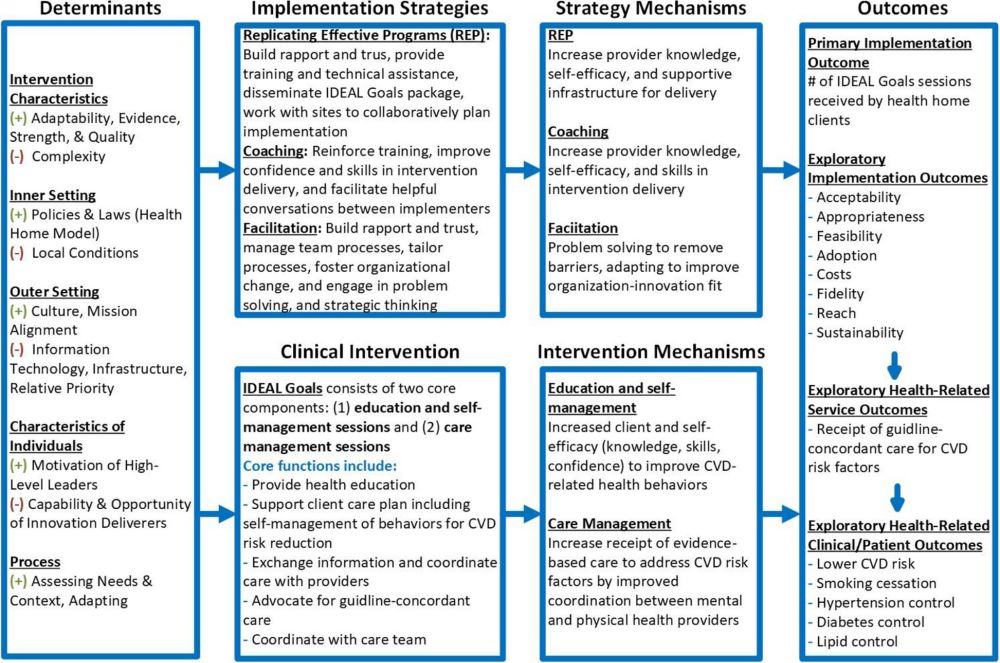
Achieving cardiovascular health equity in community mental health: study protocol for a cluster-randomized hybrid Type 3 effectiveness-implementation trial - Implementation Science Background People with serious mental illness die 10–20 years earlier than the overall population, mainly from cardiovascular disease. Although effective interventions to manage cardiovascular disease...

Achieving cardiovascular health equity in community mental health: study protocol for a cluster-randomized hybrid Type 3 effectiveness-implementation trial #impsci

implementationscience.biomedcentral.com/articles/10....

06.11.2025 10:13 β€” πŸ‘ 2    πŸ” 0    πŸ’¬ 0    πŸ“Œ 0
Preview
Implementation Strategies Applied in Communities Matching Process (ISAC Match): Expanded Guidance and Case Study - Implementation Science Background Implementation strategies are methods or techniques to improve the adoption, implementation, sustainment, and scale-up of evidence-based interventions. Limited guidance exists on feasible p...

Implementation Strategies Applied in Communities Matching Process (ISAC Match): Expanded Guidance and Case Study #impsci

implementationscience.biomedcentral.com/articles/10....

18.10.2025 14:22 β€” πŸ‘ 1    πŸ” 0    πŸ’¬ 0    πŸ“Œ 0
Preview
A pragmatic approach to estimating the cost to deliver and participate in implementation strategies - Implementation Science Background Implementation costsβ€”the combined costs of delivering expert support and participating in an implementation endeavorβ€”are often omitted from economic evaluations. When included, delivery and...

A pragmatic approach to estimating the cost to deliver and participate in implementation strategies #impsci

implementationscience.biomedcentral.com/articles/10....

18.10.2025 14:22 β€” πŸ‘ 3    πŸ” 0    πŸ’¬ 0    πŸ“Œ 0
Preview
Considerations for evaluating pragmatic design elements in digital health intervention trials: the case of Keep It Up! 3.0 - Implementation Science Communications Background Digital health interventions are increasingly promoted in healthcare and prevention practices due to their potential for reaching key populations in a cost-efficient manner. Yet there has been limited research on how to effectively implement them with pragmatic approaches that can facilitate scale-up. Keep It Up! (KIU!) 3.0 was a hybrid type 3 implementation–effectiveness trial comparing two delivery strategies (i.e. trial arms) of an HIV prevention intervention for cisgender, young men who have sex with men. We aimed to determine the level of pragmatism of our two-armed trial before and after changes to the county-randomized design. Methods We applied different versions of the PRagmatic Explanatory Continuum Indicator Summary (PRECIS) tool to the two trial arms: delivery of KIU! by community-based organizations (CBO) versus centralized, direct-to-consumer (DTC) delivery. We scored PRECIS-2 for the original study design and the modified design in which the DTC strategy expanded nationally. We applied PRECIS-2-PS to the modified study design. Nine coders in three groups independently scored the tools. Scores were iteratively discussed to arrive at one consensus score per domain, tool, design stage, and arm. We plotted results using the PRECIS-2 and PRECIS-2-PS wheels and averaged domains scores to describe overall score along the Pragmatic–Explanatory Continuum. Results Using PRECIS-2, the trial was on the pragmatic side of the spectrum for both arms and design stages, with average ratings ranging from 3.89–4.33. Both arms were highly pragmatic in the original and modified design in the Setting and Primary Analysis domains and least pragmatic in the Follow-up domain. In the modified trial design, the CBO and DTC arms again scored rather pragmatic using the PRECIS-2-PS tool, but CBO arm scored higher in the eligibility, recruitment, and organization domains compared to PRECIS-2 (5 vs. 4, respectively). Conclusions Application of both the PRECIS-2 and PRECIS-2-PS tools validated the pragmatic design of KIU! 3.0 as originally designed and after modifications during trial implementation. Our findings highlight instances where one tool may be more suitable than the other to assess the pragmatic–explanatory continuum for emerging digital health interventions delivered in diverse settings and with different implementation strategies.

Considerations for evaluating pragmatic design elements in digital health intervention trials: the case of Keep It Up! 3.0 #impsci #ImpSciComms

implementationsciencecomms.biomedcentral.com/articles/10....

09.10.2025 14:43 β€” πŸ‘ 2    πŸ” 0    πŸ’¬ 0    πŸ“Œ 0
Preview
Scaling-up an mHealth system to deliver financial incentives to improve adherence to antiretroviral therapy in Tanzania - Implementation Science Communications Background Financial incentives are increasingly used to achieve UNAIDS' 95–95-95 goals for ending HIV by 2030. While evidence supports their effectiveness, scaling these interventions remains challenging. This study examines the implementation successes and challenges of a financial incentive intervention in Tanzania, delivered via an mHealth application that provides automated mobile money disbursements, biometric identification, and SMS reminders. Methods Conducted alongside a Hybrid Type 1 Effectiveness-Implementation trial, the study evaluated financial incentives given to adults starting ART at 32 clinics. We used the Structured Assessment of Feasibility, Compatibility Beliefs in Technology (CBIT) scales, and the Program Sustainability Assessment Tool. Perspectives from 657 participants living with HIV and 90 clinic staff were collected using Proctor’s implementation science framework. Results Clinic staff rated the mHealth system highly on CBIT subscales for perceived usefulness, ease of use, and compatibility, each scoring over 6 out of 7. Integration and applicability of the financial incentive within the mHealth system were well received, with 93.0% of staff agreeing it improved job performance. Among participants, 86.4% found SMS reminders helpful for attending appointments, and 76.7% felt the cash delivery met their expectations. Challenges included unreliable fingerprint identification and undelivered SMS reminders. Conclusions Despite issues with fingerprint identification and SMS delivery, the financial incentive intervention via mHealth was found to be acceptable, feasible, and potentially sustainable in resource-limited settings, with support from host governments. Future research should enhance the intervention's effectiveness and optimize biometric identification methods. Trial registration ClinicalTrials.gov NCT04201353. Registered 17 December 2019, https://clinicaltrials.gov/study/NCT04201353

Scaling-up an mHealth system to deliver financial incentives to improve adherence to antiretroviral therapy in Tanzania #impsci #ImpSciComms

implementationsciencecomms.biomedcentral.com/articles/10....

09.10.2025 14:42 β€” πŸ‘ 1    πŸ” 0    πŸ’¬ 0    πŸ“Œ 0
Preview
Implementation research in forensic mental health: a scoping review - Implementation Science Communications Background Forensic mental health (FMH) serves as a critical juncture between the mental health and criminal justice systems. Factors on multiple levels – including sociopolitical, organizational, and individualβ€” pose challenges to conducting implementation research in these settings. This hinders the uptake of evidence-based interventions and improvements to patient outcomes. This study examined implementation research conducted in FMH settings to understand its current state and inform future implementation research and practice. Methods We conducted a scoping review following the Joanna Briggs Institute methodology. A comprehensive literature search was performed across seven databases from their inception through April 2024, supplemented by searches in Google Scholar and six review studies, to identify relevant research. We analyzed included studies descriptively to explore determinants, strategies, and outcomes associated with the implementation of evidence-, or policy-based interventions in FMH. Results Of the 1327 records retrieved, 41 implementation studies were included. All studies were conducted in high-income countries and focused on interventions such as risk assessment, rehabilitation, patient support, and technology interventions, primarily using qualitative approaches. Key determinants for implementing interventions in FMH included individual characteristics (e.g., motivation, capacity) and inner setting factors (e.g., intervention compatibility with existing practices, access to knowledge and information). Various strategies, such as using evaluative and iterative strategies, training and educating stakeholders, changing infrastructure, and engaging consumers have been used to facilitate intervention uptake in FMH. Implementation outcomes primarily focused on uptake, fidelity, and acceptability. Conclusions There is a clear need for more implementation research using rigorous study designs in FMH. Multilevel implementation strategies should be employed to address barriers from both the inner settings and individual characteristics, thereby promoting the successful implementation of interventions in FMH. Future implementation research should incorporate a health equity lens throughout the research process to enhance inclusivity and improve reporting on implementation strategies to support replications of interventions in FMH.

Implementation research in forensic mental health: a scoping review #impsci #ImpSciComms

implementationsciencecomms.biomedcentral.com/articles/10....

09.10.2025 14:41 β€” πŸ‘ 1    πŸ” 0    πŸ’¬ 0    πŸ“Œ 0
Preview
De-implementation of low-value home-based nursing care: an effect and process evaluation - Implementation Science Communications Background The demand for homecare is increasing, and reducing low-value care is essential for achieving sustainable healthcare. Low-value care refers to practices that are ineffective, inefficient, unwanted, or potentially harmful to the client. This study aimed to evaluate the effects of a tailored, multifaceted deimplementation strategy in reducing low-value home-based nursing care. Methods A prospective, multicenter, convergent parallel mixed method design was employed, including a before-and-after study, using the Reach-Effectiveness-Adoption-Implementation-Maintenance (RE-AIM) framework. The effect of reducing low-value home-based nursing care was assessed from client records, focusing on the number of clients receiving care, minutes of care per week, frequency of visits per week, and clients no longer requiring care. The de-implementation process was evaluated qualitatively through individual interviews with de-implementation ambassadors, registered nurses, and nurse assistants, using Directed Qualitative Content Analysis. This approach served to interpret the effects of the deployment of de-implementation ambassadors and the strategies they implemented. Results We observed a reduction in low-value home-based nursing care, with a decrease of 130 h per week in daily showering, bathing and/or dressing; 54 h per week in the assistance with compression stockings; and 8 h per week in changing bandages enabling clients to regain their independence. Important de-implementation strategies included involving clients and relatives in decision making, organizing informational meetings for homecare professionals, and fostering collaboration with other healthcare professionals. Factors that influenced adoption included providing reassurance and using a stepwise approach with clients and relatives. Homecare professionals noted that the de-implementation ambassadors were highly committed to reducing care. De-implementation ambassadors found their role to be intense, challenging, and exciting. Conclusions This evaluation found that the deployment of de-implementation ambassadors, paired with additional de-implementation strategies, enhanced the reduction of low-value home-based nursing care. Providing reassurance and involving clients and their relatives were identified as beneficial for the de-implementation process.

De-implementation of low-value home-based nursing care: an effect and process evaluation #impsci #ImpSciComms

implementationsciencecomms.biomedcentral.com/articles/10....

09.10.2025 14:40 β€” πŸ‘ 0    πŸ” 0    πŸ’¬ 0    πŸ“Œ 0
Preview
Protocol for a Type 3 hybrid effectiveness-implementation cluster randomized trial to evaluate multi-ethnic, multilevel strategies and community engagement to eliminate hypertension disparities in Los Angeles County - Implementation Science Background In the U.S., racial and ethnic disparities in hypertension control contribute to disparities in cardiovascular mortality. Evidence-based practices (EBPs) for improving hypertension control have not been consistently applied across patient subgroups, especially in safety-net settings, contributing to observed disparities. The Los Angeles County Department of Health Services serves racially and ethnically diverse, low-income patients with hypertension and represents a valuable setting for research to reduce disparities. We designed a hybrid Type 3 effectiveness-implementation study using a three-arm, crossover randomized controlled trial to compare the effects of patient- and provider-focused strategies and usual implementation strategy on key implementation and clinical outcomes. Methods We will enroll 27 primary care clinics. Patient-focused implementation strategies aim to increase patient access to culturally and linguistically tailored educational materials on hypertension and improve patient engagement in hypertension care. Provider-focused strategies include training in culturally tailored hypertension care and activities to strengthen clinic workflows for home blood pressure monitoring, medication titration, referral to nurse-directed blood pressure clinics, and social needs screening and referral. Implementation facilitators provide support for these EBPs. The primary implementation outcome is provider EBP adoption clustered at the clinic level, based on a scoring system using medical records, clinic observation, and webinar participation. The primary health-related outcome is the proportion of patients in a clinic with controlled hypertension by race and ethnicity. We will use the constrained generalized Poisson mixed-effects model to compare changes in event rate of provider EBP adoption between usual implementation strategy and either provider- or patient-focused strategies. We will use constrained logistic mixed-effects models to assess the effect on change in blood pressure control. We will record implementation progress using the Stages of Implementation Completion tool and identify costs and resource use using the Cost of Implementing New Strategies tool. Discussion Our study contributes to the implementation science literature on cardiovascular health equity by examining alternative implementation strategies to increase use of culturally and linguistically tailored hypertension EBPs and social needs screening and intervention. Findings from our study will build evidence for implementation of hypertension EBPs in safety-net and other health systems serving racial and ethnic minority patients. Trial registration Clinicaltrials.gov NCT06359691, registered April 10, 2024.

Type 3 hybrid effectiveness-implementation cluster randomized trial to evaluate multi-ethnic, multilevel strategies and community engagement to eliminate hypertension disparities in Los Angeles County #impsci

implementationscience.biomedcentral.com/articles/10....

09.10.2025 14:36 β€” πŸ‘ 0    πŸ” 0    πŸ’¬ 0    πŸ“Œ 0
Preview
The STop UNhealthy substance use now (STUN II) trial: protocol for a 48-site cluster randomized 2 × 2 factorial implementation trial to improve evidence-based screening and interventions for substance use disorder within primary care - Implementation Science Background Despite substance use disorders (SUD) being a leading cause of preventable death in the US, most people who visit primary care in the US are not screened for SUD. There are multiple barriers to screening for, identifying, and managing SUD in primary care. However, there are also promising strategies available to address these barriers, including practice facilitation (PF), learning collaboratives (LC), and performance incentives (PI). Methods This study is a 48-site cluster-randomized 2 × 2 factorial implementation trial that aims to compare the effectiveness of several strategies for implementing evidence-based screening and interventions for SUDs in primary care. Practices will be randomized to one of four implementation strategies: (1) PF only, (2) PF + LC, (3) PF + PI, or (4) all three strategies. An estimated 144 participants from 48 primary care practices will be enrolled. All participants will receive PF to guide them in making changes to implement screening for SUD, focusing on a defined change package and associated tools. PF includes quality improvement (QI) coaching, as well as electronic health record (EHR) support, training, and expert consultation. LC includes monthly virtual education sessions led by content experts to support practice improvement and innovation with didactics on key topics as well as facilitating participant interactions to share experiences. PI includes financial incentives for performance. Primary care practices will be the unit of analysis for both the primary outcome (rate of SUD screening) and secondary outcomes (rates of evidence-based interventions for SUD). Assessments will be conducted during a 12-month implementation phase and 12-month sustainment phase. Discussion This study will produce evidence regarding the comparative effectiveness of several strategies on implementation and sustainment of evidence-based screening and interventions for SUD within primary care. It will also generate knowledge about mechanisms of change in primary care settings. The results are expected to have a positive impact by providing a nuanced understanding of the incremental benefits of LC and/or PI to inform primary care practices, health systems, policymakers, and payers about optimal implementation strategies for SUD screening and evidence-based interventions. Trial registration ClinicalTrials.gov NCT06524232. July 23, 2024 –registered.

STop UNhealthy substance use now (STUN II) trial: protocol for a 48-site cluster randomized 2 × 2 factorial implementation trial to improve evidence-based screening and interventions for substance use disorder within primary care #impsci

implementationscience.biomedcentral.com/articles/10....

09.10.2025 14:35 β€” πŸ‘ 1    πŸ” 0    πŸ’¬ 0    πŸ“Œ 0
Preview
Integrating implementation science and intervention optimization - Implementation Science Background Implementation scientists increasingly recognize the value of multiple strategies to improve the adoption, fidelity, and scale up of an evidence-based intervention (EBI). However, with this recognition comes the need for alternative and innovative methods to ensure that the package of implementation strategies work well within constraints imposed by the need for affordability, scalability, and/or efficiency. The aim of this article is to illustrate that this can be accomplished by integrating principles of intervention optimization into implementation science. Method We use a hypothetical example to illustrate the application of the multiphase optimization strategy (MOST) to develop and optimize a package of implementation strategies designed to improve clinic-level adoption of an EBI for smoking cessation. Results We describe the steps an investigative team would take using MOST for an implementation science study. For each of the three phases of MOST (preparation, optimization, and evaluation), we describe the selection, optimization, and evaluation of four candidate implementation strategies (e.g., training, treatment guide, workflow redesign, and supervision). We provide practical considerations and discuss key methodological points. Conclusion Our intention in this methodological article is to inspire implementation scientists to integrate principles of intervention optimization in their studies, and to encourage the continued advancement of this integration.

Integrating implementation science and intervention optimization #impsci

implementationscience.biomedcentral.com/articles/10....

09.10.2025 14:32 β€” πŸ‘ 2    πŸ” 0    πŸ’¬ 0    πŸ“Œ 0
Preview
Integrating HIV prevention services into care settings for people with opioid use disorder (OUD): a study protocol for implementation strategy development and modeling - Implementation Science Communi... Background The overlapping epidemics of opioid use disorder (OUD) and HIV present a critical public health challenge. Although people with OUD frequently engage with healthcare settings, uptake of HIV...

Integrating HIV prevention services into care settings for people with opioid use disorder (OUD): a study protocol for implementation strategy development and modeling #ImpSciComms #impsci

implementationsciencecomms.biomedcentral.com/articles/10....

16.09.2025 12:38 β€” πŸ‘ 2    πŸ” 1    πŸ’¬ 0    πŸ“Œ 0