
youtu.be/vqYJRc0TJkQ?...
14.02.2026 13:42 — 👍 1 🔁 0 💬 0 📌 0youtu.be/vqYJRc0TJkQ?...
14.02.2026 13:42 — 👍 1 🔁 0 💬 0 📌 0
Excellent piece! Below
@steffenmurau.bsky.social
's four scenarios for the future of international monetary order:

⏰New interview📢
"Suzi Weissman speaks with historian Robert Brenner and sociologist Dylan Riley about the deeper meaning of Trump’s return to power."
podcasts.apple.com/tr/podcast/j...

📢POLS310 (Türkiye and Its Neighbours) is back!
Explore modern Türkiye through political history, political economy & IR—linking nation-building, regime change, crises, and geopolitics across Europe/Middle East, the EU, NATO & Eurasia.
Syllabus & readings: drqerqay.com/teaching/

In the hours after a regime collapse in Iran, inevitable to expect Israel/US strikes on Iran's military infrastructure to eliminate Iran’s future self-defence—echoing Israel’s attacks after Assad’s fall.
thecradle.co/articles/air...
3/3 The paper pushes a methodological agenda for socialist political economy. Socialist coordination remains under-modelled, especially the mechanisms by which egalitarian institutions select and stabilise cooperative equilibria under uncertainty.
31.12.2025 04:52 — 👍 1 🔁 0 💬 0 📌 02/3 It links Roemer style Kantian equilibrium and Kantian optimisation to bounded rational choice. Workers tilt toward higher payoffs amid noise and local interaction. Cooperation shows up as equilibrium selection with tipping, multiple attractors, path dependence.
31.12.2025 04:52 — 👍 1 🔁 0 💬 1 📌 0
1/3 My standout read of 2⃣0⃣2⃣5⃣ is this working paper by
@dsundal.bsky.social. It models worker cooperation as a statistical equilibrium problem across market socialist labour supply, occupational allocation in worker owned firms, and above target innovative effort.
researchsquare.com/article/rs-8...
I generally agree. Beyond the focus on secular stagnation, it seems that the conceptual framework of political capitalism is provoking more substantive debate, which this article handles more effectively (compard to Seven Theses) by keeping the discussion within clearer analytical boundaries.
12.11.2025 08:53 — 👍 0 🔁 0 💬 0 📌 0
I’ll cover the sections on class realignment in the next thread.
Until then, check out my comprehensive examination on the conceptual framework of political capitalism:
textumdergi.net/siyasi-kapit...
The Long Downturn and Its Political Results reads like an autopsy of capitalism.
Across every crisis the same recurs: profitability without production, power without growth.
The downturn is capitalism.


Against claims of technofeudalism, Riley & Brenner insist Big Tech remains capitalist: rivalrous, investment-driven, disciplined by competition.
📌Yet across the economy, profit now depends on state-backed credit.
📌A debt-saturated order where liquidity replaces accumulation.

After responding to critics, Riley & Brenner redefine political capitalism: profits now arise less from production than from politically engineered rents. The circuit shifts from M–C–M′ to M–A–M′—money to asset to money plus surplus—value sustained by inflated assets.
08.11.2025 00:10 — 👍 1 🔁 1 💬 1 📌 0
In the new configuration, stagnation persists because no crisis has cleared out obsolete capital.
📌States sustain the slowdown through bailouts, tax cuts, and credit expansion
📌Bubbleonomics becomes the onlygame.
📌Growth falters, profits survive

(4/4) They also turn turn to @delong.social: the New Deal failed (or sceptical) to cure depression, and later, the Reagan boom masked stagnation. Deficits fed consumption, not production.
08.11.2025 00:10 — 👍 0 🔁 0 💬 1 📌 0
(3/4) For endogenous explanation, Riley & Brenner revisit R. Gordon’s thesis: even in the 1930s, technological dynamism survived. New industries emerged, yet profit revival required destruction and state-led renewal. WWII reignited accumulation and built the postwar boom.
08.11.2025 00:10 — 👍 0 🔁 0 💬 1 📌 0
(2/4)📌Competition, once capitalism’s animating force, turns corrosive.
📌Firms innovate to survive; innovation multiplies capacity and drives down prices.
📌Each cycle of recovery prepares the next contraction, everything turns circular, like an engine revving in neutral.

(1/4)Some consequences (my interpretation):
📌To enter ownership, one must purchase cheaply — often on credit, indebted to the future.
📌To remain an owner, one must sell profitably in markets crowded with rivals.
📌Accumulation becomes a knife fight in a shrinking room.

Brenner and Riley,however, advance an endogenous account of secular stagnation, defining capitalism as a system of property relations. They trace issue to its core dynamic — the double constraint of market dependence that binds every owner of the means of production.
08.11.2025 00:10 — 👍 0 🔁 0 💬 1 📌 0
Larry Summers revived this idea in the 2010s and drained it of severity, reducing it to weak demand and cheap capital.
In both Hansen and Summers' accounts secular stagnation remained descriptive and related to exogenous factors.
www.youtube.com/watch?v=xvmh...

For Hansen growth depends not on consumption. Rather key driver is the expectation of future returns. However, that expectation is retrospective: capital projects the future through the memory of the past. When the past yields no confidence, investment freezes.
08.11.2025 00:10 — 👍 0 🔁 0 💬 1 📌 0
The genealogy begins with Alvin Hansen, who saw in the 1930s a capitalism unable to reproduce its own expansion. Against the Keynesian fixation on demand, Hansen located stagnation in the waning of new investment outlets.
08.11.2025 00:10 — 👍 0 🔁 0 💬 1 📌 0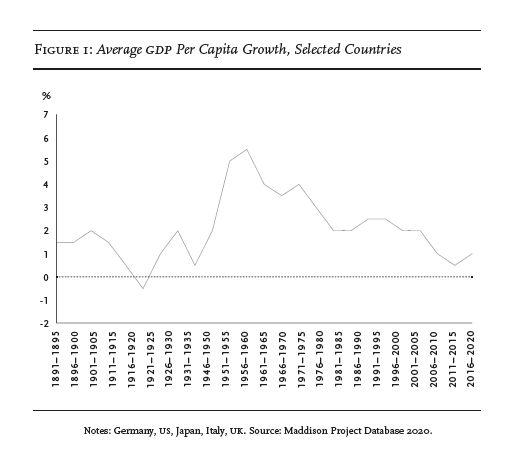
First things first: Riley & Brenner reopen their long-running argument about capitalist stagnation. For fifty years, the long downturn has defined the landscape: weak growth, thin profits, exhausted dynamism. They revisit theories of secular stagnation🔽
08.11.2025 00:10 — 👍 0 🔁 0 💬 1 📌 0
📌In their new article, DylanRiley and Robert Brenner revisit the arguments first outlined in Seven Theses (2022) and extend them into a comprehensive explanation of capitalism’s long downturn. Here’s a breakdown🔽
newleftreview.org/issues/ii155...

🚨New Article Alert🚨
The Long Downturn and Its Political Results
By Dylan Riley and Robert Brenner
newleftreview.org/issues/ii155...

Image of four copies of the book Danish Marxism: Past, Present, Future.
BREAKING NEWS 📕🚨
We are happy and proud to announce the publication of an edited anthology titled Danish Marxism: Past, Present, Future (Problema, 2025).
The book celebrates 10 years of organising by bringing 6 reflective pieces together with CfPs and abstracts from all our conferences.


New conference program just dropped!
Go check it out!
marxistiskestudier.com/wp-content/u...
📣My article “Urban Citizenship During a Protracted Crisis: Syrian Refugees’ Access to Rights and Services in Izmir, Turkey” is published in the Special Issue “Migration Crises with Adjectives” in the Journal of Immigrant & Refugee Studies. Open access link: www.tandfonline.com/doi/epdf/10....
09.08.2025 12:02 — 👍 3 🔁 1 💬 1 📌 0
🌍 In our new @textumdergi.bsky.social mini series, we discussed Climate Change as Class War with Matt Huber.
📝We talked about the power of fossil capital, the limits of green capitalism, and the possibilities for class struggle.
textumdergi.net/climate-chan...
When imperial land grants (gult) broke down during Oromo migrations, Ethiopia’s social order unraveled. Hatäta emerges here—as a philosophical response to lost sovereignty, religious conflict, and the need to ground ethics beyond feudal and clerical power.
11.06.2025 03:37 — 👍 1 🔁 0 💬 0 📌 0