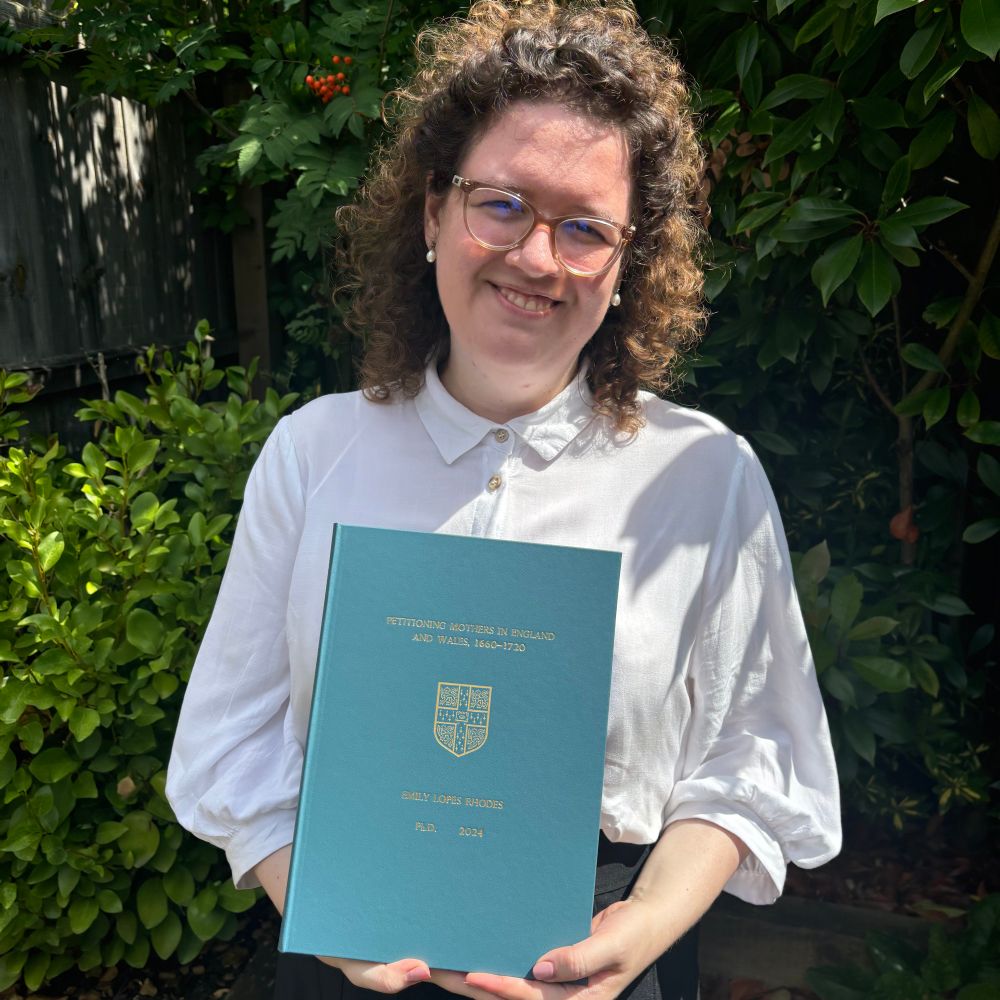

Love finding a petition in the wild at the Oxford Castle and Prison
27.07.2025 12:04 — 👍 7 🔁 0 💬 0 📌 0
Love finding a petition in the wild at the Oxford Castle and Prison
27.07.2025 12:04 — 👍 7 🔁 0 💬 0 📌 0
And overall, it has been a very eventful month!
25.07.2025 13:53 — 👍 17 🔁 0 💬 0 📌 0

First thing I did was come to change my name here…
Officially Dr Rhodes!
The social historians of the 70s were a grimly cynical bunch
29.06.2025 17:45 — 👍 18 🔁 1 💬 4 📌 0A Chicago Pope implies the existence of an MLA Pope and APA Pope
08.05.2025 17:36 — 👍 28793 🔁 8102 💬 38 📌 761
Exciting news! 🎉 The Women's History Network is now accepting submissions for the WHN Undergraduate Dissertation Prize 2024-2025. 🏆
Learn more about the submission guidelines and apply here: womenshistorynetwork.org/whn-undergra...
#WomensHistory #UndergraduateResearch #History #ResearchPrize

More excellent sneaking in of the #EarlyModern: @brodiewaddell.bsky.social mentioning @erhodes.bsky.social’s brilliant article on paid childcare and asking what the change over time is: more of degree than of kind? #QMCBS
01.05.2025 16:08 — 👍 7 🔁 1 💬 2 📌 0Thanks for the shout out!
01.05.2025 16:13 — 👍 1 🔁 0 💬 0 📌 0I can do this for you: what is your email?
01.05.2025 08:42 — 👍 1 🔁 0 💬 1 📌 0Love this! I collect these!
30.04.2025 08:02 — 👍 1 🔁 0 💬 0 📌 0
Totally! I love that.
I also don't like having to emphasise the parents' relationship to the child when I am writing about their relationship with each other (when talking about child support disputes). We need an academically appropriate term!
'The father of her illegitimate child' is just so wordy!
29.04.2025 18:16 — 👍 1 🔁 0 💬 1 📌 0Life would be much easier were it academically acceptable to use the phrase 'baby daddy' when writing about unmarried parents.
29.04.2025 15:42 — 👍 9 🔁 0 💬 2 📌 0
Screenshot of article: Rhodes, Emily. ‘Women as child carers: Arranging and compensating mothering in early modern Lancashire’, History of the Family, 30:1 (2005), pp. 108-124. Abstract: This article uses a database of fifty petitions submitted to the Lancashire Quarter Session Courts between 1660 and 1720 to locate mothers who cared for non-kin children in early modern England. While boarding children with non-kin was a practice not unknown to historians, the identities and experiences of the women who provided the childcare have hitherto been largely absent from previous scholarships. These petitions were brought by women who were not receiving the appropriate or arranged financial compensation for their caring responsibilities. Through their descriptions of disorder in their arrangements, we can uncover not only the attributes of the carers and their lived experiences but also more broadly what early modern English society expected from them. In addition, these petitions allow for a deeper understanding of how the practice of boarding children operated within and without the confines of the poor laws. Given the importance of child-rearing and the belief that it was a female task, this mothering gave common women authority that would otherwise be less accessible to them. This article thus argues that women understood the wider significance of this labour and used the influence it offered them to their advantage in their petitions. More broadly, then, this article provides a re-examination of the relationship between women, the poor law and authority in early modern England.
How did women carrying for non-kin children seek recompense for their 'mothering' labour in #EarlyModern England?
New #OpenAccess addition to the #PowerOfPetitioning annotated bibliography from @erhodes.bsky.social:
petitioning.history.ac.uk/2019/05/13/p...
Thanks so much for posting this, Brodie! Just to point out it says published in 2005 on the annotated bibliography. I wish I had been in the field for that long!
24.04.2025 15:32 — 👍 0 🔁 0 💬 1 📌 0![Screenshot of the title and abstract for: 'A cordwainer’s wife in high politics: a microhistory of Mrs Caute'
Abstract: This article introduces a hitherto unstudied pair of seventeenth-century texts, by the cordwainer’s wife Sarah Caute, which exercised political influence at the highest levels. Caute relates how in 1683–4, whilst in London, she experienced a sudden desire for herself and her six-year-old son Mathew to be baptised by Thomas Ken (1637–1711), who was then the prebend of Winchester (he would soon, in January 1685, be consecrated Bishop of Bath and Wells). Since he was a year old, Caute narrates, Mathew did not speak or walk and suffered ‘violent fitt[s]’ which ‘took him of his leges and his teeth fell out of his head at the roots…till they were all out’. Caute’s story reached the ears of Charles II and James II; thereby, she participated personally and in absentia in elite negotiations of confessional identity. Caute’s texts challenge the notion that non-elite women’s writing is scarce and of limited political interest.](https://cdn.bsky.app/img/feed_thumbnail/plain/did:plc:44em43qq5kem43otrh3vejy5/bafkreiaaohhvegu3drvayykz5zhcwjwuckc54vtc5c6ozid7zh5kfrozsm@jpeg)
Screenshot of the title and abstract for: 'A cordwainer’s wife in high politics: a microhistory of Mrs Caute' Abstract: This article introduces a hitherto unstudied pair of seventeenth-century texts, by the cordwainer’s wife Sarah Caute, which exercised political influence at the highest levels. Caute relates how in 1683–4, whilst in London, she experienced a sudden desire for herself and her six-year-old son Mathew to be baptised by Thomas Ken (1637–1711), who was then the prebend of Winchester (he would soon, in January 1685, be consecrated Bishop of Bath and Wells). Since he was a year old, Caute narrates, Mathew did not speak or walk and suffered ‘violent fitt[s]’ which ‘took him of his leges and his teeth fell out of his head at the roots…till they were all out’. Caute’s story reached the ears of Charles II and James II; thereby, she participated personally and in absentia in elite negotiations of confessional identity. Caute’s texts challenge the notion that non-elite women’s writing is scarce and of limited political interest.
How did the narrative of a cordwainer's wife about her disabled son, 'which she wrote her own self', fit into the religious politics of #EarlyModern England?
*NEW* #OpenAccess article by Laura Seymour, the first publication from #WrittenWorlds our project! 🗃️
Read it here: doi.org/10.1080/0268...

This weekend I had the pleasure of seeing A Tryal of Witches at the Theatre Royal Bury St Edmunds. What a great performance that really understood how witchcraft allegations could spread and grow
17.03.2025 10:03 — 👍 2 🔁 0 💬 0 📌 0
📢 My article on parents' letters to/about ill children is out in an exciting special issue, 'Mothers and Fathers in Medieval and Early Modern Europe', ed. @erhodes.bsky.social & Alice Whitehead. It's full of fantastic contributions to the history of parenting! 👇
www.tandfonline.com/toc/rhof20/3...
Alice and I had a great time putting this together and continue to be excited by the future possibilities of research in this field. We cannot thank @timriswick.bsky.social and the History of the Family journal enough for their help, guidance, and patience along the way!
29.01.2025 16:18 — 👍 2 🔁 0 💬 1 📌 0
Finally, the special issue closes with a note from Elizabeth Foyster, who reflects on the future of studying the history of medieval and early modern parenting: doi.org/10.1080/1081...
29.01.2025 16:16 — 👍 0 🔁 0 💬 1 📌 0
My own article sheds light on the lived experience and emotions of women who 'fostered' children in 17th century England: doi.org/10.1080/1081...
29.01.2025 16:15 — 👍 0 🔁 0 💬 1 📌 0
Kristine Dyrmann 'examines the entwined dynamics of gender, material bodies, and court politics' in 18th century Denmark, through a study of the reproductive challenges of the crown prince and princess: doi.org/10.1080/1081...
29.01.2025 16:14 — 👍 0 🔁 0 💬 1 📌 0
Erin Jordan takes a new approach to the history of royal parenting, studying how Constance of France wielded maternal and political authority: doi.org/10.1080/1081...
29.01.2025 16:11 — 👍 1 🔁 0 💬 1 📌 0Thanks for all your support, Tim!
29.01.2025 16:09 — 👍 1 🔁 0 💬 0 📌 0@ferichardsuk.bsky.social explores parenting through material culture, using coral to understand parental anxiety: doi.org/10.1080/1081...
29.01.2025 16:08 — 👍 2 🔁 0 💬 1 📌 0
We have a great batch of articles which put parents and parenting front and centre in histories of the family. First up is @earlymodernemma.bsky.social's study of parenting sick children and epistolary relationships: doi.org/10.1080/1081...
29.01.2025 16:06 — 👍 1 🔁 0 💬 1 📌 0
Nearly three years ago, Alice Whitehead and I hosted a conference on the history of parents. As baby PhD students at the time, we were honoured to be asked by @timriswick.bsky.social to edit a special issue of The History of the Family on the conference theme. The finished product is available now:
29.01.2025 16:00 — 👍 41 🔁 13 💬 1 📌 1Thanks for being such a great examiner, Brodie! I was lucky to have you!
27.01.2025 15:16 — 👍 2 🔁 0 💬 0 📌 0

As it is official today, I am really pleased to say that I passed my viva in December! Thanks to my excellent examiners, @brodiewaddell.bsky.social and Samantha Williams, I had a thoughtful and stress-free examination. Endless thanks will always be due to my supervisor, Elizabeth Foyster.
27.01.2025 12:48 — 👍 52 🔁 0 💬 7 📌 1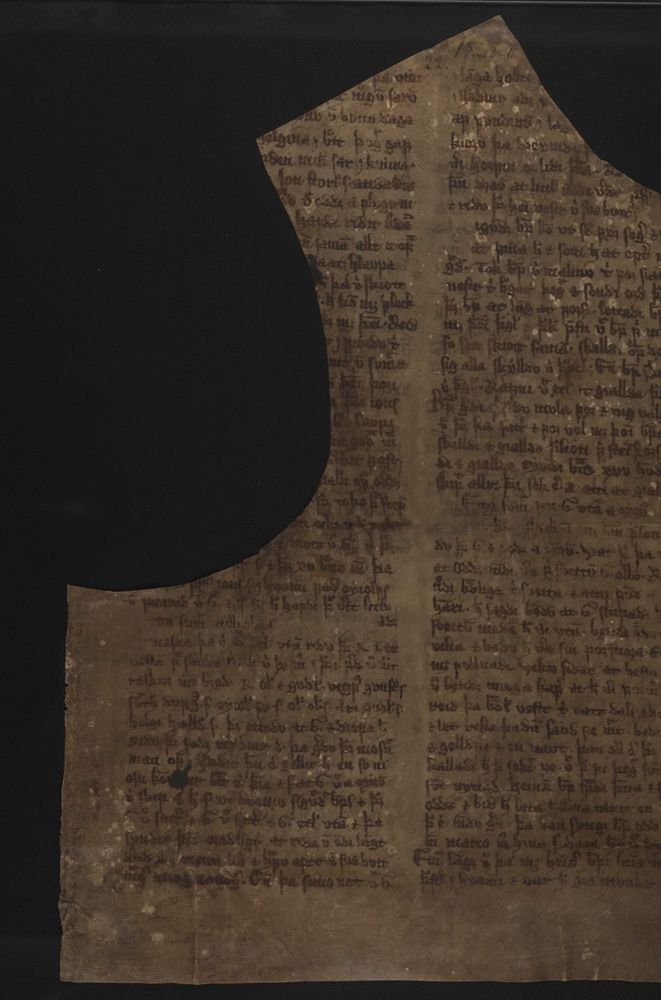
Sewing pattern for part of a shirt. It is clearly made from a dark brown manuscript page with small lettering written in two columns.
This is a sewing pattern. It is also a page from a late 14th century manuscript that is one of two primary sources for an important Icelandic saga (Sturlunga saga), but that was probably not important to the 17th century person who really needed a sewing pattern.
#upcycling