Figures of a man and woman stand over a dead nun. Lines run all through the piece. It almost looks like the nun is being carried away by a wave of lines and the two figures are standing in the lines. The figures hair is also made of many thick lines with flowers growing out of the hair.
Toorop, Jan. Dode non door man en vrouw beweend (Dead Nun Mourned by a Man and Woman). 1893, Ink and watercolour on paper, Kröller-Müller Museum, Otterlo, Netherlands.
#ink #death #watercolor #painting #drawing
11.02.2026 15:34 —
👍 3
🔁 0
💬 0
📌 0

Chalk and paint on paper of a bride coming through an archway. It is dark through the archway but the bride is illuminated in white. The archway is white while a skeleton drawn in black (representing death according to the title) stands to the left. On the right a priest drawn in black and green holds up a cup.
Toorop, Jan. De Bruid, de Priester en de Dood (The Bride, the Priest and Death). 1914, chalk and paint on paper, Kröller-Müller Museum, Otterlo, Netherlands.
#death #chalk #painting #drawing
10.02.2026 15:34 —
👍 9
🔁 1
💬 0
📌 0

Oil painting of death dancing at a ball wearing a ornate white and blue outfit with red symbols or decorations. A hazy figure can barely be seen in the upper left.
Rops, Félicien. De dood op het bal (Death at the Ball). c. 1865-1875, oil on canvas, Kröller-Müller Museum, Otterlo, Netherlands.
#death #dancing #oil #painting #dark #art
09.02.2026 15:34 —
👍 4
🔁 0
💬 0
📌 0

The title of this painting is taken from the final book of the Bible, the Revelation of Saint John the Divine, which has often been interpreted as a symbolic description of warfare: “And I looked, and behold a pale horse: and his name that sat on him was Death, and Hell followed with him. And Power was given unto them over the fourth part of the earth to kill with the sword, and with hunger, and with death, and with the beasts of the earth” (Rev. 6:8).
In this horrifying chronicle of the destruction of humankind, the rugged irregular forms, the dramatic contrasts of light and dark, and the dynamism of the turbulent movement combine with the distorted faces and pitiful gestures of the dead and dying to convey a sense of terror. The violent furor exhibits a destructive dynamism that makes this one of the most awesome depictions of the methods by which a world may be annihilated.
In 1796, the year this work was painted, England was at war with revolutionary France, and West’s picture may have been intended to comment on what was happening, or was expected to happen, in the contemporary world.
West, Benjamin. Death on the Pale Horse. 1796, oil on canvas, Detroit Institute of Arts, Founders Society Purchase, Robert H. Tannahill Foundation Fund, Detroit, Michigan.
#canvas #death #england #horse #oil #painting #romanticism
08.02.2026 15:34 —
👍 4
🔁 0
💬 0
📌 0

Drawing of a Man's Skeleton. Brown ink over graphite on medium, slightly textured, beige laid paper. Loosely drawn with more detail around the upper skeleton. Writing fills the upper right corner.
Ward, James. Drawing of a Man's Skeleton. Undated, Brown ink over graphite on medium, slightly textured, beige laid paper, Yale Center for British Art, Paul Mellon Collection, New Haven, Connecticut.
#skeleton #ink #anatomy #drawing #medicine #science
07.02.2026 15:34 —
👍 3
🔁 0
💬 0
📌 0

The damned writhe in boiling cauldrons; representing hell. Woodcut. Simple, think lines. 7 cauldrons filled with people being poked by winged and horned demons.
The damned writhe in boiling cauldrons; representing hell. Woodcut, Wellcome Collection, London, England.
#fire #hell #demonology #monsters #woodcut #illustration
06.02.2026 15:34 —
👍 8
🔁 1
💬 0
📌 0

The arrival of a naked man in hell, escorted by a winged angel clad in white. The damned already there are receiving horrendous tortures at the hands of monsters. The rotunda in the right middle-ground is similar to Virgil's tomb at Piedigrotta, near Naples: Virgil is relevant to the subject of this picture also through his narrative of Aeneas' descent to the underworld in the Aeneid and through his role as Dante's guide to the Inferno in the Divine comedy. A similar furnace-like tumulus appears in a painting of Christ's descent into limbo by a follower of Bosch
Bosch, Hieronymus. An angel leading a soul into hell. Oil painting by a follower of Hieronymus Bosch. Oil painting, Wellcome Collection, London, England.
#oil #painting #hell #damned #torture
05.02.2026 15:34 —
👍 6
🔁 0
💬 0
📌 0

A crowned fairy king seated on a hedgehog drawn by a girl holding a giant daisy, accompanied by dancing fairies.
"The seat of fairies is not always enviable." Lettering is faint and indistinct
Doyle, Charles Altamont. A crowned fairy king seated on a hedgehog drawn by a girl holding a giant daisy, accompanied by dancing fairies. 1800-1899, watercolour, Wellcome Collection, London, England.
#watercolor #painting #fairies #hedgehog #fantasy #folklore
04.02.2026 15:34 —
👍 34
🔁 10
💬 1
📌 0

The artwork forms a circle with a faun blowing into its panpipes over a bush of some kind with creatures inside. The fauns hair goes up and frames the moon with an owl over it. Sounding the faun in a circle/oval are fairies.
Maclise, Daniel, engraving by Bacon, Frederick. A faun surrounded by fairies. 1840 , intaglio prints, Wellcome Collection, London, England.
#intaglio #faun #fairy #folklore #print #fairies
03.02.2026 15:34 —
👍 3
🔁 0
💬 1
📌 0

Death rides into the world. He is the fourth knight of the apocalypse. Hell follows him.
The scene is in black and white. Death holds a scythe riding a pale horse. Surrounded by clouds. Following death are many winged creatures.
Doré, Gustave. Death on the Pale Horse. 1865, found in a 20th century Swedish bible. Wikipedia.
#death #horse #demons #monsters
02.02.2026 15:34 —
👍 12
🔁 3
💬 1
📌 0

A giant gate of stone leading into darkness with two beings sitting to either side.
The character the title names "Sin" is crying on the left with the tail of a serpent and what appears to be a dragon underneath them.
Then the character of "Death" is sitting up with their head on their fist wearing a crown and holding a spear. Smoke or steam is on either side of the gate going into darkness.
Stothard, Thomas, engraving by Bartolozzi, Francesco. The entrance to hell guarded by Sin and Death. 1792, stipple engraving, on etching, Wellcome Collection, London, England.
#sin #death #hell #gate #engraving
01.02.2026 15:34 —
👍 13
🔁 5
💬 0
📌 0

Although possibly incomplete, the subject can be identified as Death, the last of the Four Horsemen of the Apocalypse who announce the Day of Judgement (Book of Revelation). The choice may have been in response to the death of Turner’s father in 1829, suggested by the unusual treatment which is both tender and menacing. Death appears, not as a triumphant, upright figure astride his horse, but as a phantom emerging from a turbulent mist: his skeletal form, arms outstretched, and draped submissively over the horse’s pale back. Such disturbing visions were considered to embody the very concept of the sublime.
William, Joseph Mallord. Death on a Pale Horse. c.1825-30, Oil paint on canvas , Nigel Llewellyn and Christine Riding (eds.), The Art of the Sublime, Tate Research Publication, January 2013, www.tate.org.uk/art/research...
#death #horse #oil #painting #apocalypse #phantom
31.01.2026 15:34 —
👍 25
🔁 4
💬 0
📌 1

A physician wearing a seventeenth century plague preventive costume. Black hat, brown mask over head and upper torso with a beak like extension and glass goggles, a red robe, brown gloves, black shoes.
A physician wearing a 17th century plague preventive. Watercolor painting, Wellcome Collection, London, England.
#watercolor #plague #mask #doctor
30.01.2026 15:34 —
👍 4
🔁 0
💬 1
📌 0

Drawing of a skeleton face down on the ground. Graphite and brown ink and brown and gray wash; verso: watercolor on medium, smooth, cream wove paper mounted on medium, slightly textured, beige laid paper.
Ward, James. A Human Skeleton. Undated, Graphite and brown ink and brown and gray wash, Yale Center for British Art, Paul Mellon Collection, New Haven, Connecticut.
#skeleton #graphite #ink #anatomy #drawing
29.01.2026 15:34 —
👍 4
🔁 0
💬 0
📌 0

Duivels op bokkenpoten sleuren of dragen naakte mannen en vrouwen richting de vuren van de hel. De prent heeft een Latijns onderschrift en maakt deel uit van een vierdelige serie over de vier uitersten. (Demons with goat legs drag or carry naked men and women towards the fires of hell. The print has a Latin caption and is part of a four-part series about the four last things.)
Sadeler, Johann/ Barendsz, Dirck. Hel als een van de vier uitersten (Hell as one of the four extremes ). 1560 - 1600, engraving, Rijksmuseum, Amsterdam, Netherlands.
#hell #demons #fire #engraving
28.01.2026 15:34 —
👍 2
🔁 0
💬 0
📌 0

Witches' Sabbath shows Satan, surrounded by a coven of young and aged witches in a moonlit barren landscape. The goat possesses large horns and is crowned by a wreath of oak leaves. On the right, an old crone can be seen holding an extremely starved looking, but apparently still living, infant in her hands, while a younger witch to her right does the same with a healthier looking child, implying they will follow the same fate. The Devil seems to be acting as a sort of priest at an initiation ceremony for the children, although popular superstition at the time believed the Devil often fed on children and human fetuses. The dead body of an infant can be seen discarded to the left, whereas the legs of another can be seen held down with force to the ground by a presumably younger witch in the center foreground. More witches, young and old, can be seen in the background, as well as three dead infants hanging from the neck on a stake to the left.
Typical of the imagery of witchcraft, many of the symbols used are inverted. The goat extends his left rather than right hoof toward the child, while the quarter moon faces out of the canvas at the top left corner. In the middle high-ground, a number of bats can be seen flying overhead, their flocking motion echoing the curve of the crescent moon.
Goya, Francisco. El aquelarre (The Sabbath of witches). 1797-98, oil on canvas, Lázaro Galdiano Museum, Madrid, Spain.
#sabbat #sabbath #goya #oil #painting #satan #witchcraft
26.03.2025 14:34 —
👍 18
🔁 2
💬 0
📌 0
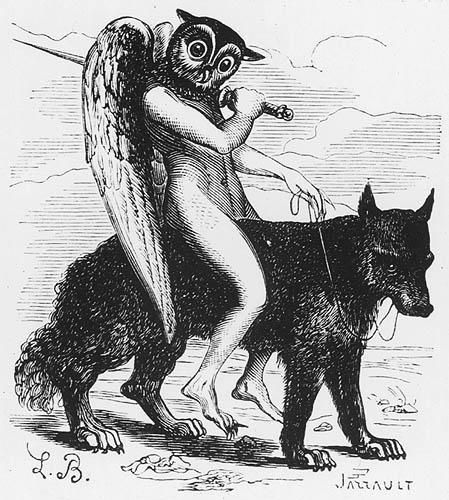
The demon Andras.

Depiction of the demon Paimon, or Paymon.

Ronove as depicted in the Dictionnaire Infernal

Marchosias appears as a fire-spitting chimeric wolf with the wings of a griffon and the tail of a serpent.
Le Breton, Louis. Images from The Dictionnaire Infernal (Infernal Dictionary) by Jacques Collin de Plancy. 1863, Wikipedia.
#demonology #hell #bookillustrations #publicdomain
25.03.2025 14:34 —
👍 5
🔁 1
💬 0
📌 0

Dance of Death, leaf from "The Nuremberg Chronicle"
Wolgemut, Michael. Dance of Death, leaf from "The Nuremberg Chronicle". 1493, Woodcut and letterpress text, The Met, New York, NY, Bequest of Herbert Mitchell, 2008
#death #skeleton #dancing #woodcut
24.03.2025 14:34 —
👍 15
🔁 1
💬 0
📌 1

Images from Surgical anatomy by Joseph Maclise

Images from Surgical anatomy by Joseph Maclise

Images from Surgical anatomy by Joseph Maclise

Images from Surgical anatomy by Joseph Maclise
Images from Surgical anatomy by Joseph Maclise. Project Gutenberg.
#anatomy #medicalhistory #publicdomain #book
23.03.2025 14:34 —
👍 8
🔁 3
💬 0
📌 0

The Ages and Death (Spanish: Las Edades y la Muerte) is an oil-on-canvas painting created between 1541 and 1544 by the German artist Hans Baldung which is in the collection of the Prado Museum, in Madrid. It is also referred to as "The Ages of Woman and Death".
The work is an allegorical painting alluding to the transience of beauty and the fragility of human life. Death with his hourglass and broken lance has already taken the arm of the old woman who is in turn holding on to the younger one. A baby lies sleeping on the ground. In the lower background is a depiction of Hell with above a crucified Christ in a shaft of heavenly light, representing the opposing visions of life after death. The owl at bottom left is a symbol of wisdom warning of the consequences of sin.
Grien, Hans Baldung. Die Lebensalter und der Tod (The Ages and Death). Between circa 1540 and circa 1543, oil on panel, Museo del Prado, Madrid, Spain.
#allegorical #painting #oil #life #death
22.03.2025 14:34 —
👍 4
🔁 0
💬 0
📌 0

Circus poster shows a woman sleeping in midair with devils below.
Warren, Johnson & Co. Devils and floating girl, circus stock poster. 1870, woodcut. Library of Congress, Washington DC.
#devils #circus #publicdomain #woman #woodcut
21.03.2025 21:34 —
👍 8
🔁 1
💬 0
📌 0

Whence heaping woe on woe he hurried off,
As one grief stung to madness. But I there
Still linger'd to behold the troop, and saw
Things, such as I may fear without more proof
To tell of, but that conscience makes me firm,
The boon companion, who her strong breast-plate
Buckles on him, that feels no guilt within
And bids him on and fear not. Without doubt
I saw, and yet it seems to pass before me,
A headless trunk, that even as the rest
Of the sad flock pac'd onward. By the hair
It bore the sever'd member, lantern-wise
Pendent in hand, which look'd at us and said,
"Woe's me!" The spirit lighted thus himself,
And two there were in one, and one in two.
How that may be he knows who ordereth so.
When at the bridge's foot direct he stood,
His arm aloft he rear'd, thrusting the head
Full in our view, that nearer we might hear
The words, which thus it utter'd: "Now behold
This grievous torment, thou, who breathing go'st
To spy the dead; behold if any else
Be terrible as this. And that on earth
Thou mayst bear tidings of me, know that I
Am Bertrand, he of Born, who gave King John
The counsel mischievous. Father and son
I set at mutual war. For Absalom
And David more did not Ahitophel,
Spurring them on maliciously to strife.
For parting those so closely knit, my brain
Parted, alas! I carry from its source,
That in this trunk inhabits. Thus the law
Of retribution fiercely works in me."

More than a hundred spirits, when that they heard,
Stood in the foss to mark me, through amazed,
Forgetful of their pangs. "Thou, who perchance
Shalt shortly view the sun, this warning thou
Bear to Dolcino: bid him, if he wish not
Here soon to follow me, that with good store
Of food he arm him, lest impris'ning snows
Yield him a victim to Novara's power,
No easy conquest else." With foot uprais'd
For stepping, spake Mohammed, on the ground
Then fix'd it to depart. Another shade,
Pierc'd in the throat, his nostrils mutilate
E'en from beneath the eyebrows, and one ear
Lopt off, who with the rest through wonder stood
Gazing, before the rest advanc'd, and bar'd
His wind-pipe, that without was all o'ersmear'd
With crimson stain. "O thou!" said 'he, "whom sin
Condemns not, and whom erst (unless too near
Resemblance do deceive me) I aloft
Have seen on Latian ground, call thou to mind
Piero of Medicina, if again
Returning, thou behold'st the pleasant land
That from Vercelli slopes to Mercabo;
"And there instruct the twain, whom Fano boasts
Her worthiest sons, Guido and Angelo,
That if 't is giv'n us here to scan aright
The future, they out of life's tenement
Shall be cast forth, and whelm'd under the waves
Near to Cattolica, through perfidy
Of a fell tyrant. 'Twixt the Cyprian isle
And Balearic, ne'er hath Neptune seen
An injury so foul, by pirates done
Or Argive crew of old. That one-ey'd traitor
(Whose realm there is a spirit here were fain
His eye had still lack'd sight of) them shall bring
To conf'rence with him, then so shape his end,
That they shall need not 'gainst Focara's wind
Offer up vow nor pray'r." I answering thus:
"Declare, as thou dost wish that I above
May carry tidings of thee, who is he,
In whom that sight doth wake such sad remembrance?"

Scarcely had his feet
Reach'd to the lowest of the bed beneath,
When over us the steep they reach'd; but fear
In him was none; for that high Providence,
Which plac'd them ministers of the fifth foss,
Power of departing thence took from them all.

Amid this dread exuberance of woe
Ran naked spirits wing'd with horrid fear,
Nor hope had they of crevice where to hide,
Or heliotrope to charm them out of view.
With serpents were their hands behind them bound,
Which through their reins infix'd the tail and head
Twisted in folds before. And lo! on one
Near to our side, darted an adder up,
And, where the neck is on the shoulders tied,
Transpierc'd him. Far more quickly than e'er pen
Wrote O or I, he kindled, burn'd, and chang'd
To ashes, all pour'd out upon the earth.
When there dissolv'd he lay, the dust again
Uproll'd spontaneous, and the self-same form
Instant resumed. So mighty sages tell,
The' Arabian Phoenix, when five hundred years
Have well nigh circled, dies, and springs forthwith
Renascent. Blade nor herb throughout his life
He tastes, but tears of frankincense alone
And odorous amomum: swaths of nard
And myrrh his funeral shroud. As one that falls,
He knows not how, by force demoniac dragg'd
To earth, or through obstruction fettering up
In chains invisible the powers of man,
Who, risen from his trance, gazeth around,
Bewilder'd with the monstrous agony
He hath endur'd, and wildly staring sighs;
So stood aghast the sinner when he rose.
Doré, Gustave. Images from The vision of Hell, purgatory, and paradise by Dante Alighieri. Project Gutenberg.
#dore #bookillustration #publicdomain #hell
21.03.2025 14:34 —
👍 4
🔁 0
💬 0
📌 0
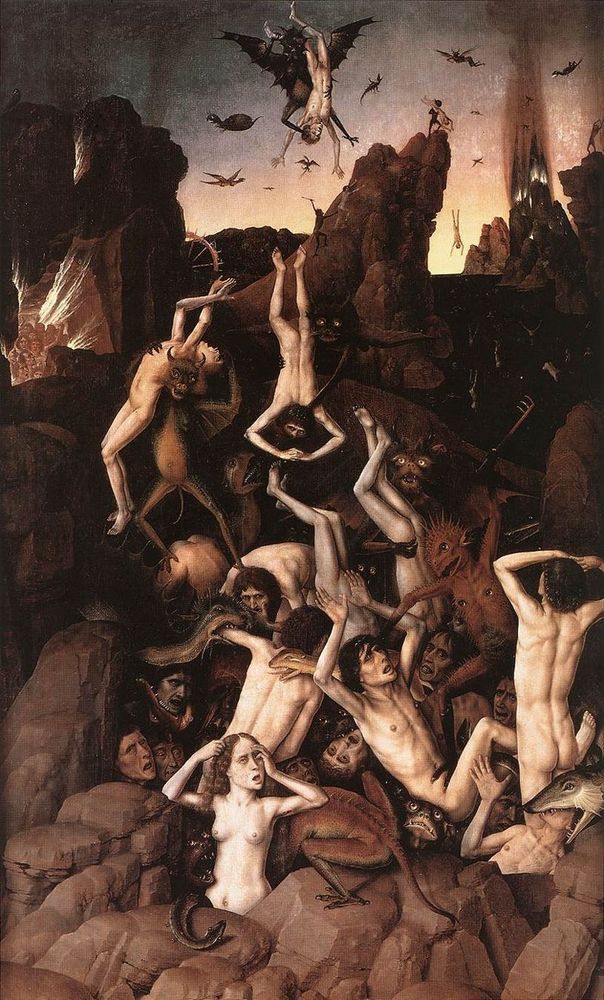
Panel from the Triptych of the Last Judgement. An oil on panel painting by the Early Netherlandish painter Dieric Bouts, completed in 1470. It was produced as the rightmost section of a triptych of a Last Judgment scene commissioned for the town hall of Louvain, Belgium, in 1468. The central panel of the triptych is lost, but the left side panel (or shutter), the Ascension of the Elect, survives along with the Fall of the Damned. The set of images would have drawn narrative inspiration from Genesis 2:10, the Book of Revelation and from the Purgatory of St Patrick, a 14th-century Irish manuscript by Berol telling of Sir Owein's legendary trip to Purgatory. The Fall has been on permanent loan from the Louvre to the Palais des Beaux-Arts de Lille, where it has been reunited with the Ascension since 1957.
Bouts, Dieric. De Val van de verdoemden (The Fall of the Damned). c. 1468, oil on panel, Palais des Beaux-Arts de Lille, Lille, France.
#oil #painting #triptych #hell
20.03.2025 14:34 —
👍 3
🔁 0
💬 0
📌 0

A treatise on Antichrist, the Last Judgement, Heaven and Hell, comprising the final part ('le desrain liure') of a longer text.

A treatise on Antichrist, the Last Judgement, Heaven and Hell, comprising the final part ('le desrain liure') of a longer text.

A treatise on Antichrist, the Last Judgement, Heaven and Hell, comprising the final part ('le desrain liure') of a longer text.

A treatise on Antichrist, the Last Judgement, Heaven and Hell, comprising the final part ('le desrain liure') of a longer text.
Livre de la Vigne nostre Seigneur (End of Time in the Middle Ages: The Vineyard of Our Saviour). c. 1450–1470, parchment, Oxford, Bodleian Library MS. Douce 134
#hell #manuscript #illustrated #french #antichrist
19.03.2025 14:34 —
👍 3
🔁 1
💬 0
📌 0

Astrological & lunar chart / Sorciére; Astrological & lunar chart / Sorciere. Calendrier Magique.
Orazi, Manuel. Astrological & lunar chart / Sorciére; Astrological & lunar chart / Sorciere. 1895, chromolithography, Division of Rare and Manuscript Collections, Cornell University Library, Ithaca, NY.
#lithograph #witchcraft #magic #occultism #publicdomain #skull #bat #owl
17.03.2025 14:34 —
👍 3
🔁 1
💬 0
📌 0

Dreamlike scene with a snake/monster and cowering people.
Bracquemond, Félix. Untitled (The Dream of the Mogul?). 1886, etching on vellum, National Gallery of Art, Washington D.C.
#dream #monsters #snakes #figures #creatures
16.03.2025 14:34 —
👍 6
🔁 1
💬 0
📌 0

Le haut d'un battant de porte (Birds Nailed to a Barn Door)
Bracquemond, Félix. Le haut d'un battant de porte (Birds Nailed to a Barn Door). 1852, etching on laid paper, National Gallery of Art, Washington D.C.
#birds #etching #publicdomain
15.03.2025 14:34 —
👍 7
🔁 0
💬 0
📌 0

A land storm. Painted by G. Moreland ; Engraved by J.R. Smith, mezzotinto engraver to His Royal Highness the Prince of Wales
Painted by Moreland, G.; Engraved by Smith, J.R. A storm in a wild and rocky landscape: lightning flashes while a man drives a a coach and four hourses through the darkness. 1798, mezzotint, Wellcome Collection, London, England.
#storm #lightning #darkness #horses #gloomy
14.03.2025 14:34 —
👍 5
🔁 0
💬 0
📌 0

A magician in his gothic study conjuring demons: a naked woman appearing from a mirror. Compendium maleficarum de demonialitate, De viperis. De venenis. Félicien Rops Lettering "Compendium maleficarum de demonialitate. De viperis. De venenis" is the title of the large folio volume held by the magician
Rops, Félicien. A magician in his gothic study conjuring demons: a naked woman appearing from a mirror. 1800-1899, soft-ground etchings, Wellcome Collection, London, England.
#etching #gothic #magic #demon #conjuration #woman
13.03.2025 14:34 —
👍 5
🔁 0
💬 0
📌 0

In German and Latin. On white, brown and grey-green paper. The title within an ornamental border in wash, with skulls, skeletons and cross-bones. Illustrated with 31 extraordinary water-colour drawings of demons, and three pages of magical and cabbalistic signs and sigils, etc. At the end the figures are in red, and part of the text is written in white on the grey-green paper.

In German and Latin. On white, brown and grey-green paper. The title within an ornamental border in wash, with skulls, skeletons and cross-bones. Illustrated with 31 extraordinary water-colour drawings of demons, and three pages of magical and cabbalistic signs and sigils, etc. At the end the figures are in red, and part of the text is written in white on the grey-green paper.

In German and Latin. On white, brown and grey-green paper. The title within an ornamental border in wash, with skulls, skeletons and cross-bones. Illustrated with 31 extraordinary water-colour drawings of demons, and three pages of magical and cabbalistic signs and sigils, etc. At the end the figures are in red, and part of the text is written in white on the grey-green paper.

In German and Latin. On white, brown and grey-green paper. The title within an ornamental border in wash, with skulls, skeletons and cross-bones. Illustrated with 31 extraordinary water-colour drawings of demons, and three pages of magical and cabbalistic signs and sigils, etc. At the end the figures are in red, and part of the text is written in white on the grey-green paper.
Compendium rarissimum totius Artis Magicae sistematisatae per celeberrimos Artis hujus Magistros. Anno 1057. Noli me tangere (A very rare compendium of the entire Art of Magic...) c.1775, book, Wellcome Collection, London, England.
#demonology #magic #occult #publicdomain
12.03.2025 14:34 —
👍 8
🔁 0
💬 0
📌 0