This work is a close collaboration with colleagues previously at Microsoft Research (@msftresearch.bsky.social) and currently at Ubiquant and various other places. Huge thanks to them for the ideas and computational resources.
03.12.2025 18:14 — 👍 0 🔁 0 💬 0 📌 0

Our @neuripsconf.bsky.social work led by YunyangLI “E2Former: An Efficient and Equivariant Transformer with Linear-Scaling Tensor Products” was selected as a spotlight (with score ranked ~17 / 21k submissions).
Poster: Thur Dec 4, Exhibit Hall CDE #5512
Online: openreview.net/forum?id=ls5...
03.12.2025 18:11 — 👍 1 🔁 1 💬 1 📌 0
PNAS
Proceedings of the National Academy of Sciences (PNAS), a peer reviewed journal of the National Academy of Sciences (NAS) - an authoritative source of high-impact, original research that broadly spans...
Our new PNAS study bridges histology and genomics. Using deep learning and imageQTL analysis, we show how tissue images reflect gene expression and aging — making histology more interpretable with AI. By RanMeng, W. Zhu, C. Cameron, P. Ni, X. Zhou, T. Ulammandakh, and @markgerstein.bsky.social
20.11.2025 20:07 — 👍 4 🔁 1 💬 0 📌 0
📚 Yale students have returned to campus, so time for a roster meeting!
We again made our Nobel Prize predictions (given how accurate we were last year 😉)
🥇Our top prediction is Habener & Knudsen (GLP-1) with 28.5% of the vote!
🥈 In second is Rothberg & David Klenerman (NGS)
22.09.2025 19:01 — 👍 1 🔁 1 💬 1 📌 0
New @natcomms.nature.com paper led by @beaborsari.bsky.social & Mor Frank. Also thanks to co-authors Eve Wattenberg, @xuke0828.bsky.social , Susanna Liu, Xuezhu Yu & @markgerstein.bsky.social
25.08.2025 15:38 — 👍 0 🔁 1 💬 0 📌 0
3/3 The test yielded a p-value of 4.91 × 10⁻⁸, which is far below the conventional significance threshold of 0.05. This indicates a statistically significant deviation in personality type distribution within the lab.
14.07.2025 23:44 — 👍 0 🔁 0 💬 1 📌 0
2/3 In contrast, within the Gerstein Lab, there are 26 Analysts, 20 Diplomats, 6 Sentinels, and 4 Explorers. A chi-square goodness-of-fit test was conducted to evaluate whether the MBTI distribution in the lab significantly differs from that of the general population.
14.07.2025 23:44 — 👍 0 🔁 0 💬 1 📌 0
1/3 Based on a survey of 22,678,145 individuals in the United States, the distribution of MBTI personality types in the general population is as follows: Analysts account for 16.72%, Diplomats for 44.43%, Sentinels for 23.91%, and Explorers for 14.93%
14.07.2025 23:43 — 👍 0 🔁 0 💬 1 📌 0
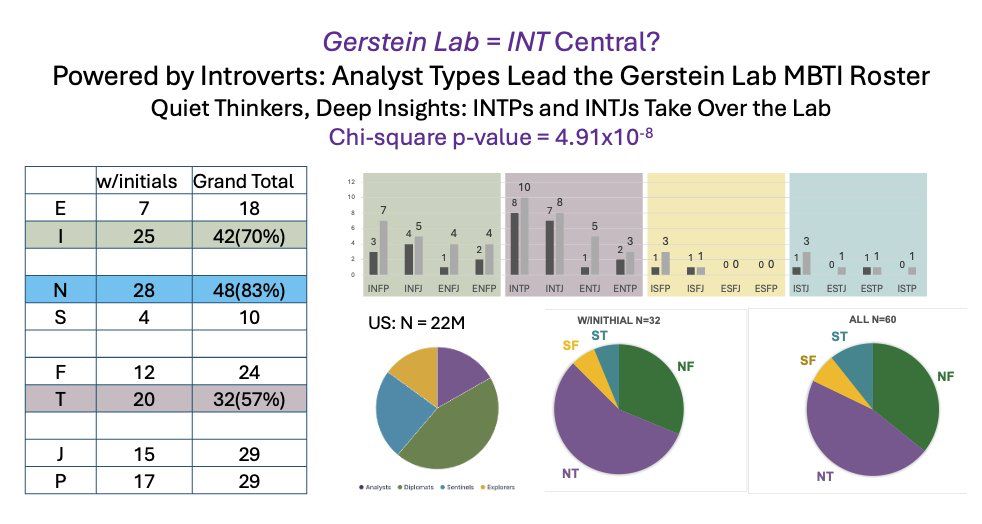
🧠 At our recent Gerstein Lab roster meeting, we took a detour into… personality science!
Turns out we’re INT Central 🧪
📌 70% Introverts
📌 83% Intuitives
📌 57% Thinkers
Analysts (INTP, INTJ) dominate, far more than the U.S. baseline.
#MBTI #INTP #INTJ
14.07.2025 23:43 — 👍 1 🔁 1 💬 1 📌 0
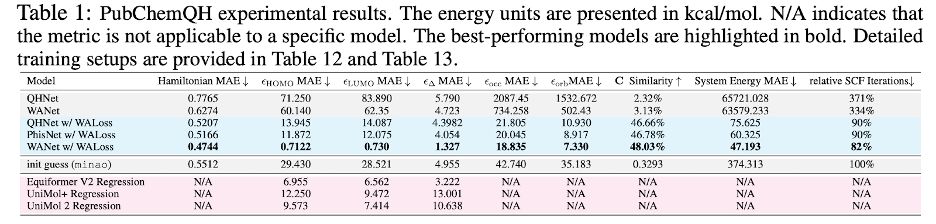
4/4 ⚡ WANet + WALoss ⇒ 18 % faster SCF convergence & 1 000 × energy-error reduction vs. SOTA. One model, many properties—HOMO/LUMO, dipoles, electron densities—all from a single predicted Hamiltonian.
05.05.2025 17:17 — 👍 2 🔁 0 💬 1 📌 0
3/4 🗂️ First release of PubChemQH—50 k large-molecule Hamiltonians (40–100 atoms) for robust benchmarking, generated by 128 GPUs for one month of processing, which motivates a scaling challenge which we refer to as SAD.
05.05.2025 17:17 — 👍 0 🔁 0 💬 1 📌 0
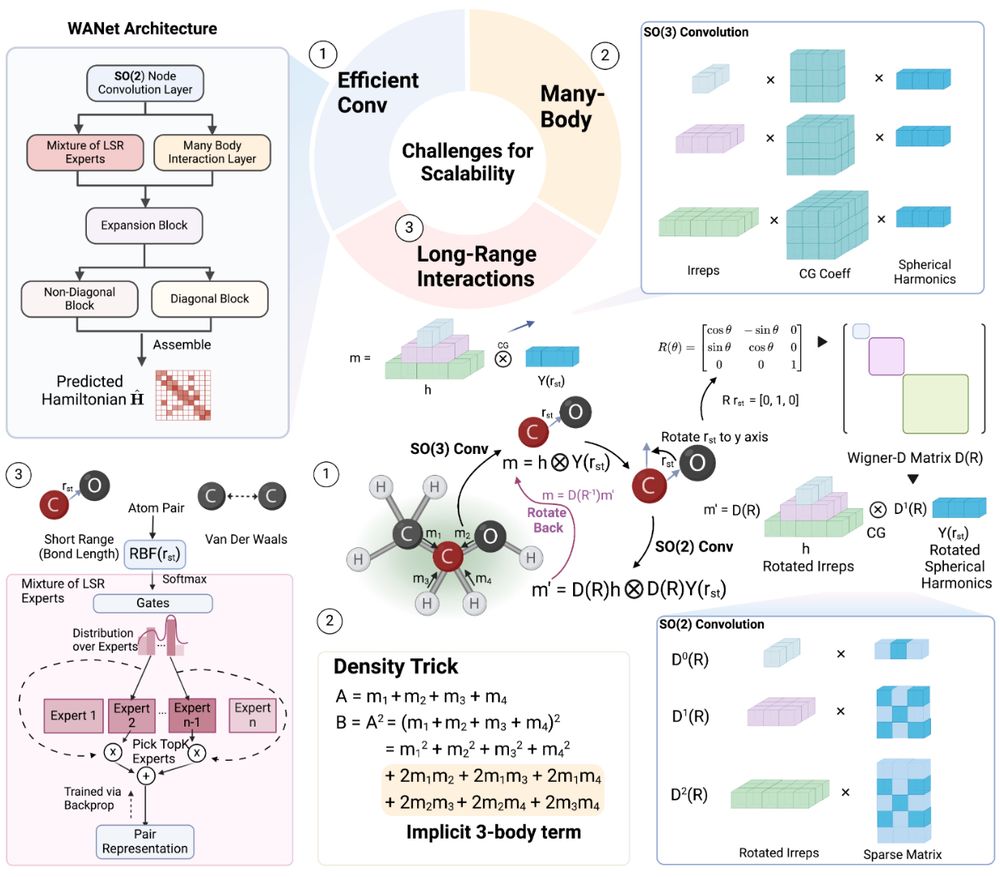
2/4 🧩 We introduce Wavefunction-Alignment Loss + WANet, slashing SCF iterations while keeping ab-initio precision for molecules 3× larger than training data.
05.05.2025 17:17 — 👍 0 🔁 0 💬 1 📌 0
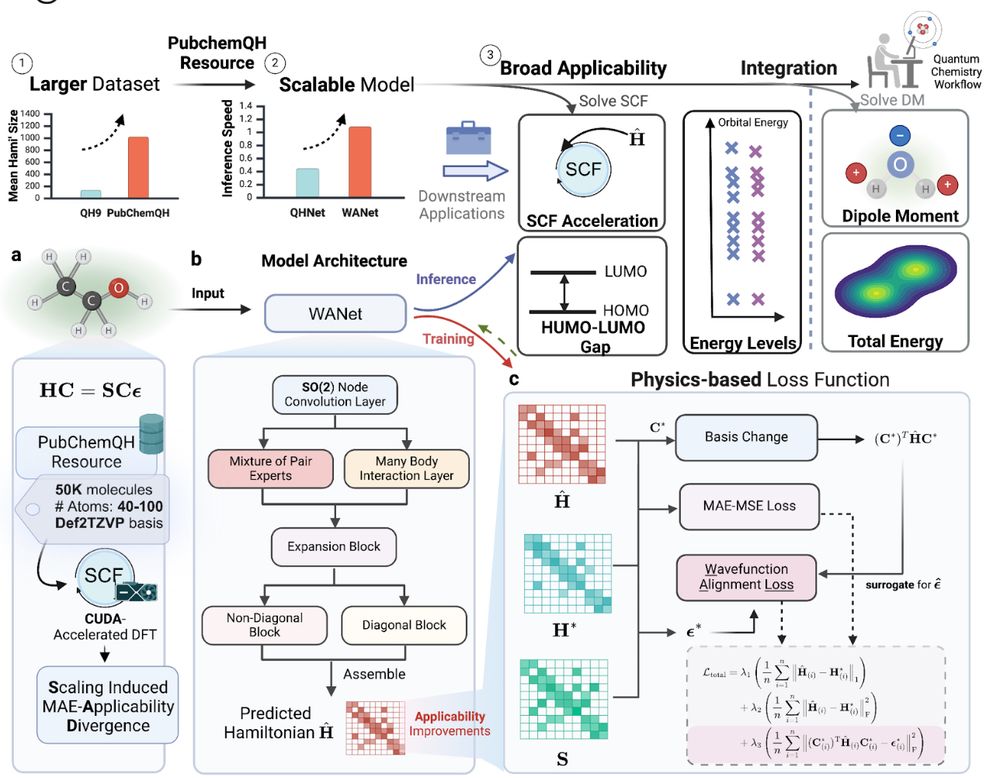
1/4 🚀 New #ICLR2025 SPOTLIGHT ALERT
Gerstein Lab presents “Enhancing the Scalability & Applicability of Kohn-Sham Hamiltonians”—led by YunyangLI & Z Xia & L Huang & J Zhang & @markgerstein.bsky.social . Joint work with @msftresearch.bsky.social .
05.05.2025 17:16 — 👍 2 🔁 1 💬 1 📌 0
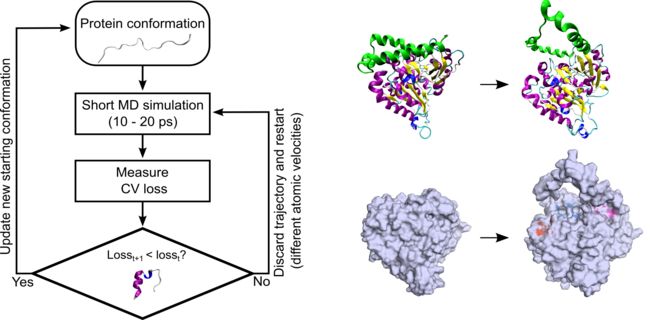
New @biophysj.bsky.social paper by Alan Ianeselli, Joe Howard and @markgerstein.bsky.social . A Molecular Dynamics algorithm to rapidly compute protein folding pathways and identify folding intermediates for targeted drug discovery! doi.org/10.1016/j.bp...
20.04.2025 15:04 — 👍 4 🔁 1 💬 0 📌 0
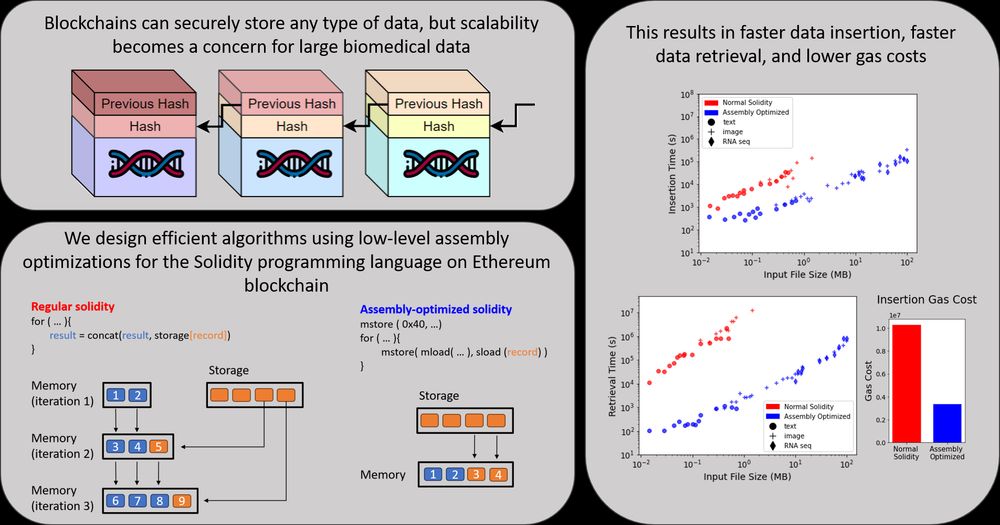
Our new paper describes the iDASH-winning method for efficient blockchain storage of biomedical data. We cut gas costs by 60% and sped up retrieval 500x with low-level Solidity optimization.
By Eric Ni, Elizabeth Knight, @markgerstein.bsky.social
doi.org/10.1016/j.jb...
18.04.2025 14:59 — 👍 3 🔁 1 💬 0 📌 0
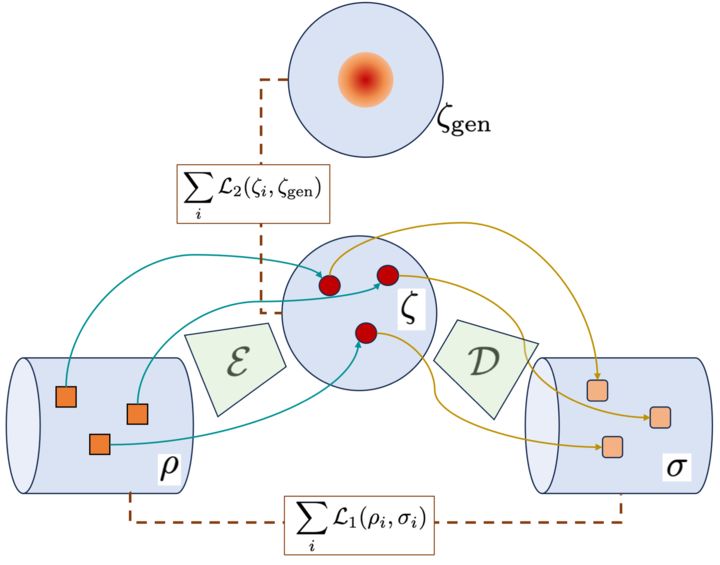
New paper by Gaoyuan Wang, Jonathan Warrell, Prashant Emani and @markgerstein.bsky.social ! Check out our new model QVAE, a fully quantum variational autoencoder with latent regularization: journals.aps.org/pra/abstract...
16.04.2025 01:35 — 👍 2 🔁 1 💬 0 📌 0

Jobs
Post-doctoral Position in Biomedical Data Science at Yale Applicants are invited for a post-doctoral position at Yale University. The position is for 2 years with possible extensions. The choice of…
🚨We have an immediate postdoc opening for US nationals (citizens/green-card holders). Needs to be filled within 6 months. Lots of fun topics (e.g. biosensors, brain genomics, AI for bio, &c). If interested, see jobs.gersteinlab.org
21.01.2025 14:45 — 👍 2 🔁 0 💬 0 📌 0
Also thanks Y Li, S Liu, Y Gao, X Xin, S Lou, M Jensen, D Garrido, T Verplaetse, G Ash, J Zhang, M Girgenti, W Roberts, YaleCBB, YaleMBB, YaleBIDS, YalePsych, YaleCSDept, YaleData, UCIrvine, UniBarcelona, NIMHgov
19.12.2024 18:11 — 👍 2 🔁 0 💬 0 📌 0
YouTube video by Jason Liu
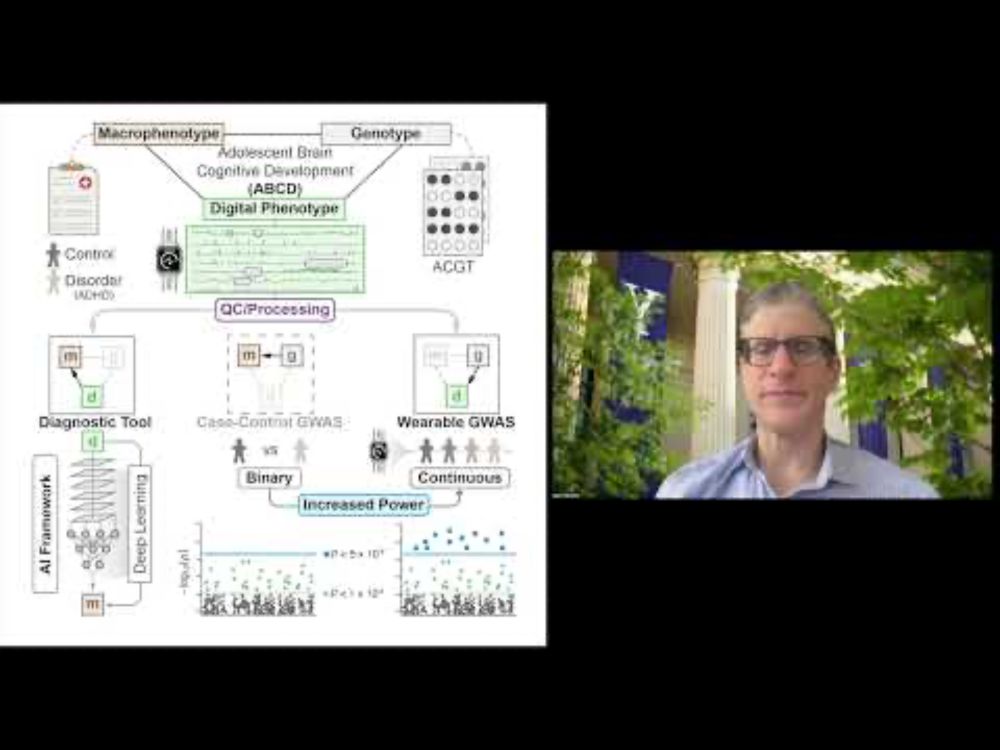
Digital phenotyping using AI for psychiatric disorders and genetics
We show wearable-derived digital phenotypes improve accuracy of predicting adolescents affected by psychiatric disorders using AI models for time series. This enables continuous GWAS to identify genetic variants missed by traditional case-control GWAS.
www.youtube.com/watch?v=3Gv-...
19.12.2024 18:10 — 👍 2 🔁 0 💬 1 📌 0
Redirecting
Excited to share our new paper in @cellcellpress.bsky.social on digital phenotyping from wearable biosensors to characterize psychiatric disorders and identify genetic associations, led by @jasonjliu.bsky.social and @beaborsari.bsky.social @markgerstein.bsky.social: doi.org/10.1016/j.ce...
19.12.2024 18:10 — 👍 3 🔁 1 💬 1 📌 0
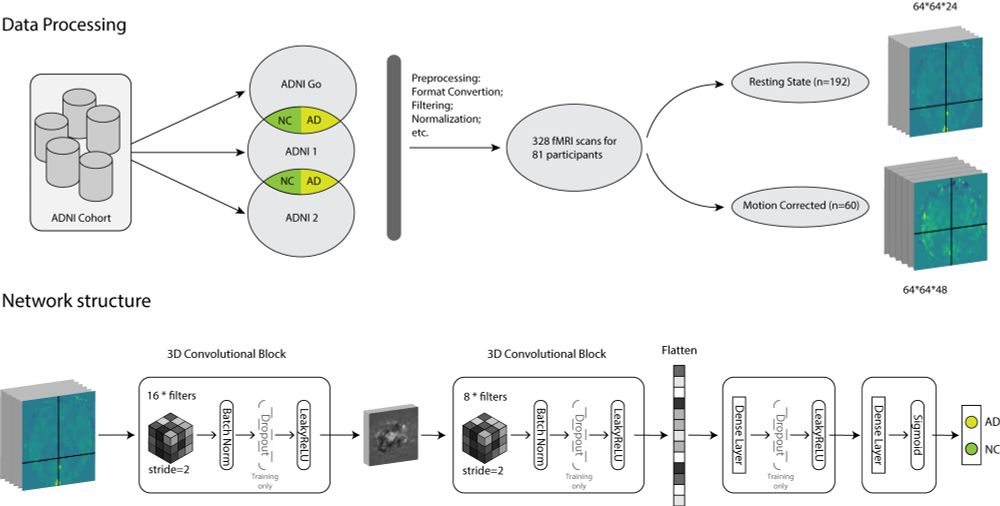
New @plosone.org paper by Xiao Zhou, Sanchita Kedia, Ran Meng, and @markgerstein.bsky.social. Our deep learning framework analyzes fMRI scans for early Alzheimer's Disease detection, achieving 92.8% accuracy with a focus on model interpretability: t.co/Ro5WzyJUyZ
16.12.2024 18:42 — 👍 2 🔁 0 💬 0 📌 0