

“I needed to respond to the West Africa display as the story of the diaspora was missing”'.
Looking forward to seeing Charmaine Watkiss's new works at the Royal Albert Memorial Museum soon.
www.theguardian.com/artanddesign...
“I needed to respond to the West Africa display as the story of the diaspora was missing”'.
Looking forward to seeing Charmaine Watkiss's new works at the Royal Albert Memorial Museum soon.
www.theguardian.com/artanddesign...
For anyone interested in our 18-month post in British Studies please follow the link below. @ihr.bsky.social
www.jobs.london.ac.uk/Job/JobDetai...

Please join us next Wed 11 Feb 2-3.30 in Oxford for ‘Imperial Circulations
Climate Knowledge, Port Labor, and Material Worlds’

New blog post for the fab @bemccollective.bsky.social summarising my recent @rhi-ihr.bsky.social article on labour, global commodities, and material skill in the Port of London’s ivory warehouse sites.manchester.ac.uk/bodies-emoti...
15.01.2026 11:25 — 👍 1 🔁 0 💬 0 📌 0
Dummy board of a woman peeling apples, c. 1690, of English make (Victoria & Albert Museum) Dummy boards were life-size images placed in stairwells or in front of fireplaces in summer time. They were designed to amuse and also to startle visitors.
14.01.2026 21:29 — 👍 12 🔁 3 💬 0 📌 0Looking to expand your historical knowledge in 2026? Why not see what @oxlifelonglearning.bsky.social has to offer. My disease in early modern England course is now full, but there are still a few spaces on my history of the Stuarts course. Details here: lifelong-learning.ox.ac.uk/tutors/13676
27.12.2025 17:38 — 👍 13 🔁 9 💬 0 📌 0The story of this collection awaits its historian and fullest telling. It really is an amazing insight into multiple forms of historical erasure, neglect, and theft.
11.12.2025 14:13 — 👍 7 🔁 5 💬 0 📌 0
So awesome! Terrific and vocal support for the humanities.
BUT this university is also near to slow-closing its languages programs and for real these schemes raise questions about economic feasibility arguments.

Between Thompson and the Global: Reflections on Labour History Today We invite papers for a workshop entitled “Between Thompson and the Global: Rethinking Labour History Today”, to be held at the University of Warwick on 26-27 June 2026. This workshop will seek to bring together historians of labour to collectively reflect on a large historiographical shift that has taken place over the last two decades, from the social history of labour (in national contexts) to global and trans-national labour history. The social history of labour “from below” is a tradition initiated by E.P Thompson’s The Making of the English Working Class (1963), and extended over several decades by a robust tradition of politically engaged left-wing historical studies of the working classes: a tradition most powerfully entrenched in British historiography (but with many imprints elsewhere, ranging from the United States to Brazil to South Africa to India). The global history of labour, which revised and questioned many of the features of “Thompsonian” history-writing, has sought to overcome “methodological nationalism” in the writing of labour history, to investigate specific labour histories within a global frame, and to enable trans-national histories of workers and work. It has emerged as an increasingly dominant frame of reference for contemporary studies of labour around the world. This workshop seeks to place these two historiographical traditions in conversation with each other, to examine the stakes of the passage from the older, “Thompsonian” tradition to the “global turn”, and to think about the changed meanings of “doing labour history” today. Participants are urged to explicitly reflect on the methodological and conceptual issues at stake in the practice of labour history.

We would like to invite submissions that address (but are not necessarily limited to) the following themes: 1. To what extent has the global labour history tradition that has flourished over the last 20 years drawn upon or rejected the methodological and conceptual approaches of Thompsonian social/labour history? What other methodologies and concepts have been deployed and proven fruitful? 2. How do we address the burgeoning critique of Thompsonian social/labour history as parochial and Anglocentric (Bressey, 2015; Satia, 2020), and how have historians responded to this challenge and reshaped British labour history accordingly? What can historians of British labour learn from broader global trajectories of workforce formation and labour movements? 3. How might integrating histories of consumption, environment, and reproduction enrich our understanding of labour and its global entanglements? 4. In what ways can collaboration between historians of Britain and the global south generate new analytical frameworks or unsettle established narratives of class, race, and empire? 5. What kinds of politically-engaged global social and labour history can best respond to the contemporary challenges of rising global inequality and the appropriation of class politics by some sections of the populist right? 6. The legitimacy of 'radical' forms of labour-history writing initially arose from politics, from the apparently established centrality of the industrial working class both in society and in projects of social emancipation. That centrality has now been in precipitous decline for a long time. In this context, how might we think about what the ‘politics of doing labour history’ actually implies today? 7. What has been gained and what has been lost in the shift from a labour history dominated by “history from below” to one dominated by global history? Please send abstracts to globalhistory@warwick.ac.uk
#CfP Call for Papers
Organised by Global History and Culture Centre, University of Warwick:
Between Thompson and the Global: Reflections on Labour History Today
Workshop: 26-27 June 2026, University of Warwick
Deadline for abstracts: 30 January 2026
Submit to globalhistory@warwick.ac.uk
How does a physical space become a site for global economic history? @alibennett.bsky.social unpacks the significance of African ivory in the Port of London 👇
06.12.2025 10:56 — 👍 3 🔁 1 💬 0 📌 0
Do you work at the intersection of universities, the arts 🎭 & culture? If so, we are very keen to hear from you! At @ncace.bsky.social we are organising our 2nd Festival of Cultural Exchange, taking place in April 2026.
If you want to get involved apply by 8 Dec.
files.ncace.ac.uk/NCACE%20Fest...

Medieval Visual Culture Seminar
'New directions in the study of ivories from the Islamic world: A talk and handling session'
Mariam Rosser-Owen (V&A) & Ashley Coutu (Pitt Rivers)
5pm Nov 20 🗓️
Khalili Research Center 🏢
(Co-sponsored by the Khalili Research Center)
www.hoa.ox.ac.uk/event/mediev...
A brilliant opportunity to work on a new exhibition on the Global Renaissance.
25.11.2025 17:47 — 👍 1 🔁 0 💬 0 📌 0The first volume of the Special Issue on Global Economic History @rhi-ihr.bsky.social is now out! It features 4 new articles on 4 commodities in global economic history - salt, ivory, raw cotton, and finished cotton goods - all open access. It was a great experience editing this volume!
19.11.2025 11:05 — 👍 7 🔁 5 💬 0 📌 0Very pleased to have published this new article entitled ‘Port labour, global commodities, and material skill development: A study of the ivory warehouse in the Port of London and its representation c. 1860-1968’ with @rhi-ihr.bsky.social. Huge thanks go to @alkaraman.bsky.social as special editor!
18.11.2025 11:45 — 👍 3 🔁 0 💬 1 📌 0
We are very pleased to be working with @ihr.bsky.social and @findmypast.bsky.social on this new Applied History Fellowship programme.
The launch event on Weds 19 November bit.ly/49vcgCS provides further details of the scheme and how to apply #Skystorians
On flags and ‘patriotism’ in Kent right now 😩 www.telegraph.co.uk/news/2025/10...
10.10.2025 11:05 — 👍 0 🔁 0 💬 0 📌 0
Fascinating article by Nuala Zahedieh about the centrality of canoes in early colonial exploitation 🗃️https://academic.oup.com/past/advance-article/doi/10.1093/pastj/gtaf021/8231030
13.08.2025 20:23 — 👍 70 🔁 32 💬 1 📌 2
Over 90% of the world's museum collections are locked away in storage. Not anymore.
UofG’s Museums in the Metaverse is bringing hidden treasures to life through 3D technology.
Sign up to be first to hear about the beta launch www.gla.ac.uk/mim
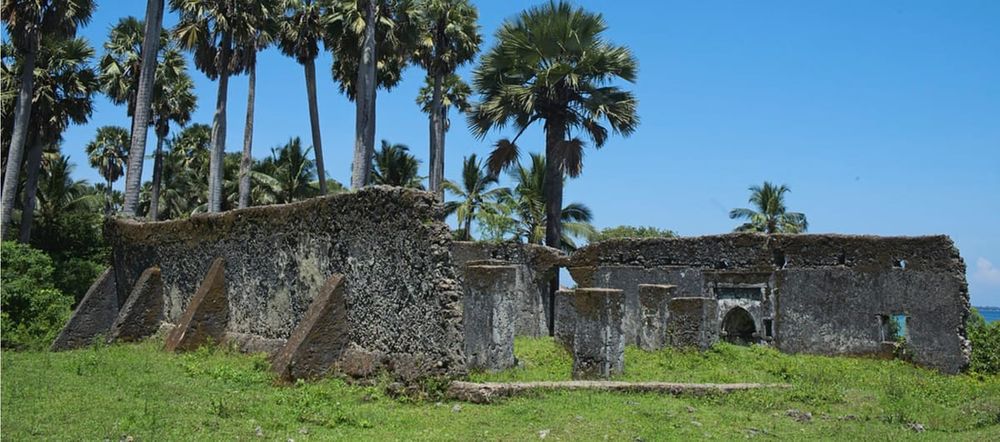
After my annual summer break, I'm back with a new series on teaching East Africa in world history. This first post is free and introduces some resources and themes we can use when teaching East Africa.
🗺️🗃️
www.liberatingnarratives.com/a-mixed-popu...

Screenshot of page proofs for an essay titled «So, Who Killed the Elephant?». Tracing African-European Entanglements in the ‘Global Middle Ages’, Verena Krebs, Ruhr-Universität Bochum
Two years later, it still feels surreal that I had the (quite literally) once-in-a-lifetime honour of giving a keynote at the International Medieval Congress in Leeds.
Turning that talk into an essay—whose proofs arrived today—is just the icing on the absurdity cake.


With it being #WorldElephantDay #ElephantDay we just had to post a photo of the Seal of the borough of Pwllheli featuring an elephant and castle, as it appears on the ceiling of the wonderful Shankland Reading Room here at Bangor University.
12.08.2025 11:22 — 👍 6 🔁 4 💬 0 📌 0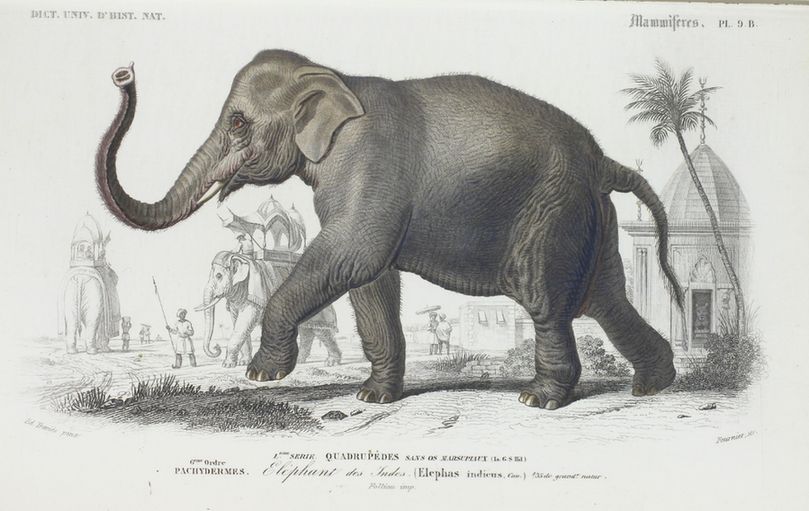
A coloured illustration showing an elephant in motion. Behind is are faint illustrations of people, and other elephants being ridden. Text below reads "Elephant des Indes"
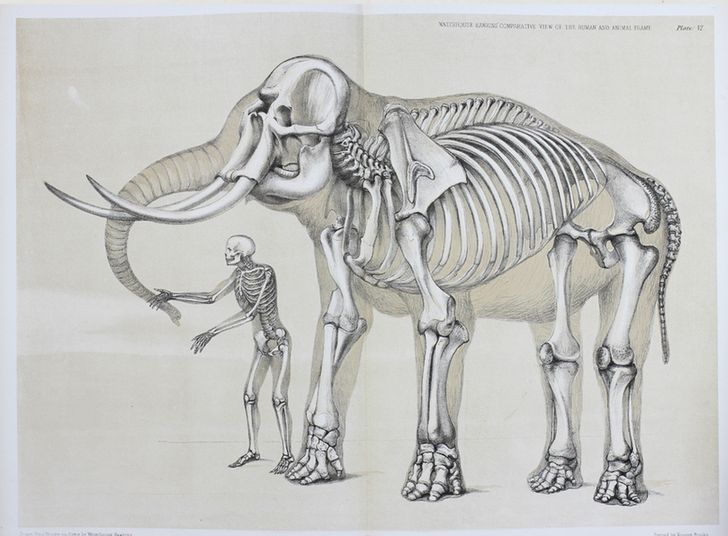
An illustration of a human and an elephant stood close together. Through the silhouette of each animal its skeleton is visible in great detail.
Today is #ElephantDay! Enjoy these illustrations of the largest living land animals from our collections. The first is from C. d’Orbigny's, 'Dictionnaire universel d’histoire naturelle', 1847, and the second from B. Hawkins's, 'A comparative view of the human and animal frame', 1860.
12.08.2025 13:30 — 👍 20 🔁 5 💬 0 📌 0
A bit of good news from the Yale University Art Gallery. www.nhregister.com/connecticut/...
17.07.2025 01:54 — 👍 67 🔁 16 💬 1 📌 2
Our latest @jich.bsky.social 'Current Debate' essay entitled 'Trump and the Commonwealth' is now #OpenAccess for a limited time. The journal's former editor Professor Philip Murphy offers some compelling commentary on the US president's ambition of joining the Commonwealth.
doi.org/10.1080/0308...
I *think (though not yet 100% certain) that some of the ships used to carry emigrants to East and West Africa after WW1 may also have been used at some point for carrying ivory to the London docks - the shifting trajectory of a ship!
08.05.2025 10:16 — 👍 1 🔁 0 💬 0 📌 0I have found myself doing a little bit of research into the Union Castle line (re ivory) in case you fancy teaming up for a conference panel some time! I shall keep my eyes peeled for anything interesting 👀
08.05.2025 10:11 — 👍 1 🔁 0 💬 2 📌 0
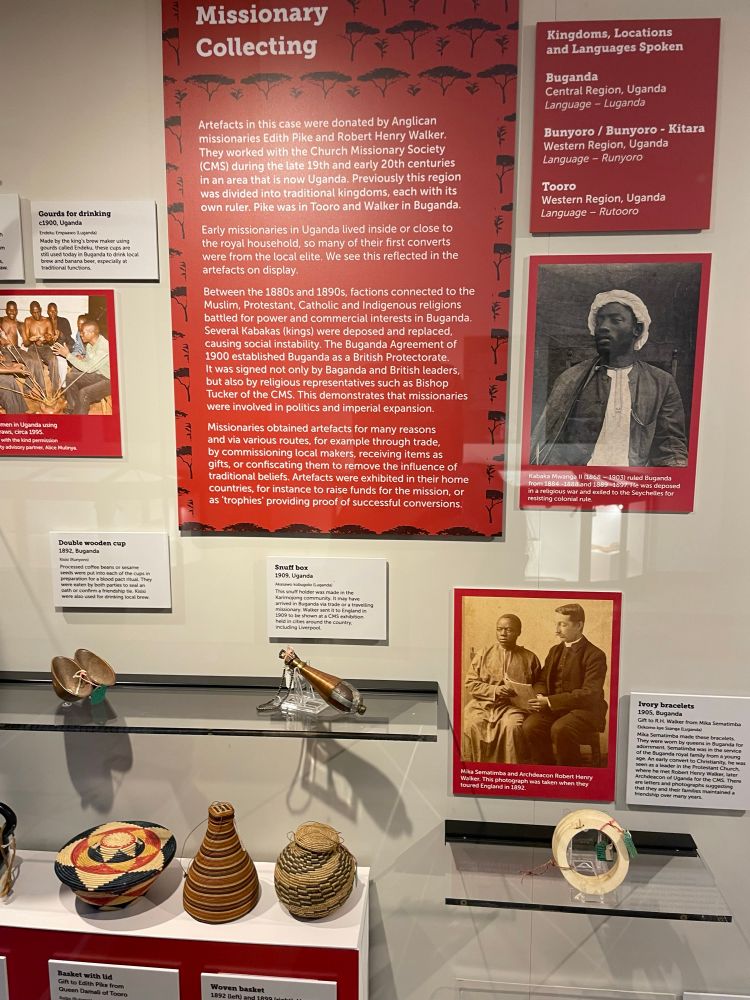
If you find yourself in the Margate area, do check out the Powell-Cotton Museum’s redisplay of some of its East African Collections. Especially useful for those interested in missionary collecting but also a new focus on Ugandan figures- not just the solitary British missionary ‘expert’ or explorer
25.04.2025 17:41 — 👍 11 🔁 2 💬 0 📌 1Congrats Freddy! So pleased to see this in print!
25.04.2025 17:26 — 👍 0 🔁 0 💬 1 📌 0