Thank you! :)
03.12.2025 15:36 — 👍 0 🔁 0 💬 0 📌 0

Thanks to Advanced Functional Materials for highlighting our work on their back cover!
03.12.2025 14:06 — 👍 2 🔁 1 💬 2 📌 0

Big congrats to Dr. Krishna Gupta for winning the best poster prize at Oxford Global’s NextGen Omics conference in London, where he presented our work on #LASSO pulldown polymers. 💪
LASSO is a new general-purpose method for fast and ultra-selective biomolecule purification.
15.11.2025 10:31 — 👍 0 🔁 0 💬 1 📌 1

Multiplexed detection of viral pathogens on an AUTONOMOUSLY LOADING chip for point-of-care #diagnostics.
Congrats to first authors Beatrise Berzina and Krishna Gupta and the entire EKFZ-funded *VirChip* team!
23.10.2025 14:20 — 👍 7 🔁 2 💬 2 📌 0

New Perspectives on the Hidden World of Proteins
Schering Young Investigator Award 2025 goes to Agnes Toth-Petroczy
Schering Young Investigator Award 2025 by the Schering Stiftung for Agnes Toth-Petroczy @tothpetroczylab.bsky.social @mpi-cbg.de @csbdresden.bsky.social. She receives the award for her work on the evolution, diversity, and function of proteins. Congratulations! 🎉 www.mpi-cbg.de/news-outreac...
30.09.2025 07:49 — 👍 30 🔁 5 💬 1 📌 2
This type of technology is used on cryptocurrency hardware wallets. Even though no technology is 100% safe, that's as good as it gets.
I think technology can at least mitigate the other side of the problem, which is that our incentive structure is broken. Ideally we'd fix the latter was well.
18.09.2025 20:44 — 👍 1 🔁 0 💬 0 📌 0
I agree with both points.
On the technology side, we have things like Secure Element Chips, where the signing happens directly on the hardware. The private key never leaves the device (e.g. it could happen inside an AFM). The image and its metadata would already be signed when it reaches the user.
18.09.2025 20:44 — 👍 1 🔁 0 💬 1 📌 0
This is doing the rounds in my messages with colleagues, and is a very real threat to the field of microscopy 😬.
Given one (published) microscope image probably costs between $100 and $10,000 (or more) to make - the lure of "oh I will just ChatGPT it" is very much there.
18.09.2025 07:50 — 👍 17 🔁 5 💬 1 📌 0
Yes absolutely. And ideally microscope manufacturers should have their instruments digitally sign all raw images, this way faking raw images would become very difficult.
16.09.2025 04:37 — 👍 1 🔁 0 💬 0 📌 0
I knew from the beginning, have been following this story...
15.09.2025 19:46 — 👍 1 🔁 0 💬 0 📌 0
lol, of course.
15.09.2025 19:42 — 👍 0 🔁 0 💬 1 📌 0
Interesting. For me, looking 15 min on a story like that, this is puzzling how it can happen. I hope these types of disputes can be conclusively settled in the future, once instruments digitally sign raw data that is appended to all manuscripts.
15.09.2025 19:23 — 👍 0 🔁 0 💬 1 📌 0

Seems to be a weird compression artifact (?) What does the journal say? The author seems to be helpful in providing the raw images (though the scale bar is indeed off :D)
15.09.2025 18:46 — 👍 0 🔁 0 💬 1 📌 0
True. Those manipulations were always just the tip of the iceberg.
15.09.2025 13:07 — 👍 2 🔁 0 💬 0 📌 0
Fair! There is a potential solution we had originally discussed, but it didn't make it into the final version: If manufacturers make their microscopes *digitally sign* all raw images, they become very hard to fake. This is done already for things like forensic data but rarely in academic research.
15.09.2025 11:43 — 👍 7 🔁 0 💬 2 📌 0

AI can now generate fake microscopy images that are nearly impossible to detect. A serious threat to scientific integrity—and we’re not prepared for it.
Commentary in @natnano.nature.com
#nanotechnology
15.09.2025 10:38 — 👍 165 🔁 75 💬 6 📌 14

DyNAtrix also allowed us to measure "resonance bands" of the cell's mechanical interactions with their environment, revealing the timescales at which these interactions take place.
(Check out Supp. Info. Note S1 to understand how exactly this works) 🤓
#Mechanobiology
3/
11.09.2025 20:36 — 👍 1 🔁 0 💬 1 📌 0
Here you see a kidney cyst inverting its polarity after we added synthetic DNA signals.
These signals enter the material and "flip switches" that change its stress-relaxation time.
For the first time, switching ECM stress-relaxation can be done reversibly and during an ONGOING cell culture!
2/
11.09.2025 20:36 — 👍 0 🔁 0 💬 1 📌 0
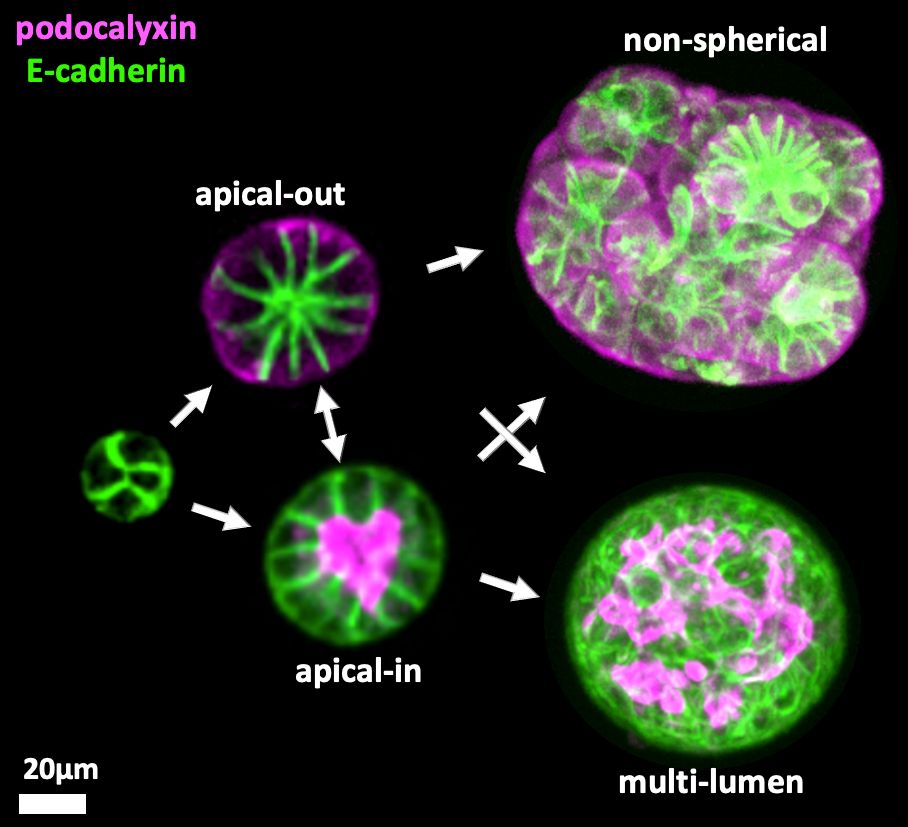

Exciting application of our programmable #CellCulture matrix #DyNAtrix.
By creating a mechanically reconfigurable microenvironment, we can now invert & guide epithelial cell polarity in real time.
#DNAnanotech
1/ 🧵
11.09.2025 20:36 — 👍 10 🔁 2 💬 1 📌 0
Group Leader at @ibmb-csic.bsky.social
Studying protein assembly from a physical, evolutionary, and cellular perspective.
Marie-Sklodowska Curie PhD fellow in @igflyon.bsky.social @michalis-averof.bsky.social lab interested in early triggers of leg regeneration in 🦐 | Previously Center for Regenerative Therapies @tudresden.bsky.social and Bilkent University
Molecular biologist in Salt Lake City. Nostalgic for the days when PCR was new and cool. Still trying to understand In Vitro Diagnostics. Hiker, new grandfather.
Post-Doc @katjaroeper.bsky.social lab @pdncambridge.bsky.social
Interested in kidney organoids and lumen formation; Former @honigmann_lab,
@biotec-tud.bsky.social, @cmcb-tud.bsky.social,@mpicbg.bsky.social
and @boulantlab
The Wyss Institute seeks to transform engineering, medicine and the environment by creating new materials and devices using Nature’s design principles.
Science and fun from the lab of Tony Hyman at the MPI-CBG @mpicbg.bsky.social. Tweets by Hymanlab members.
https://hymanlab.org/
Forschen für die beste der möglichen Welten.
Website: https://www.leibniz-gemeinschaft.de/
Impressum: https://www.leibniz-gemeinschaft.de/impressum
Geochemist and biologist, Interested in lipids, RNA, pathogens, & synthesis of life.
Y. Eva Tan Professor in Neurotechnology, MIT. Investigator, HHMI. Leader, Synthetic Neurobiology Group, http://synthneuro.org. Scientist, inventor, entrepreneur.
Biological algorithms of cell motility and pattern formation in active living matter, using theoretical physics https://physics-of-life.tu-dresden.de/friedrich
Chemist in a CellBio place. Fan of lipids & membranes
Penchant for the odd & curious. Ally for researchers at the career bottleneck.
#LeadershipInScience #ResearchManagement
Scientist interested in the physics of life
How do cells form tissues? Our research program spans the scales from molecules to organisms. News from the Max Planck Institute of Molecular Cell Biology and Genetics (MPI-CBG) in Dresden, Germany. Impressum: https://www.mpi-cbg.de/impressum
Molecular Transport in Cell Biology and Nanotechnology - Research group of Stefan Diez at B CUBE, TU Dresden and MPI-CBG Dresden
We are a research lab in the Cluster of Excellence Physics of Life at the Technische Universität Dresden. Our interests are cell mechanics, cell biology and atomic force microscopy and modelling.