A small polymerase ribozyme that can synthesize itself and its complementary strand
The emergence of a chemical system capable of self-replication and evolution is a critical event in the origin of life. RNA polymerase ribozymes can replicate RNA, but their large size and structural ...
How could a simple self-replicating system emerge at the origins of life? RNA polymerase ribozymes can replicate RNA, but existing ones are so large that their self-replication seems impossible. Could they be smaller?
Excited to share our latest work in @science.org on a new small polymerase.
1/n
13.02.2026 11:42 —
👍 496
🔁 207
💬 10
📌 27

I finally know why the cap was designed that way.....
22.05.2025 15:02 —
👍 0
🔁 0
💬 0
📌 0
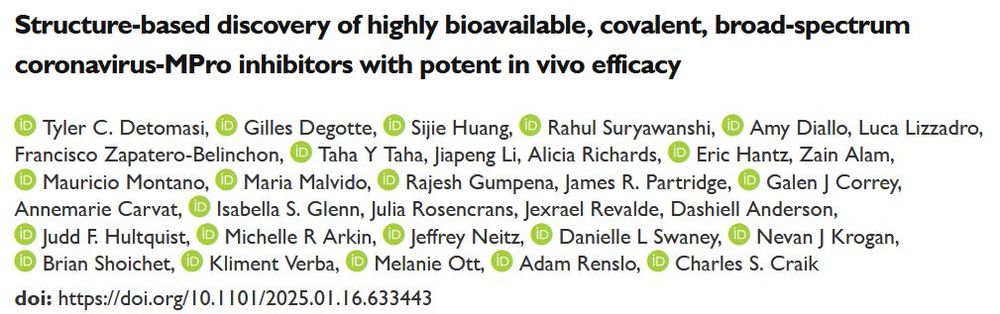
Interesting bioRxiv preprint by a team around Charles Craik, Adam Renslo and @theottlab.bsky.social. Inhibitors for Mpro of coronaviruses based on a dihydrouracil chemotype and a propargyl amide warhead as reactive group to engage the catalytic cysteine. #chemsky #ChemBio www.biorxiv.org/cont...
22.01.2025 15:00 —
👍 5
🔁 3
💬 0
📌 0
I’m incredibly proud of our team’s work to unravel these complexities, especially Shahrzad Ezzatpour, Jennifer Hayashi, and Chengjin Ye. Special thanks to members of the Luis Martinez-Sobrido, Hector Aguilar-Carreno, and @theottlab.bsky.social labs for their contributions and helpful discussions.
03.01.2025 19:55 —
👍 6
🔁 0
💬 0
📌 0

As of today, this mutation has somewhat disappeared from dominant lineages post-XBB.1.16, but it is still detected at low levels and was certainly present in variants prior to BQ.1.1. JN.1-derived lineages may be content with NSP6 R252K for now.
See outbreak.info report
03.01.2025 19:55 —
👍 3
🔁 0
💬 1
📌 0

Interestingly, the NSP6 L260F mutation was enriched in the lungs of experimentally infected mink (insight.jci.org/articles/vie...) suggesting that it alters viral tropism (lung > upper respiratory tract) and may explain the decreased pathogenesis of the revertant virus in our study.
03.01.2025 19:55 —
👍 3
🔁 0
💬 1
📌 0

We validated our results in vivo using the K18-hACE2 mouse model 🐁and found that while replication was lower in the NSP6 F260L virus, pathogenesis was much lower indicating a role for this mutation in pathogenesis as well.
03.01.2025 19:55 —
👍 3
🔁 0
💬 1
📌 0

To verify our results in the context of replication competent virus, we generated revertant XBB.1.16 and BA.5 viruses (i.e. NSP6 F260L) that are hypothesized to have LOWER replication. Indeed, both revertant viruses replicated lower in infected cells.
03.01.2025 19:55 —
👍 3
🔁 0
💬 1
📌 0

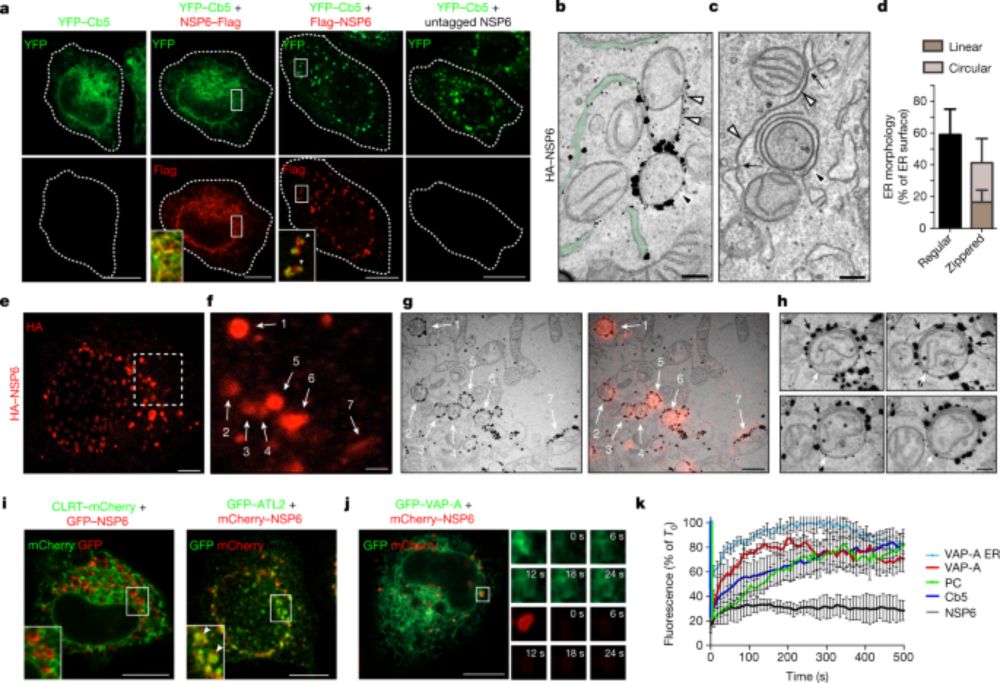
We see this phenotype if we only express NSP6 in cells as well.
03.01.2025 19:55 —
👍 3
🔁 0
💬 1
📌 0

In the current study, we find that L260F rescues the reduced lipid droplet consumption and RNA replication of BA.2 NSP6 (i.e. ΔSGF).
03.01.2025 19:55 —
👍 4
🔁 0
💬 1
📌 0

We validated that SARS-CoV-2 consumes lipids during infection, and we found that Omicron BA.1 mutations in NSP6 reduce the lipid droplet consumption function and this correlates with reduced viral RNA replication.
03.01.2025 19:55 —
👍 4
🔁 0
💬 1
📌 0

We used replicons to safely validate that the enhanced replication in these variants is due to NSP6 L260F. Indeed, reversion of this mutation to wt decreases replication significantly. New NSP6 R252K mutation in JN.1.1.1 enhanced replication as well but not as much as L260F.
03.01.2025 19:55 —
👍 4
🔁 0
💬 1
📌 0
x.com
For more insight into this mutation, see posts from @jbloomlab.bsky.social and @ryanhisner.bsky.social
x.com/jbloom_lab/s...
03.01.2025 19:55 —
👍 5
🔁 0
💬 1
📌 0
We found that within a variant lineage (e.g. BA.5 or XBB) strains emerged with higher entry but evolved towards higher replication. Two high RNA replication strains, BQ.1.1 and XBB.1.16, had independently acquired NSP6 L260F. This mutation has been observed in chronic infections.
03.01.2025 19:55 —
👍 5
🔁 0
💬 1
📌 0

Using Spike-defective replicons, we decoupled viral entry and RNA replication. We observed a fascinating trend: as Spike function decreased under immune pressure, RNA replication increased as a compensatory mechanism. 📈
03.01.2025 19:55 —
👍 5
🔁 0
💬 1
📌 0

We showed using replicons that the SARS-CoV-2 Omicron BA.1 variant has attenuated RNA replication due to mutations in NSP6, namely ΔLSG and I189V.
03.01.2025 19:55 —
👍 5
🔁 0
💬 1
📌 0

We have previously developed a reverse genetics platform to construct natural variant genomes rapidly. Using this technology, we also developed a replicon that reports on RNA replication and lacks the Spike coding sequence.
www.nature.com/articles/s41...
03.01.2025 19:55 —
👍 5
🔁 0
💬 1
📌 0

While many BA.2-derived mutations (shown in red) have been fixed in subsequent variants, mutations continued to accumulate across the genome.
03.01.2025 19:55 —
👍 5
🔁 0
💬 1
📌 0

First, let's take a look at how SARS-CoV-2 variants evolved in the past ~4 years. 🧬🔬
The virus has accumulated over 60 nonsynonymous mutations in Spike and research efforts focused on defining the role of these mutations in spread, pathogenesis, and immune evasion.
03.01.2025 19:55 —
👍 6
🔁 0
💬 1
📌 0
Thrilled to share our latest work identifying that #SARSCoV2 #Omicron variants harboring an L260F mutation in NSP6 have enhanced replication and pathogenesis. A not so brief thread 🧵
03.01.2025 19:55 —
👍 23
🔁 10
💬 1
📌 1