

Just a reminder that our TSL Summer Conference in Plant-Microbe Interactions is taking place this summer in Norwich!
⏰ APPLY by 30 March 2026
More info on our website: www.tsl.ac.uk/tsl-summer-c...
Just a reminder that our TSL Summer Conference in Plant-Microbe Interactions is taking place this summer in Norwich!
⏰ APPLY by 30 March 2026
More info on our website: www.tsl.ac.uk/tsl-summer-c...

PCP February Issue cover confocal image showing root colonization by the endophytic fungus Colletotrichum fructicola expressing GFP, with A. thaliana plasma membranes visualized using an mCherry-fused aquaporin (magenta). Photo credit: Shunsuke Miyashima, Ishikawa Prefectural University, Japan.
🔥Hot off the press....!🔥
⭐The February Issue of Plant & Cell Physiology is out now!⭐
🛋️ academic.oup.com/pcp/issue/67/2
@academic.oup.com
@jspp-news.bsky.social
#PlantScience 🌱
📸Photo credit: Shunsuke Miyashima, Ishikawa Prefectural University, Japan
📝Related paper: doi.org/10.1093/pcp/...

Join us on March 10, 2026 at Kyoto University 🇯🇵 for a day celebrating my long-time friend and collaborator Prof. Ryohei Terauchi.
"Kyoto Mini-Symposium on Plant–Microbe Interactions"

Out in @science.org this week, two fungal enzymes synthesise DHHA, which controls cell wall porosity and turgor in plant pathogenic fungi www.science.org/doi/10.1126/...
#mycology
#plantscience
Preprint: Here we report a glass bead-based system suitable for the *simultaneous monitoring* of Arabidopsis root exudate and root microbiome dynamics. Teaser: some link between glucosinolates ~ SynCom composition. Happy reading. Credits to Charlotte Joller et al.! www.biorxiv.org/content/10.6...
30.01.2026 16:43 — 👍 25 🔁 15 💬 1 📌 0Great opportunity!! It was very very valuable experience. Don’t miss it!
15.01.2026 00:05 — 👍 1 🔁 0 💬 0 📌 0
Join us in Norwich this July for the TSL Summer Conference in Plant-Microbe Interactions! ☀️🌱🧬
Discuss the latest approaches & discoveries in plant health with international keynote and local speakers.
APPLY by 30 March '26 ⬇️ Click link for more info
www.tsl.ac.uk/tsl-summer-c...

Finally!! 🎉 After a long journey and multiple rounds of revisions, my Commentary is officially out in @plantcellphysiol.bsky.social !
We discuss the fascinating "Gatekeeper" role of endophytes in plant immunity based on the great work by @keihiruma.bsky.social et al.
📄 Read here:
Genetic factors driving multi-host infection in a core member of the root mycobiota https://www.biorxiv.org/content/10.1101/2025.12.01.690973v1
02.12.2025 03:37 — 👍 3 🔁 2 💬 0 📌 0
Finally published!
Our new study in Curr Biol @currentbiology.bsky.social analyzes how CYP707A1 promoter variation drives an evolutionary trade-off between stomatal defense and gas exchange across Brassicaceae species.
Free-access link:
authors.elsevier.com/a/1m7H93QW8S...

Our ten years of work is finally out in Current Biology! We reveal a new mode of action of the bacterial phytotoxin coronatine produced by Pseudomonas syringae. www.cell.com/current-biol...
18.11.2025 03:41 — 👍 26 🔁 11 💬 1 📌 1
Great opportunity for Early Career Researchers - Utrecht PhD Summer School 2026!
eps.sites.uu.nl

Get a First Look 🔍: "STT3A Is Required for Recognition of Pathogen-Derived Sphingolipids in Arabidopsis," by Seowon Choi et al. https://doi.org/10.1094/MPMI-05-25-0061-R
29.10.2025 16:47 — 👍 0 🔁 1 💬 0 📌 0Novel system to explore plant-fungi interaction and fungus-fungus competition. Colletotrichum rocks!
29.10.2025 10:53 — 👍 1 🔁 0 💬 0 📌 0
We’ve built this virtual plant scientist PlantScience.ai to grow alongside human researchers🌿. It thinks like an expert, cites like a scholar, and never stops learning. Come and have a chat with it! @yiliangding.bsky.social @johninnescentre.bsky.social
www.biorxiv.org/content/10.1...

Spread the word! 🗣️🎙️
Together with @azulsilva.bsky.social and Bluesky-less Magdalena Miranda, supported by @elife.bsky.social, we’re organizing a webinar bringing together people working in science communication and outreach.
Please, feel free to share the flyer with anyone who might be interested!
We’re delighted to share that our paper has been just accepted in PCP!
We analyzed fungus–fungus competition that suppresses pathogenic colonization in Arabidopsis roots.Special thanks to Duke, Hiroyuki, Yuki, Nanami, and everyone who contributed!
t.co/obQyD1rzI1
The koji-fungus, Aspergillus oryzae, traditionally used in Japanese brewing, is now widely used to make enzymes.
It seems its capacity for enzyme production is thanks to its unique ability to proportionally increase cell volume and nuclear number.
buff.ly/bPSNRL6

A long road to the Cover of Science!
www.science.org/doi/10.1126/...

updated preprint: Intriguingly, Arabidopsis responded with both, improved growth and enhanced defence to a maize-conditioned soil microbiome, and this dual microbiome feedbacks were mediated by priming of the defences. Credits to Katja Stengele et al.!
www.biorxiv.org/content/10.1...
Exactly😣 It was big conference that I rarely got to see you. Next time, let’s have lunch or dinner — I want to talk about our science! I hope your new journey in Switzerland goes well🤞
16.08.2025 13:25 — 👍 0 🔁 0 💬 0 📌 0Congrats Fantin🎊 Beautiful work!!
16.08.2025 07:47 — 👍 0 🔁 0 💬 1 📌 0We have posted our latest preprint. We explore how an endophytic fungus promotes plant growth and fitness under fluctuating nitrogen-limited conditions in both field and laboratory settings, in additively with bacteria attracted to its hyphae. We hope you enjoy it!
08.08.2025 02:57 — 👍 10 🔁 5 💬 0 📌 0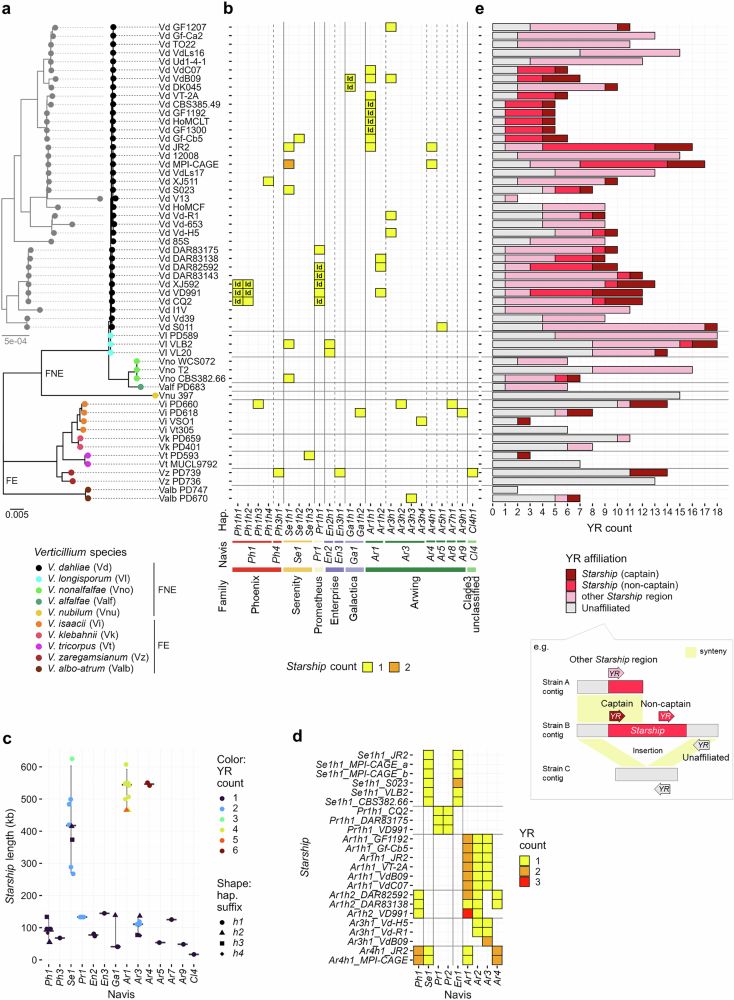
📣 Happy to see the journal publication 📄 of our work on Starships 🚀 in Verticillium fungi: terrific work led by @yukiyosato.bsky.social
rdcu.be/exBSp

Epipactis helleborine, also know as broad leaf helleborine. An orchid with many small green-purple flowers starting to open .
Epipactis helleborine, also known as broad leaf helleborine. An orchid with many small green-purple flowers starting to open.
Finding wild orchids brings me joy.
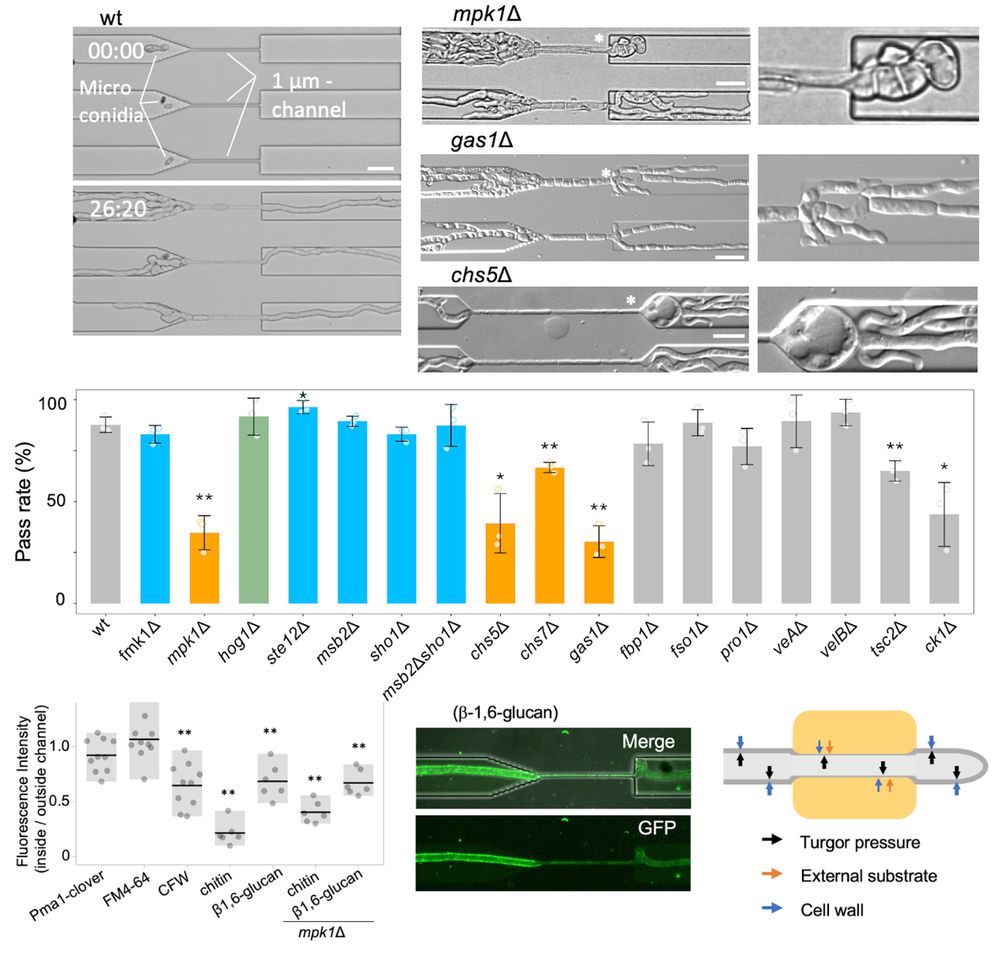
Cell wall remodeling in a fungal pathogen is required for hyphal growth into microspaces. #mBio This study highlights the critical role of hyphal plasticity and cell wall remodeling in the pathogenicity of Fusarium oxysporum by genetics and micro-channel devices. journals.asm.org/doi/10.1128/...
04.07.2025 08:01 — 👍 6 🔁 2 💬 0 📌 0
Updated preprint: MMF1 is "a microbiota receptor” through which Arabidopsis plants perceive their soil microbiome. Perception optimises root microbiome composition, immune status and ultimately leads to better growth. www.biorxiv.org/content/10.1...
30.06.2025 06:27 — 👍 31 🔁 9 💬 0 📌 0
A single domestication origin of adzuki bean in Japan and the evolution of domestication genes |
Science www.science.org/doi/10.1126/...
Do you love もち (mochi)? If so (or even if you don't), this is an interesting article on the origin of adzuki beans (あずき), source of "red bean paste".
Next Monday!
17.05.2025 08:26 — 👍 0 🔁 0 💬 0 📌 0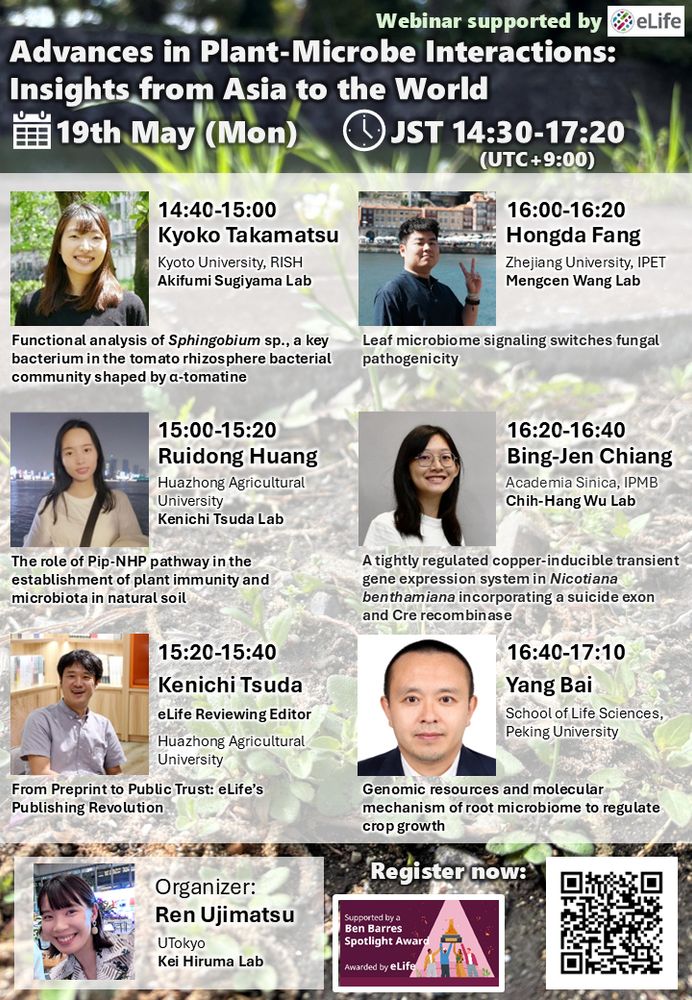
Webinar Alert🌱
Want to learn cutting-edge studies in plant-microbe interaction? Join our webinar "Advances in Plant-Microbe Interactions: Insights from Asia to the World" with
@elifecommunity.bsky.social !
📅 May 19, 2025 | 🕝 JST 14:30–17:20 (UTC+9)
📌Register: u-tokyo-ac-jp.zoom.us/webinar/regi...
