📣 The UC Davis Economics Department is thrilled to announce our 2025-2026 Economics Job Market Candidates! Learn more about their research below ⬇️
06.11.2025 12:49 — 👍 10 🔁 5 💬 1 📌 1
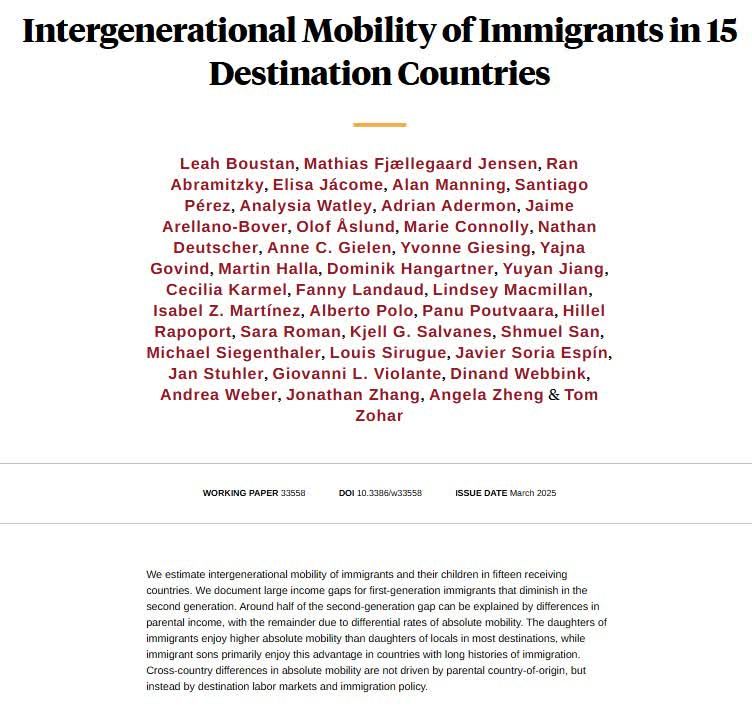
Daughters of immigrants are more upwardly mobile than daughters of locals in most destinations. Sons of immigrants are only more upwardly mobile outside of continental Europe, from Boustan, Fjællegaard Jensen, Abramitzky, Jácome, et al https://www.nber.org/papers/w33558
16.03.2025 17:00 — 👍 51 🔁 22 💬 2 📌 2
New edition of the Summer School on the "Economics of Immigration" happening again this year in Mexico City July 21-24. More info here: globalmigration.ucdavis.edu/summer_school3
05.03.2025 02:01 — 👍 1 🔁 0 💬 0 📌 0
New paper studying the intergenerational mobility of immigrants in 15 destination countries. This paper is the result of an international collaboration of 15 country teams and a total of 38(!) coauthors. Comments welcome!
21.02.2025 22:33 — 👍 5 🔁 0 💬 0 📌 0
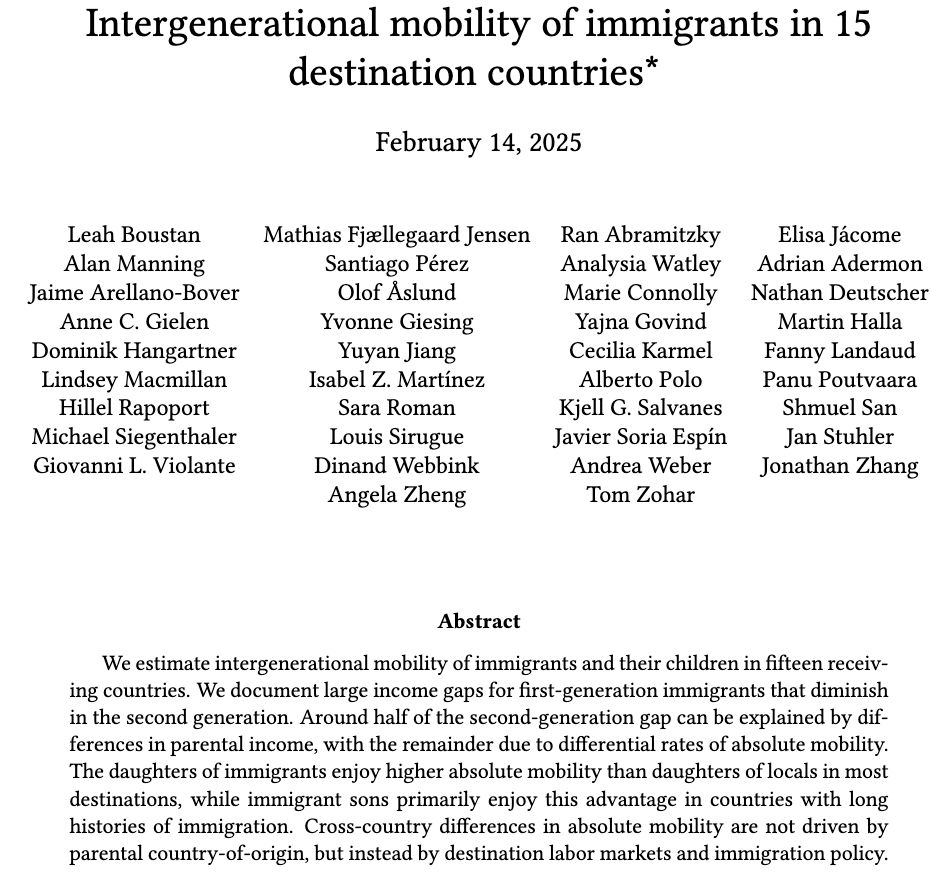
1/ 🚨 New paper! 🚨
How do the economic trajectories of children of immigrants vary across 15 high-income countries? We study intergenerational mobility of immigrants, using individual-level linked parent-child data across Europe, North America, and beyond. 🧵👇 #EconSky
21.02.2025 11:44 — 👍 112 🔁 54 💬 2 📌 7

During Prohibition when many men lost their jobs, daughters increased their labor supply and delayed marriage and childbearing likely in an effort to compensate for lost wages, from Anna Aizer, Gabrielle Grafton, and Santiago Pérez https://www.nber.org/papers/w33346
15.01.2025 18:00 — 👍 12 🔁 5 💬 0 📌 0
Love seeing two new @nberpubs.bsky.social WPs out today that use the Census Tree!
"Daughters as Safety Net...Evidence from Alcohol Prohibition" by Aizer, Grafton, & Pérez
"The Gilded Age & Beyond: The Persistence of Elite Wealth in American History" by Kalsi & @econzach.bsky.social
13.01.2025 14:11 — 👍 29 🔁 7 💬 1 📌 0

Climbing the Ivory Tower: How Socio-Economic Background Shapes Academia
Founded in 1920, the NBER is a private, non-profit, non-partisan organization dedicated to conducting economic research and to disseminating research findings among academics, public policy makers, an...
academics from poorer backgrounds are:
-severely underrepresented
-more likely to not publish
-have outstanding publication records
-introduce more novel scientific concepts, but less likely to receive recognition, as measured by citations, Nobel Prize nominations & awards
www.nber.org/papers/w33289
24.12.2024 10:31 — 👍 220 🔁 70 💬 3 📌 3
Had a great time presenting at WFU 🙌
21.11.2024 17:51 — 👍 7 🔁 1 💬 1 📌 0
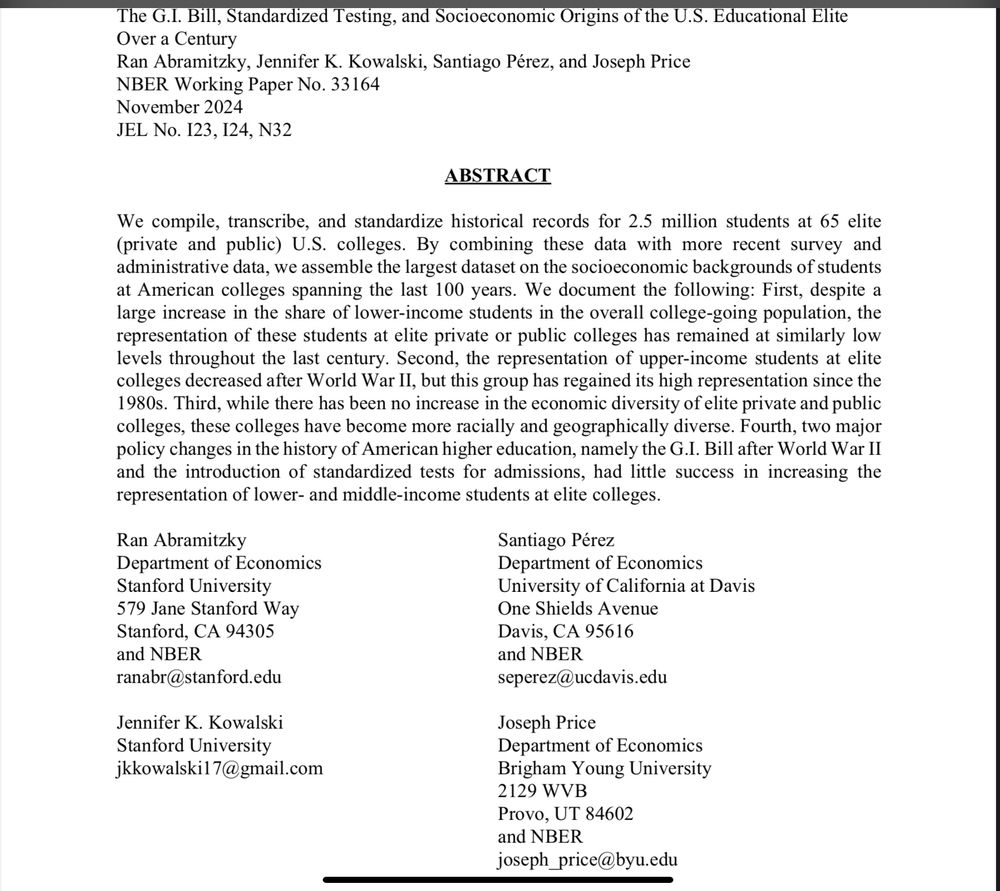
The G.I. Bill, Standardized Testing, and Socioeconomic Origins of the U.S. Educational Elite Over a Century
Ran Abramitzky, Jennifer K. Kowalski, Santiago Pérez, and Joseph Price
NBER Working Paper No. 33164
November 2024
JEL No. 123, 124, N32
ABSTRACT
We compile, transcribe, and standardize historical records for 2.5 million students at 65 elite (private and public) U.S. colleges. By combining these data with more recent survey and administrative data, we assemble the largest dataset on the socioeconomic backgrounds of students at American colleges spanning the last 100 years. We document the following: First, despite a large increase in the share of lower-income students in the overall college-going population, the representation of these students at elite private or public colleges has remained at similarly low levels throughout the last century. Second, the representation of upper-income students at elite colleges decreased after World War II, but this group has regained its high representation since the 1980s. Third, while there has been no increase in the economic diversity of elite private and public colleges, these colleges have become more racially and geographically diverse. Fourth, two major policy changes in the history of American higher education, namely the G.I. Bill after World War II and the introduction of standardized tests for admissions, had little success in increasing the representation of lower- and middle-income students at elite colleges.
Holy crap this is an astounding piece of historical research
Will post ungated link later today unless someone beats me to it
www.nber.org/system/files...
18.11.2024 12:47 — 👍 1384 🔁 469 💬 66 📌 75
Thanks for the kind words 🙏!
18.11.2024 12:57 — 👍 10 🔁 0 💬 0 📌 0
ND Econ PhD candidate ☘️
I am on the 25/26 job market.
haleywilbert.com
Econ PhD student @UCDavis • Migration, labor, and development • Former Junior Economist @IDinsight • Proud @GeorgetownSFS alum
https://mitali-mathur.github.io
Incoming PhD Student @ UC Davis | Political Economy ∩ Econ History ∩ Development, mainly institutions | Economist^2 from CIDE
https://gabriel-hdez-leon.github.io/
Economics PhD student @UCDavis.
Economist, Economic Historian. Soccer Dad, Climber Dad.
https://voices.uchicago.edu/richardhornbeck/
Econ Assistant Prof at Yale SOM. Education, innovation, gender. Born & raised in Monopoli, Italy. Mom of 3.
Assistant Prof in Economics (Copenhagen Business School ECON)
Working on migrants' integration (citizenship) & racial inequality
French, Mauritian
Fellow WIL & ICM
Research: Inequality & Migration |
PhD: PSE & INED
Econ prof in Vancouver in Vancouver @ SFU. My research explores how culture and institutions shape long-run development. 👉 guillaumeblanc.com
Senior Research Fellow at the Department of Economics, University of Oxford. Interested in (gender) inequalities and intergenerational mobility 🏳️🌈
https://fjaellegaard.com/
Assistant Prof at UW Madison AAE. Studies Regional Growth, Economic History, and Development Across Indigenous Communities. Northern Cheyenne. Formerly at Vassar.
Interested in how the rich stay rich and the poor poor. Sociologist at @sriucl.bsky.social @ucl.ac.uk. He/him/his. http://perengzell.com Photo bomber @simoneschneider.bsky.social
Economist of Education UTexas, LBJ School, College of Education
www.jeffdenning.com
Annie & Ned Lamont Professor of International Studies, Thomas J. Davis, Jr. Faculty Scholar @ SIEPR, Professor of Economics @ Stanford
www.healthinequalitylab.org
Economist @ Wake Forest
https://aeimit.weebly.com/
Argentina- Brazil/ literature- culture- politics/ FSOC-UBA/ UC Davis/ Roger Williams University/ pets/
Professor of Economics at the University of Texas at Austin and Former Member of Obama's Council of Economic Advisers, animal-lover. Health Insurance is a human right. Poverty is a policy choice.
I study Economic History & Finance, esp US + Germany in the 20th century.
Google Scholar: https://t.co/RdOYnDBiW5
Views are my own.
Photo: Bergen, Norway