A good summary from @deepcutnews.bsky.social of the misinformation doing the rounds in the media almost immediately following the mass shooting
15.12.2025 21:45 —
👍 14
🔁 7
💬 1
📌 0

Protected area management has significant spillover effects on vegetation - Nature
Analysis of effect sizes of vegetation spillovers from protected areas in Australia shows that 71% of over 3,063 analysed protected areas had a positive spillover effect, and that these effects c...
Happy to share my new publication in #Nature
doi.org/10.1038/s415.... Vegetation spillovers from Aus protected areas are common & widespread; also, management inside the area can affect vegetation outside the area. Spillovers don't factor much into conservation policy, but perhaps they should! 🧪🌍🌐
11.12.2025 02:16 —
👍 17
🔁 8
💬 1
📌 1

Inferring recent and ongoing plant extinctions. Katus shortfall- the unknown loss of biodiversity past, present and future is broader than ‘dark extinction’- species becoming extinct before being formally described nph.onlinelibrary.wiley.com/doi/10.1111/...
18.09.2025 23:05 —
👍 3
🔁 1
💬 0
📌 0

29 Natural Ecosystems Technical Report: Synthesis
This assessment found Australia’s natural environment is highly exposed and vulnerable to climate change. The projected change is outside the conditions to which most native species have adapted.
National climate change risk assessment for #Australia’s natural ecosystems tech reports are online: We report
Australia’s natural ecosystems are highly exposed & vulnerable to climate change across the land and sea. 1/🧵
16.09.2025 19:19 —
👍 12
🔁 8
💬 2
📌 0

🔥Are you investigating how plants respond to shifting fire regimes? Submit to our new Special Collection🌱
Title: "After the fires: Plant responses and resilience under shifting fire regimes"
📖 Submit by 30 Sept 2025.
🧪 Details 👉 www.publish.csiro.au/bt/content/C...
#Fire #Botany #Plantscience
08.07.2025 02:15 —
👍 10
🔁 9
💬 0
📌 1

Alpine forests face collapse without urgent reforestation, say scientists
Bushfires and a lack of seed have created a "ticking time bomb" in Victoria's alpine and mountain ash forests, scientists are warning.
I've been banging on about this issue - immature alpine ash, fire and seed - for years so it was great to get a chance to contribute to this ABC Landline story about it. "A 'time bomb' in the state's ash forests" www.abc.net.au/news/2025-06...
21.06.2025 23:54 —
👍 21
🔁 14
💬 0
📌 2

Finite resources, lots of species requiring conservation. @saltandbrine.bsky.social asks the question - how far do we go for each plant species? A simple question generating deep thought! #ICCB2025
17.06.2025 04:10 —
👍 9
🔁 1
💬 0
📌 0
🗺️ Ever wander to a new place and think, "Hmm I wonder what birds/plants/[insert favourite taxonomic group] I can find here?" 🔍
We built {infinitylists} 📋 to help nature lovers create personalised, location-based taxon lists! 🌏
11.06.2025 23:55 —
👍 32
🔁 11
💬 1
📌 1

When nice isn’t working: Rethinking climate advocacy under a Labor government — campaign-republic.com
After Labor’s recent election win, many in the climate and environment space breathed a sigh of relief. The Coalition and its nuclear fantasy were resoundingly rejected. In its place, a government tha...
There's "a false perception that Labor values the environment movement & its endorsement. In reality, Labor only wants to neutralise it. [..] They want to be able to name-drop supportive organisations in press conferences, but they’re far less willing to adopt those same groups’ policy proposals"
01.06.2025 22:32 —
👍 142
🔁 68
💬 6
📌 4
Thank to everyone involved, not sure whos on here sorry if you don't get tagged
P.S. the papers pay walled but I know a guy who can pass it on for free.... 4/4
@markooiecol.bsky.social @saltandbrine.bsky.social @seedysarah.bsky.social @joe-atkinson.bsky.social
12.05.2025 07:43 —
👍 4
🔁 0
💬 0
📌 0

Our study shows managers can have confidence in rapid assessments of extinction risk and it has great potential as a tool for quickly responding to megadisturbances. We also believe the project shows comprehensive assessments of the Australian flora are within reach given the right resourcing 3/4
12.05.2025 07:43 —
👍 5
🔁 0
💬 1
📌 0
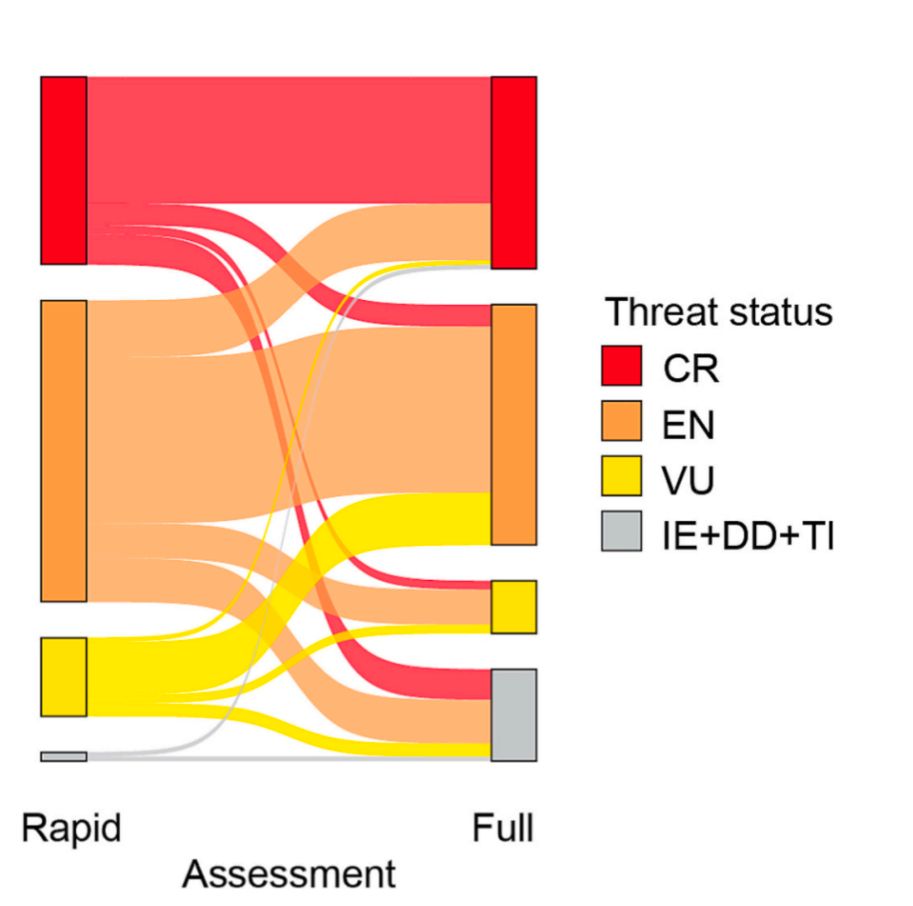
The rapid assessments accurately identified species as threatened in 84% of cases despite much less time and data per species. Importantly they were accurate in identifying Critically Endangered species (67%) and Endangered species (54%). 2/4
12.05.2025 07:43 —
👍 5
🔁 1
💬 1
📌 0
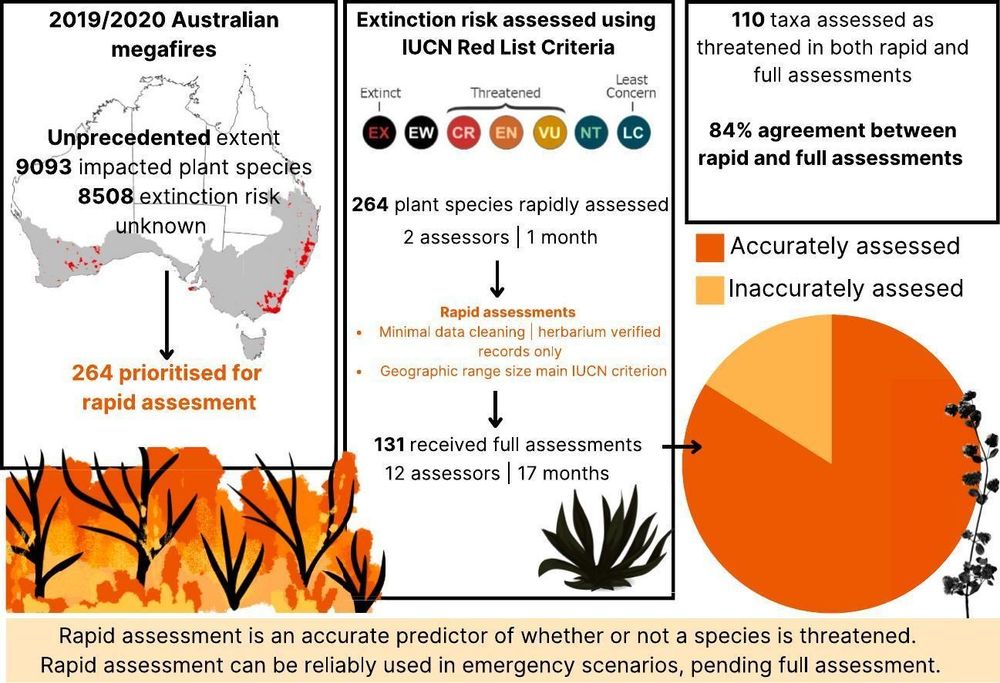
New paper out! After the 2019-2020 #fires in Australia our team undertook #IUCN Red List assessments of fire affected #plant species, to handle the volume we undertook paired rapid and full assessments and compared their accuracy 1/4
doi.org/10.1016/j.bi...
12.05.2025 07:43 —
👍 27
🔁 14
💬 1
📌 0
Thanks to my awesome coauthors Dr Chantelle Doyle @saltandbrine.bsky.social, Dr Amy-Marie Gilpin and Associate Professor Mark Ooi @markooiecol.bsky.social. And thanks to the Editorial team and reviewers at @ausjbotany.bsky.social their input was invaluable. 5/5
#bees #varroamite #plantconservation
11.03.2025 01:39 —
👍 5
🔁 0
💬 0
📌 0

Honeybee visitation and native plant pollination Australia
Honeybee visitation and native plant pollination Australia What insect pollinators are visiting flowers in your area? Are the pollinators European honeybees or are they something else? As varroa mite ...
To get started we are launching a citizen science project on iNaturalist where anyone can contribute images of honeybees or native pollinators visiting native flowers so we can have a baseline for how flower visitation changes before and after varroa mite reaches different parts of the country 4/5
11.03.2025 01:39 —
👍 11
🔁 7
💬 1
📌 0
There is a huge need for more research on pollination in native species and support for existing work. Collection of baseline data is crucial as is monitoring already threatened species. There may also be unexpected impacts arise through interactions with other threats like fragmentation or fire 3/5
11.03.2025 01:39 —
👍 4
🔁 2
💬 1
📌 0

A figure showing the impending spread of varroa mite across Australia and the possibly positive effects of a reduced honeybees on fruit set for some native plant species
We found a decline in feral honeybees will be good news for some plants and bad news for others. But we found major gaps in our knowledge of how honeybees influence native plant pollination and pollinators. The loss of feral honeybees due to varroa mite is an opportunity to fill these gaps 2/5
11.03.2025 01:39 —
👍 3
🔁 1
💬 2
📌 0
Varroa mite arriving in Australia has been a big worry for agriculture and bee keeping but it will also result in a massive decline in feral honeybee populations. This will affect many native plant species visited by honeybees, our new paper aimed to understand what those effects might be 1/5
11.03.2025 01:39 —
👍 15
🔁 7
💬 1
📌 1

Preprints often make news. Many people don’t know what they are
The public needs context about unreviewed manuscripts, survey suggests
There are many issues with preprints, but one of the biggest is when they are seen as credible before being peer-reviewed.
This is potentially very dangerous. A 🧵
🧪 #SciPub #AcademicSky
10.01.2025 18:52 —
👍 151
🔁 45
💬 14
📌 12

Around 9,000 species have already gone extinct in Australia and we’ll likely lose another this week – new study
A new study estimates there have been more than 9,000 Australian invertebrate extinctions since 1788. Only one has been officially listed.
10 = The officially recognised number of #extinct Australian #invertebrates.
We show the actual number is likely much higher, 9,000+ species. AND 1-3 invertebrate species are being lost each week.
This level of loss is not sustainable. This is a wake up call 🌍🧪
theconversation.com/around-9-000...
10.12.2024 22:06 —
👍 27
🔁 9
💬 0
📌 2
Thanks to everyone who came, if you still have questions or just want to chat and see me around #ESAus2024 come say hi.
10.12.2024 21:23 —
👍 10
🔁 1
💬 0
📌 0

Overcoming Major Barriers in Seed Ecology Research in Developing Countries | Seed Science Research | Cambridge Core
doi:10.1017/S0960258523000181
03.02.2024 17:41 —
👍 9
🔁 4
💬 0
📌 1
While questions still remain around this case study, we identified some easy steps that can be taken to improve the outcomes for threatened species. More importantly we hope and believe our conceptual model can help examine similar questions of threat management and species conservation. 4/4
19.11.2024 21:33 —
👍 0
🔁 0
💬 0
📌 0

Our conceptual model considered 5 key aspects required for threat management to be applied to species and found that for each aspect there was evidence that the policy had been effective but also was also falling short of achieving threat mitigation for all species that needed it. 3/4
19.11.2024 21:33 —
👍 0
🔁 0
💬 1
📌 0