Adam Kampff’s passion for understanding and explaining the world was unmatched. Living by example and not ever compromising on his dreams, Adam was uncanny in making people realize they can learn and understand anything and everything. Keep his dream alive!
In his own words: tinyurl.com/ye29csw3
15.12.2025 13:16 —
👍 39
🔁 11
💬 1
📌 0
Fellows Positions | Cold Spring Harbor Laboratory
CSHL Simons Fellow in NEUROSCIENCE Cold Spring Harbor Laboratory (CSHL) is seeking to fill a Cold Spring Harbor Laboratory Fellow position in the area of NEUROSCIENCE (experimental and/or computationa...
Come join us as a CSHL-Simons Fellow!
supporting bold research programs aimed at tackling fundamental questions across all Neuroscience areas, from NeuroAI to brain body interactions. CSHL Fellows are appointed for 3-5 years and direct their own research groups.
www.cshl.edu/about-us/car...
25.10.2025 13:17 —
👍 10
🔁 2
💬 0
📌 0

Apply to the new CSHL grad program in BioAI/neuroAI!
(Masters degree or equivalent required in a quantitative area such as computer science, physics, mathematics, or engineering)
www.cshl.edu/phd-program/...
22.10.2025 23:59 —
👍 29
🔁 14
💬 0
📌 0
Human intelligence is overrated and not a useful yardstick for AI - a polemic. markusmeister.com/2025/09/15/w...
15.09.2025 03:15 —
👍 20
🔁 9
💬 2
📌 0
Hi Weijian - it would be great if you could join next year - we were indeed discussing having 2p miniscopes on site as well :)
04.07.2025 10:47 —
👍 1
🔁 0
💬 1
📌 0

@trose-neuro.bsky.social @daniobrain.bsky.social @neurovenki.bsky.social @naoshigeuchida.bsky.social @olveczky.bsky.social @benjulab.bsky.social @jvoigts.bsky.social @asheshdhawale.bsky.social @danielavallentin.bsky.social @andreasjkeller.bsky.social
28.06.2025 16:39 —
👍 10
🔁 0
💬 0
📌 0
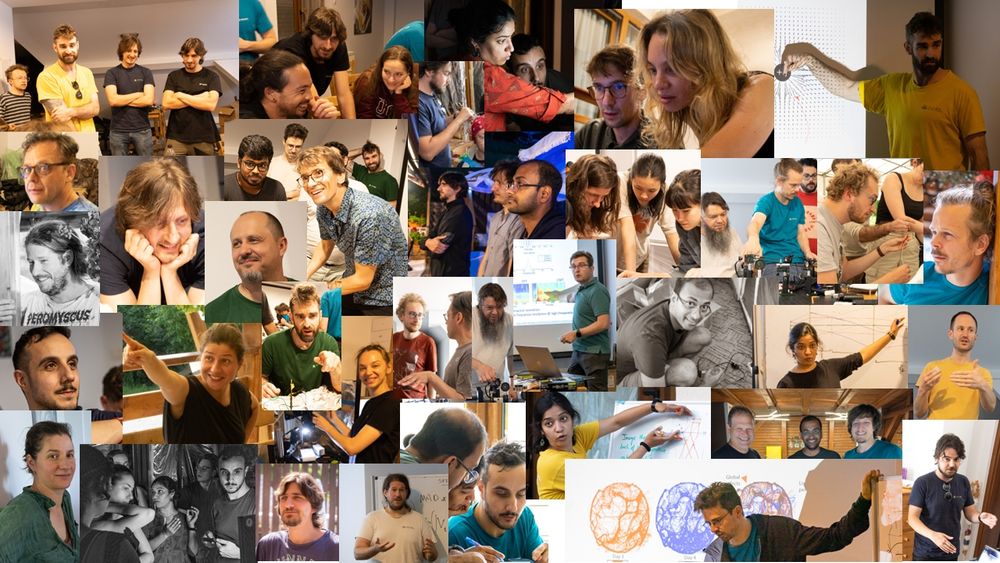
...all due to passion and the enthusiasm of the wonderful TAs and lecturers that make TENSS happen (only some with handles here): @pgupta-cshl.bsky.social @open-ephys.org @antblot.bsky.social @brunopichler.bsky.social @mtkostecki.bsky.social @neuroetho.bsky.social @alecamera.bsky.social
28.06.2025 16:34 —
👍 18
🔁 4
💬 2
📌 0
 26.06.2025 13:16 —
👍 3
🔁 0
💬 0
📌 0
26.06.2025 13:16 —
👍 3
🔁 0
💬 0
📌 0
 26.06.2025 13:14 —
👍 2
🔁 0
💬 0
📌 0
26.06.2025 13:14 —
👍 2
🔁 0
💬 0
📌 0

the 2025 TENSSies...juggernaut joy, enthusiasm, curiosity, playfulness and journey of discovery.
26.06.2025 13:13 —
👍 9
🔁 1
💬 2
📌 1

ongoing...a new edition of TENSS (www.tenss.ro). thanks to the wonderful people that make it happen yet again!
05.06.2025 13:38 —
👍 13
🔁 1
💬 1
📌 0
:)
19.05.2025 12:50 —
👍 1
🔁 0
💬 0
📌 0

In Upset, Centrist Wins Romania’s Presidential Election
In Upset, Centrist Wins Romania’s Presidential Election www.nytimes.com/2025/05/18/w...
19.05.2025 01:05 —
👍 6
🔁 0
💬 1
📌 0

Exclusive: NSF stops awarding new grants and funding existing ones
US science funder also plans to screen grant applications for compliance with ‘agency priorities’.
BREAKING: NSF has frozen all grant funding, as of yesterday. It's unclear when they will resume funding awards, or why the pause has been put in place. www.nature.com/articles/d41...
01.05.2025 22:58 —
👍 1316
🔁 969
💬 39
📌 171

Inching closer to understanding the physical, neural and perceptual odor spaces. Check out our progress on high-throughput mapping of odorant receptors (OR) to glomeruli and odor responses at the @achems.bsky.social poster tomorrow from Zarmeena, Kira, Walter and @alexkoulakov.bsky.social.
24.04.2025 00:20 —
👍 9
🔁 0
💬 0
📌 0
Our first look at midbrain PAG’s role in singing mouse vocal control. When near each other, these mice produce two divergent vocal modes. Same circuits for USVs and Songs—or different ones? Bets were made..some of us bought beers for others! Led by @xmikezheng20.bsky.social & Clifford Harpole. 👇🏽
06.04.2025 02:08 —
👍 44
🔁 16
💬 1
📌 0
We also note that in land vertebrates evolution has invented a parallel pathway (tufted cells-to-AON and striatum) whose responses resemble more closely those of first-order neurons. This representation may improve odor intensity decoding and localization, albeit with higher energy costs. 3/3
26.03.2025 10:37 —
👍 0
🔁 0
💬 0
📌 0
We analyze two plausible decoding schemes (firing rate versus spike timing) by which downstream neural circuits can read-out concentration information, ponder on their constraints, and raise experimentally testable hypotheses. 2/3
26.03.2025 10:30 —
👍 0
🔁 0
💬 1
📌 0

An evolutionarily conserved scheme for reformatting odor concentration in early olfactory circuits
Understanding how stimuli from the sensory periphery are progressively reformatted to yield useful representations is a fundamental challenge in neuroscience. In olfaction, assessing odor concentration is key for many behaviors, such as tracking and navigation. Initially, as odor concentration increases, the average response of first-order sensory neurons also increases. However, the average response of second-order neurons remains flat with increasing concentration – a transformation that is believed to help with concentration-invariant odor identification, but that seemingly discards concentration information before it could be sent to higher brain regions. By combining neural data analyses from diverse species with computational modeling, we propose strategies by which second-order neurons preserve concentration information, despite flat mean responses at the population level. We find that individual second-order neurons have diverse concentration response curves that are unique to each odorant — some neurons respond more with higher concentration and others respond less — and together this diversity generates distinct combinatorial representations for different concentrations. We show that this encoding scheme can be recapitulated using a circuit computation, called divisive normalization, and we derive sufficient conditions for this diversity to emerge. We then discuss two mechanisms (spike rate vs. timing based) by which higher order brain regions may decode odor concentration from the reformatted representations. Since vertebrate and invertebrate olfactory systems likely evolved independently, our findings suggest that evolution converged on similar algorithmic solutions despite stark differences in neural circuit architectures. Finally, in land vertebrates a parallel olfactory pathway has evolved whose second-order neurons do not exhibit such diverse response curves; rather neurons in this pathway represent concentration information in a more monotonic fashion on average, potentially allowing for easier odor localization and identification at the expense of increased energy use. ### Competing Interest Statement The authors have declared no competing interest.
New preprint on common algorithms and evolutionary inventions that may account for apparent idiosyncratic encoding of odor concentration across species millions of years apart by taking advantage of divisive normalization: steered by Yang Shen, @arkarupbanerjee.bsky.social and Saket Navlakha. 1/3
26.03.2025 10:27 —
👍 6
🔁 4
💬 1
📌 1

openRxiv has arrived!
We’re thrilled to announce the launch of openRxiv as an independent, researcher-led nonprofit to oversee bioRxiv and medRxiv, the world’s leading preprint servers for life and health sciences.
openrxiv.org/introducing-...
#openRxiv #OpenScience #Preprints #bioRxiv #medRxiv
11.03.2025 13:18 —
👍 407
🔁 231
💬 3
📌 18

How to communicate the value of curiosity-driven research
The burden of proof is on us, as researchers, to explain why what we do is valuable to society.
We must learn to showcase the practical significance of basic research, demonstrating how seemingly arcane investigations yield transformative applications, writes @tonyzador.bsky.social www.thetransmitter.org/outreach/how...
04.03.2025 15:16 —
👍 53
🔁 33
💬 0
📌 2
started by Arka Banerjee, Matthew Koh and Francesca Anselmi and brought together by Sanjeev Kaushalya, @arkarupbanerjee.bsky.social, @pgupta-cshl.bsky.social with help from: D.E. Hernandez, W.G. Bast, P.S. Villar, H. Chae, M.B. Davis, S. Teja, Z. Qu and V. Gradinaru. An expression of team work. 7/7
28.02.2025 03:00 —
👍 0
🔁 0
💬 0
📌 0
This approach also discriminates between different inhibitory inter-glomerular connectivity schemas. We find that short axon (DAT+) cells associated with different glomeruli mediate dense, but heterogeneous (non-uniform) suppression of mitral and tufted cells baseline and odor responses. 6/7
26.02.2025 17:06 —
👍 0
🔁 0
💬 1
📌 0
By targeting optically addressable glomeruli, we identify multiple cohorts of daughter sister mitral and tufted cells driven by parent glomeruli, and reveal sparseness and differential action in the olfactory bulb inhibitory lateral interactions. 5/7
26.02.2025 17:05 —
👍 0
🔁 0
💬 1
📌 0