
Hey Kash Patel & Palantir, I am an Anti Fascist, because I am the opposite of Pro Fascist. F*ck you.
04.10.2025 16:08 — 👍 0 🔁 0 💬 0 📌 0Hey Kash Patel & Palantir, I am an Anti Fascist, because I am the opposite of Pro Fascist. F*ck you.
04.10.2025 16:08 — 👍 0 🔁 0 💬 0 📌 0This is dead simple: Make the app a PWA so you can get it without going through an app store. Hey Joshua, if you read this, hit me up and I'll do if for you if you don't have time. I believe in what you're doing.
03.10.2025 21:53 — 👍 0 🔁 0 💬 0 📌 0Be patriotic! Defend our Republic! Sell your Tesla and Tesla stock!
12.02.2025 16:21 — 👍 0 🔁 0 💬 0 📌 0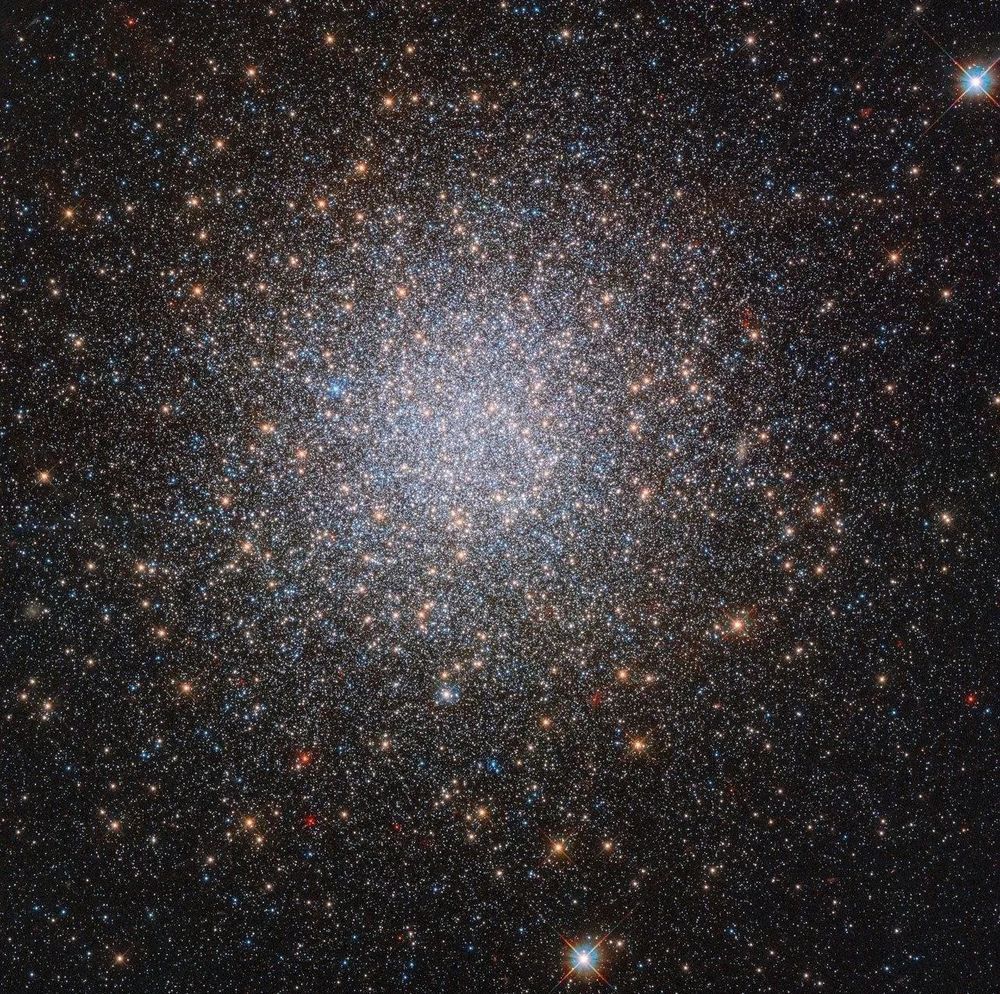
Many stars crowd the image, shining in shades of white, blue, and orange, and more closely concentrated at the center.
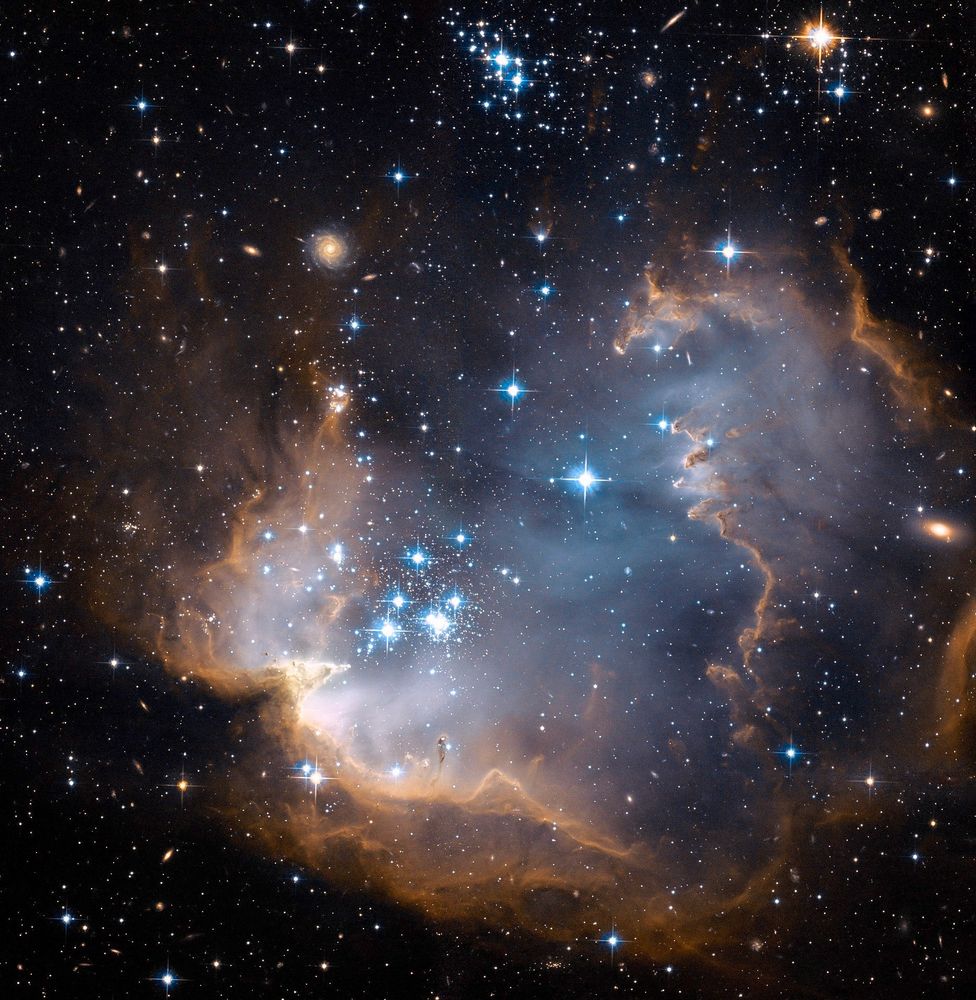
Bright blue stars are in a cluster at the center of the image. They are surrounded by a shell of brownish and burnt orange dust and gas. The shell has ridges that reach towards the stars like teeth. Stars within the dust and gas are hidden from Hubble but visible to Webb in the infrared. A number of more distant galaxies also appear in the background.
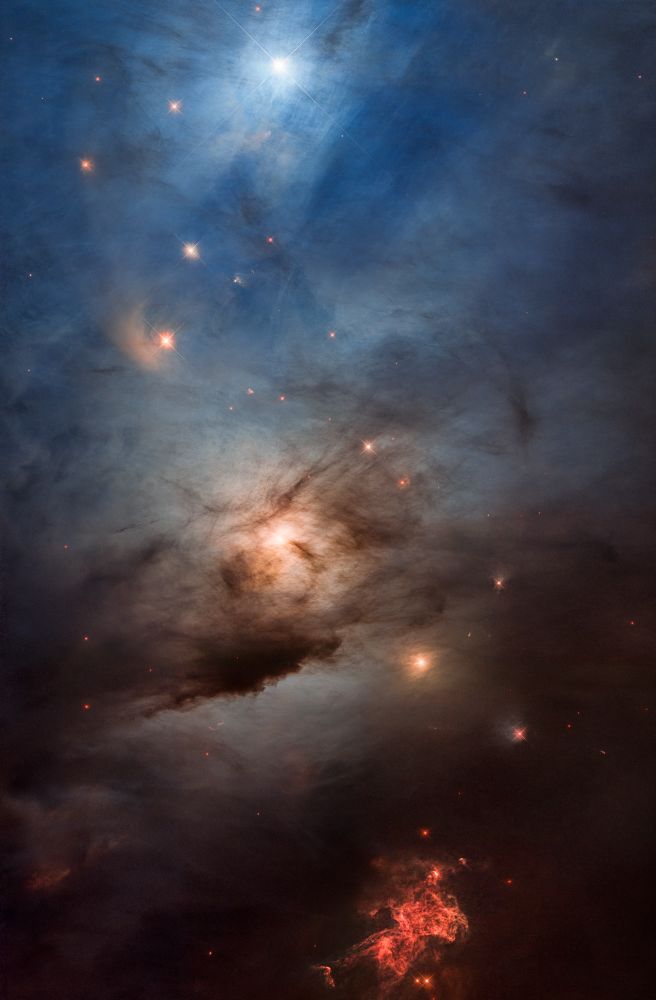
Ferocious stellar winds, likely from the bright blue star at the top of the image, are blowing through a curtain of dust. The fine dust scatters the starlight at blue wavelengths. Farther down, another bright, super-hot star shines through filaments of obscuring dust, looking like the Sun shining through scattered clouds. A diagonal string of fainter accompanying stars looks reddish because dust is filtering starlight, allowing more of the red light to get through. The bottom of the picture presents a keyhole peek deep into the dark nebula. Hubble captures the reddish glow of ionized hydrogen. It looks like a fireworks finale, with several overlapping events.
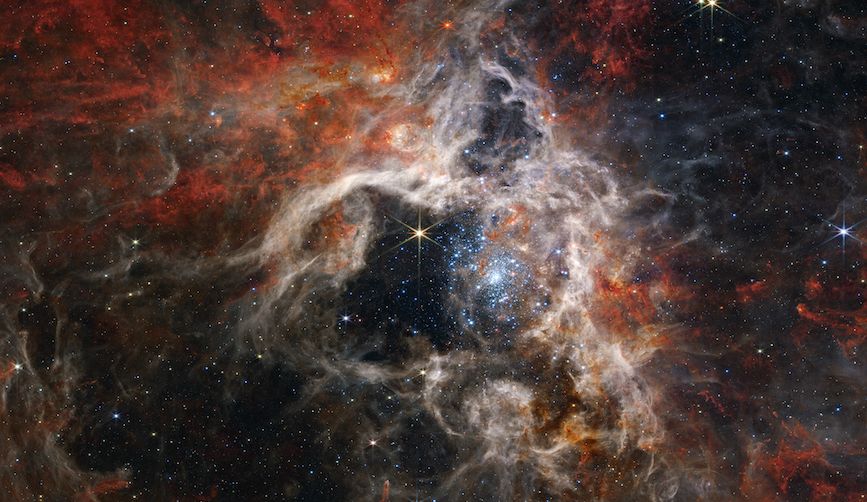
Fluffy tan-colored nebula clouds, with rust-colored highlights, surround a black central area. Within that area, the focal point of the image is one large yellow star with eight long thin points. To the right of this star is a bright star cluster in an oval shape. The stars within the cluster look like tiny pale blue sparkles. The cluster is more densely packed at its core and scatters outward. Towards the bottom of the image, multiple arms appear to spiral out of a cloudy tan knob. Taken together, the structures resemble a spider or a squid. Other blue and yellow eight-pointed stars, as well as distant galaxies, are dotted throughout the image. Credits: NASA, ESA, CSA, STScI, Webb ERO Production Team
i can’t fix anything that’s going on right now, but i can show you some beauty that’s out there… 🌌✨
28.01.2025 21:19 — 👍 9193 🔁 917 💬 213 📌 44I like cats.
28.01.2025 22:01 — 👍 1 🔁 0 💬 1 📌 0
“Roman writers found the relative empowerment of Celtic women remarkable” - so starts this brilliant new research article by Lara Cassidy, Miles Russell et al.
New ancient DNA research suggest that Iron Age communities were matrilocal: women stayed put while men moved away to marry… 1/2

Good morning, Bluesky friends. 💙
16.01.2025 12:54 — 👍 3377 🔁 164 💬 163 📌 13
Leafless tree branches silhouetted against a sky with scattered clouds. The sun shines brightly near the center, creating a halo effect and iridescent colors on the surrounding clouds. The sky transitions from light blue to soft hues of orange and pink in some areas.
January sky.
15.01.2025 20:12 — 👍 1194 🔁 78 💬 25 📌 1
Pillars of Creation (Eagle Nebula) shot with the 32" Schulman telescope on Mount Lemmon. Full image in comments. Enjoy! 🔭
15.01.2025 21:42 — 👍 1196 🔁 114 💬 25 📌 2
The James Webb Space Telescope's Near-Infrared Camera (NIRCam) has unveiled the majestic spiral galaxy NGC 3627 in exquisite detail. The image showcases the galaxy's grand design, with prominent spiral arms winding outwards from a luminous central core. The arms are studded with clusters of young, hot stars, while the core harbors a supermassive black hole. The image also reveals a delicate dusting of interstellar dust lanes, tracing the galaxy's intricate structure.
Almost every white pixel here is a star.
NGC 3627: processed by @thocarp.bsky.social
www.flickr.com/photos/19746...
🔭 🧪

These shimmering cosmic curtains show interstellar gas and dust that has been heated by the flashbulb explosion of a long-ago supernova. The gas then glows infrared light in what is known as a thermal light echo. As the supernova illumination travels through space at the speed of light, the echo appears to expand. NASA’s James Webb Space Telescope observed this light echo in the vicinity of the supernova remnant Cassiopeia A. NASA, ESA, CSA, STScI, J. Jencson (Caltech/IPAC)

These shimmering cosmic curtains show interstellar gas and dust that has been heated by the flashbulb explosion of a long-ago supernova. The gas then glows infrared light in what is known as a thermal light echo. As the supernova illumination travels through space at the speed of light, the echo appears to expand. NASA’s James Webb Space Telescope observed this light echo in the vicinity of the supernova remnant Cassiopeia A. NASA, ESA, CSA, STScI, J. Jencson (Caltech/IPAC)

These shimmering cosmic curtains show interstellar gas and dust that has been heated by the flashbulb explosion of a long-ago supernova. The gas then glows infrared light in what is known as a thermal light echo. As the supernova illumination travels through space at the speed of light, the echo appears to expand. NASA’s James Webb Space Telescope observed this light echo in the vicinity of the supernova remnant Cassiopeia A. NASA, ESA, CSA, STScI, J. Jencson (Caltech/IPAC)

These shimmering cosmic curtains show interstellar gas and dust that has been heated by the flashbulb explosion of a long-ago supernova. The gas then glows infrared light in what is known as a thermal light echo. As the supernova illumination travels through space at the speed of light, the echo appears to expand. NASA’s James Webb Space Telescope observed this light echo in the vicinity of the supernova remnant Cassiopeia A. NASA, ESA, CSA, STScI, J. Jencson (Caltech/IPAC)
my jaw genuinely dropped at how beautiful the new jwst image is.
14.01.2025 19:58 — 👍 8215 🔁 881 💬 107 📌 34
A model image of what our home galaxy, the Milky Way, might look like face-on: as viewed from above the disc of the galaxy, with its spiral arms and bulge in full view. In the centre of the galaxy, the bulge shines as a hazy oval, emitting a faint golden gleam. Starting at the central bulge, several glistening spiral arms coil outwards, creating a perfectly circle-shaped spiral. They give the impression of someone having sprinkled pastel purple glitter on the pitch-black background, in the shape of sparkling, curled-up snakes.

A model image of what our home galaxy, the Milky Way, might look like edge-on, against a pitch-black backdrop. The Milky Way’s disc appears in the centre of the image, as a thin, dark-brown line spanning from left to right, with the hint of a wave in it. The line appears to be etched into a thin glowing layer of silver sand, that makes it look as if it was drawn with a coloured pencil on coarse paper. The bulge of the galaxy sits like a glowing, see-through pearl in the shape of a sphere in the centre of this brown line
The ESA #Gaia mission has delivered the best Milky Way maps to date and taken its last starlight before spacecraft retirement 🔭
www.esa.int/Science_Expl...