Dear Sir Paul,
Re: Royal Society Code of Conduct
I am sure that many scientists have written to you about the specific question of Elon Musk’s Fellowship and whether, under the Royal Society’s Code of Conduct, his retaining that Fellowship is appropriate. I will not rehash these issues. Instead, as a female scientist with extensive experience of activities aiming to increase equality, diversity and inclusion in the engineering and physical sciences sector, I am writing to you (in a personal capacity) to ask you to reconsider the statements you have recently made in this context to the UK press about the Royal Society’s Code of Conduct and how it is applied.
A 2018 report from the joint National Academies of the United States of America, concluded that “sexual harassment is common in academic science, engineering, and medicine” and that “greater than 50 percent of women faculty and staff and 20–50 percent of women students encounter or experience sexually harassing conduct in academia”. This report described codes of conduct that make clear that sexual harassment is unethical and will not be tolerated as a “powerful incentive for change”. The authors also noted that sexual harassment can have significant and damaging effects on the integrity of research. In my own praxis, I have found that clear and consistently-implemented codes of conduct that address these issues make female scientists and engineers safer, and allow them to focus more effectively on their research. For codes of conduct to have such a positive effect, it is vital that sanctions for actions which transgress the code are meaningful and substantial.

I was hence aghast to realise that in an interview with the Financial Times published on 9/1/26, you appear to have suggested that the Royal Society “should only expel fellows if their science proved “faulty or fraudulent or highly defective””. Moreover, in a further interview with the Guardian on 11/1/26 you suggested that the code “may need to be looked at again”, with the implication that your aim would be to remove the option of sanctions on Fellows for reasons not strictly related to faults or defects in their research.
I suggest that changing the Royal Society’s code of conduct so that the likelihood of serious sanctions for sexual harassment is reduced, would directly endanger women who interact with the Royal Society at events or otherwise, and would provide a licence to harass to the already powerful people on whom the Society bestows fellowship. The implications of your words - that under your leadership the only infringements of the code which are likely to receive the sanction of the Fellowship being removed are those related to research misconduct - already risk empowering harassers. You stated, in the Financial Times interview, that “there’s many bad people around, but they have made scientific advances”. Given this awareness of the possibility of bad actors in our scientific community, it is wholly irresponsible to suggest that the Royal Society would not act to sanction these people if they harass more vulnerable scientists.
I am hence writing to request that you retract any suggestion that the Society’s Code of Conduct should be changed so that the only reason a Fellow might be sanctioned by the removal of their Fellowship is “faulty or fraudulent or highly defective” research. This action is necessary to safeguard female scientists, a requirement placed on the Society by safeguarding legislation and UK statutory guidance.
Yours sincerely,
Professor Rachel A. Oliver.
Following coverage over the weekend of Sir Paul Nurse's comments that suggested that the only reason that a Fellow should be expelled from @royalsociety.org is scientific misconduct, I have written to him to explain the risks such an attitude poses of increasing sexual harassment in STEM.
12.01.2026 08:59 —
👍 812
🔁 297
💬 25
📌 29

An Oreo consisting of three black bits and two white centres.
Big day for me.
29.10.2025 20:34 —
👍 2
🔁 0
💬 0
📌 0
*Probably* become a Bayesian…
09.09.2025 19:29 —
👍 2
🔁 0
💬 1
📌 0
Accurate Estimation of Diffusion Coefficients and their Uncertainties — kinisi 2.0.0 documentation
We have just released kinisi-2.0.0. This new release represents a substantial rewrite of the kinisi package: improving stability, reducing technical debt, and most significantly integrating the scipp library. Check it out for all your diffusion analysis needs! kinisi.readthedocs.io
15.08.2025 16:55 —
👍 5
🔁 1
💬 0
📌 0
Can people please stop using black and red symbols to disambiguate different datasets in plots…
02.07.2025 09:22 —
👍 2
🔁 0
💬 0
📌 0

Promotional image for the Royal Society of Chemistry's Materials Chemistry Poster Symposium, featuring a colourful abstract design, happening on 25 November 2025 in London, UK, with a button to submit an abstract.
Early career scientists in materials chemistry – join us for an exciting event. Showcase your research in poster and flash presentations, network, enhance your skills and develop your career. Don’t miss out. Find out more buff.ly/wZKrQIc #ChemSky
17.06.2025 09:01 —
👍 5
🔁 5
💬 0
📌 0
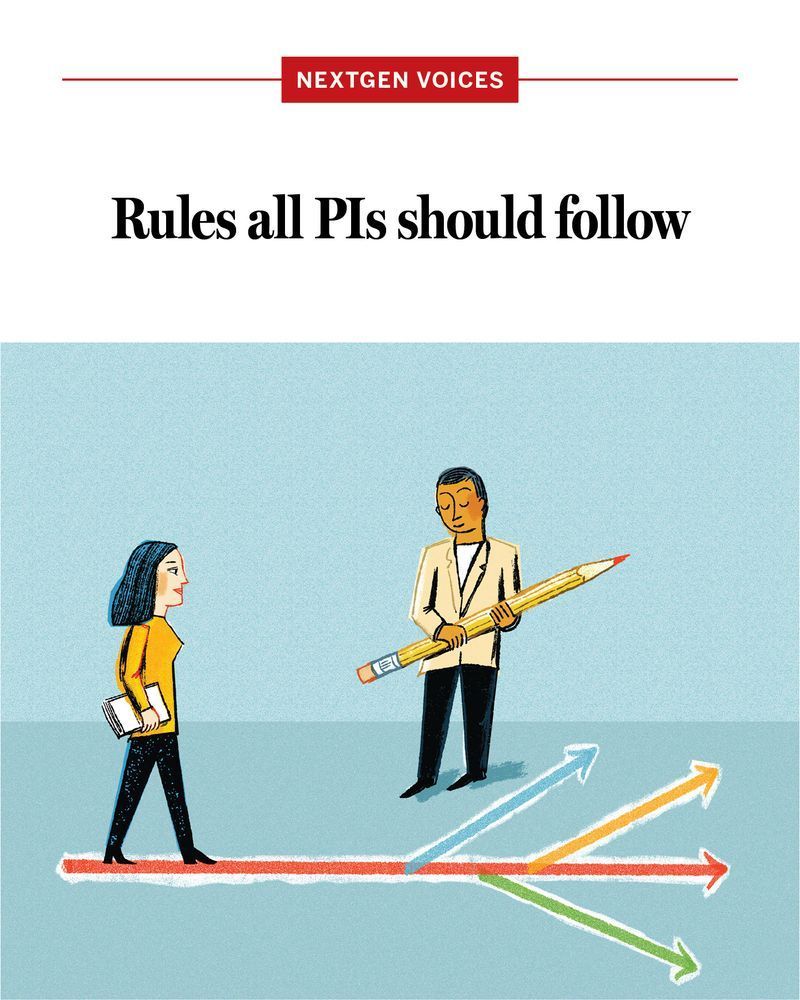
Illustration of two people, one holding a large pencil, the other walking along a path of diverging arrows. Hedline is "Rules all PIs should follow."
#NextGenSci asked young scientists to write a rule that all principal investigators should be required to follow to improve the experience of young scientists in their lab.
Check out their answers on #NationalHigherEducationDay: scim.ag/45zsFEr
06.06.2025 18:56 —
👍 130
🔁 39
💬 1
📌 11
I am a big Julia fan (though the lack of object orientation slightly breaks my brain whenever I try to use it). The Python in Chemistry community is unfortunately named; we aren't just interested in Python, but keen to develop all "digital skills" in chemistry students.
30.05.2025 08:09 —
👍 1
🔁 0
💬 1
📌 0
Allow me to correct myself then: Welcome to the *Scottish* Isles chemistry community! 🏴
30.05.2025 08:07 —
👍 2
🔁 0
💬 0
📌 0
Might have been the raised by Rangers fans coming out…. What is the preferred collective term for these those islands in Ireland? (Asking cause I genuinely thought I had got it right!)
30.05.2025 07:49 —
👍 1
🔁 0
💬 1
📌 0
Welcome to Python in Chemistry! — Python in Chemistry
Welcome to the British Isles chemistry community! Happy to have another “digital” (broadly defined) chemist around. The pythoninchemistry.org network is always looking for people keen on coding.
29.05.2025 21:30 —
👍 3
🔁 0
💬 2
📌 0
How munch will Kingsmill/Hovis pay me for the advertising tagline “Live Laugh Loaf”?
22.05.2025 17:43 —
👍 1
🔁 0
💬 0
📌 0
Great to see Harry’s first paper coming out. Fantastic leadership from Josh to solve this problem (that he had been agonising with for years!).
22.05.2025 10:28 —
👍 0
🔁 0
💬 0
📌 0
Gotcha. mpl-for life ❤️
30.04.2025 12:15 —
👍 2
🔁 0
💬 0
📌 0
What do you mean by “GUI tools vs code based”?
30.04.2025 10:41 —
👍 0
🔁 0
💬 1
📌 0
Come work with me. It will be fun, I promise!
23.04.2025 15:30 —
👍 4
🔁 2
💬 0
📌 0
PhD Stipend/Integrated PhD Stipend In Computational Materials Chemistry
A PhD stipend or integrated PhD stipend in computational materials chemistry is available. Development of new sustainable energy materials, including materia...
Open PhD position in computational materials chemistry
As part of my Villum Young Investigator project "Entropy in materials design: Accelerated discovery of disordered solid electrolytes", I am looking for PhD student to join my group.
Please share with anyone interested!
#compchem #chemsky
07.03.2025 15:00 —
👍 11
🔁 8
💬 0
📌 0

🚀 First Bluesky Post! 🎉 VMD 2.0 Alpha is here! Released today at BPS 2025, this is the biggest update in 30 years—new UI, real-time ray tracing, fast surfaces, UHD & touchscreen support. Monthly updates coming in 2025! Try it now! #VMD #BPS2025 #MolecularVisualization
www.ks.uiuc.edu/Research/vmd...
17.02.2025 06:56 —
👍 115
🔁 42
💬 3
📌 6
CECAM - Quantum and Mixed Quantum Classical Dynamics in Photochemistry
Less than two weeks left to register for the 2025 CECAM Flagship school in computational photochemistry: shorturl.at/xsbEa with lectures from Basile Curchod, Javier Segarra, Javier Cerezo, Roger Bello and myself. Please spread the word!
#compchem #compchemsky
15.02.2025 07:36 —
👍 25
🔁 16
💬 0
📌 1
Is there not already a discussion around stopping publishing there over the “Article Development Charge” (fee to submit if you plan to publish open access)?
11.02.2025 12:25 —
👍 0
🔁 0
💬 0
📌 0
The @acs.org has deleted its website on diversity, equity, inclusion and respect.
www.acs.org/about/divers...
10.02.2025 07:33 —
👍 85
🔁 72
💬 14
📌 55

Screenshot of the results of a Google search for “when does the six nations start”, showing that the first game is today.
🏉 🎶 It’s the most wonderful time of the year 🎶 🏉
31.01.2025 10:01 —
👍 1
🔁 0
💬 0
📌 0
Tillykke! Meget fortjent 👏👏👏
27.01.2025 20:09 —
👍 1
🔁 0
💬 0
📌 0
I'm hearing that NSF panels have been canceled. Did any #ChemSky folks get a cancelation email today? Would appreciate hearing from you for a potential @cenmag.bsky.social article.
Reach me via DM, email (k_vasquez@acs.org) or Signal (kvasquez.12)
27.01.2025 16:34 —
👍 32
🔁 33
💬 1
📌 3