Like other professionals, scientists are considering the impacts of #AI. The @smbmathbiology.bsky.social is no exception. Reinhard Laubenbacher shared his thoughts on how AI could be incorporated into #MathBio in a meaningful way.
Links to the full #BiologyInNumbers episode: smb.org/news/13588558
03.03.2026 20:43 —
👍 3
🔁 1
💬 0
📌 0
Right now, Professor Longhua Zhao from Case Western is giving a talk on fluid-structure interaction.
Please see below for information about joining the seminar.
03.03.2026 16:04 —
👍 3
🔁 2
💬 0
📌 0
Right now, John Metzcar from the Cleveland Clinic is giving a talk titled "GBM-FORECAST: Predicting recurrence in glioblastoma using serial white blood cell counts and patient advocacy influences on my career". Please see below for information to join.
24.02.2026 16:07 —
👍 1
🔁 1
💬 0
📌 0
Original post on fediscience.org
The latest from @smbmathbiology.bsky.social #BiologyInNumbers: @math.onco's own Ranjini Bhattacharya, working with Joel Brown to study the role of #tumor cell-cell interactions in the context of #metabolism with #TheoreticalBiology #MathOnco […]
28.01.2026 13:50 —
👍 4
🔁 3
💬 0
📌 0
In a few minutes, Haridas Das from Oklahoma State University will be giving a talk on modeling infectious disease dynamics in metapopulations.
Please see the link below for more information about joining the talk.
27.01.2026 15:57 —
👍 4
🔁 1
💬 0
📌 0
Society for Mathematical Biology - Landahl Travel Awards
📣 Planning to attend the joint ECMTB-SMB conference in Gratz? Need final support?
Applications for the Landahl Travel Awards from @smbmathbiology.bsky.social are now open!
The closing date is 𝟏𝟓 𝐌𝐚𝐫𝐜𝐡 𝟐𝟎𝟐𝟔.
🔗 smb.org/Landahl-Trav....
16.01.2026 08:45 —
👍 3
🔁 3
💬 0
📌 0
New paper from the lab! Led by PhD student Chris Carlson, with me and Matt Osmond (not on Bluesky), this study explored the effects of genotype-by-environment interactions on the maintenance of genetic variation in mutualisms
24.12.2025 05:46 —
👍 31
🔁 11
💬 1
📌 0
Right now, Dr. Maximillian Newman (University of Chicago) is giving the first Midwest Mathematical Biology Seminar talk for the spring semester, presenting on models of genetic inheritence across the genome.
Please see below for info to join.
13.01.2026 16:04 —
👍 4
🔁 1
💬 0
📌 0

Figure of how the optimal trap plant proportion of the field varies with the attractiveness of the trap plant and how much yield is at risk by the pests
My new paper on the #math of #wildlife friendly #agriculture. Reduce pesticides by using attractive "trap" plants to divert pests. But how many traps maximize yield? onlinelibrary.wiley.com/doi/10.1111/... #MathSky #MathsToday #iteachmath 🌍 Accessible to undergrads @smbmathbiology.bsky.social
13.01.2026 13:58 —
👍 15
🔁 5
💬 0
📌 0

Picture of the conference booth for the Society for Mathematical Biology, which features baseball cards of famous mathematical biologists.
SMB is at JMM! Stop by our booth (#423) to learn more about what we've been up to and to add to your SMB Baseball card collection! #JMM2026 @jointmath.bsky.social
04.01.2026 20:01 —
👍 8
🔁 1
💬 0
📌 1

S3 Ep3: AI or die - with Reinhard Laubenbacher
Podcast Episode · Biology in Numbers · 12/30/2025 · 32m
I am working on my 'recap of 2025' post for the @mathonco.bsky.social blog and found that many of last year's posts had to do with #AI in one form or the other. In this #BiologyInNumbers podcast, @smbmathbiology.bsky.social president Laubenbacher talks about the promises and challenges for us
04.01.2026 02:44 —
👍 6
🔁 4
💬 0
📌 0
Excited to share the first paper from my group with Gianluca Teza (MPI-PKS) and Attilio L. Stella (U Padova)! “Coarse-Graining via Lumping: Exact Calculations and Fundamental Limitations” shows when lumping is exact and when it fails even without approximations. arxiv.org/pdf/2512.11974
16.12.2025 14:34 —
👍 9
🔁 2
💬 0
📌 0
In the last talk for the semester, Tyler Simmons from the University of Minnesota is about to give a talk on "Chemically Self-Assembled Nanorings: Therapeutic Efficacy, Response Variability, and Guiding Principles".
Please see below for information on joining the seminar.
16.12.2025 15:59 —
👍 4
🔁 1
💬 0
📌 0
Validate User
Before 2025 closes out, I wanted to make a thread on my proudest recent paper! (Ok, it's from 2024, but I haven't done a bluesky thread on it before).
Allen et al. (2024) "Nonlinear social evolution and the emergence of collective action", PNAS Nexus
academic.oup.com/pnasnexus/ar...
12.12.2025 20:34 —
👍 22
🔁 5
💬 2
📌 1

Edwin Thompson Jaynes Fellowship
Applications are open until December 15 for the Ed T. Jaynes Postdoctoral Fellowship in Physics. You’ll have the freedom and support to pursue your own research ideas independently.
24.11.2025 19:58 —
👍 2
🔁 2
💬 0
📌 0
University Assistant/Associate Professor in Control Theory and Systems Biology
Applications are invited for a University Assistant/Associate Professorship in the broad area of Control Theory and Systems Biology. The successful candidate will join the Control Group
We are opening a FACULTY POSITION (tenure track, permanent) in the University of Cambridge at the interface of control and biology, interpreted broadly. Theorists and wet lab quantitative biologists with backgrounds in control, EE, applied math, ... apply by Jan 28!
www.cam.ac.uk/jobs/univers...
03.12.2025 12:19 —
👍 42
🔁 41
💬 0
📌 1
Right now, Binan Gu from WPI is giving a talk on " Modeling Cell Transport in Deformable Microenvironments: From Engineered Scaffolds to the Blood–Brain Barrier".
Please see the link below for information to join the seminar.
09.12.2025 16:01 —
👍 3
🔁 1
💬 0
📌 0
Interested in cell adhesion, evolution of multicellularity, or developing tools for emerging marine models?
My lab at UM is hiring a postdoc, and the application is now open:
🔗 tinyurl.com/28jvu4aa
If you know anyone looking for a postdoc, please pass this along!
08.12.2025 18:37 —
👍 54
🔁 50
💬 0
📌 2
Looking forward to the Modern Coexistence Theory workshop tomorrow.
Please repost :)
07.12.2025 21:54 —
👍 23
🔁 27
💬 0
📌 0
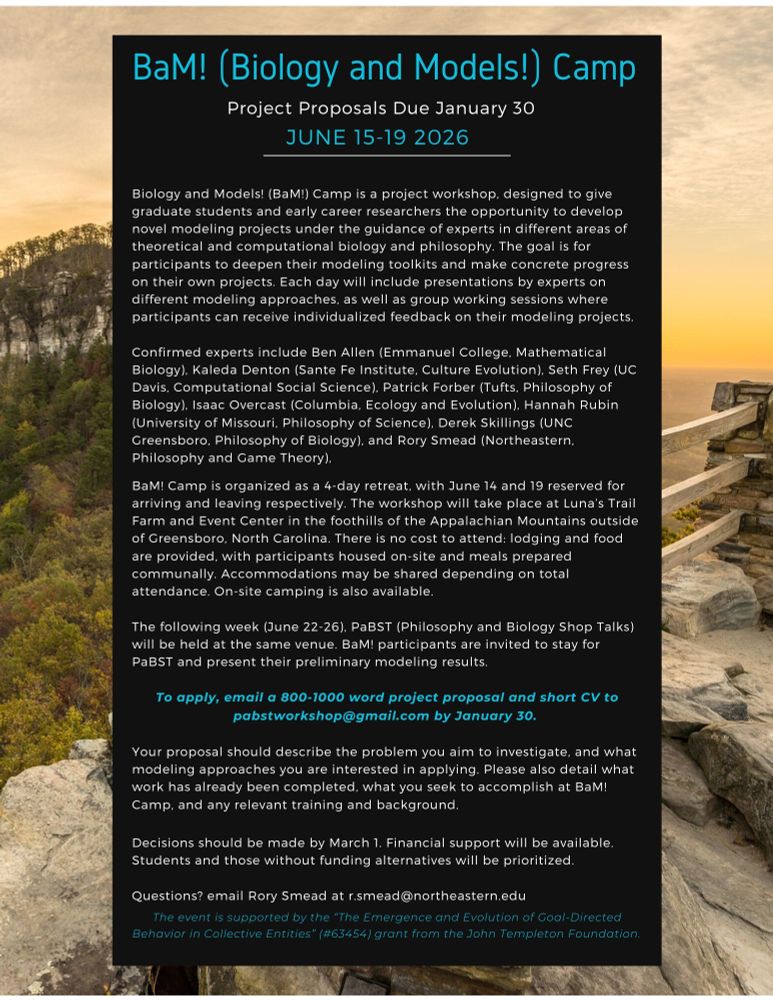
Hi everyone! I'm co-organizing this retreat/workshop June 15-19 for those looking to get started in mathematical/computational modeling of biological processes. Location is a beautiful farm in NC. Please share with students and others who want to build modeling skills. Interdisciplinarity welcome!
02.12.2025 19:00 —
👍 46
🔁 26
💬 1
📌 2
Right now, @tedloch.bsky.social from Rice University is giving a talk on a coordination game approach to studying symbiosis.
Please see below for more information about joining the talk.
02.12.2025 16:02 —
👍 4
🔁 1
💬 0
📌 0

CIFAR MacMillan Multiscale Human School - CIFAR
Follow Us FaceBook Twitter YouTube LinkedIn Instagram CIFAR MacMillan Multiscale Human School The CIFAR MacMillan Multiscale Human School brings together PhD students and postdoctoral fellows […]
Great opportunity! Deadline DEC 17
The CIFAR MacMillan Multiscale Human School explores interdisciplinary models to build a virtual twin that accurately capture development. cifar.ca/next-generat...
@smbmathbiology.bsky.social
@stemcellnetwork.ca
@the-node.bsky.social
@biologists.bsky.social
29.11.2025 13:11 —
👍 5
🔁 4
💬 0
📌 1

Big congratulations to Dr Nikhil Sharma on receiving the Kiel Life Science Postdoc Award 2025! His outstanding work in theoretical biology and evolutionary graph theory makes us proud. Well deserved! 👏 #KLS #MPIEvolBio
www.evolbio.mpg.de/3847270/kiel...
(Photo: Christian Urban, Kiel University)
26.11.2025 07:10 —
👍 25
🔁 4
💬 0
📌 0


