A simple embroidered caterpillar or worm in shades of cream and golden yellow, on an off-white ribbed silk fabric with broken strips of silver. Tips of embroidered leaves, mostly cropped out, appear to the right and left of the animal.
Today’s challenge: locate (and cite) the best, earliest possible definition of the thread - gimp, a silk floss core tightly wrapped with contrasting silk floss - that was couched to make this delightful little caterpillar on the circa 1600 Bacton Altar Cloth.
#TextileTuesday
30.09.2025 11:41 — 👍 4 🔁 0 💬 0 📌 0

Inside an arched stone recess in a church wall, the nearly colourless carved stone effigy of a cross-legged knight lays on a plain stone slab. Both hands grasp the hilt of his sword. His legs have been broken off and battered and his face worn until almost featureless. His head, neck, arms, hands and lower legs are carved in a texture that represents linked metal mail while his torso and thighs are covered with the flowing facsimile of his fabric surcoat.

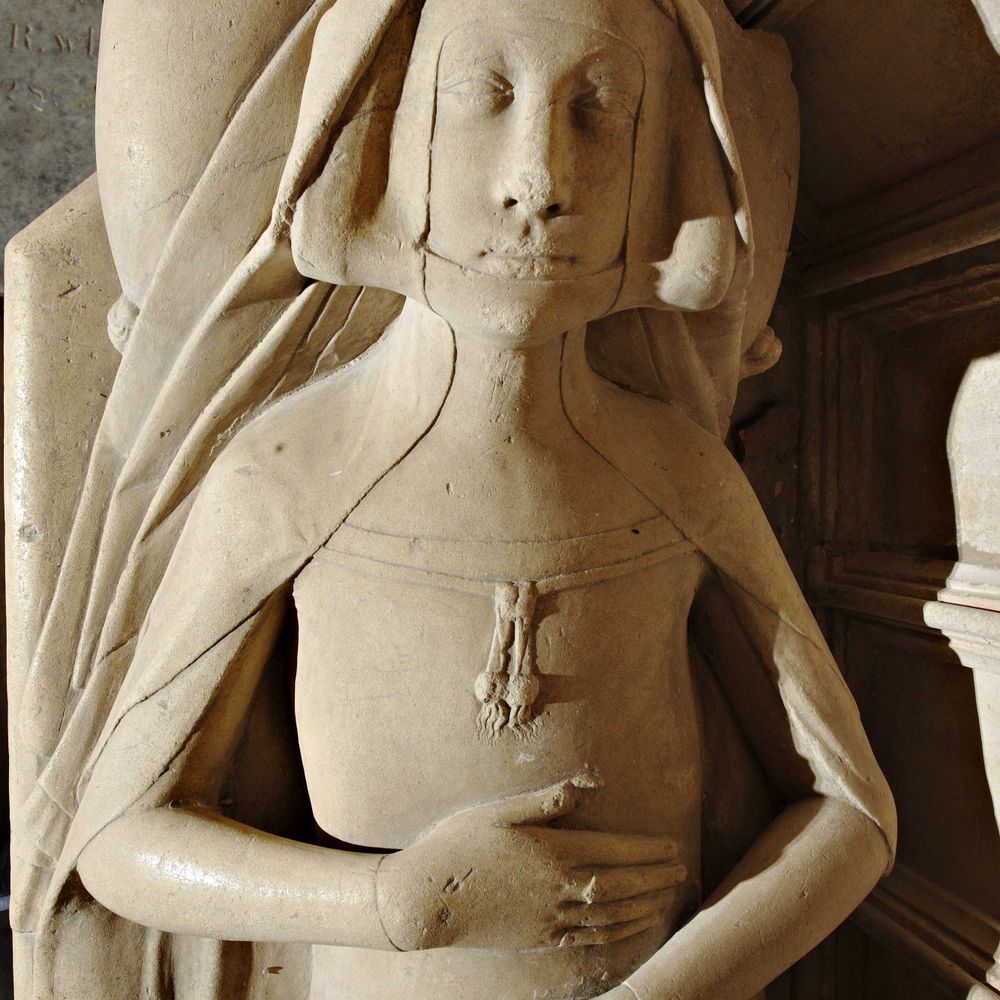
Detail of the head of the carved stone effigy of a knight as viewed from above his left shoulder. His head and neck, except his face, is encased in the round linked pattern of a medieval mail coif. A flat band on his forehead encircles his head. His head rests on two battered pillows and the eroded face has lost all human features.
Explored All Saints, Brixworth, Northamptonshire, and admired the effort put into carving the mail on this effigy. Probably represents Sir John de Verdun (1299 - 1376) first Baron Verdun, Lord of Brixworth. If only I could see it in its original brightly coloured paint. #MonumentsMonday
29.09.2025 12:54 — 👍 4 🔁 0 💬 0 📌 0

A museum display of two Roman weaving tablets made of thin square pieces of bone with four holes, one near each corner. The larger tablet also has an inscribed cross dividing the square into quadrants. Shrewsbury Museum and Art Gallery

Detail of an illuminated medieval image showing a young girl draped in a cloak working on a narrow woven band on a bow-shaped wooden frame tucked under her left arm. Her left hand manipulates a small stack of square weaving tablets on a gold warp while her right hand holds a weaving sword for beating the weft into the warp. From Sermologium, produced in northern Germany c 1320-50 showing scenes from the life of the Virgin. Bodleian Library MS. Douce 185 f. 35v, University of Oxford. https://digital.bodleian.ox.ac.uk/objects/43f84a7d-2160-4cfc-9e68-c3981788a4f6/surfaces/b2dede3e-49fb-4c3f-91cd-84c000bb829d/
Archaeological artifacts gain context when paired with historical depictions of them in use, and come alive when practitioners recreate and use them. Bone tablets for weaving narrow wares (Roman Britain) and an illuminated detail of a girl weaving with tablets (N Germany c1320-50). #TextileTuesday
13.05.2025 14:57 — 👍 9 🔁 2 💬 1 📌 0
Hmm, I suppose that's also true - but is it more of an issue because so many people try to use ink they think they can wash out?
24.04.2025 16:18 — 👍 0 🔁 0 💬 1 📌 0

An embroidered butterfly-like insect in yellows, greys, and browns flies between loops of elaborate, shiny gold metal stitching arranged in a coiling vine pattern. The threads making its lower body are missing, revealing the outline of the pattern that had been drawn onto the linen, and empty stitch holes. To its lower right, a borage flower embroidered in shades of blue and white grows from one of the looping golden vines, but its black flower centre is missing, again revealing ink lines. Bits of other embroidered leaves, flowers, and fruits are also visible in a wide range of colours. Embroidered jacket object number 23.170.1, Metropolitan Museum of Art.
Modern artists recreating historic textiles set themselves impossible goals, like trying to find washable inks to wipe away the patterns drawn on to guide embroidery. They didn’t do it - why should we?
Detail of an early 17th century English jacket at the Metropolitan Museum of Art.
24.04.2025 11:08 — 👍 17 🔁 3 💬 1 📌 0

Detail of Elizabeth of York kneeling at prayer before a table covered with cloth of gold, on which sits an open book and a sovereign’s orb. Behind her kneel four daughters in matching dress. https://www.rct.uk/collection/401228/the-family-of-henry-vii-with-st-george-and-the-dragon
Faces essentially identical. Ermine to show royal status. Hats obscured by crowns (imagined, or never worn that way), hair down for maidens. Gowns covered with a symbolic “sideless surcoat” to indicate that they are queens and princesses. I can see jewellery and cuffs, but little else. Sigh. 2/2
23.04.2025 08:46 — 👍 5 🔁 0 💬 1 📌 0

In a landscape with fantastic castles in the background, Saint George on horseback attacks the flying dragon before Princess Cleodolinde, who holds a lamb. In the foreground are two tents with an angel holding open the flaps. Before the tents Henry VII and Elizabeth of York kneel facing each other with their children, sons behind Henry and daughters behind Elizabeth. https://www.rct.uk/collection/401228/the-family-of-henry-vii-with-st-george-and-the-dragon
This #SaintGeorge with the family of Henry VII and Elizabeth of York is a missed opportunity. Nothing wrong with the saint and dragon–that’s dramatic enough–but the utterly generic, stylised royal family in formulaic fashion saddens me; I want detailed portraits and contemporary clothing. 1/2
23.04.2025 08:46 — 👍 6 🔁 0 💬 1 📌 0

The first new leaves and flowers burst forth from the twig of a maple tree, a bright yellow-green in the sunshine.
I travelled Shropshire last week absorbing springtime to the rhythm of this Robert Frost poem:
Nature’s first green is gold,
Her hardest hue to hold.
Her early leaf’s a flower;
But only so an hour.
Then leaf subsides to leaf.
So Eden sank to grief,
So dawn goes down to day.
Nothing gold can stay.
14.04.2025 13:26 — 👍 3 🔁 0 💬 0 📌 0

Detail of a wooden gable from an Elizabethan house now in a museum. The wood is dark and the lower beam is carved with decorative leaves, vines and grapes, and the date 1570 below a merchants mark and the letters D and LL for David Lloyd who commissioned the building.
Detail of the carving above. The square in the middle has the initials D and LL for David Lloyd, who commissioned this building, around his merchant's mark, with the date below. #WoodcarvingWednesday
09.04.2025 06:42 — 👍 6 🔁 0 💬 0 📌 0

A triangle of wood from the gable of an Elizabethan house sits in a museum surrounded by signage. The wood is dark and on two sides carved with decorative leaves, vines and grapes, and the date 1570 below a merchants mark and the letters D and LL for David Lloyd who commissioned the building. Behind the wood are old photos of the building before it was dismantled.
Admired the carved beams of this gable helpfully dated 1570, now in the Shrewsbury Museum. The sinusoidal pattern with pairs of leaves above and below, here with grape clusters between the leaves, is also commonly found decorating carved effigies. Was this a carvers pattern or also used on textiles?
09.04.2025 06:42 — 👍 7 🔁 0 💬 2 📌 0
Yes, might I be able to help? My focus is primarily England but of course I have to compare it to continental fashion.
27.03.2025 13:55 — 👍 1 🔁 0 💬 2 📌 0
The kids jousting with hobby horses and pinwheels are absolutely delightful. I love these little treasures preserved in churches, and also the magic of stumbling across them unexpectedly.
17.03.2025 18:26 — 👍 7 🔁 2 💬 0 📌 0
Looks like you can still sign up to attend, this Friday evening in Fulbrook, Oxfordshire. Talking about both early Tudor fashion and Elizabethan botany: fulbrookparishcouncil.gov.uk/wp-content/u...
17.03.2025 12:42 — 👍 2 🔁 1 💬 0 📌 0

A late medieval alabaster carving of a seated man in the hood and gown of a bedesman, holding prayer beads in front of his torso in both hands. He is bearded, likely representing an older person, and his gown hangs in loose folds all the way to his ankles. His left hand has been broken off. The off-white stone is unpainted.
When I go to churches, seems like I take photos of everything. But today I needed a photo of someone wearing a medieval hood, and so this little bedesman from the side of the c.1502 tomb to Richard Croft and Ann Fox in Chipping Norton, Oxfordshire, just made it into the slide show of my next talk.
17.03.2025 12:42 — 👍 11 🔁 4 💬 1 📌 0

An unpainted wooden door with ornate black iron hinges set in the cream-coloured stone of an arched doorway on the outside of a church. The iron hinges are huge, with branching scrolls, and each cover about a quarter of the height of the door. They have clearly been moved from one side of the door to the other, because lighter-coloured wood shows the exact shape of the hinges, but from the left side, while now the hinges are on the right. The overlap of the light wood “shadow hinges” and dark iron real hinges is artistic. The stone surrounding the door is aged and worn, coloured greens and yellows in places by moss and lichens.
This delightful door from St Mary’s, Goudhurst, Kent, apparently needed to be rehung to swing the other direction, but not replaced, leaving an artistic shadow from the iron hinges. One of the very first parish churches I visited, February 2013, and still such a happy memory. #ADoorableThursday
13.03.2025 09:54 — 👍 26 🔁 1 💬 2 📌 0

The branching shadow of a tree falls diagonally across a brightly lit field of daffodils in two shades of yellow.

A bright blue sky full of puffy white clouds over a distant view of a city, taken from an elevated perspective. In the foreground, paved paths, green lawns, and park benches. In the middle ground, grand 17th century architecture made of fine white stone: a pair of domed towers on two symmetrical buildings with gables on the roofs and arcades of columns along the ground. In the background, a cluster of modern skyscrapers visually fills the space between the two 17th century buildings.
Some daffodils for a seasonal #FlowersonFriday, taken three years ago in front of the National Maritime Museum, Greenwich, following a visit to that and the Queen’s House. Plus a lovely view taken there of the Isle of Dogs, viewed through the twin spires of the Old Royal Naval College.
07.03.2025 09:34 — 👍 7 🔁 0 💬 0 📌 0

Large, ornate Jacobean tomb in a chapel. In front of an off-white wall, from the ceiling height down, is: a classical looking sculpture on a pedestal with children pressed close; two cherubs with trumpets; a heraldic shield in red and gold decorated with 3 circles and 3 crescent moons in front of ornate cresting and flanked by two more classical figures; a frieze with a great many elite early 17th century men arranged in rows either side of another man in a pulpit - this frieze is flanked by two more cherubs and two more classical statues; two bearded men in armour stand either side of a large inscription, over which are carved a skull and human figures symbolic of youth and old age - this portion his framed by four black columns with ornate capitals; the next stage, the effigy of the deceased, is obscured by an iron railing surrounding the tomb.
Thomas Sutton died in 1611 and is buried in the Charterhouse Chapel. His tomb is rather a bit grander, but harder to photograph, given the railing. I wonder, though, would John Dudley’s monument still stand had it not been cared for in his wife’s second husband’s honour?
#MonumentsMonday
03.03.2025 16:09 — 👍 9 🔁 3 💬 0 📌 0

Detail of an elaborate early 17th century tomb featuring the reclining effigy of a bearded man wearing long, fur-lined robes and a white starched ruff, hands clasped in prayer. Above him is an inscription in gold on black stone, flanked by the lower portions of two armoured figures. Ornate ribbons, clusters of fruit, scrolls, and moulding cover the tomb, which is made of many different shades of stone, and also painted with great care.
“Several Prelates and other Persons educated at Charter House School, the Foundation of Thomas Sutton, Esq. by their respectful contributions caused this tomb to be repaired, A.D.: 1808.” This made me look up her second husband, who I found I had visited some seven years earlier. 🧵
03.03.2025 16:09 — 👍 8 🔁 3 💬 1 📌 0

Detail of the tomb pictured above, showing the stage with the figures of the deceased and his family. The man kneels at the left, facing to the right, wearing full armour and with a plumed helmet on a pedestal behind him. In the centre of the space is a black column, and the sides are framed by red marble columns, all with ornate gold-painted capitals. On the right kneels a woman facing left in a long, loose gown, and behind her a much smaller daughter, similarly dressed. All figures are on red and gold cushions, hands clasped in prayer. An inscription with his date of death is over the left side, but the right side space is blank.
with your first spouse, especially if you’ve erected a beautiful monument there. I notice that no one carved in her date of death. Maybe it was painted in and has since flaked away; maybe not. But the additional panels on the tomb tell why it was restored instead of dismantled: 🧵
03.03.2025 16:09 — 👍 4 🔁 0 💬 1 📌 0

A large, ornate Elizabethan tomb, finely carved and fully 3-dimensional, primarily in natural creamy stone colour but with parts painted black, red, and around the heraldry, many coloured. The base of the tomb is a large chest with three panels for inscriptions and much decorative moulding. Above this is a shallower portion with inscriptions above and below three figures: a man in armour, kneeling at prayer and facing his wife and daughter, also kneeling. Above this is a fancy gable shape pediment on top of which is carved a large rondel with complex heraldry and an ornate crest.
Tombs survive for such interesting reasons. Take John Dudley: after he died in 1580, this fine tomb was erected. His widow Elizabeth remarried Thomas Sutton, but when she died in 1602, she too was buried here, in Old St Mary’s, Stoke Newington. That’s not so unusual, asking to be buried 🧵
03.03.2025 16:09 — 👍 10 🔁 4 💬 1 📌 0

A medieval wooden carving of an elephant wearing a saddle with a castle complete with central tower and walls on its back, standing between two stylised trees. The wood is a dark red-brown and the elephant's trunk is broken, lost. At the top of the image is the wooden edge of the small seat under which this decoration was carved.
Is anything more whimsically delightful and anatomically questionable than a medieval elephant? Maybe one with a castle on its back, like this 15th century misericord in Manchester Cathedral. I love how the carver felt compelled to give it horse’s hooves and bat-wing ears. #WoodcarvingWednesday
26.02.2025 11:21 — 👍 13 🔁 0 💬 1 📌 0
I'm submitting to Medieval Clothing and Textiles, published by Boydell and Brewer.
21.02.2025 13:48 — 👍 1 🔁 0 💬 0 📌 0

A squat t-shaped cream table cover, laid flat, covered with colourful embroidered Elizabethan botanical motifs, three rows on each panel. Around the plants smaller animals - mammals, fish, birds, insects, etc. - are embroidered.
I’ve been ignoring social media, trying to finish my first full-length paper about the Bacton Altar Cloth, but I just couldn’t miss another #FlowersonFriday. And while I’m pretty sure there aren’t any forget-me-nots in the embroidery, botanical accuracy in art is very much on my mind. 4/4
21.02.2025 11:51 — 👍 6 🔁 0 💬 1 📌 0

A cluster of forget-me-not flowers, five light blue petals with yellow centres, with leaves of the plant in the background. Photo by Anne Burgess, CC BY-SA 2.0, via Wikimedia Commons
She noted the five round petals and ridge around the concave flower centre - but is that enough to name this flower? What about the leaves, which on the cup are ovate and toothed, but on the plant are oblong and smooth? When is a medieval flower a specific plant, and when a decorative motif? 3/4
21.02.2025 11:51 — 👍 4 🔁 0 💬 1 📌 0

Detail of the raised goldwork on a medieval goblet showing a twisting stem, two leaves, and a five-petaled flower.
In connection with its shimmering appearance in the British Library exhibition about Medieval Women, I went to a fascinating online lecture by Dr Mary Franklin-Brown in which (in part) she dove into the identities of plants on this cup, and identified this little flower as a forget-me-not. 2/4
21.02.2025 11:51 — 👍 3 🔁 0 💬 1 📌 0

A dark photo of a medieval golden goblet covered with raised ornamentation: grape vines and flowers on the bowl, a crown-like ornament around the foot.

A dark photo of a cone-shaped golden medieval goblet cover. It has similar raised ornamentation to that on the cup: grape vines and flowers on the bowl, a crown-like ornament around the lower edge, and a Tudor rose on the finial on top.
The mid-15th century silver-gilt Foundress’ Cup from Christ’s College, Cambridge (bequeathed by Margaret Beaufort, though originally made for Eleanor Cobham and Humpfrey, Duke of Gloucester) and its ornate lid, refashioned by the King’s Mother to include the Tudor Rose on top. 1/4
21.02.2025 11:51 — 👍 11 🔁 3 💬 1 📌 0
We donned hard hats and wore reflective vests that said "visitor" and rode the construction lift to the removed window that served as an entrance. We were walking around on a fairly solid, if temporary, floor, and did not climb the additional scaffolding set up for the workers.
02.02.2025 16:45 — 👍 3 🔁 0 💬 1 📌 0

An angled view from the floor of Canterbury Cathedral looking at the Gothic vaulting of the nave. Columns stretch upwards and fan out into decorative geometric designs arching high above the space. Although the photograph mostly captures the ornate stonework, coloured glass is visible in the clerestory windows and the large west window. Dots of colour, mostly red and gold, at the intersections of the arches are all that is perceptible of the decorative roof bosses and heraldry mounted on the ceiling.

View of the clerestory of the nave of Canterbury Cathedral, taken from the west looking east at the height of the top of the columns before the ribs begin to fan out, showing the decorative Gothic architecture arching overhead. Two people stand on scaffolding near the ceiling. The space has been partitioned by erecting a temporary floor during restoration works, brightly lit by fluorescent lights.

Detail of the ceiling of the nave of Canterbury Cathedral showing four stone ribs intersecting and at the meeting point the gold-painted face of a bearded man with a hat, wide eyes, and an open mouth. Cracks in the ribs near the head give evidence of previous repair or replacement.
When I visited Canterbury Cathedral for the first time in 2013, I stared at the ceiling and said “wow”. When I visited in 2019 (as part of a conference) they were restoring the roof and cleaning the ceiling, and I said “wow” much closer up. Still can’t believe I got to do this. #ChurchCrawling
02.02.2025 11:52 — 👍 9 🔁 2 💬 1 📌 0

Close up detail of a decorative thread-covered bead and tassel from the corner of a 17th century cushion worked in pink, green and yellow silks and metal silver thread wound around a white thread core.
The cushion has spectacular tassels on the corners, too. What materials are under the silk and silver threads to give that shape - a wooden or clay core, perhaps? What techniques did they use to work the loops and knots and braids? Who made this, and how was it used?
21.01.2025 13:15 — 👍 7 🔁 2 💬 1 📌 0

Detail of an embroidered seventeenth-century cushion covered with flowers and silver spangles showing some of the stems winding through a scattering of small round flat metal disks held on with a stitch through coils of wire. The ground fabric is white silk satin and it is stitched with a range of silk and silver threads in green, pink, red, blue and yellow hues.

An embroidered seventeenth-century decorative cushion covered with flowers and silver spangles. The ground fabric is white silk satin and it is stitched with a range of silk and silver threads in green, pink, red, blue and yellow hues. The flowers include Tudor rose, borage, pansy, cornflower, carnation, and others.
When I admired this 17th century cushion in Westwood Manor, a National Trust property in Wiltshire, they tried to tell me it was a pincushion, which it most certainly is not - those are silver spangles held with a single stitch threaded through a tiny bit of silver purl.
#TextileTuesday
21.01.2025 13:15 — 👍 15 🔁 3 💬 2 📌 0
Nature comics (Bird and Moon). Books about nature. Talks. Bird facts. rosemarymosco.com She/her.
PostSecret is a global collection of secrets mailed anonymously on postcards to:
PostSecret
28241 Crown Valley Parkway
F-224
Laguna Niguel, CA 92677
A charitable trust to further education, learning, and research related to the history of late medieval England (and in particular the reign of Richard III) 📚 www.yorkisthistorytrust.org
Bronx born Medievalist, Art Historian, Hispanist, Lover of Italy and Antiquity
New site: www.jamesdemilio.com
Swept up by politics these days, but I do post photos on ancient, medieval, and Christian art. Check @capitalsandmore.bsky.social for art only.
Associate Professor in Classics (Roman History) @Durham_Classics. Latin inscriptions & the ancient world by day. Rome, dogs, wine & friends by all other means.
🇧🇷 poorly drawing cats since 2016
https://poorlycatdraw.carrd.co/
Historian: 1st Century Material Culture | New Testament Reception | Religion & Pop-Culture | Clothing, Costume, Film
Co-Host: www.GodsAndMoviemakers.com
More about me: www.KatieTurnerPhD.com
Man of Kent, Herefordian 'from off' for past 37 years. Retired after career of extreme variety. Architectural history, photographer, woodworker, waterways, railways. Grateful OU graduate. 'Just lots of wistful nostalgia' some say... Quite happy with that.
We offer a focus for those with an interest in church monuments of all types and periods. Posts by @heritagepilgrim.bsky.social
PhD candidate in History of Art at The Courtauld • Monstrosity, posthumanism, and early modern print culture in Antwerp
she/her
IT geek, World Traveler, Hobbyist Glassblower, Amateur Photographer, SCAdian (Windmasters Hill - Atlantia), occasional Bread Baker and brewer.
Retired pediatrician in North Carolina
Welsh 🏴 Early Medievalist. Manuscripts, Archives, Text Technologies, Early British literature. Author of Perceptions of Medieval Manuscripts (OUP, 2021) and Disrupting Categories, 1050-1250 (ARC, 2024), etc. Living in California, but Ceredigion forever.
Not affiliated with the Greeneville Pet Cemetery
Moated historic Tudor manor house in south Suffolk with walled garden & rare breed farm.
Home of world famous historical recreations, Dickensian Christmas, Scaresville & Halloweenies.
This year it’s 1536!
https://www.kentwell.co.uk/
CO10 9BA
Retired and back at school. Explorer of rabbit holes, calligrapher, illuminator, experimental archaeology enthusiast, food gardener, adorer of dogs.
Medieval Churches, paintings, carvings, stained glass, gravestones,
Cathedral, Priory, Abbey,
Church traveller/crawler whenever possible -
Blog: https://church-travellers.eu/