Are you involved in ecological forecasting or prediction in Europe?
We’re mapping forecasting applications across the continent — from SDMs to observatories with predictive potential.
Submit here 👉 euro-ecoforecast.wordpress.com/forecasting-...
#EcologicalForecasting #EEFI #OpenScience
12.11.2025 15:18 — 👍 1 🔁 3 💬 0 📌 0
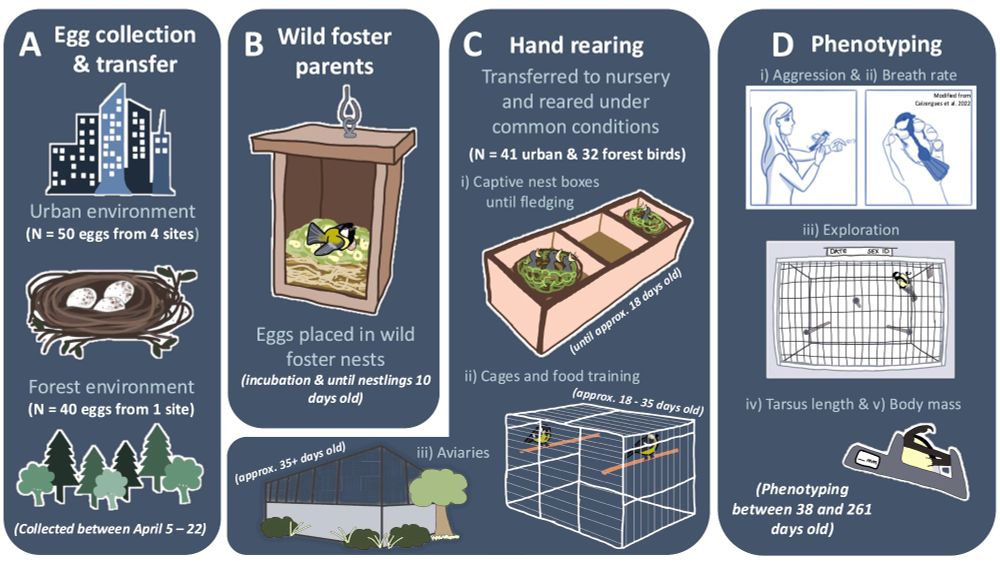
Visual representation of common garden procedure.
Our common garden experiment with urban and forest great tits is out early view in Evolution! doi.org/10.1093/evol... @denisreale.bsky.social @annecharmantier.bsky.social
25.02.2025 11:11 — 👍 57 🔁 28 💬 1 📌 1
Our results suggest that the reliability of space-for-time projections can be very context-dependent, even for a single species 🦋
But, we also show how spatiotemporal datasets provide an opportunity to test the key assumptions of causality and space-for-time transferability that underlie many SDMs.
28.02.2025 16:20 — 👍 0 🔁 0 💬 0 📌 0

Figure depicting spatial and temporal temperature-abundance and temperature-occuancy relationships for the orange tip butterfly in the UK, and the difference between these spatial and temporal slopes across the orange tip's range. Temperature generally has a positive effect on abundance and probability of presence in both space and time. Spatial and temporal temperature-occuapncy slopes are significantly different below 19.7°C, with the slope in time shallower than the slope in space. The slopes do not differ above 19.7°C, where both spatial and temporal slopes flatten. Temperature-abundance slopes do not differ at lower temperatures, but do differ above 16.4°C, where the temporal slope becomes increasingly shallower than the spatial slope.
We found that the level of equivalence between spatial and temporal temperature-distribution relationships varies across different temperatures within the species’ range 🌡️, with patterns differing between occupancy vs abundance 🦋
28.02.2025 16:20 — 👍 0 🔁 0 💬 1 📌 0
We then apply a statistical approach that allows comparison of the spatial and temporal effects of temperature on two distribution metrics – occupancy (presence/absence) and abundance 🦋
28.02.2025 16:20 — 👍 0 🔁 0 💬 1 📌 0

Figure depicting the orange tip butterfly's lifecycle and the AICs of models including different temperature windows as predictors of orange tip abundance. A seasonal pattern in AICs is depicted, with models including temperatures in May-July of the previous year having the lowest AICs. This corresponds to a period where the Orange-tip adults, eggs and larvae are all present.
Using @ukbms.bsky.social records of the Orange-tip butterfly’s abundance in the UK, we first apply a sliding window approach to identify when in the year temperature is most predictive of abundance🌡️🦋…
28.02.2025 16:20 — 👍 0 🔁 0 💬 1 📌 0

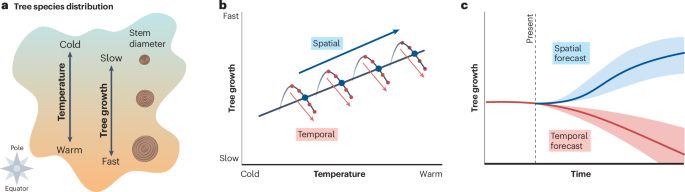
Conceptual figure depicting possible patterns of spatial and temporal climate-distribution relationships that may be seen across a species' range. Spatial relationships are hump-shaped, with temporal relationships as local deviations from this curve. In some instances, spatial and temporal slopes are similar, meaning that a space-for-time substitution would be valid. In other instances, these slopes are in the same direction, but the response in time is shallower, consistant with a lagging response in time. Here, space-for-time substitution may be valid in the long-term. In some cases, the response in time is flat, or the spatial and temporal slopes are in opposite directions, suggesting that the climate variable is not having a causal effect. The level of similarity between spatial and temporal slopes may vary across a species' climate range.
Projecting species’ future distributions often involves ‘space-for-time substitutions’ where relationships between climate variables & species’ distributions are identified in space & then projected over time 🌍→⏰
This assumes that these relationships are causal & equivalent in space and time 🌍=⏰?
28.02.2025 16:20 — 👍 0 🔁 0 💬 1 📌 0
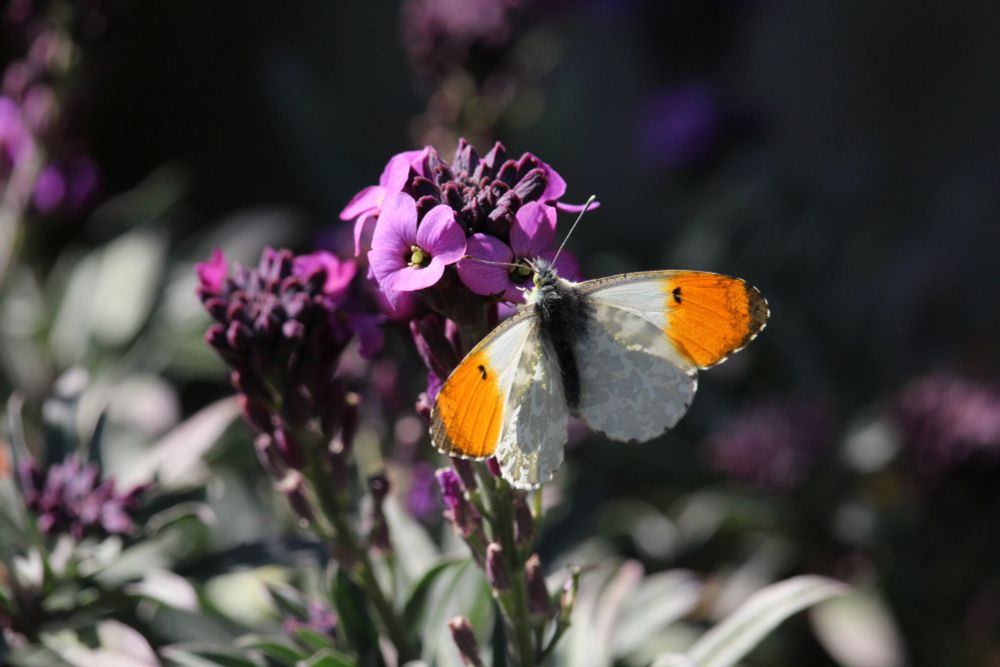
Testing space‐for‐time transferability of climate effects on occupancy and abundance
Read the free Plain Language Summary for this article on the Journal blog.
🦋 New paper out in @funecology.bsky.social! 🦋
Using the Orange-tip butterfly in the UK🦋, we test a key assumption of many species’ distribution models (SDMs): that climate effects on species’ distributions are equivalent over space🌍 versus time⏰
doi.org/10.1111/1365-2435.70005
🧵👇
28.02.2025 16:20 — 👍 28 🔁 10 💬 1 📌 1

Me with my viva cake. The cake has an Orange-tip butterfly and the words "Dr Becca" on it.

A printed copy of my thesis titled "Climate impacts on species’ distributions in space and time"
Very excited to say that earlier this month I passed my PhD viva! 🦋👩💻
Thanks to @lancasterlt.bsky.social and Jarrod Hadfield for a really interesting discussion, and of course to @allyphillimore.bsky.social for being the most wonderful supervisor! #PhDone
25.02.2025 16:30 — 👍 18 🔁 0 💬 0 📌 0
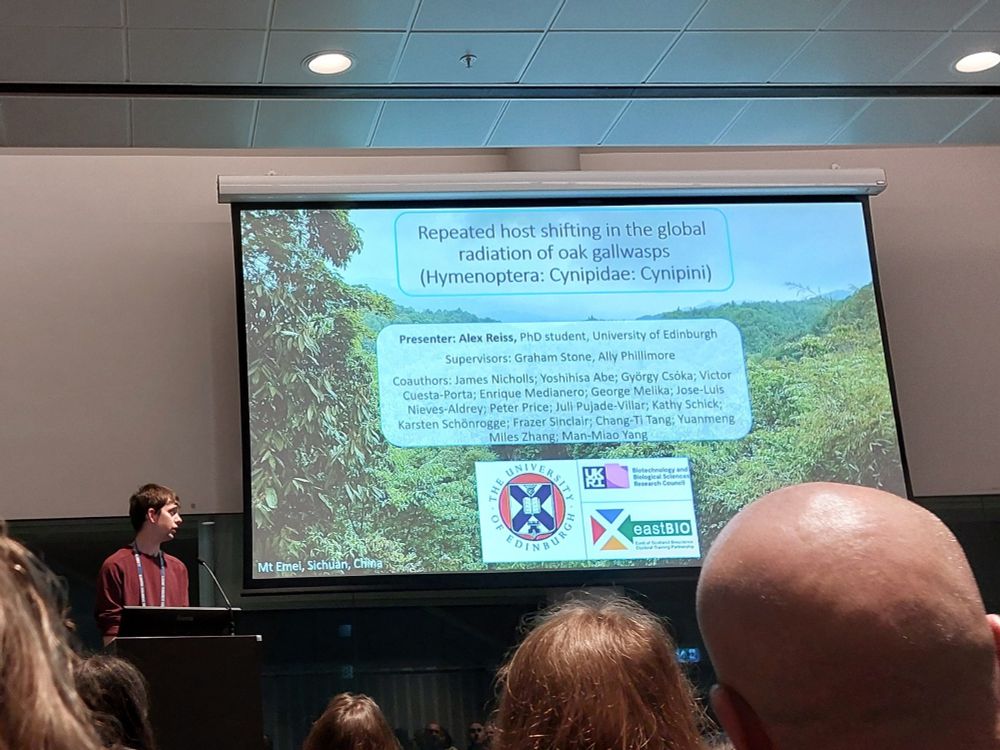
Alex Reiss giving a talk titled 'Repeated host shifting in the global radiation of gallwasps'
Another awesome talk from the group from Alex Reiss 🐝 #BES2024
12.12.2024 10:27 — 👍 1 🔁 0 💬 0 📌 0
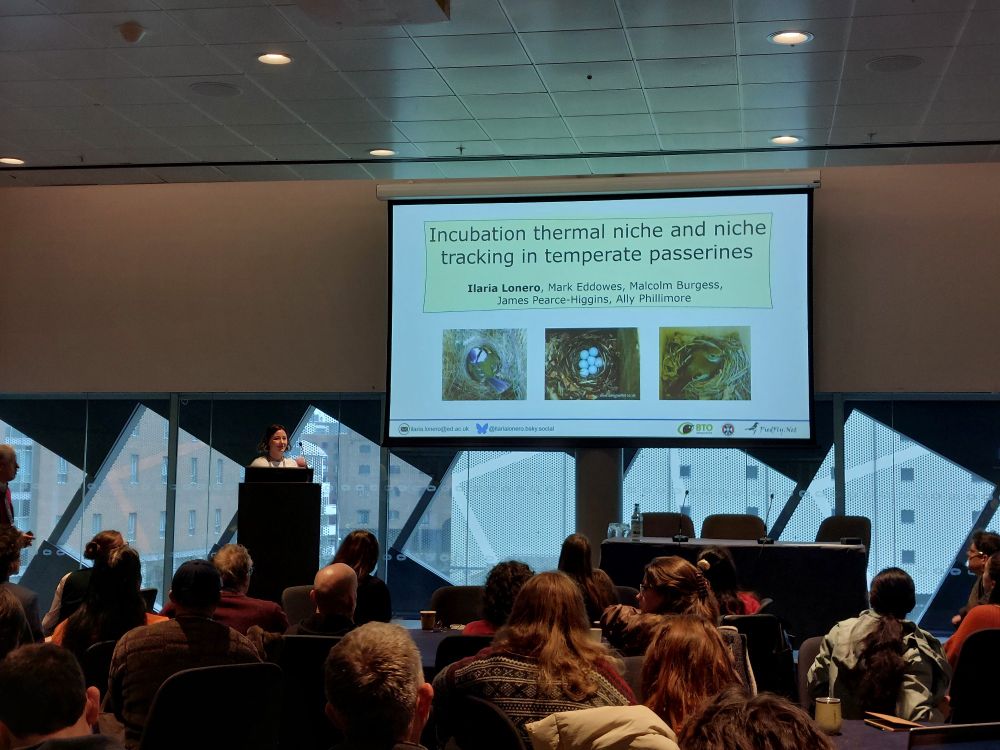
Ilaria Lonero giving a talk on 'Incubation thermal niche and niche tracking in temperate passerine'
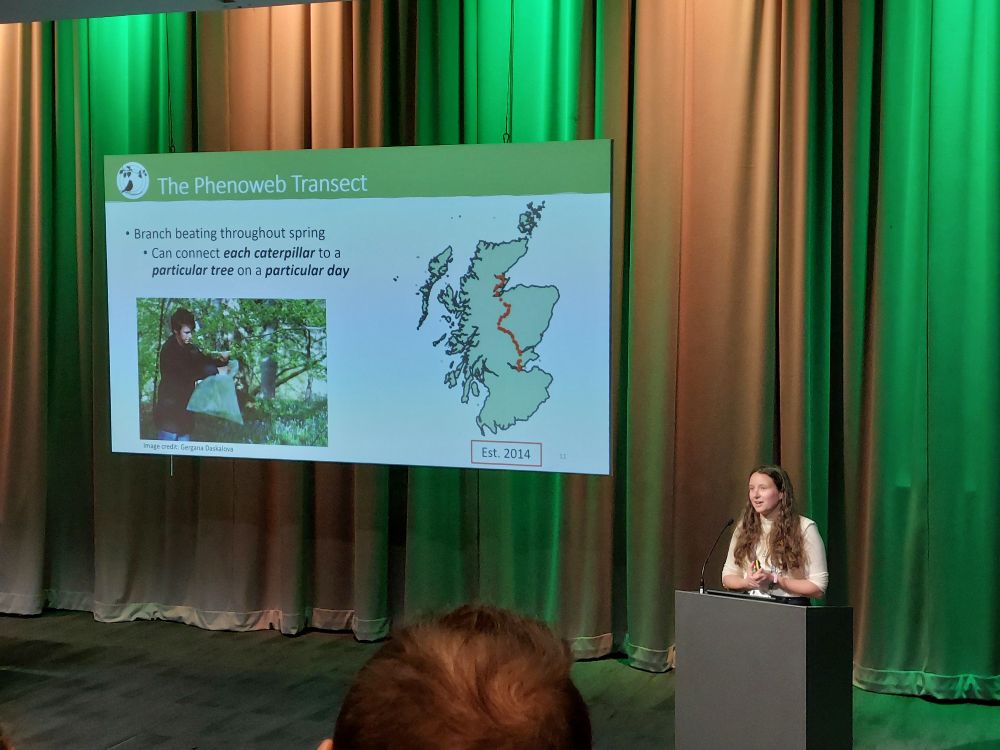
Megan Stamp giving a talk on the drivers of caterpillar community composition, in front of a slide introducing the Phenoweb transect.
Fantastic talks from my lab mates @ilarialonero.bsky.social and Megan Stamp 🐦🐛 #BES2024
11.12.2024 12:33 — 👍 11 🔁 1 💬 1 📌 0
Excited to present my PhD research at #BES2024 today! 🌾Join me at 16:00 in Auditorium 1C as I dive into how species turnover and intraspecific trait plasticity shape grass community responses to grazing. See you there!
11.12.2024 09:05 — 👍 12 🔁 3 💬 0 📌 0
Evolutionary ecologist • range shifts and invasions • plants and odonates • postdoc @uniofaberdeen.bsky.social • nickylustenhouwer.weebly.com
We’re the museum looking deeper into the Earth’s past to shape a new future where both people and planet thrive.
Protecting the planet, it’s in our nature. 🌍
PhD student at the University of Edinburgh studying evolutionary ecology in the Soay sheep
PhD candidate studying mountain chickadee breeding ecology | University of Nevada, Reno
she/her/hers
laurenwhitenack.com
Photos my own unless otherwise noted.
Local activism to make birding accessible and welcoming to all people 💜
Forest ecologist, plant demographer, dendrochronologist. Assoc. Professor at the University of Arizona, Laboratory of Tree-Ring Research - views are my own. Scientist at the intersection of the climate and biodiversity crises. Mom, dancer, gardener, cook.
A non-profit committed to cultivating excellent academic mental health worldwide! 🌎 http://dragonflymentalhealth.org
#AcademicMentalHealth
The home of Kew Science 👩🔬
🌱Collections
📚Archives
🍄Applied research
🤝Partnerships
🥼Training
👉More: linktr.ee/kewscience
Evolutionary ecologist, entomologist, and environmentalist. Macroecology postdoc at the University of Tartu (@macroecologyut.bsky.social), now also meandering into soil ecology. Bird and butterfly watcher.
https://matsittonen.com
Publishing at the forefront of ornithology and driving SciComm on social media | Home of #theBOUblog | Upcoming events #BOUasm25 #BOU2026 #BOUasm26
Professor of Eco-Evolutionary Dynamics at McGill University
Birds 🦜 Passerines 🐦 Fossils 🦴 Macroevolution
Post-doc at Girton College and Cambridge University (Sarah Woodhead Research Fellow in Earth Science)
We are the only global Partnership conserving birds and all life on our planet.🦜 123 Partners in 119 Countries.📍🌍 Follow us to join the flock!
🇫🇷 University of La Rochelle - MSc student in Ecology
🇨🇭 Vogelwarte - Researching how birds adjust their laying date to temperature (plasticity and genetic)
🌡️ Looking for a PhD in conservation, climate change, and biodiversity evolution
Research Institute in Dept of Biology at University of Oxford studying all aspects of Behaviour, Ecology and Evolution of Birds in natural environments. Follow us for updates on science, seminars, jobs & field projects: https://egioxford.web.ox.ac.uk/
Ecological forecaster aiming to predict population responses to changing environments. Chancellor's Fellow at University of Edinburgh
PhD Candidate @PrecisionMedPhD @EdinburghUni | statistical genetics | dermatogenetics | http://brownlab.co.uk
Ornithology | Biogeography | Conservation | Ecology
PhD student (@leibnizlib); Freelancer Biologist; NWO office (@nworni); OAG Bonn;
views are personal
Community #ecologist studying #insects under #globalchange, with a special focus on #landuse and #climatechange.
Based at #Agroscope in Switzerland
Hobby #macro photographer
He/him
Ecologist interested in species behavioural responses to changing environments | Based at University of Glasgow and Edinburgh Napier University | A Permit British Trust for Ornithology bird ringer | She/Her
postdoc @helsinki.fi @rececochange.bsky.social | Temporal genomics of adaptation to global change in Lepidoptera 🐛🌡️🧬 | ♥️ #OpenScience #zerowaste #baking #languages