Interesting convergence:
The trick that made predictive self-supervised vision models work seems to be what the brain was doing all along
w/ @predictivebrain.bsky.social: visual cortex is most sensitive to high-level prediction errors -- even in V1
Now published:
journals.plos.org/ploscompbiol...
03.02.2026 10:35 — 👍 20 🔁 5 💬 0 📌 0

Forward and backward prediction in learning and perception
Predictive processing frameworks have emphasized the role of forward prediction as a critical ingredient for learning and perceptual inference. We ant…
"Forward and backward prediction in learning and perception"
@predictivebrain.bsky.social @clarepress.bsky.social
nice to see our work situated within a broader research program on differences between learning & perceptual predictions
www.sciencedirect.com/science/arti...
02.02.2026 11:07 — 👍 14 🔁 4 💬 0 📌 1

A unifying account of replay as context-driven memory reactivation
A context-driven memory model simulates a wide range of characteristics of waking and sleeping hippocampal replay, providing a new account of how and why replay occurs.
Really thrilled that this paper led by @neurozz.bsky.social is now published in its final version in @elife.bsky.social!!
This is a memory-focused (as opposed to RL-focused) account of the detailed characteristics of forward and backward awake and sleep replay!
elifesciences.org/articles/99931
15.01.2026 13:57 — 👍 139 🔁 53 💬 3 📌 1

Uruguay’s Renewable Charge: A Small Nation, A Big Lesson For The World
Uruguay built a power grid that runs 99% on renewables—at half the cost of fossil fuels. Here’s how its bold energy overhaul became a global model.
“Uruguay did what most nations still call impossible: it built a power grid that runs almost entirely on renewables—at half the cost of fossil fuels. The physicist who led that transformation says the same playbook could work anywhere—if governments have the courage to change the rules.”
10.01.2026 08:29 — 👍 11030 🔁 4518 💬 203 📌 344
With some trepidation, I'm putting this out into the world:
gershmanlab.com/textbook.html
It's a textbook called Computational Foundations of Cognitive Neuroscience, which I wrote for my class.
My hope is that this will be a living document, continuously improved as I get feedback.
09.01.2026 01:27 — 👍 582 🔁 237 💬 16 📌 10

🧠 Feature-specific predictive processing: What’s in a prediction error? 🧠
Perspective article w/ Cem Uran, @martinavinck.bsky.social & @predictivebrain.bsky.social now in @imagingneurosci.bsky.social, highlighting recent work on the nature of surprise reflected in visual prediction errors.
🧵👇
08.01.2026 17:12 — 👍 19 🔁 5 💬 1 📌 0
This paper had a pretty shocking headline result (40% of voxels!), so I dug into it, and I think it is wrong. Essentially: they compare two noisy measures and find that about 40% of voxels have different sign between the two. I think this is just noise!
05.01.2026 17:22 — 👍 232 🔁 98 💬 8 📌 9
Rep. Seth Moulton comes on CNN and starts by saying: "Is anyone going to just stop for a second and be honest? This is insane. What the hell are we doing? We've got a lot of problems in America today, and invading / occupying / running Venezuela does not solve any of them."
03.01.2026 18:46 — 👍 9075 🔁 2370 💬 205 📌 98
Me getting back to sending nagging emails on January 6th when people return to work from the Christmas break
31.12.2025 11:32 — 👍 70 🔁 4 💬 2 📌 1
There's been a cluster of recent work on these sort of flow based or trajectory based world models, including nova flow and amplify (amplify a past episode of ours). These are super exciting because they reduce requirements for really accurate action labels imo
19.12.2025 14:57 — 👍 30 🔁 5 💬 0 📌 1

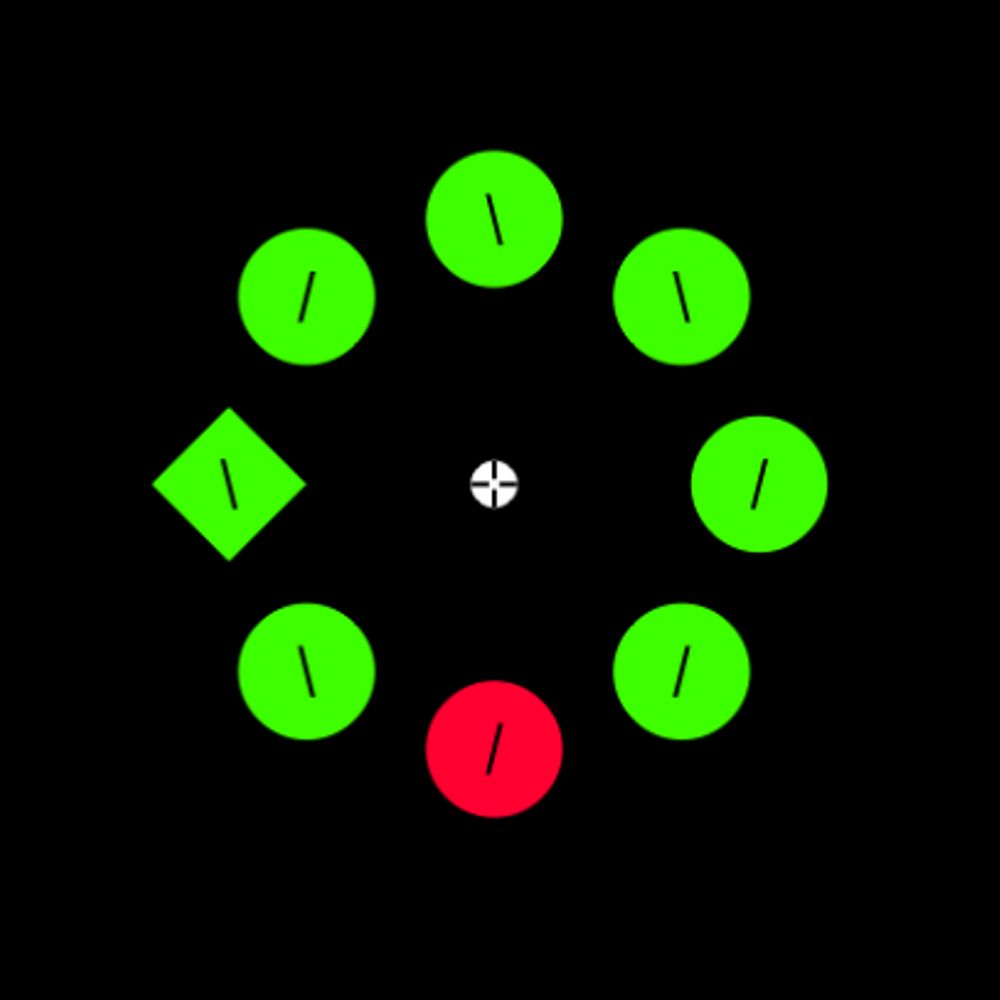
Ok, this is nuts. Once you see it you cannot unsee it. Do you see it?
(OP @drgbuckingham.bsky.social )
16.12.2025 19:39 — 👍 362 🔁 105 💬 50 📌 52

Dimensionality reduction may be the wrong approach to understanding neural representations. Our new paper shows that across human visual cortex, dimensionality is unbounded and scales with dataset size—we show this across nearly four orders of magnitude. journals.plos.org/ploscompbiol...
11.12.2025 15:32 — 👍 223 🔁 64 💬 7 📌 9
Very well done Peter, congrats!
11.12.2025 21:10 — 👍 2 🔁 0 💬 1 📌 0
I am very excited and grateful to have been awarded a Consolidator grant by @erc.europa.eu. We will use it to investigate the role of memory in perception, focused on the hippocampus. Thank you to all the colleagues in my team and the department for their support in making this possible!
11.12.2025 16:46 — 👍 176 🔁 7 💬 27 📌 0

Rapid computation of high-level visual surprise
Health sciences
High-level visual surprise is rapidly integrated during perceptual inference!
🚨 New paper 🚨 out now in @cp-iscience.bsky.social with @paulapena.bsky.social and @mruz.bsky.social
www.cell.com/iscience/ful...
Summary 🧵 below 👇
05.12.2025 14:37 — 👍 34 🔁 17 💬 2 📌 0

1/6 New preprint 🚀 How does the cortex learn to represent things and how they move without reconstructing sensory stimuli? We developed a circuit-centric recurrent predictive learning (RPL) model based on JEPAs.
🔗 doi.org/10.1101/2025...
Led by @atenagm.bsky.social @mshalvagal.bsky.social
27.11.2025 08:24 — 👍 140 🔁 41 💬 3 📌 4

Find a baby and watch them (when they're not napping). What you will no doubt observe is a tiny human curiously exploring the world around them, playing with objects, making noises, imitating faces, and otherwise learning from interactions and experiences. "Studies suggest that children learn about the world in much the same way that scientists do— by conducting experiments, analyzing statistics, and forming intuitive theories of the physical, biological and psychological realms," the cognitive scientist Alison Gopnik notes, all before learning how to talk. Babies may not yet be able to use language, but of course they are thinking!
If you’d like to independently investigate this for yourself, here’s one simple way:
www.theverge.com/ai-artificia...
25.11.2025 20:32 — 👍 70 🔁 6 💬 3 📌 1

Scientific Director Donders Institute | Radboud University
Do you want to work as a Scientific Director Donders Institute at the Donders Institute? Check our vacancy!
Donders Institute seeks to appoint a new Scientific Director to lead our internationally oriented and interdisciplinary organisation 🌍🧠
Are you ready to help shape the future of brain, cognition, and behaviour research?👇
www.ru.nl/en/working-a...
26.11.2025 08:26 — 👍 8 🔁 10 💬 0 📌 0
This was a fabulous, once in a lifetime colloquium -- and now the videos are available in high quality on the College de France web site @college-de-france.fr
www.college-de-france.fr/fr/agenda/co...
With talks by Edvard Moser, Nancy Kanwisher, Liz Spelke, Manuela Piazza, Luca Bonatti and more!
02.11.2025 15:08 — 👍 55 🔁 24 💬 1 📌 1

Chimpanzees rationally revise their beliefs
The selective revision of beliefs in light of new evidence has been considered one of the hallmarks of human-level rationality. However, tests of this ability in other species are lacking. We examined...
Are humans really the only rational animals? Our NEW PAPER 🎉 out in @science.org suggests otherwise! In a large collaboration led with my joint first author @hanna-schleihauf.bsky.social, we show that “Chimpanzees rationally revise their beliefs” 🧵
30.10.2025 18:17 — 👍 1558 🔁 437 💬 159 📌 53
🚀 We’re hiring - Join our lab 🚀
🔍 Hiring: PhD (75% TV-L) & Postdoc (100% TV-L)
🧠 fMRI, VR, EEG, modelling
We combine a range of cognitive neuroscience methods to study flexible behaviour.
📅 Start: Feb 2026 or later | ⏳ Apply by Nov 3!
More details:
tinyurl.com/ms3a9ajt
#CognitiveNeuroscience
27.10.2025 11:57 — 👍 53 🔁 44 💬 1 📌 2
Nice piece about extreme multiverse analysis! The exemplar study performed 3.6 billion regression models. The author argues against this approach and suggests that multiverse analysis should only include valid models selected based on theories. Statistical inference requires thinking before acting🤓
25.10.2025 13:32 — 👍 6 🔁 3 💬 0 📌 0

Universities are embracing AI: will students get smarter or stop thinking?
Millions of students arriving at campuses are now using artificial intelligence. Worries abound.
Reading, thinking and writting are defunct. 😢😡
"Faculty members also worry that students are using AI to short-cut their way through assignments and tests, and some research hints that offloading mental work in this way can stifle independent, critical thought."
www.nature.com/articles/d41...
21.10.2025 15:14 — 👍 16 🔁 6 💬 2 📌 0
Last week, the International Brain Laboratory released a comprehensive activity map of the rodent brain during decision-making, enabling researchers to "test new ideas in a really easy and powerful way," says neuroscientist @predictivebrain.bsky.social.
By @claudia-lopez.bsky.social
bit.ly/4mhqMRO
08.09.2025 19:48 — 👍 26 🔁 7 💬 0 📌 0
Assistant professor of psychology, Bar-Ilan University | computational cognitive science & psychiatry
🚨 Fully-funded PhDs and Postdocs - if interested, email CV to paul.sharp@biu.ac.il 🚨
Website: sharplabbiu.github.io
We investigate temporal cognition and conceptual spaces.
Part of @unicog.bsky.social @inserm.fr @cea.fr @univparissaclay.bsky.social.
Team leader: @virginievanw.bsky.social
PI: @herbstso.bsky.social, @vigano.bsky.social
https://brainthemind.com/about/
Barcelona Summer School for Advanced Modelling of Behaviour. We bring together cognitive scientists, neuroscientists, psychologists, computer scientists, machine learning researchers, and everyone interested in behavioural modelling.
PhD in neuroscience, MA in philosophy. Writing about science and philosophy of mind: https://cognitivewonderland.substack.com/
cognitive neuroscience, U Nottingham
PhD student @ Ernst Strüngmann Institute for Neuroscience
| Vision • Working Memory • Prediction |
Associate Professor of Neurosurgery @upenn.edu | Neuroscientist | Human Neurophysiology, Neuromodulation & Neurotechnology | Memory & Perception | 🇦🇺 | https://www.fosterneurolab.com/
PhD candidate at the @unigroningen
working on working memory
Interested in the building blocks of intelligence: neural & computational mechanisms underlying how we rapidly learn, generalize; how our mental models help us experience & infer; curiosity and ideation
https://tarananigam.github.io/TaranaNigam/index.html
Exploring how the brain uses specialized knowledge in domain-general cognition.
NeuroSPACE unites 4 labs led by @hansopdebeeck.bsky.social, @bertdesmedt.bsky.social, @kobedesender.bsky.social & @neuropsylab.bsky.social.
🌐 ppw.kuleuven.be/neurospace
Postdoc @ Egner Lab | Duke University
Cognitive control | Distractor suppression | Statistical learning
SL in Psychology based at York St John University. Cognitive neuroscience of language processing. Tries to make sense from nonsense (from experiments in verbal STM and reading).
We undertake fundamental research into the psychological, social and biological foundations of #language | Onderzoeksinstituut voor #taal, van genetica tot gedrag |
PhD Candidate in the Visual Cognitive Neuroscience group & Predictive Brain Lab @ Donders Institute.
PhD Candidate at the Predictive Brain Lab @DondersInstitute | MSc in Brain and Cognitive Sciences @UvA_Amsterdam.