
Here here !! Well done CPSY
15.05.2025 17:55 — 👍 3 🔁 0 💬 0 📌 0Here here !! Well done CPSY
15.05.2025 17:55 — 👍 3 🔁 0 💬 0 📌 0
#OCD is a understudied disorder, meaning that we know way too little about the underlying (brain) processes.
We have thus built the Brain Explorer app www.brainexplorer.net where everyone can easily contribute to understanding OCD.
#MentalHealthAwareness @tueneurocampus.bsky.social @ucl.ac.uk
I think that's already the case !! We can stop measuring the function of bored brains now
10.04.2025 13:39 — 👍 0 🔁 0 💬 0 📌 0
prompt for a reinforcement learning game

second prompt
2 prompts attached !
10.04.2025 12:15 — 👍 2 🔁 0 💬 0 📌 0
it wrote all the front-end code ! just need to connect your database and adjust the trials. I just gave it this image for the style
10.04.2025 10:23 — 👍 0 🔁 0 💬 0 📌 0@kellydonegan.bsky.social @tobywise.bsky.social
09.04.2025 19:43 — 👍 0 🔁 0 💬 2 📌 0
Hey cognitive scientists
I asked lovable.dev to make me a 2-arm bandit RL task
2 prompts and 3 minutes later
🤯🤯🤯🤯
Play it:
preview--cosmic-bandit-quest.lovable.app
Think of the hours and grad student tears saved 😅
Yes lovable I accept your sponsorship terms

Make a choice and get reward feedback
Make a choice and get feedback
09.04.2025 19:34 — 👍 0 🔁 0 💬 0 📌 0
The RL game starts with two bandits
Trial 1
09.04.2025 19:34 — 👍 0 🔁 0 💬 1 📌 0
An info sheet and consent form for an RL game
Hello world
09.04.2025 19:34 — 👍 0 🔁 0 💬 1 📌 0
“Motivation drives changes in the subjective value of reward both in the moment and in the future.”
www.pnas.org/doi/10.1073/...
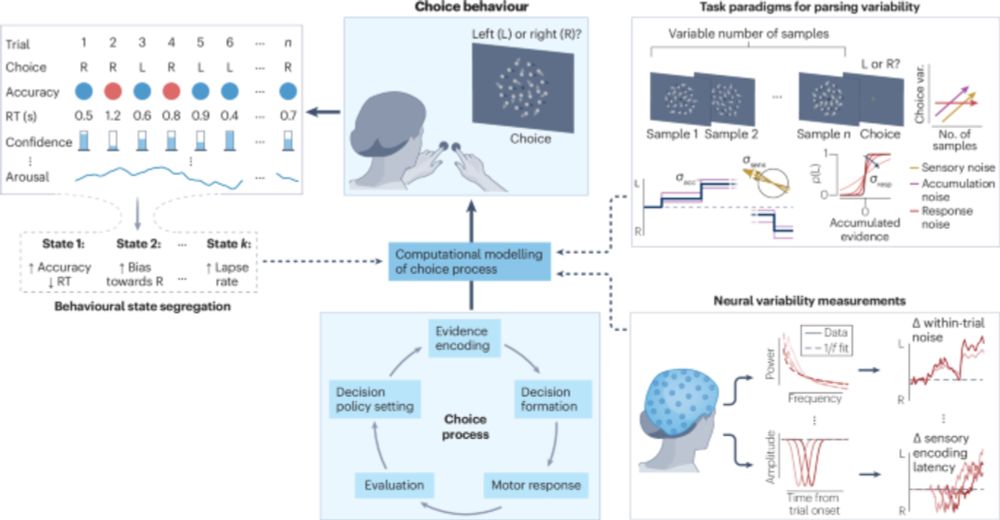
In life, 3 things are certain: death, taxes, and decision-making variability🧠. Our review tinyurl.com/4dcwafc4 explores how computational models 💻 explain variability, their limits, and recent advances. A thread🧵👇
@redmondoconnell.bsky.social @neuromurphy.bsky.social Mark Bellgrove (not on Bluesky)
When I began my PhD, there was a major disconnect between my own lived experience and the way researchers probed mental health-behaviour links.
I hope this work inspires others to use new designs to appreciate the complexity of human beings and their experiences.
link.growkudos.com/1f5ss3bn1ts
this is super cool and clever. Well done, really like it. Sth like this has been scratching at me for a while too - congrats on putting it together
20.03.2025 10:30 — 👍 3 🔁 0 💬 1 📌 0This is a great study, if I may say. We have had a lot of data showing correlations between subjective assessments and behaviour between individuals. With this study, we are starting to see how they interact over days within individuals. Congratulations @samuelhewitt.bsky.social!
18.03.2025 17:51 — 👍 10 🔁 5 💬 0 📌 0Thanks Quentin!
18.03.2025 21:46 — 👍 0 🔁 0 💬 0 📌 0thanks Micah !!
18.03.2025 13:08 — 👍 1 🔁 0 💬 0 📌 0
game demo: ema-motivation.web.app
repository: github.com/DevComPsy/re...

woopsy sorry, will correct!
here is a link to the full repo
github.com/DevComPsy/re...
and you can also play a demo of the game on your phone here:
ema-motivation.web.app
thank you to brilliant collaborators Prof @docqhuys.bsky.social and Dr Agnes Norbury (now Thymia) and my PhD supervisor Prof @tobiasuhauser.bsky.social
18.03.2025 11:23 — 👍 1 🔁 0 💬 0 📌 1
I hope it goes without saying that all data and code, including the smartphone game are available
osf.io/3mhqb/
This suggests that specific transient feelings can drive computational decision mechanisms in the future.
We think this study design can allow many new questions in computational psychiatry, bridging long established lab theories with real, human experiences and potentially clinical translation
State motivation-choice coupling was driven by fluctuations in reward sensitivity. This is a fancy way of saying that when more motivated, (the same) rewards seemed more rewarding.
What I think is SUPER 😎 is that this was not only rewards NOW, but also rewards at the NEXT timepoint.
State motivation was a critical source of variability in choices over time (leading to greater willingness to make effort, duh).
But state motivation also interacted with trait-motivation, meaning that people with LOWER trait (higher apathy) had even stronger state-choice coupling.
N.B. our game could also reliably capture effort-based choices and the model-parameters which govern this value-based decision
18.03.2025 11:23 — 👍 0 🔁 0 💬 1 📌 0Critically, the design allowed us to entirely orthogonalise how people felt in each moment from how they felt on average. So by "state", we mean literally your momentary feeling W.R.T however you normally feel
18.03.2025 11:23 — 👍 1 🔁 0 💬 1 📌 0
tl/dr thread:
for 2 wks, people reported feelings 2x/day and played a smartphone effort-based game on alternate days 📲
There were big fluctuations in how motivated people felt (🔗 with momentary happiness, fatigue and sleep, and also stable trait apathy-motivation prior to the study)

A little bby from my PhD is published!
we did a complex study to answer a simple Q:
do day-to-day feelings impact choices?
A: Yes. When feeling motivated (independent of other stable or unstable feelings) choices changed because rewards seemed greater.
open access link:
doi.org/10.1073/pnas...
3.5 year PhD studentship in cognitive computational neuroscience open in my MSN lab, @thechbh.bsky.social, co-supervised with @selmalugtmeijer.bsky.social & @simonlittle.bsky.social. Deadline 23rd March. Only open to UK candidates. More details here: www.findaphd.com/phds/project...
Pls repost
Congrats ! On the cool job too
07.03.2025 17:47 — 👍 0 🔁 0 💬 1 📌 0