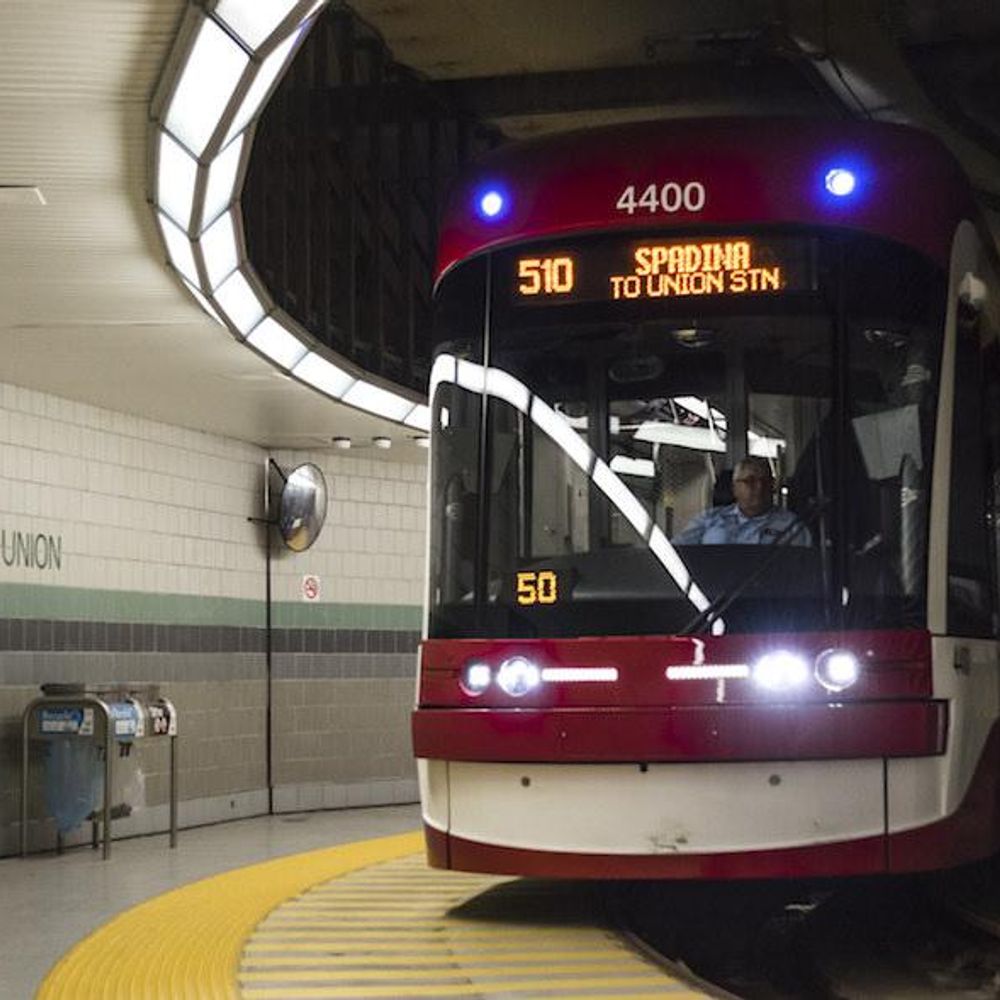
Except we use that for active realtime TSP installations not preemption (which Ion does use in places on their level crossings when running in CN right of way not street). Heck, sometimes transit signals are used without actual TSP when transit is in dedicated median lanes.
09.03.2026 03:14 —
👍 1
🔁 0
💬 1
📌 0


I wish Toronto used the bar signals instead of normal traffic lights but on a black instead of yellow backing. Only the vertical bar is legal in Ontario but defined as a fully protected dedicated love (like a transit only turn) in Toronto, Waterloo got an exception for their bar signals on Ion.
09.03.2026 03:09 —
👍 1
🔁 0
💬 1
📌 0
Preemptive is kind of challenging for the frequencies TTC runs (it basically means that regardless of anything, the train will always get a green like with railways which otherwise can’t stop), so “screw cross traffic, pedestrians be damned, I’m getting through”. At low frequencies, it can recover.
09.03.2026 02:32 —
👍 1
🔁 0
💬 0
📌 0
Well it should be active signal priority. That was what was promised for the LRT. Do you mean not expecting preemption?
09.03.2026 01:45 —
👍 0
🔁 0
💬 1
📌 0
There is some transit signal priority improvement on Line 5.
I just saw phase rotation three times at Eglinton/Sloane/Bermondsey - the left turn phase on Eglinton has always come before straight through but now it comes after if there's a train waiting to proceed. #TTC #Line5
05.03.2026 17:32 —
👍 12
🔁 2
💬 1
📌 0
Yeah, that’s a good point. The Toronto streetcars/LRT in dedicated/restricted lanes have their own transit signals (which look like normal ones but with giant TRANSIT SIGNAL signs but in mixed traffic just use the same general traffic signal heads.
09.03.2026 01:36 —
👍 2
🔁 0
💬 1
📌 0

I would be very interested in seeing the operational schema. Very weird that everything I’m seeing online is wrong.
09.03.2026 01:03 —
👍 1
🔁 0
💬 0
📌 0
Roughly familiar with the age, layout, and rolling stock. But it no way an expert on the system.
Looking on Google Earth I note that it doesn’t have transit only signals usually (even in the shared bus lane on Grand and MLK). Very curious to learn more (here in Toronto we need to speed ours up)
09.03.2026 00:59 —
👍 2
🔁 0
💬 2
📌 0
That’s the east side loop? Your descriptions sounds more like a pre-timing of the signals than the streetcars actually triggering a green for themselves because they’re on almost at the intersection. Active TSP can get awfully close to preemption’s performance @ontariotrafficman.bsky.social
09.03.2026 00:50 —
👍 1
🔁 0
💬 1
📌 0
Everything I can find only seems to say that the Portland Streetcar only gets signal priority for turning movements, so it could be that she doesn’t know the details.
Curb lane streetcars like Portland’s are especially vulnerable to parking and stopping unlike centre lane streetcars like Toronto.
09.03.2026 00:20 —
👍 1
🔁 0
💬 1
📌 0
But most of the intersections on the streetcar still have active TSP? Does it always work or only for late streetcars? I’m curious why the commenter above mentioned that there was no signal priority if there actually is? Is active TSP just not good enough signal priority for Portlanders?
08.03.2026 23:54 —
👍 1
🔁 0
💬 1
📌 0
So that’s the challenge for Toronto because every 10 minutes is a worst case frequency for us. Line 5 is every 4min at peak and will increase to every 3’30” by summer. Line 6 is every 6. Busy streetcars like the 510 are every 4 minutes. The stops are also closer together so less accurate predictions
08.03.2026 23:51 —
👍 2
🔁 0
💬 1
📌 0
When you say timed TSP you mean passive?
08.03.2026 23:39 —
👍 0
🔁 0
💬 1
📌 0
Is that what MAX yellow and orange and blue use on their median alignments?
How does that work without interfering with minimum pedestrian crossing times and cross traffic?
08.03.2026 23:35 —
👍 1
🔁 0
💬 1
📌 0
I’m curious what type of priority (if any) Portland Streetcar has? Here in Toronto many streetcars have active TSP but only to do green extension. They are upgrading it to allow phase rotation so that a streetcar and through traffic phase can come before left turns on streetcars with median lanes.
08.03.2026 23:31 —
👍 1
🔁 0
💬 1
📌 0
Signal preemption is very rarely used for LRT or tramways because it requires plenty of advance notice and can potentially ruin queue lengths for general traffic. It is used for railways because big trains can never stop in time so must go through regardless (even emergency vehicles must wait).
08.03.2026 23:22 —
👍 3
🔁 0
💬 2
📌 0
Active TSP (what I’m referring to) which is changing the signal cycle when transit is detected to extend a green, truncate a red, or swap a green in sooner (phase insertion/rotation).
Signal preemption means signals change for transit regardless with no ability to wait (used for railway crossings).
08.03.2026 23:21 —
👍 2
🔁 0
💬 2
📌 0
So there are three concepts:
Passive TSP which just means timing signal coordination for transit to get a green wave but no realtime changes. Not worthy of the term in my opinion, so I refuse to call it TSP.
1/2
08.03.2026 23:20 —
👍 2
🔁 0
💬 1
📌 0
The TTC hires outside rail grinding services. They should probably bring that in house with a rail grinder for the streetcar network along with other maintenance of way equipment to keep the track smooth.
The Flexitys aren’t going anywhere for decades, so we need a faster network with them.
08.03.2026 03:42 —
👍 1
🔁 0
💬 1
📌 0
I’m curious did they ban chain cafes and stores from the neighbourhood retail? I wonder if that reduce some of the NIMBY fears. Compared to Sydney for instance, a lot of the cafes here in Toronto are big chains like Starbucks, Tim’s, and Second Cup not local mom&pop cafes which are unique to an area
08.03.2026 03:12 —
👍 1
🔁 0
💬 1
📌 0
It’s not like mixed switch suppliers is an interoperability problem like say signalling systems (because contrary to what I said above, I think the TTC and Metrolinx should non competitively procure Urbalis400 CBTC from @alstom.bsky.social for Line 2’s ATC to ensure interoperability with Line 1).
08.03.2026 03:03 —
👍 1
🔁 0
💬 0
📌 0
Governments are supposed to do competitive procurement to ensure the best outcome for taxpayers and residents. So the TTC should be allowed to stick with an outdated design that ties them to a single supplier. Double point switches are made by dozens of companies (including ones not from the USA).
08.03.2026 02:59 —
👍 1
🔁 0
💬 1
📌 0
Well the TTC finally bit the bullet and got rid of trolley polls (are any routes still left with them @swanboatsteve.bsky.social?). Hopefully the same will be true of single point switches, stop-check-go, and unreliable switch controls in general.
08.03.2026 02:57 —
👍 5
🔁 0
💬 1
📌 0
Nice to see Toronto shed its “Fun is illegal” reputation. A neighbourhood coffee shop is legal!
08.03.2026 02:54 —
👍 5
🔁 0
💬 2
📌 0
No signal priority on a streetcar line is insane. Like if you’re going to the effort to put in the rails, the overhead wires, and probably stop platforms, add some loops and upgraded traffic signal controllers so that the streetcar can get its green sooner!
08.03.2026 02:37 —
👍 5
🔁 0
💬 1
📌 0
In my dream, Ford loses the next election and replaces PP as leader of the federal conservatives or better yet goes off as Ambassador to the USA where he can keep the Republicans up at night and monopolize the airwaves.
08.03.2026 02:10 —
👍 2
🔁 0
💬 0
📌 0
Ohh, no train operators will have no speed limit. I propose a 10km/hr speed limit for left turning cars only.
If I can dream, I also propose automated speed cameras at every intersection and more jails so that we can punish law-breaking drivers (progressives will have me for the last one).
07.03.2026 22:25 —
👍 4
🔁 0
💬 2
📌 0
That train sure is taking some tight curves and steep grades.
07.03.2026 22:20 —
👍 1
🔁 0
💬 1
📌 0
Well seeing as TTC’s solution to many things is speed restrictions, I propose a 10km/hr speed limit for all left turn lanes in Toronto.
07.03.2026 22:19 —
👍 2
🔁 0
💬 1
📌 0
Ummm, there’s this thing called rails which they use.
Maybe we could confiscate people’s drivers licenses more often.
07.03.2026 22:16 —
👍 4
🔁 0
💬 1
📌 0