Raporttini akateemisen vapauden tilasta Suomessa julkaistiin tänään. Se pohjautuu tutkijoille ja opettajille tehtyyn kyselyyn. Raportin loppuun kehittelin oman tulkintani siitä, mitkä kaikki tekijät vapautta uhkaavat. Tein siitä tällaisen kuvan. edition.fi/tsv/catalog/...
04.02.2026 09:08 — 👍 7 🔁 3 💬 1 📌 0


🎉The inaugural webinar of the Discussion Series on Scholar-led Publishing was today and it was perfect!
🙏Thank you to the 3 speakers and participants.
👀To see an overview of the presentations, expand the thread.
11.12.2025 17:02 — 👍 10 🔁 5 💬 1 📌 2
Thank you @almasiproject.bsky.social for this webinar to connect with the ALMASI (Aligning and Mutualizing Nonprofit #OpenAccess Publishing Services Internationally) community and the discussion on why #DiamondOpenAccess matters for reclaiming knowledge!
Learn more about ALMASI: almasiproject.org
11.12.2025 15:36 — 👍 2 🔁 1 💬 0 📌 0
Next on stage Milda Baltrimienė podering abt #multilingualism in research. #HelsinkiInitiative is one fine initiative, but it has some cons, too. Ahoy @jpolonen.bsky.social Milda's abstract: doi.org/10.7557/5.8164
19.11.2025 11:05 — 👍 2 🔁 2 💬 2 📌 0

A table showing profit margins of major publishers. A snippet of text related to this table is below.
1. The four-fold drain
1.1 Money
Currently, academic publishing is dominated by profit-oriented, multinational companies for
whom scientific knowledge is a commodity to be sold back to the academic community who
created it. The dominant four are Elsevier, Springer Nature, Wiley and Taylor & Francis,
which collectively generated over US$7.1 billion in revenue from journal publishing in 2024
alone, and over US$12 billion in profits between 2019 and 2024 (Table 1A). Their profit
margins have always been over 30% in the last five years, and for the largest publisher
(Elsevier) always over 37%.
Against many comparators, across many sectors, scientific publishing is one of the most
consistently profitable industries (Table S1). These financial arrangements make a substantial
difference to science budgets. In 2024, 46% of Elsevier revenues and 53% of Taylor &
Francis revenues were generated in North America, meaning that North American
researchers were charged over US$2.27 billion by just two for-profit publishers. The
Canadian research councils and the US National Science Foundation were allocated US$9.3
billion in that year.

A figure detailing the drain on researcher time.
1. The four-fold drain
1.2 Time
The number of papers published each year is growing faster than the scientific workforce,
with the number of papers per researcher almost doubling between 1996 and 2022 (Figure
1A). This reflects the fact that publishers’ commercial desire to publish (sell) more material
has aligned well with the competitive prestige culture in which publications help secure jobs,
grants, promotions, and awards. To the extent that this growth is driven by a pressure for
profit, rather than scholarly imperatives, it distorts the way researchers spend their time.
The publishing system depends on unpaid reviewer labour, estimated to be over 130 million
unpaid hours annually in 2020 alone (9). Researchers have complained about the demands of
peer-review for decades, but the scale of the problem is now worse, with editors reporting
widespread difficulties recruiting reviewers. The growth in publications involves not only the
authors’ time, but that of academic editors and reviewers who are dealing with so many
review demands.
Even more seriously, the imperative to produce ever more articles reshapes the nature of
scientific inquiry. Evidence across multiple fields shows that more papers result in
‘ossification’, not new ideas (10). It may seem paradoxical that more papers can slow
progress until one considers how it affects researchers’ time. While rewards remain tied to
volume, prestige, and impact of publications, researchers will be nudged away from riskier,
local, interdisciplinary, and long-term work. The result is a treadmill of constant activity with
limited progress whereas core scholarly practices – such as reading, reflecting and engaging
with others’ contributions – is de-prioritized. What looks like productivity often masks
intellectual exhaustion built on a demoralizing, narrowing scientific vision.

A table of profit margins across industries. The section of text related to this table is below:
1. The four-fold drain
1.1 Money
Currently, academic publishing is dominated by profit-oriented, multinational companies for
whom scientific knowledge is a commodity to be sold back to the academic community who
created it. The dominant four are Elsevier, Springer Nature, Wiley and Taylor & Francis,
which collectively generated over US$7.1 billion in revenue from journal publishing in 2024
alone, and over US$12 billion in profits between 2019 and 2024 (Table 1A). Their profit
margins have always been over 30% in the last five years, and for the largest publisher
(Elsevier) always over 37%.
Against many comparators, across many sectors, scientific publishing is one of the most
consistently profitable industries (Table S1). These financial arrangements make a substantial
difference to science budgets. In 2024, 46% of Elsevier revenues and 53% of Taylor &
Francis revenues were generated in North America, meaning that North American
researchers were charged over US$2.27 billion by just two for-profit publishers. The
Canadian research councils and the US National Science Foundation were allocated US$9.3
billion in that year.

The costs of inaction are plain: wasted public funds, lost researcher time, compromised
scientific integrity and eroded public trust. Today, the system rewards commercial publishers
first, and science second. Without bold action from the funders we risk continuing to pour
resources into a system that prioritizes profit over the advancement of scientific knowledge.
We wrote the Strain on scientific publishing to highlight the problems of time & trust. With a fantastic group of co-authors, we present The Drain of Scientific Publishing:
a 🧵 1/n
Drain: arxiv.org/abs/2511.04820
Strain: direct.mit.edu/qss/article/...
Oligopoly: direct.mit.edu/qss/article/...
11.11.2025 11:52 — 👍 641 🔁 452 💬 8 📌 66

📢 Register for the 5th Helsinki Initiative webinar (8 December) on Multilingualism in Scholarly Communication with presentations by @tatsuya-amano.bsky.social, @karenstroobants.bsky.social and Andre Brasil!
More information and registration: www.helsinki-initiative.org/en/events/5t...
03.11.2025 13:09 — 👍 7 🔁 4 💬 0 📌 0
Amplifying global voices: Removing language barriers in academic conferences
We invite you to share your experiences with language barriers at academic conferences. Your insights will help shape more inclusive and multilingual events across disciplines and formats.
This surve...
🌍 Have you experienced language barriers at academic conferences, or not at all?
We want to hear from everyone to better understand how language shapes participation and accessibility.
📝 Take our short survey and help make conferences more inclusive and multilingual:
forms.gle/u8ESktcJP8Y6...
13.09.2025 18:02 — 👍 8 🔁 9 💬 0 📌 1

Visual image to promote the ALMASI Diamond OA Policy Forum Wednesday 29 October
🌍💎 Bringing together #OpenAccess policymakers & funders across Africa, Europe, and Latin America is key to supporting #DiamondOA
@almasiproject.bsky.social launches The Diamond OA Policy Forum on 29 October 2025, 15:00-16:30 UTC
Register here: almasiproject.org/the-diamond-...
13.10.2025 00:06 — 👍 5 🔁 4 💬 0 📌 0
A promotional image featuring the logo of the European University Association for the briefing: "Reclaiming academic ownership of the scholarly communication system: Challenges and opportunities for universities." The background is a blue overlay.
Research assessment reform is essential to break the cycle of dependence on high-impact commercial journals and related metrics.
➡️ Reclaiming academic ownership of the #ScholarlyCommunication system buff.ly/0C0Wqfn
#OpenScience
04.08.2025 13:33 — 👍 2 🔁 2 💬 0 📌 0
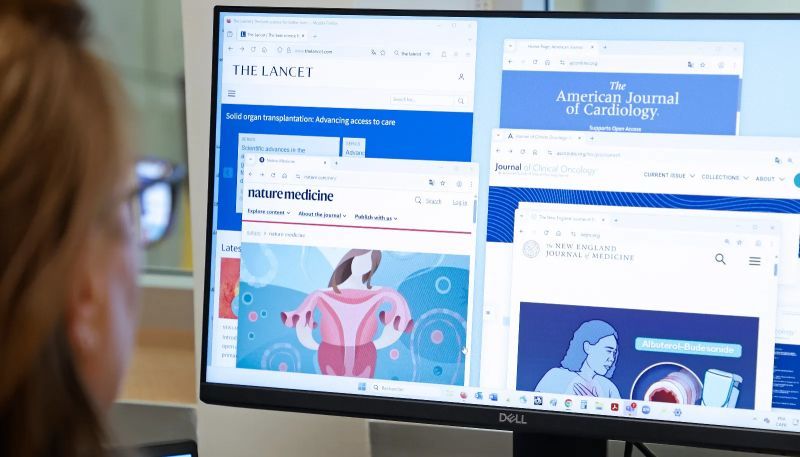
→ Plaidoyer pour le multilinguisme en sciences
📚 Article à lire : @bowkerl.bsky.social, Mikael Laakso & @jpolonen.bsky.social explorent les risques liés au monolinguisme anglophone sur l’écosystème scientifique.
📌 L'article : id.erudit.org/iderudit/111...
📌 Résumé de l'article : shorturl.at/nKGgo
23.07.2025 15:03 — 👍 9 🔁 6 💬 0 📌 0
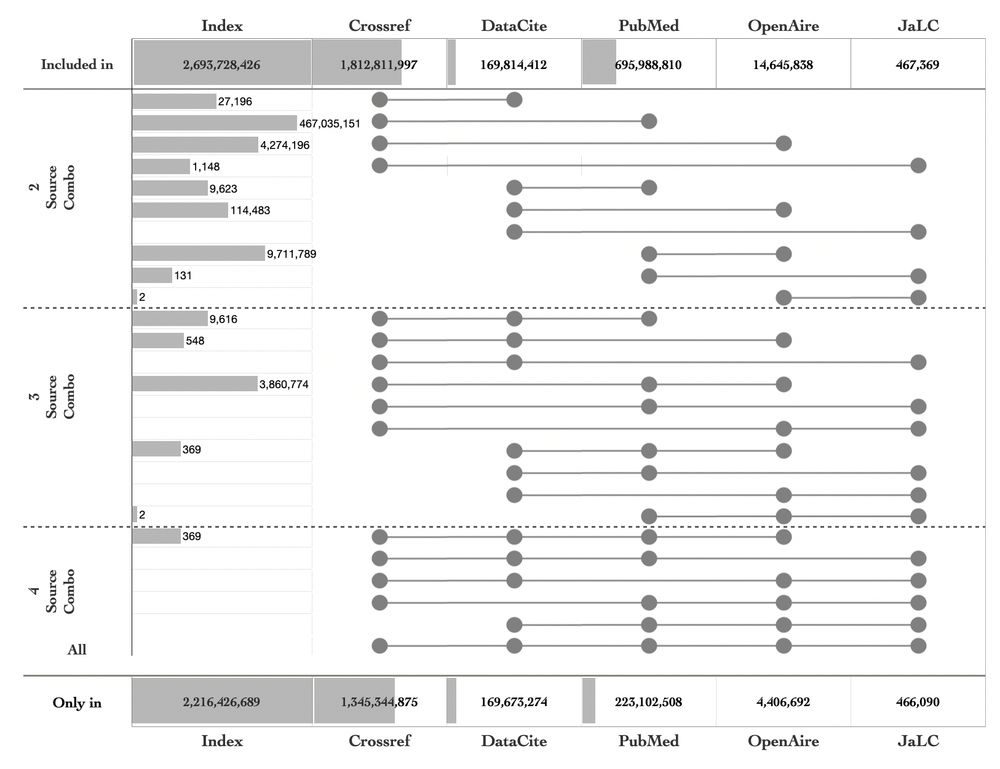
The July 2025 dump of OpenCitations Index is out! Now featuring 2.21 BILLION citations from 5 data sources.
👉 download.opencitations.net
Ever wondered how these sources overlap? This chart shows where citations are shared and where they're unique:
17.07.2025 15:08 — 👍 5 🔁 3 💬 0 📌 0

Mapping the publisher types and collaborations behind Web of Science indexed journals
Abstract. Although the organisational aspects of scholarly journals—such as the types of organisations responsible for publishing individual journals, whether independently or in collaboration—have si...
74.4% of the 21,886 WoS-indexed journals involve commercial professional publishers, 29% societies, and 27.8% research organisations as sole/co-publishers. Our paper co-authored with @zehrataskin.bsky.social, Emanuel Kulczycki & @mikaellaakso.bsky.social - now on QSS website: doi.org/10.1162/qss....
15.07.2025 10:57 — 👍 15 🔁 6 💬 0 📌 0
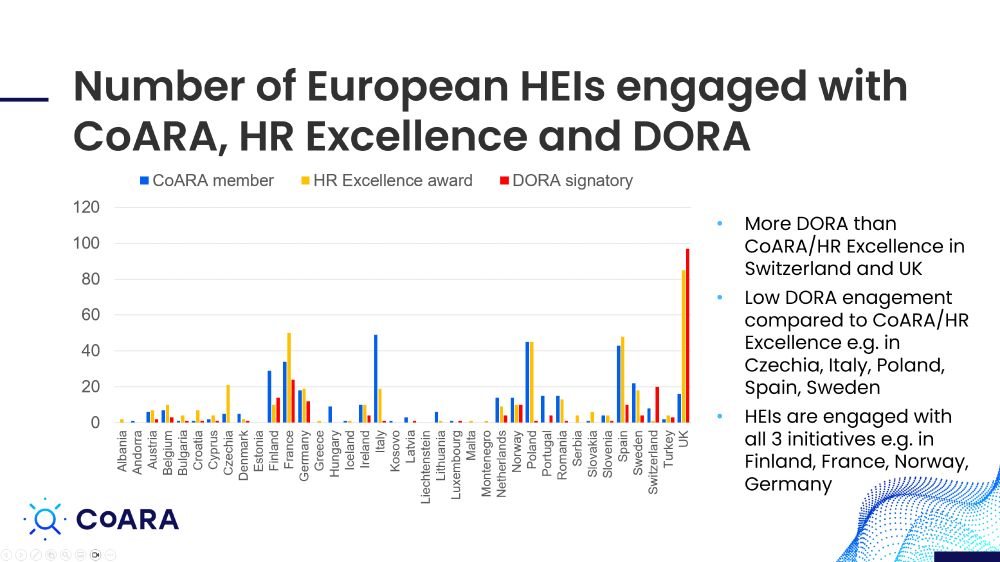
Significant differences between European countries in the higher education institution's engagement with #CoARA, #HRS4R @dorassessment.bsky.social. This and other findings in my presentation at the CoARA General Assembly 23 June on CoARA Uptake across European HEIs: doi.org/10.5281/zeno...
25.06.2025 05:59 — 👍 1 🔁 1 💬 0 📌 0
Significant differences between European countries in the higher education institution's engagement with #CoARA, #HRS4R @dorassessment.bsky.social. This and other findings in my presentation at the CoARA General Assembly 23 June on CoARA Uptake across European HEIs: doi.org/10.5281/zeno...
25.06.2025 05:59 — 👍 1 🔁 1 💬 0 📌 0
This interesting new preprint on SocArXiv shows that "The landscape of academic journals is beyond the oligopoly: it is diverse and often grounded in public, academic-driven initiatives rather than market imperatives." osf.io/preprints/so...
11.06.2025 17:01 — 👍 11 🔁 5 💬 1 📌 0
OSF
📢 Our new study challenges the prevailing narrative that a few commercial publishers dominate global scholarly publishing! Read the preprint: Beyond the oligopoly: Scholarly journal publishing landscapes in Latin America and Europe. doi.org/10.31235/osf...
11.06.2025 12:19 — 👍 19 🔁 13 💬 0 📌 2
Glad to see this report about 'reclaiming academic ownership of scholarly communication system'.
I like presentation of diamond OA and publish-review-curate (PRC) as complementary approaches. Important to note that PRC is not only about reclaiming ownership but also about various other issues.
07.06.2025 16:27 — 👍 11 🔁 5 💬 2 📌 0
Reclaiming academic ownership of the scholarly communication system
EUA - European University Association
📖 What are the main factors shaping the current academic publishing system?
🚧 What key challenges does the academic community face?
🔍 Are there opportunities for universities to reshape the future of #ScholarlyCommunication?
🔗 New EUA briefing buff.ly/0C0Wqfn
#AcademicSky #EduSky
05.06.2025 14:08 — 👍 8 🔁 4 💬 0 📌 2
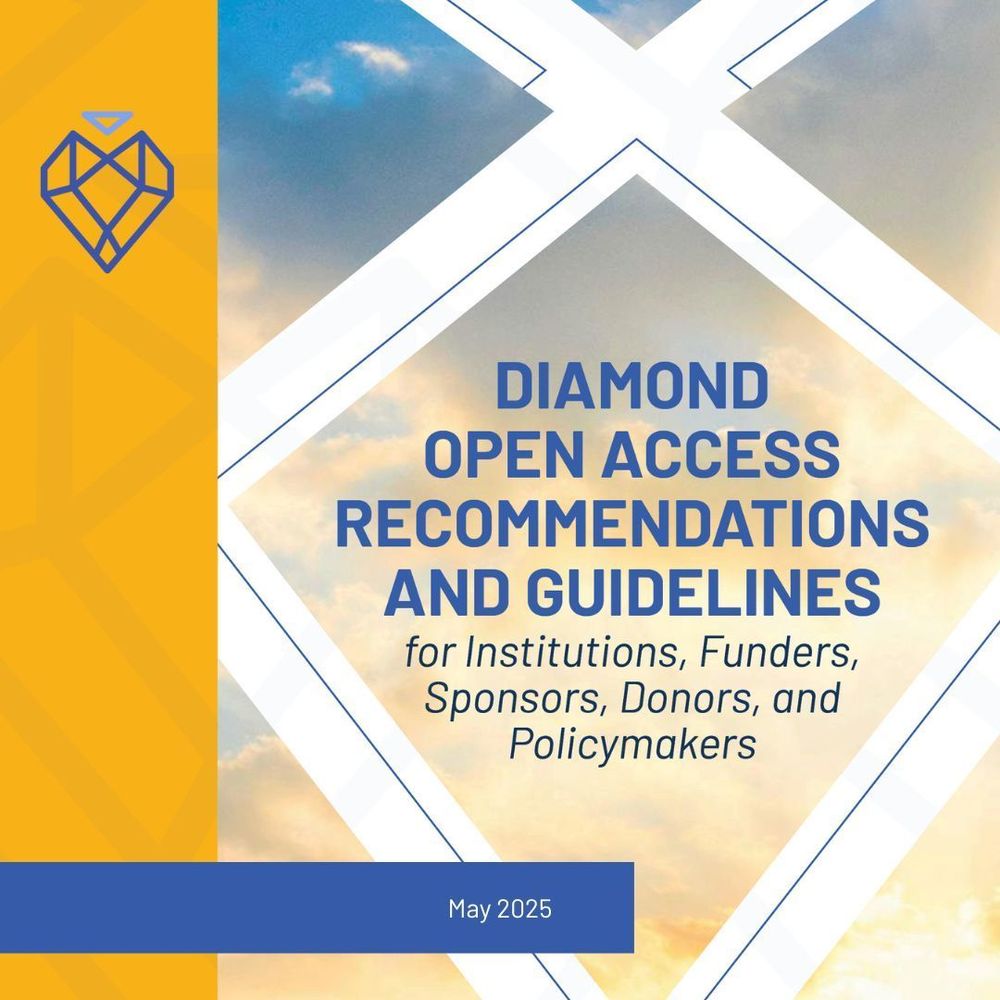
DIAMAS releases Diamond Open Access Recommendations and Guidelines
EUA - European University Association
💎 📖 #Diamas project releases #DiamondOA Recommendations and Guidelines
for Institutions, Funders, Sponsors, Donors, and Policymakers.
ℹ️ buff.ly/bwSeFJL
#OpenAccess #ScholarlyPublishing #OpenScience #SciencePolicy @eudch.bsky.social
06.06.2025 16:19 — 👍 3 🔁 1 💬 0 📌 0
How universities can protect and promote academic freedom
EUA - European University Association
Universities and their communities play an essential role in protecting and promoting academic freedom. 🛡️ 🤲 They must commit to making academic freedom a lived and daily reality.
Read EUA's position paper buff.ly/35qwaif
#AcademicFreedom
04.06.2025 15:29 — 👍 2 🔁 1 💬 0 📌 0
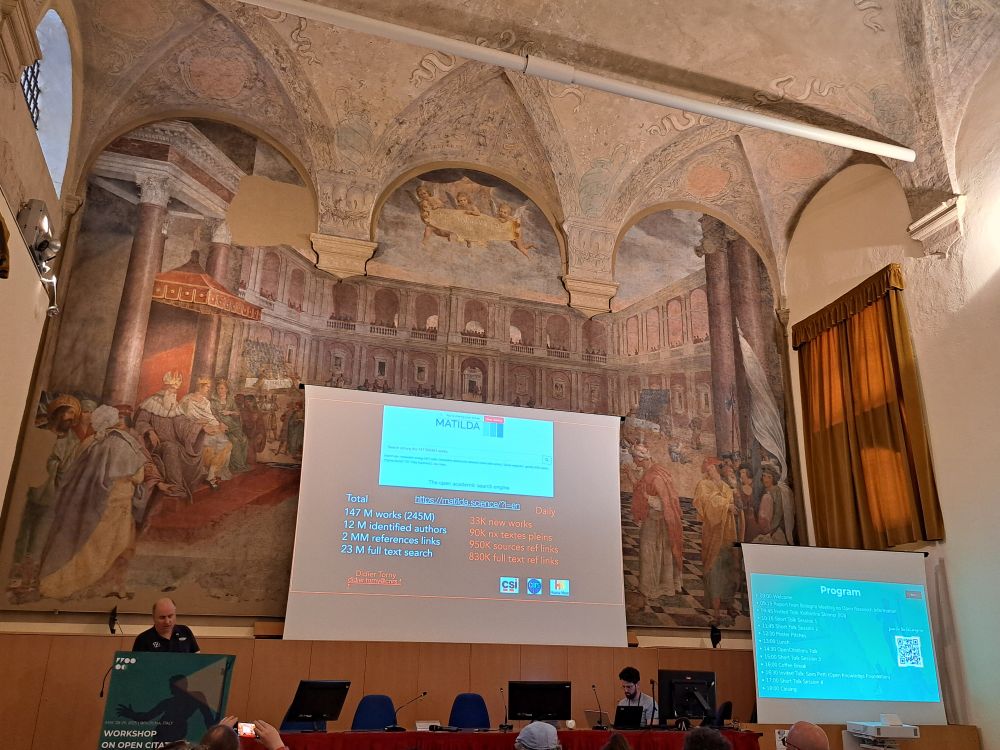
@polecopub.bsky.social presenting #Matilda as a new source for Open Citations at #WOOC2025 in Bologna
29.05.2025 13:15 — 👍 4 🔁 1 💬 1 📌 0
📢 Webinaari 11.6. klo 10:00-11:30: Yliopistojen, AMKien ja tutkimuslaitosten näkemyksiä tutkimuksen yhteiskunnallisen vaikuttavuuden arvioinnista sekä Alankomaiden, Norjan, Puolan ja UK:n arviointijärjestelmien vertailu.
Ilmoittautuminen ja lisätietoa: www.julkaisufoorumi.fi/fi/tapahtuma...
28.05.2025 06:04 — 👍 0 🔁 1 💬 0 📌 0
Thank you Pablo for the great contribution and discussion @RESSH2025!
21.05.2025 03:21 — 👍 1 🔁 0 💬 0 📌 0
PhD Student in Information and Communication Sciences | Université Claude Bernard Lyon 1 | https://yutong-fei.github.io/ | website : https://elico-recherche.msh-lse.fr/membres/yutong-fei
Working at @episciences
#DiamondOA overlay journals
www.episciences.org
Promoting publishing literacy for early-career researchers at Publishing Unlocked. Professor, 2x uni rector (OsloMet, NMBU), vice rector (UTromsø), CoE director (CASTL). Currently head of Fulbright Norway.
💻 Science manager @cais-research.bsky.social
📙 Deputy editor @policyr.bsky.social
PhD from @unihalle.bsky.social
✒️ #writing #digitaltransformation #openaccess #careerdevelopment #ruhrgebiet📍
🚀 space 💊 medicine 🧪 science 🍑 Southern politics 📺 FOX senior correspondent 🎤 Huntington’s disease research advocate 🧬
JDIS is an open-access, peer-reviewed journal published by the Chinese Academy of Sciences (CAS). It offers a platform for scientists across diverse fields to enhance the quantitative understanding of research activities. WoS: Q2; Scopus: Q1
PS: Political Science & Politics is the journal of record for the discipline. Email: ps@apsanet.org. Co-editors: Lina Benabdallah, Justin Esarey, Peter Siavelis, Betina Wilkinson. apsanet.org/ps
#DiamondOpenAccess publisher of scholarly books based in Tampere, Finland. https://edition.fi/tup
Sentientism, food policy for desired/anticipated consumption patterns, plant-based food for climate, consumption behaviour, history and reporting of global goals, framing.
Managing Editor http://BJNANO.org (Beilstein-Institut) #DiamondOA, free to publish, free to access. Proud to be part of the #DOA movement! Dog lover, powered by music, coffee, Zumba and Pilates. Posts are my own.
University lecturer @oulu.fi | PI of the @percola.bsky.social | eye movements | visual cognition | reading | figurative language
>> https://olkoniemi.com
Professor of Engineering at the University of Sydney
Account is only about science, tech, art & nature
Opinions are my own
Associate Prof, Animal Behaviour & Welfare-Hong Kong https://www.alanmcelligott.co.uk/ Animal behaviour, cognition, welfare; research ethics & integrity; environment; science; higher education; Diversity Equity Inclusion (DEI) advocate. 🌈🇮🇪 he/him 🐂 🐃🐐🐥 🦆
Academy Research Fellow, University of Helsinki. Transnational & global history, antifascism, resistance, solidarity, memory & urban history. Cape Town - NYC - Chicago - London – Berlin | https://researchportal.helsinki.fi/en/persons/kasper-brasken
🏛️ The Provenance Integrity Institute (PII) is a Hawaiian NGO dedicated to advancing knowledge, preservation, and transparency in the pursuit of global enlightenment. https://provenanceii.org/
🖥️ Global Scholars DAO https://discord.com/invite/ctstmGQWKv
Senior researcher at CWTS, Leiden University and co-chair of UNESCO Chair on Diversity and Inclusion in Global Science. Passionate about all things Open Science!
RE4GREEN is a three-year Horizon Europe project creating a framework to support the green transition by addressing ethics and integrity in research with environmental impacts and in climate-focused knowledge and technologies.
Ohjelmistokehityksen ammattilainen. Värikäs jalankulkija. Jazzin, kulttuuriantropologian ja kirjallisuuden harrastaja.
Teknologiateollisuus ry:n viestintäjohtaja, ex-politiikan- ja taloustoimittaja. ”Lempiniminä” mm. punavihreä kommunisti, äärifeministien pääideologi ja rikkaiden lakeija - eli siis äärisentristi. Politiikkaa, ilmastoasioita, taloutta ja ränttäystä.