Chris Campisano's Avatar

Chris Campisano

@campisano.bsky.social

Geologist & Paleoanthropologist @ Institute of Human Origins (IHO) and Arizona State University (ASU)

225 Followers  |  57 Following  |  11 Posts  |  Joined: 20.11.2024
Posts Following

Posts by Chris Campisano (@campisano.bsky.social)

Preview
Geochronological insights of middle miocene primates and vertebrate fauna of Ramnagar (J&K, India): Integrating litho- and magnetostratigraphy The Middle Miocene site of Ramnagar (Jammu and Kashmir), India is well-known for its fossil primates including Sivapithecus indicus, Kapi ramnagarensis, and Ramadapis sahnii. Although always suggested...

A new paper out from our Miocene project in India - updated FAD for Sivapithecus in India, ~200,000 years older than in Pakistan. Congrats to Deepak Choudhary who put in an extraordinary amount of work on this. Also to Dan, Chris, Biren, Rajeev and the rest of the team. dx.plos.org/10.1371/jour...

27.02.2026 18:57 β€” πŸ‘ 2    πŸ” 2    πŸ’¬ 0    πŸ“Œ 0
Preview
New discoveries of Australopithecus and Homo from Ledi-Geraru, Ethiopia - Nature Hominin fossils from the Ledi-Geraru Research Project area, Ethiopia, suggest that early Homo and Australopithecus species co-existed in the region more than 2.5 million years ago.

Open access article

www.nature.com/articles/s41...

13.08.2025 18:49 β€” πŸ‘ 1    πŸ” 0    πŸ’¬ 0    πŸ“Œ 0

Happy to be part of such a great team.

13.08.2025 18:48 β€” πŸ‘ 3    πŸ” 0    πŸ’¬ 1    πŸ“Œ 0
Preview
A Middle Eocene Haplorhine Frontal Bone From the Tornillo Basin of Texas, and Its Implications for the Phylogenetic Relationships of Rooneyia and Other Paleogene Primates Middle Eocene haplorhine frontal bone (TMM 46513-1) from the Tornillo Basin of Texas.

A little something for #FossilFriday led by Chris Kirk.
doi.org/10.1002/ajpa...

11.04.2025 14:28 β€” πŸ‘ 0    πŸ” 1    πŸ’¬ 0    πŸ“Œ 0
Summary of JHE Open Forum & response to Elsevier communications

We thank all those who attended and participated in the Open Forum (concerning the en masse resignation of the JHE Editorial Board) which was held at the annual meeting of the AABA on Saturday, March 15th, from 10:30am–12:00pm. The Open Forum was led by Emeritus Editors Andrea Taylor (in person) and ClΓ©ment Zanolli (via Zoom); Emeritus Editor Mark Grabowski sent his regrets as he was unable to attend this year’s AABA meeting. The meeting was well attended (~50–60) and included a number of Emeritus Editors and immediate past and earlier Editorial Board (EB) members. What follows is a summary of the discussion that took place during this Open Forum. Additionally, in the days before the Open Forum, Elsevier published an editorial and a publisher’s note. While we will not engage in continued back-and-forth discussion of communications from Elsevier as we do not see this as productive, we do believe there is a crucial need to set the record straight on several claims and for the paleoanthropological community to understand the implications of some of the assertions in those communications.

Summary of the Open Forum:
The forum began with a short presentation which included a brief background of changes in the publishing world, including the history of Open Access (OA) in Europe and the 2022 US federal mandate by the Office of Science and Technology that all federal agencies make federally funded research freely available to the public immediately upon publication by the end of 2025 (NSF Public Access Plan 2.0); the implications of the 2025 mandate for authors in the US; the consequences of the OA mandate in Europe and the US for publishers, journals, and authors; and the fundamental misalignment of the goals of JHE and the goals of the publisher that ultimately led to the en masse resignation (the details of which were communicated at the time of the resignation and were not the focus of the Open Forum)

Summary of JHE Open Forum & response to Elsevier communications We thank all those who attended and participated in the Open Forum (concerning the en masse resignation of the JHE Editorial Board) which was held at the annual meeting of the AABA on Saturday, March 15th, from 10:30am–12:00pm. The Open Forum was led by Emeritus Editors Andrea Taylor (in person) and ClΓ©ment Zanolli (via Zoom); Emeritus Editor Mark Grabowski sent his regrets as he was unable to attend this year’s AABA meeting. The meeting was well attended (~50–60) and included a number of Emeritus Editors and immediate past and earlier Editorial Board (EB) members. What follows is a summary of the discussion that took place during this Open Forum. Additionally, in the days before the Open Forum, Elsevier published an editorial and a publisher’s note. While we will not engage in continued back-and-forth discussion of communications from Elsevier as we do not see this as productive, we do believe there is a crucial need to set the record straight on several claims and for the paleoanthropological community to understand the implications of some of the assertions in those communications. Summary of the Open Forum: The forum began with a short presentation which included a brief background of changes in the publishing world, including the history of Open Access (OA) in Europe and the 2022 US federal mandate by the Office of Science and Technology that all federal agencies make federally funded research freely available to the public immediately upon publication by the end of 2025 (NSF Public Access Plan 2.0); the implications of the 2025 mandate for authors in the US; the consequences of the OA mandate in Europe and the US for publishers, journals, and authors; and the fundamental misalignment of the goals of JHE and the goals of the publisher that ultimately led to the en masse resignation (the details of which were communicated at the time of the resignation and were not the focus of the Open Forum)

JHE update: here below is a summary of the JHE Open Forum at AABA and a final response to recent Elsevier communications

01.04.2025 11:20 β€” πŸ‘ 7    πŸ” 3    πŸ’¬ 1    πŸ“Œ 1

Update: We have now received form emails from our Elsevier contact thanking us for our service and letting us know the papers we were handling will now be re-assigned to the the new EICs.

10.01.2025 19:01 β€” πŸ‘ 5    πŸ” 0    πŸ’¬ 0    πŸ“Œ 0

While I don't totally blame Elsevier (we did resign after all), I wanted to update those I have told we might be able to see them through, and give others who have submitted a heads up. Good luck to the 3 new editors who now have to do the work of 30 of us. 2/2

10.01.2025 18:12 β€” πŸ‘ 7    πŸ” 0    πŸ’¬ 0    πŸ“Œ 0

JHE Update: the previous JHE Editorial Board no longer has access to the editorial management system. Despite the previous editors and many other associate editors volunteering to finish handling any papers already in our pipeline, we have been cut-off without any notice. 1/2

10.01.2025 18:12 β€” πŸ‘ 10    πŸ” 5    πŸ’¬ 2    πŸ“Œ 3
Preview
Additional analyses of stem catarrhine and hominoid dental morphology support Kapi ramnagarensis as a stem hylobatid Fossil gibbons are exceedingly rare, with much of the hylobatid fossil record and, consequently, hylobatid evolutionary history remaining unknown. Kap…

Our recent paper confirming Kapi as the most compelling earliest hylobatid (gibbon ancestor). Thanks to the heavy lifting by my coauthors, I even understand most of it! (and likely my second to last paper in the β€œold” JHE).

www.sciencedirect.com/science/arti...

07.01.2025 14:09 β€” πŸ‘ 0    πŸ” 0    πŸ’¬ 0    πŸ“Œ 0
Post image Post image

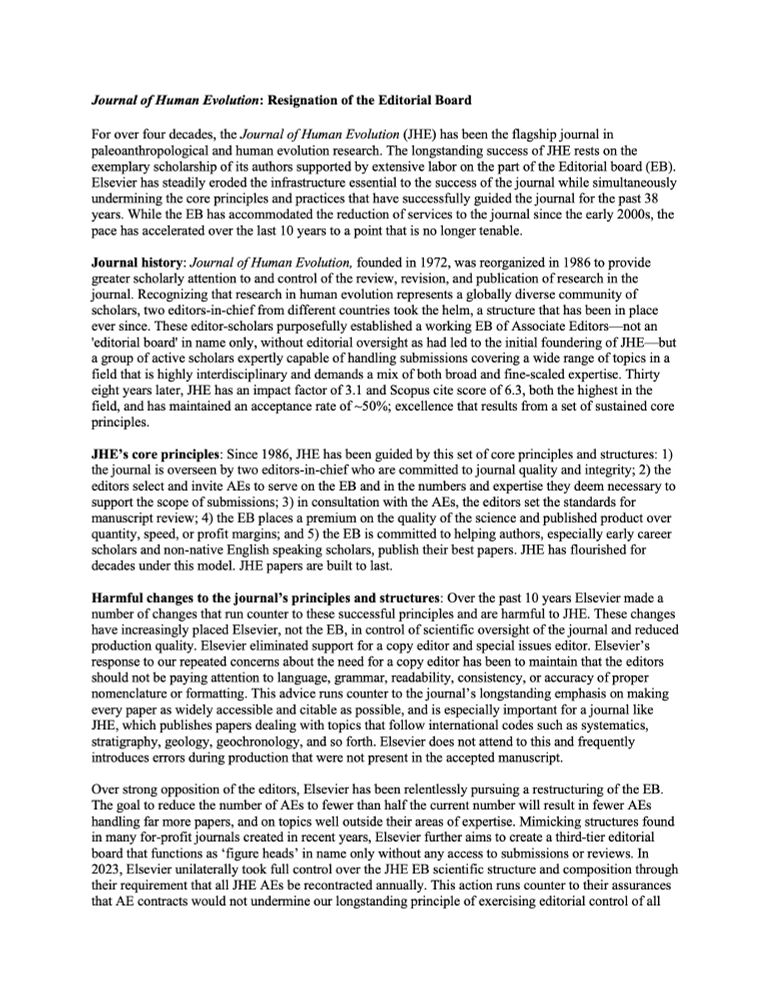
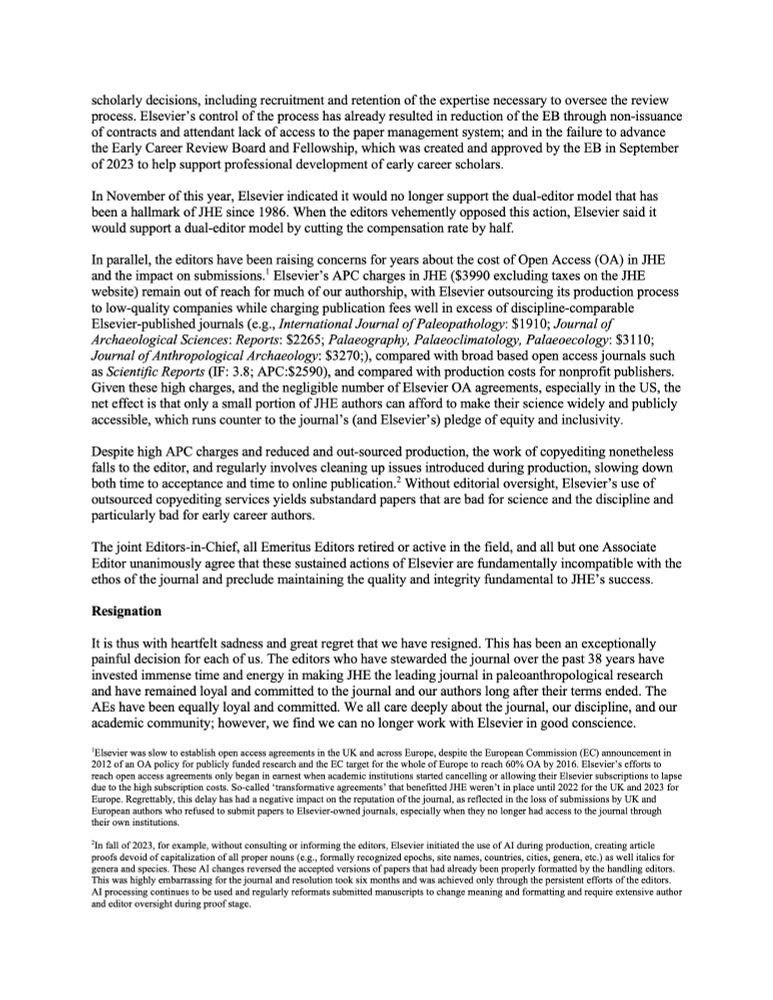
Resignation of the Journal of Human Evolution Editorial Board: We are saddened to announce the resignations of The Joint Editors-in-Chief, all Emeritus Editors retired or active in the field, and all but one Associate Editor. Press release below.

26.12.2024 16:52 β€” πŸ‘ 1007    πŸ” 539    πŸ’¬ 58    πŸ“Œ 168
Post image Post image

We lost another long time friend and field assistant of the Hadar Research Project. Ibrahim Digra was already one of the senior workers when I started in 2001, and I was happy (and surprised) to have him as part of our crew earlier this year. RIP old friend. (credit M. Mekonnen for the 2023 photo).

23.12.2024 19:43 β€” πŸ‘ 2    πŸ” 0    πŸ’¬ 0    πŸ“Œ 0
Preview
Lucy's Lasting Legacy Fifty years after her discovery in Africa, scientists are still unraveling how Lucy and her species fit into the bigger picture of human evolution.

Free stream of the AZ PBS show on Lucy's 50th and some coverage of our 2024 Hadar field season.

azpbs.org/lucys-lastin...

20.11.2024 21:13 β€” πŸ‘ 1    πŸ” 1    πŸ’¬ 0    πŸ“Œ 0

Add please?

20.11.2024 19:46 β€” πŸ‘ 1    πŸ” 0    πŸ’¬ 1    πŸ“Œ 0