Hypnotic photo of a curtain aurora that truly looks like a flying dragon.The image is extraordinary: an enormous serpentine green shape twisting through the night sky above a snow-covered landscape, with tiny human silhouettes that emphasize the epic scale. It looks like something straight out of a fantasy story, yet it is completely real.
🧵
'Dragon Aurora over Norway' is an enchanting pic showing an impressive auroral curtain, captured by Marco Bastoni above Tromsø in Northern Norway.
The aurora's glittering green glow somehow reminds of a large dragon. 🔭
➡️ apod.nasa.gov/apod/ap18041...
🧪 ⚛️ #sciart #astrophotography #science
1/4
22.02.2026 16:23 —
👍 1150
🔁 204
💬 11
📌 10
This thread of mine from June 2025 is about MoM-z14, the most distant galaxy spectroscopically confirmed to date, discovered by #JWST 🔭
Well: months later, NASA has just released the official press release (Jan 28, 2026)➡️ science.nasa.gov/missions/web...
And the arXiv paper ...
🧪 #cosmology 1/2
31.01.2026 10:25 —
👍 44
🔁 16
💬 1
📌 1


Très fier d’avoir reçu le Grand Prix de l’innovation SAF ! 🏆 Nous avons été récompensés par la Société astronomique de France et son président, Roland Lehoucq pour le projet #SUNSCAN by #STAROS. Une réussite collective avec V. Desnoux, C. Buil, O. Garde et Matthieu Le Lain (@matlastro.bsky.social)
30.11.2025 09:07 —
👍 14
🔁 4
💬 7
📌 0

Pure black cosmos dotted with hundreds of tiny white, gold, pink, and blue specks—distant galaxies. Top-left: target galaxy GS-NDG-9422 inside a crisp white square box, just a faint, barely-there reddish smudge, almost invisible. A larger inset with white frame near the center zooms it in, turning that pale glow soft orange.That tiny boxed reddish puff on the left feels incredibly old and delicate—a whisper from the universe at one billion years young.
Exceptional!
The faint blur you see in this NIRCam image refers to GS-NDG-9422, a "strange" galaxy identified with the JWST and announced in 2024.
➡️ science.nasa.gov/missions/web...
Credits: NASA, ESA, CSA, STScI, Alex Cameron (Oxford)
🔭 🧪 #science #extragalactic #cosmology #JWST #Webb
1/5
29.11.2025 18:19 —
👍 100
🔁 17
💬 2
📌 0

Figure 1

Figure 2

Figure 3

Figure 4
Orbital parameters of the bright binary alpha Draconis based on amateur spectra from the STAROS database. G. Bertrand et. al. https://arxiv.org/abs/2511.17206
24.11.2025 07:06 —
👍 3
🔁 2
💬 1
📌 0
Gaia will find ~120,000 exoplanets, mostly super-Jupiters!
From 2014–2025 at L2, it tracked >1B stars so precisely: a pinhead on the Moon from Earth!
Full data by 2030; first release predicts 7,500 planets.
Also: hypervelocity stars, quad systems & ancient galaxy merger remnants. 🔭 🧪 #science
12.11.2025 09:37 —
👍 31
🔁 6
💬 3
📌 2

My linocut of Annie Jump Cannon shows her in a 3/4 profile view wearing a shirt with a lace collar and her hair up. She is printed in a gradient of violet at the bottom to green at the top, printed on white 11” x 14” paper. The background is printed in a gradient (left to right) of dark blue, light blue, yellow, pale yellow, pale orange, orange and red. The background block excludes her silhouette of shoulder and head with the exception of a smattering of small dots in a swath from upper left to lower right (which extends to white spots on the coloured background). Also along the bottom are a series of circles of decreasing size (left to right, blue through red) labelled O, B, A, F, G, K, M. There’s a axis line along the bottom with 6 tick marks. Vertically from top to bottom along the left side are 15-, 10-, 5-, 0, 5, 20, 15.
For Day 21 of #spacetober_challenge prompt star: trailblazing US #astronomer Annie Jump Cannon (1863 – 1941), here with her stellar classification system which sorted stars based on spectral types, revealing their temperature from hot blue to cool red stars: O,B,A, F, G, K & M. 🧪🐡👩🏼🔬🔭#histsci 🧵
21.10.2025 11:32 —
👍 101
🔁 32
💬 1
📌 2
Commander | Siril - Le livre de référence
Bonne nouvelle pour les francophones, le livre sur Siril est disponible à la précommande, avec une réduction valable tout le mois de septembre !!
siril.fr/commander/
01.09.2025 16:04 —
👍 7
🔁 5
💬 1
📌 0

Astronomers Map Stellar ‘Polka Dots’ Using NASA’s TESS, Kepler - NASA Science
Scientists have devised a new method for mapping the spottiness of distant stars by using observations from NASA missions of orbiting planets crossing their
Sweet NASA feature article on @sabinastro.bsky.social's work on mapping stellar surfaces: 🔭🧪 #stellarastro
science.nasa.gov/missions/tes...
Why? Because:
1) #StarsAreStillInteresting
2) Messy stars complicate our view of exoplanet atmospheres. To remove stellar contamination, you must map it. 🗺️
25.08.2025 15:34 —
👍 41
🔁 13
💬 2
📌 0
Betelgeuse is a double! Fun to learn something new about a familiar star.
21.07.2025 19:09 —
👍 148
🔁 28
💬 7
📌 6

Figure 1

Figure 2

Figure 3

Figure 4
Spectroastrometry and Reverberation Mapping of Active Galactic Nuclei. II. Measuring Geometric Distances and Black Hole Masses of Four Nearby Quasars. Yan-Rong Li et. al. https://arxiv.org/abs/2502.18856
01.07.2025 09:05 —
👍 1
🔁 1
💬 0
📌 0

Cosmic Indigestion Is Causing Black Holes to Spit Up Stars
After black holes devour stars, sometimes the feast comes back up
MY FIRST EVER ARTICLE FOR SCIENTIFIC AMERICAN IS OUT!!!
It's all about how black holes shred stars and how we discovered that black holes "burp" after eating them, and even includes a black hole called Jetty McJetface! What's not to love? 🤩
www.scientificamerican.com/article/why-...
🔭🧪🎢
18.06.2025 22:40 —
👍 593
🔁 123
💬 48
📌 12
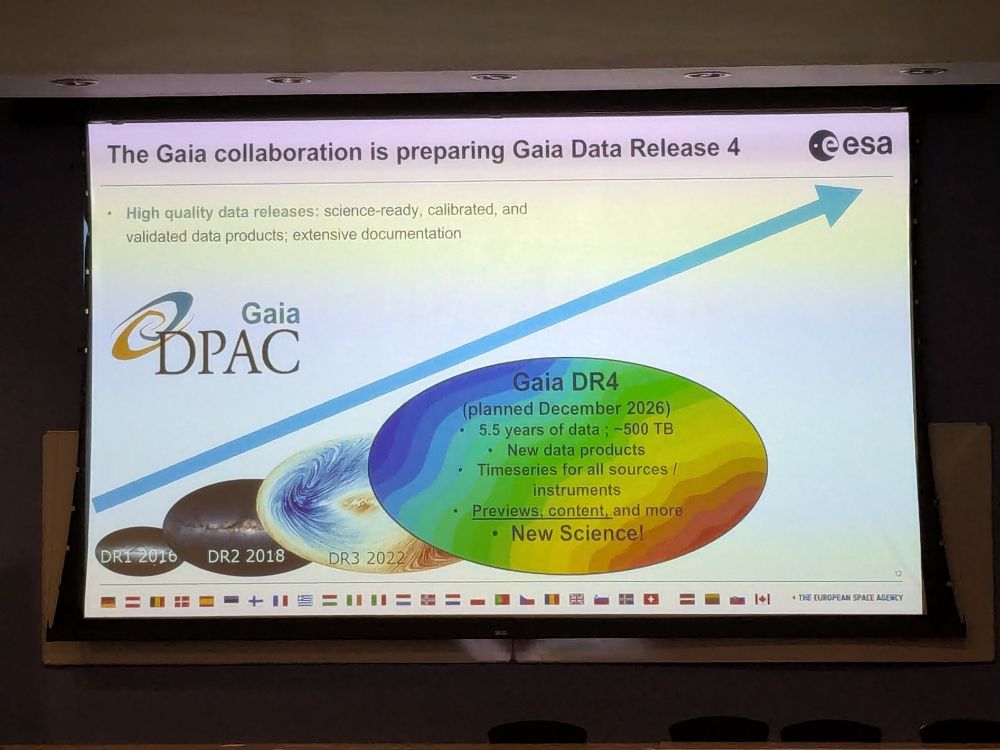
A photo of the slide with the December 2026 release date
Finding out about Gaia at #EAS2025Cork! ☄️
Just announced: Gaia DR4 will be released in December 2026!
26.06.2025 14:11 —
👍 96
🔁 37
💬 1
📌 1
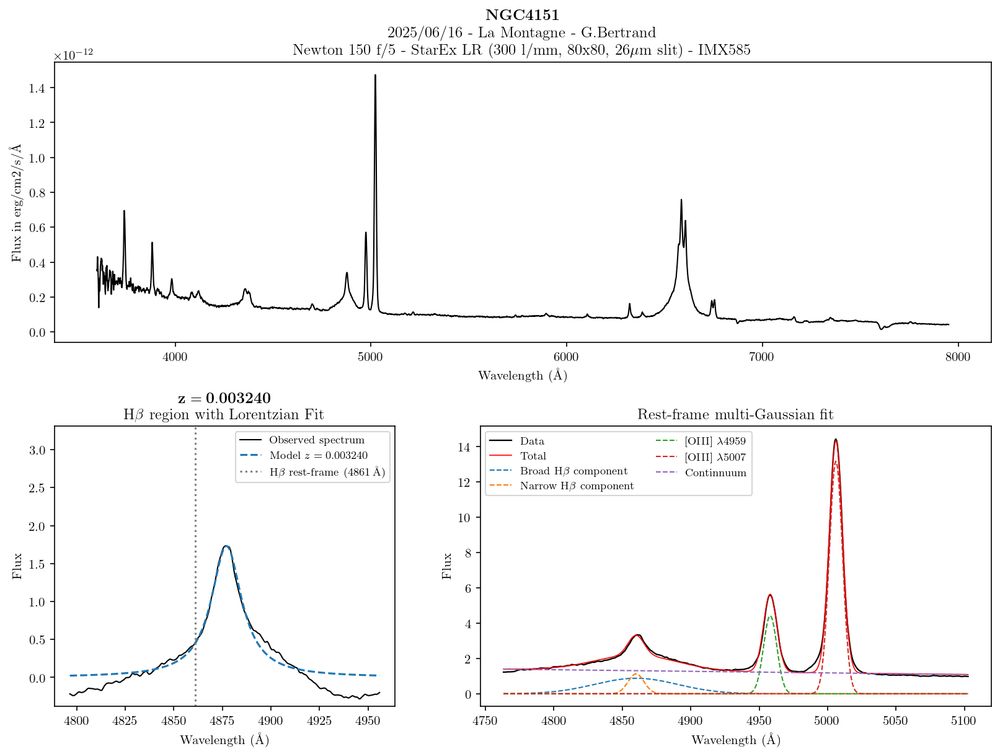
Here's a cool spectro and photometry experiment to measure the mass of supermassive black holes from your backyard :) Based on single-epoch estimators in broad-line AGN. 🌈🔭 #astrophysics #astronomy #spectroscopy #photometry
guillaumebertrand.notion.site/Estimating-b...
26.06.2025 11:43 —
👍 10
🔁 3
💬 0
📌 0


Happy to announce that the line-detector.oca.eu website is now online!
It allows the user to select the stellar type, [M/H], λ- range, and resolving power and the page returns:
-purity of the line and minimum S/N required to detect it.
-interactive plot to identify the lines in the spectra
23.06.2025 07:25 —
👍 11
🔁 6
💬 0
📌 1
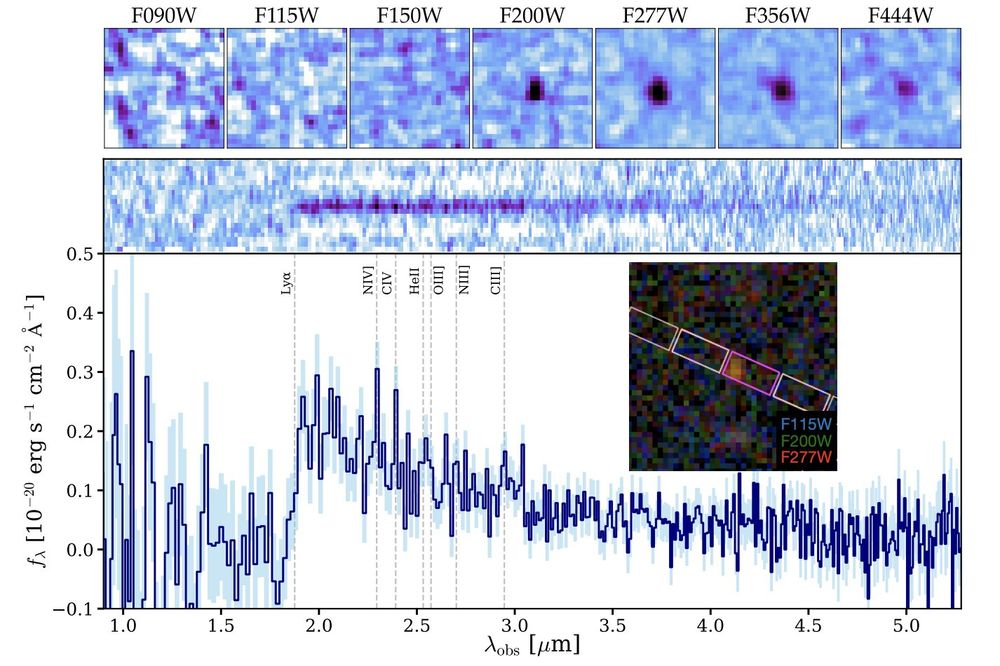
We found the most distant confirmed galaxy
(some Sergej Boebka vibes 😅)
arxiv.org/abs/2505.11263
19.05.2025 06:42 —
👍 48
🔁 15
💬 0
📌 6
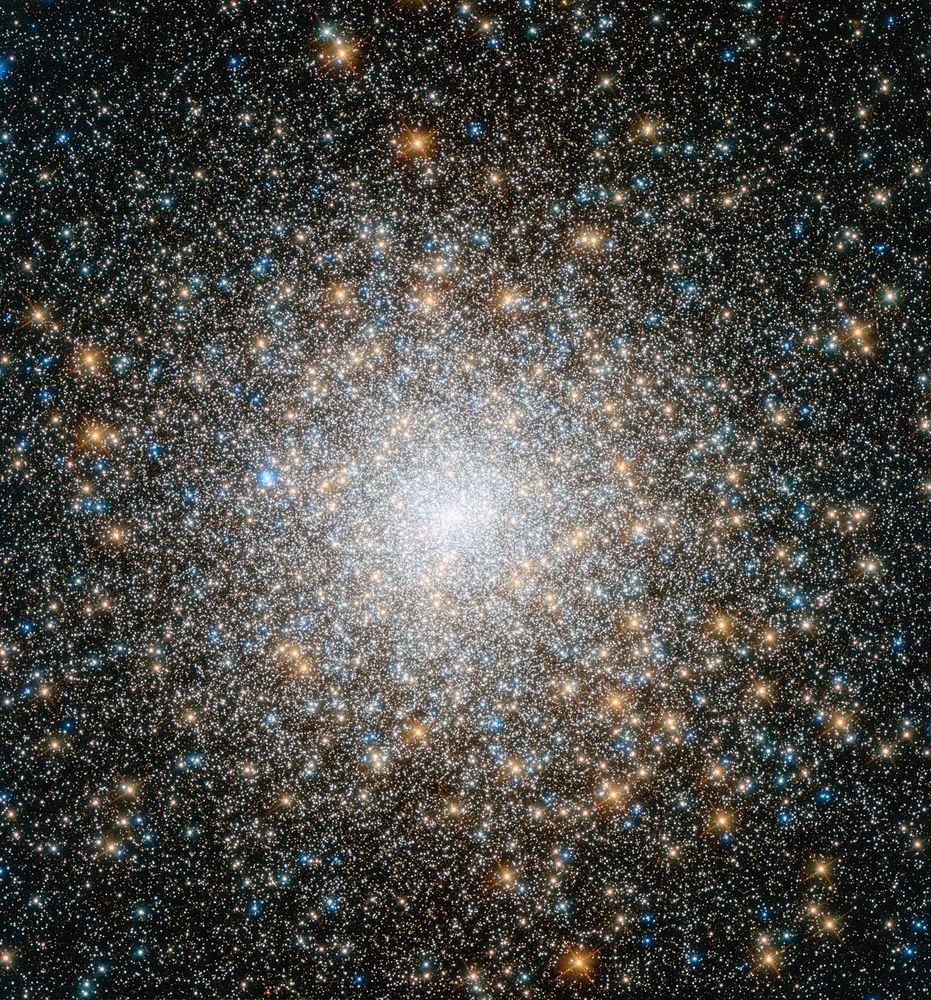
This cluster of stars is known as Messier 15, and is located some 35,000 light-years away in the constellation of Pegasus (The Winged Horse). It is one of the oldest globular clusters known, with an age of around 12 billion years. This new image is made up of observations from Hubble's Wide Field Camera 3 and Advanced Camera for Surveys in the ultraviolet, infrared, and optical parts of the spectrum. (NASA, ESA)
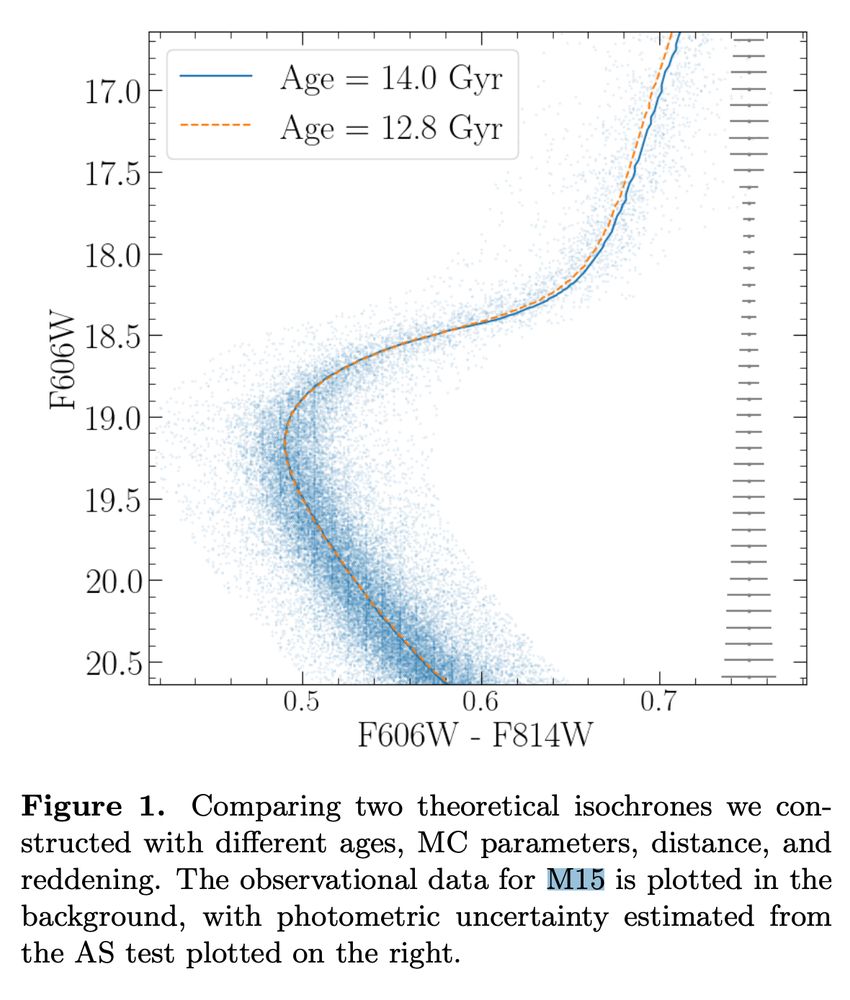
Figure 1. Comparing two theoretical isochrones we constructed with different ages, MC parameters, distance, and reddening. The observational data for M15 is plotted in the background, with photometric uncertainty estimated from the AS test plotted on the right.
This is the globular cluster M15, imaged by Hubble. It's a great target for binoculars or backyard telescopes, in the constellation Pegasus.
Jiaqi Ying et al. measured M15's age with 3% precision. This group of stars formed *immediately* after the Universe did.
arxiv.org/abs/2505.02969
🔭🧪 #stars
07.05.2025 16:13 —
👍 232
🔁 35
💬 4
📌 4

Zooniverse
The Zooniverse is the world’s largest and most popular platform for people-powered research.
Been an exciting week for @galaxyzoo.org - our relaunch with JWST imaging has resulted in highest daily classification rate since March 2020. www.galaxyzoo.org. 🔭👩🔬🎉
01.05.2025 13:12 —
👍 22
🔁 11
💬 0
📌 1

The new official paper/poster browser for ICLR 2025 is out.
Enjoy!
iclr2025.vizhub.ai
#iclr #ai #iclr2025
18.04.2025 16:21 —
👍 21
🔁 5
💬 1
📌 0

📢 New dataset out!
We introduce HypoGen💥, a dataset of ~5.5K structured problem–hypothesis pairs (Bit–Flip–Spark + Chain‑of‑Reasoning) to advance LLM-driven scientific ideation💡.
Fine‑tuned LLaMA 3.1 8B & R1‑distilled models show significant gains. Humans are still the best🥇.
18.04.2025 17:57 —
👍 5
🔁 4
💬 1
📌 1

Excited to announce our new paper as part of our 2^2 week: AstroLLaVA, a vision language model for astronomy that enables natural dialogue with astronomical imagery! Shout out to Sharaf Zaman for leading this work arxiv.org/abs/2504.08583 🔭☄️
16.04.2025 12:17 —
👍 7
🔁 3
💬 1
📌 2
Was great fun cooking this up with Sharaf and team! Check out all the code at github.com/UniverseTBD/... and paper at arxiv.org/abs/2504.08583
16.04.2025 12:19 —
👍 2
🔁 2
💬 0
📌 0
PRIX DE THESE #SF2A 2025: Le conseil de la SF2A a l'honneur de décerner le prix de thèse 2025 à Giulia Pagnini pour sa thèse: "L'évolution précoce et tardive de notre Galaxie à travers la lentille des amas globulaires", au laboratoire GEPI, observatoire de Paris, sous la direction de P. Di Matteo.
12.04.2025 06:58 —
👍 10
🔁 7
💬 1
📌 0
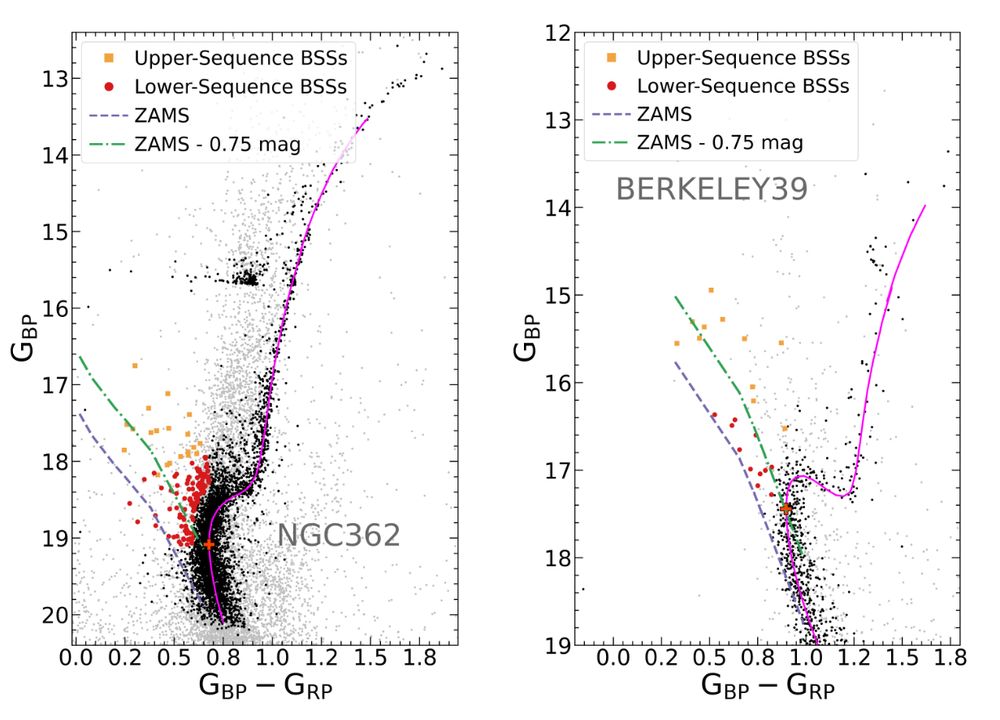
Their Figure 11, showing the location of blue straggler stars (BSSs) in two of the clusters they study
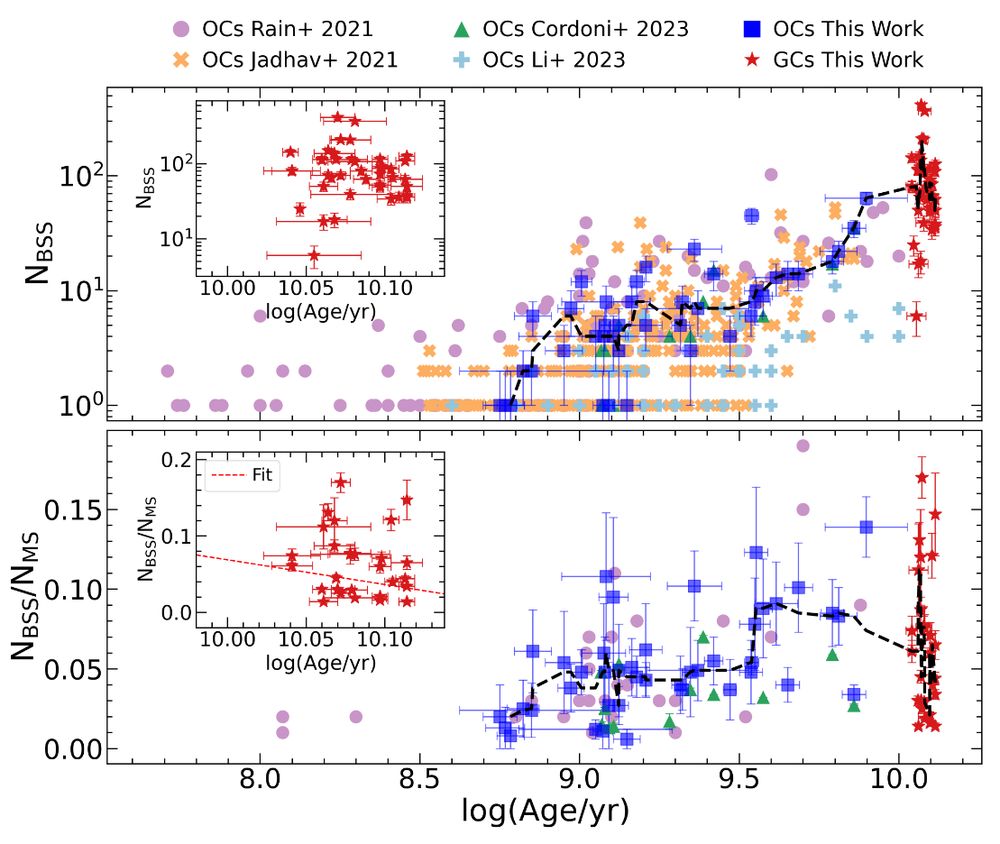
Their figure 3, showing the changing number of blue stragglers as a function of age. Especially the bottom plot, where it's normalized - it's bumpy!
Nice paper out today by Francisco Carrasco-Varela et al. looking at blue straggler stars in #galactic open and globular clusters! ☄️ #stellarastro
These weird stars form in mergers, and in their comprehensive survey they find an increasing fraction with age and multiple 'bumps' over time.
28.03.2025 08:58 —
👍 27
🔁 5
💬 1
📌 0

Follow the reveal of Euclid’s new catalogue on 19 March
The European Space Agency is releasing the first catalogue of astronomical data from the Euclid space telescope, including three new enormous image mosaics with zoom-ins. Follow the reveal live on Wed...
~2h to go until @esa.int and the Euclid Consortium release the first 63 deg² of #Euclid survey science data plus 34 papers to go with this "Q1"-release.
More here: www.esa.int/Science_Expl...
Press releases and directions for data access will follow at the same time.
#astronomy #space #science
19.03.2025 09:12 —
👍 22
🔁 8
💬 0
📌 0
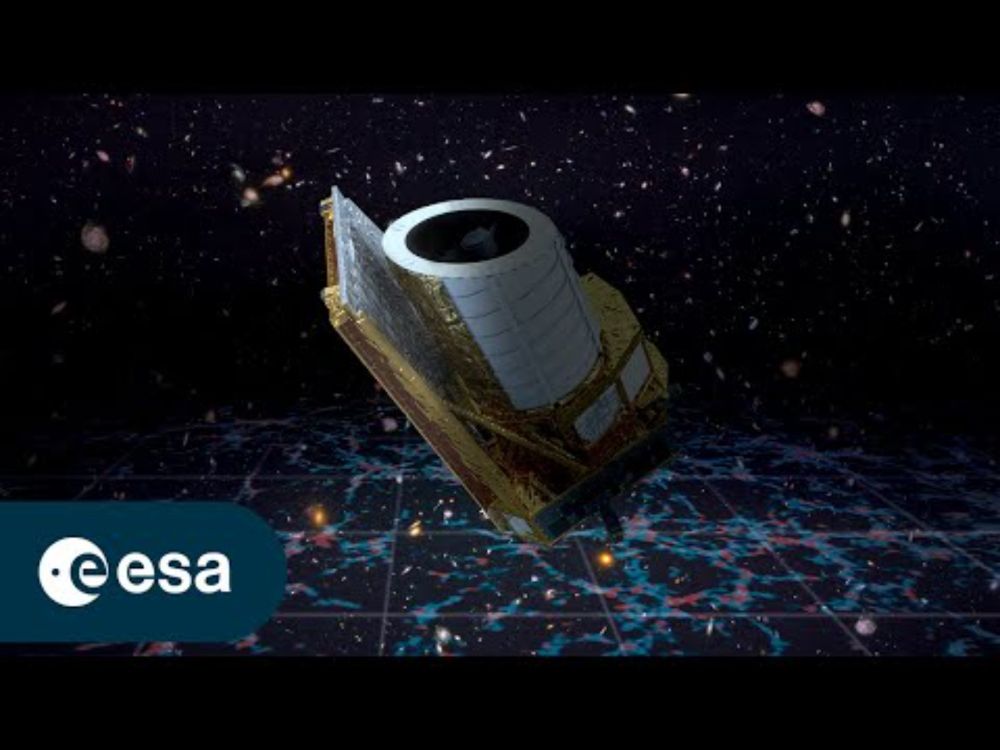
YouTube video by European Space Agency, ESA
Euclid's first deep dive into the Universe
⏰ Have you set your alarm for 12:00 CET / 11:00 GMT today?
Be ready to be amazed at the latest treasures uncovered by #ESAEuclid, our #DarkUniverse detective 🕵️
Watch this space for details & this link for a video premiere: www.youtube.com/watch?v=rXCB...
🔭🧪 #astrosci
19.03.2025 08:12 —
👍 90
🔁 42
💬 4
📌 9