How does our brain excel at complex object recognition, yet get fooled by simple illusory contours? What unifying principle governs all Gestalt laws of perceptual organization?
We may have an answer: integration of learned priors through feedback. New paper with @kenmiller.bsky.social! 🧵
24.10.2025 14:00 —
👍 99
🔁 27
💬 6
📌 8

Dimensionality reduction may be the wrong approach to understanding neural representations. Our new paper shows that across human visual cortex, dimensionality is unbounded and scales with dataset size—we show this across nearly four orders of magnitude. journals.plos.org/ploscompbiol...
11.12.2025 15:32 —
👍 224
🔁 64
💬 7
📌 10

Disconnection between brain regions explains why some people don’t enjoy music. http://dlvr.it/TMMDYD
@cp-trendscognisci.bsky.social
@ub.edu Ernest Mas-Herrero, Robert J. Zatorre
@mcgill.ca Josep Marco-Pallarés
07.08.2025 15:06 —
👍 8
🔁 5
💬 0
📌 0
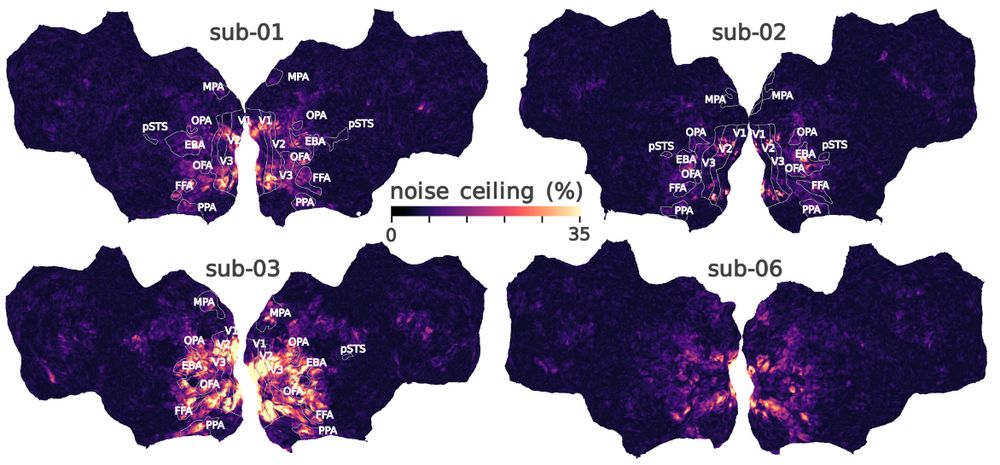
four brain maps showing noise ceiling estimates in response to image presentation
New CNeuroMod-THINGS open-access fMRI dataset: 4 participants · ~4 000 images (720 categories) each shown 3× (12k trials per subject)· individual functional localizers & NSD-inspired QC . Preprint: arxiv.org/abs/2507.09024 Congrats Marie St-Laurent and @martinhebart.bsky.social !!
30.07.2025 01:57 —
👍 35
🔁 17
💬 1
📌 0
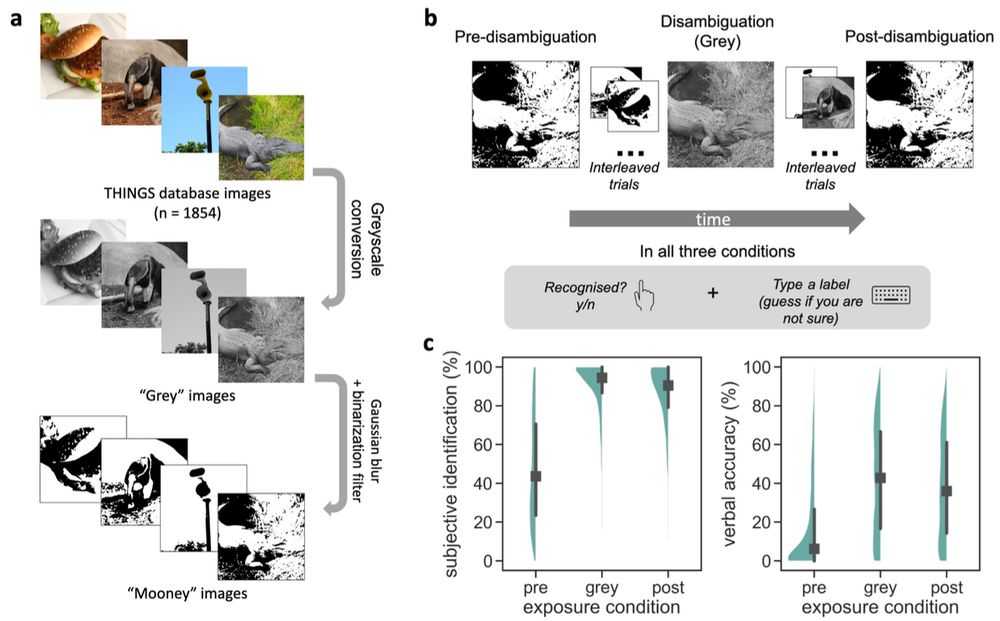
New preprint! 🚨→ Determinants of Visual Ambiguity Resolution. A new work with @ortiztudela.bsky.social @jvoeller.bsky.social @martinhebart.bsky.social and @gonzalezgarcia.bsky.social
We created ~2k images and collected ~100k responses to study visual ambiguity.
www.biorxiv.org/content/10.1...
29.05.2025 12:46 —
👍 46
🔁 29
💬 1
📌 4
Exciting new preprint from the lab: “Adopting a human developmental visual diet yields robust, shape-based AI vision”. A most wonderful case where brain inspiration massively improved AI solutions.
Work with @zejinlu.bsky.social @sushrutthorat.bsky.social and Radek Cichy
arxiv.org/abs/2507.03168
08.07.2025 13:03 —
👍 140
🔁 59
💬 3
📌 11
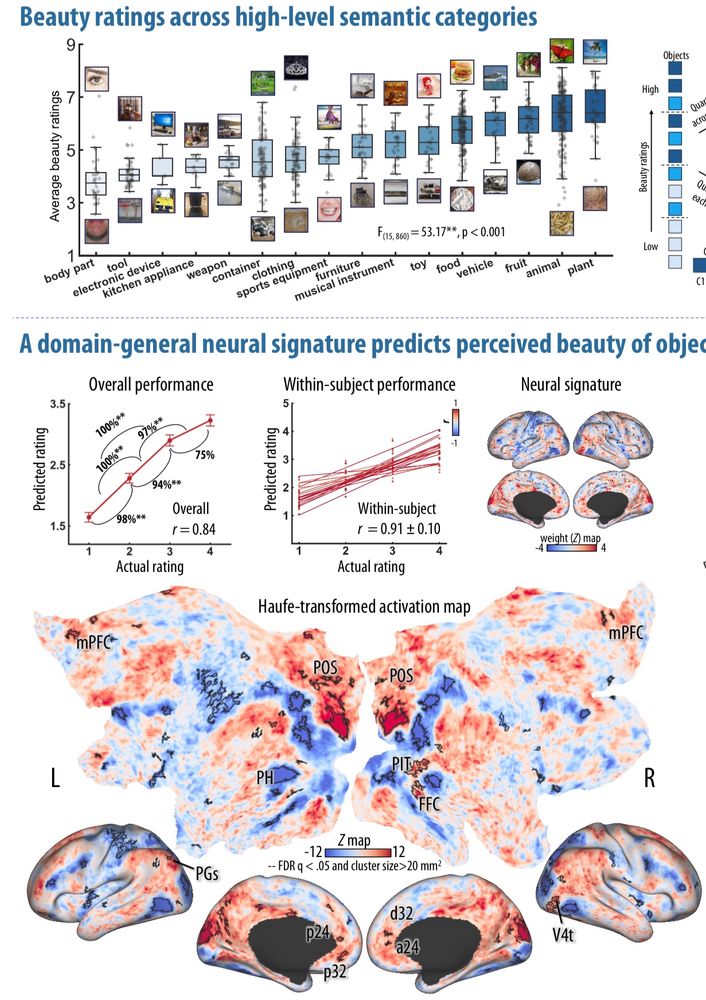
@neocosmliang.bsky.social demonstrating a domain general neural signature that predicts perceived beauty of objects 🌹🥀 in collab with the amazing @martinhebart.bsky.social and @dkaiserlab.bsky.social #THINGS
25.06.2025 00:04 —
👍 11
🔁 8
💬 0
📌 1
Meet the MIT engineer who invented an AI-powered way to restore art
17.06.2025 12:13 —
👍 49
🔁 15
💬 4
📌 3
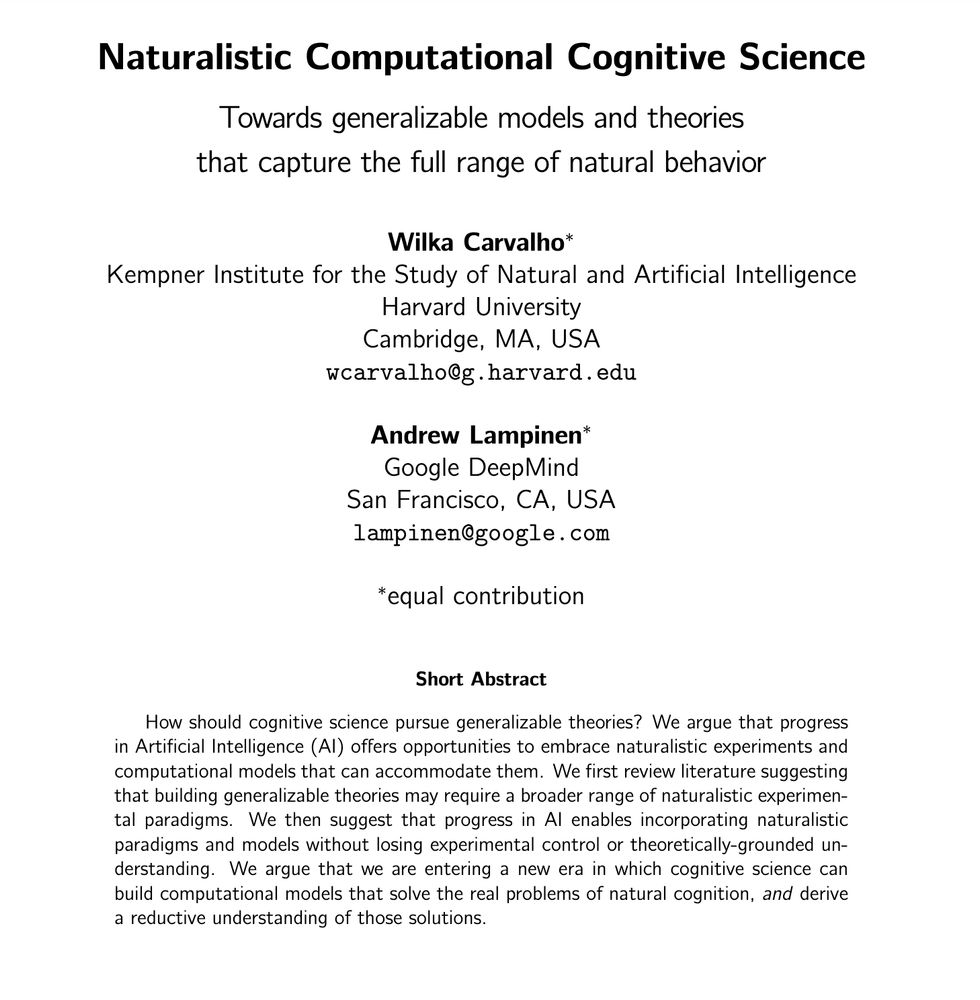
Excited to share this project specifying a research direction I think will be particularly fruitful for theory-driven cognitive science that aims to explain natural behavior!
We're calling this direction "Naturalistic Computational Cognitive Science"
16.06.2025 19:30 —
👍 99
🔁 22
💬 3
📌 2
1. The evolution of [proto] music. My arguments against the social bonding hypothesis and in favor of the signaling hypothesis 🧪
The Explicandum: The evolution in the human lineage of vocalizations that are:
* Loud
* Synchronized
* Variable
🧵
27.05.2025 22:28 —
👍 18
🔁 6
💬 3
📌 1
Great seeing your work at VSS!The topic on aesthetics and NeuroAI was one of my favorites. Hope we get to discuss more next time!
21.05.2025 22:19 —
👍 0
🔁 0
💬 1
📌 0
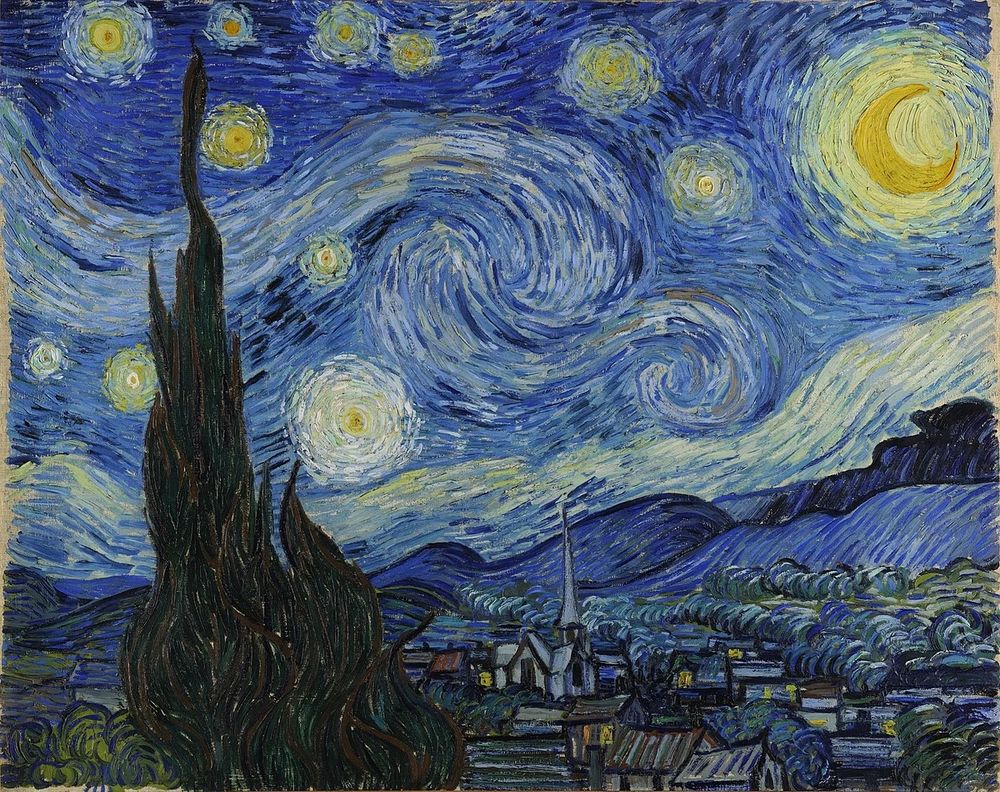
Looking at Van Gogh’s Starry Night, we see not only its content (a French village beneath a night sky) but also its *style*. How does that work? How do we see style?
In @nathumbehav.nature.com, @chazfirestone.bsky.social & I take an experimental approach to style perception! osf.io/preprints/ps...
14.05.2025 16:42 —
👍 81
🔁 29
💬 2
📌 3
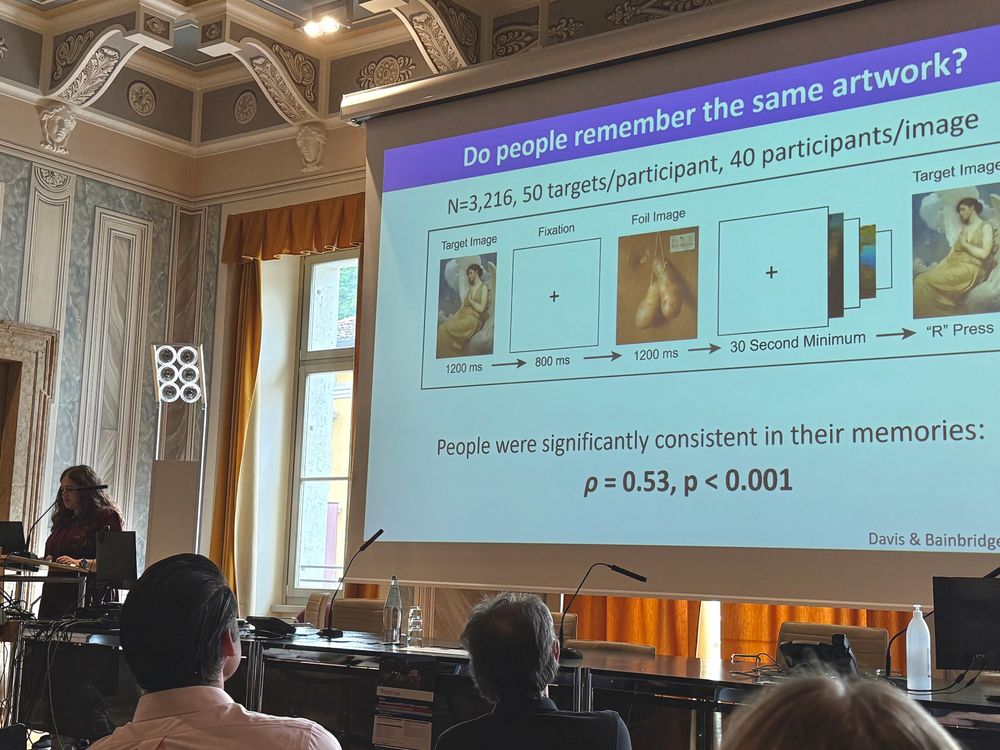
#CAOS2025 starting in Rovereto, with a fantastic talk by Wilma Bainbridge on memorability. Among others,she looked at memorability of paintings in the Art Institute of Chicago, highlighting the role of context, painting size & interestingness on memorability, & that famous pieces are more memorable.
08.05.2025 07:30 —
👍 27
🔁 4
💬 2
📌 0

Group of children in a class, sitting in front of a Jackson Pollock painting at the Museum of Modern Art in New York City. Stock photo.
People viewing abstract art show more interindividual variability in activity in high-order brain areas than people viewing representative art. According to the authors, abstract art is completed by the viewer, who imbues it with meaning. In PNAS: www.pnas.org/doi/10.1073/...
17.04.2025 18:29 —
👍 9
🔁 3
💬 0
📌 0

A move you can afford
Where a person will look next can be predicted based on how much it costs the brain to move the eyes in that direction.
Where a person will look next can be predicted based on how much it costs the brain to move the eyes in that direction.
buff.ly/SXw5LPy
13.04.2025 20:01 —
👍 12
🔁 3
💬 1
📌 1
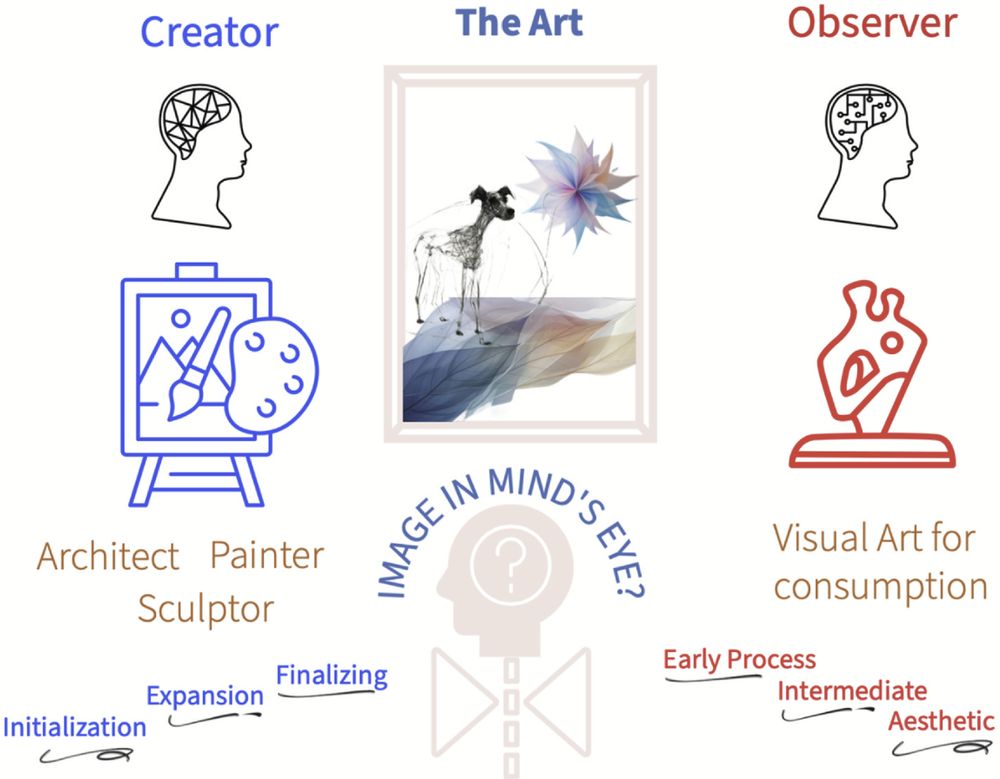
The Mirror Model of Art sees creativity and aesthetics as mirrors of one another.
Creativity as aesthetics in reverse? How does the Mirror Model of Art hold up when seen through the lens of neuroscience? It doesn't.
New paper with Oshin Vartanian, Delaram Farzanfar and Pablo Tinio in Neuropsychologia.
doi.org/10.1016/j.ne...
@uoftpsychology.bsky.social
@uoft.bsky.social
11.04.2025 01:05 —
👍 14
🔁 4
💬 0
📌 0

Art promotes exploration of negative content | PNAS
Experiencing negative content through art has a unique power to transform our perceptions
and foster engagement. While this idea has been widely di...
"Our results suggest that art stands as a powerful tool for communicating negative information, that is otherwise costly and unpleasant to engage with... Art may serve as a gateway for staying engaged, and potentially facilitate knowledge, meaningful dialog, and action"
www.pnas.org/doi/10.1073/...
24.03.2025 19:37 —
👍 7
🔁 2
💬 1
📌 0
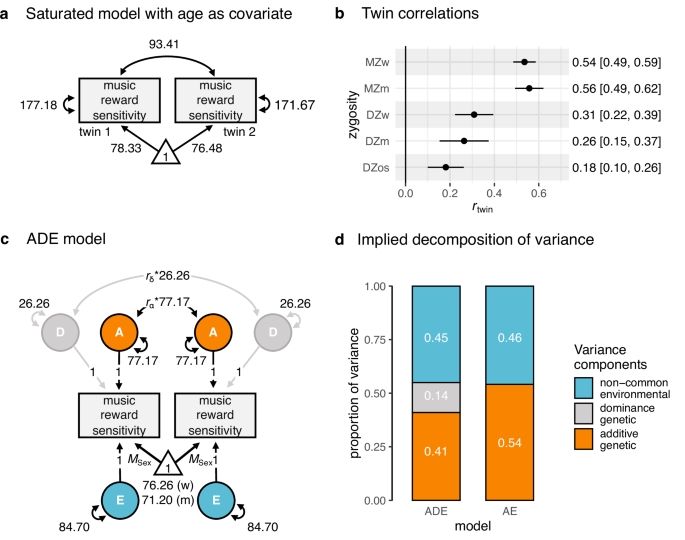
Twin modelling reveals partly distinct genetic pathways to music enjoyment - Nature Communications
Here, Bignardi et al. report on a study of over 9,000 Swedish twins that indicates the ability to enjoy music is influenced by multiple partly distinct genetic factors.
“What an odd thing“ wrote Oliver Sacks “to see an entire species playing with listening to meaningless tonal patterns, preoccupied for much of their time by what they call ‘music’...“. Our new paper, led by ace student @giacomobignardi.bsky.social, unpacks this puzzle from a genetic perspective. 🧪
25.03.2025 22:07 —
👍 68
🔁 23
💬 2
📌 4
Happy to share our paper on the #AestheticsToolbox around the #QIP-Machine has been published #OpenAccsess in Behavior Research Methods!
It can can be used to easily and transparently compute a wide range of quantitative image properties for digital images 📸
📄 link.springer.com/article/10.3...
17.03.2025 16:30 —
👍 15
🔁 7
💬 0
📌 1

Out today in Nature Machine Intelligence!
From childhood on, people can create novel, playful, and creative goals. Models have yet to capture this ability. We propose a new way to represent goals and report a model that can generate human-like goals in a playful setting... 1/N
21.02.2025 16:29 —
👍 135
🔁 40
💬 5
📌 4
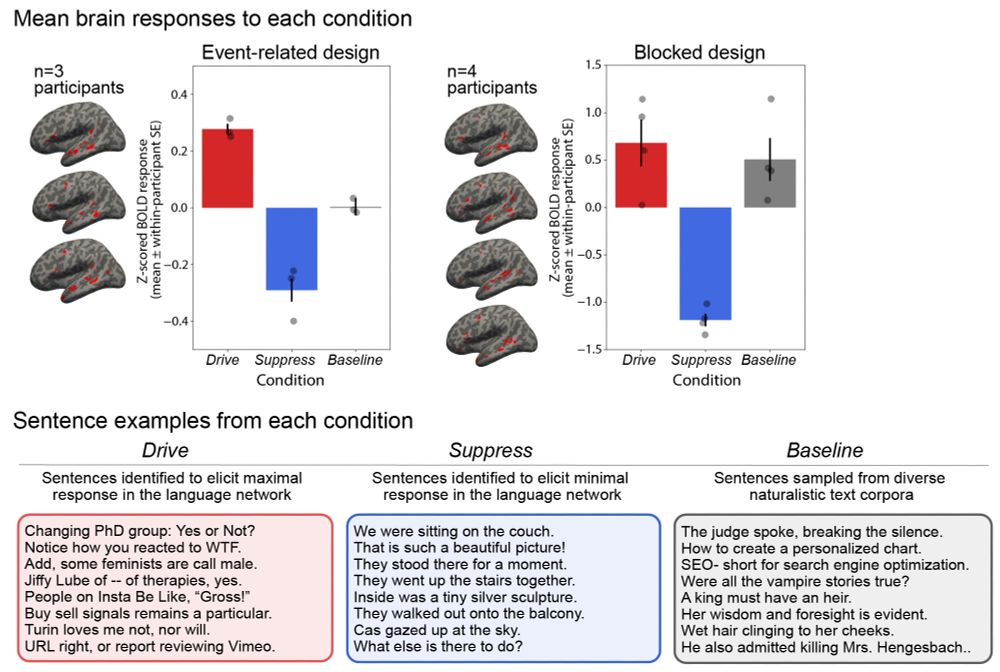
1/
Our paper is published in Nature Human Behavior!
tinyurl.com/p28jy3bx
Driving and suppressing brain activity in the human language network with model (GPT)-selected stimuli
With A. Sathe, S. Srikant, M. Taliaferro, M. Wang, @mschrimpf.bsky.social, K. Kay, @evfedorenko.bsky.social
03.01.2024 23:57 —
👍 24
🔁 5
💬 1
📌 0
Characterizing internal models of the visual environment: http://osf.io/wucx8_v1/
21.02.2025 10:39 —
👍 1
🔁 1
💬 0
📌 0
We are very excited to announce the open release of a new 170 participant dataset: Linked MEG, TMS, multimodal 3T MRI, 7T MRI, Connectom MRI, cognitive /questionnaire data. Immense effort from a fabulous
CUBRIC team. Paper by Carolyn McNabb et al: doi.org/10.1038/s415...
06.02.2025 11:43 —
👍 144
🔁 67
💬 2
📌 8