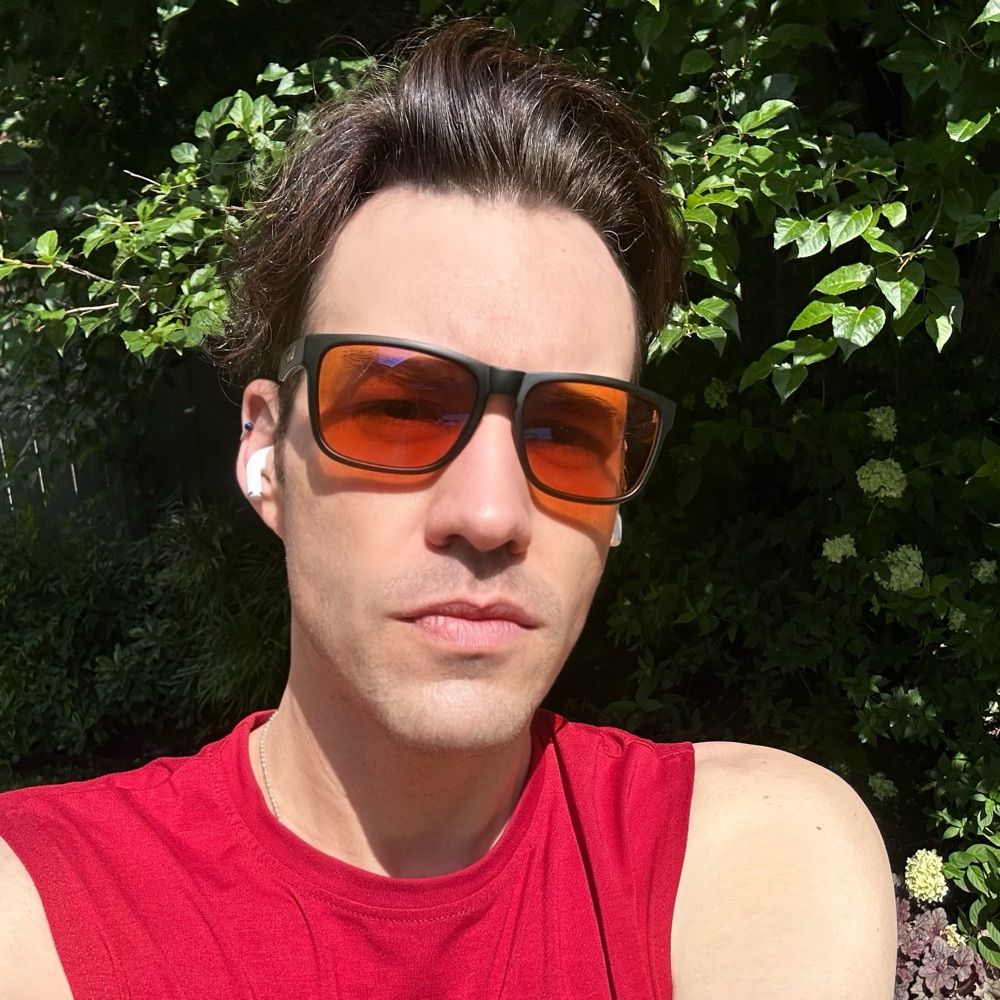

My name is Simon Vautrin, and I was born in Brooklyn in October of 1975. That was the year my parents stopped running from whatever shadows haunted them on the old continent and decided America would be the place to raise kids. They arrived with so few possessions that it would shame even the most minimalist of individuals. A few suitcases, a box of old family heirlooms, and their stubborn belief that on this side of the ocean, life would be prosperous.
By the time I was 25, I had carved out a quiet life for myself, living alone in a narrow two-story house at the northern tip of Manhattan. My days are filled with cataloging relics in a posh museum on the Upper East Side, sifting through the dust of people that the world has chosen to forget. At night, I spend time with my partner, Sam, delving into our shared love of cinema.
Life moved in steady loops: subway rides, late-night dinners, and the occasional beer night out with Anthony, my oldest friend. But then came the package, carrying a notebook that froze me from the inside out, the way you feel just before someone delivers tragic news. Even if I didn’t know yet that the notebook had passed through the hands of a man working up high in the north tower of the World Trade Center, a man who never made it out that September morning. I also had no idea how his death would knot my name to his work, or how blood moves in patterns so tangled it sometimes takes a lifetime and a tragedy to drag them into the light.
That package wasn’t the end of a story; it was the opening scene, the voices of my ancestor demanding that his story be heard, and the tragic demise of the man who discovered it.
Part I – The Package
It arrived in the months following the attacks, a small package, postage stamped with the frugality of official U.S. government mail. I was on my way off to work when I found it in the mailbox, but intrigued, I went back in the house to open it.
Inside the packaging was a black leather-bound notebook, no logo, no inscriptions. Alongside it, a single sheet on FBI letterhead:
This item was recovered from the debris of the World Trade Center site. Affixed to the back of the notebook was a small piece of paper bearing your contact information, with a handwritten request to return the item to this address if found. Despite exhaustive efforts, we have been unable to positively identify its owner. Based on available evidence, it is believed to have been in the possession of one of the victims located on the 95th floor at the time of the incident. Please accept our most sincere condolences for your loss. signed Director Robert S. Mueller the third. Federal Bureau of Investigation.
My hands were trembling as I turned the notebook over, and there it was, a torn piece of paper, rough edges, my contact information scribbled on it as if it had been written in a hurry. I was in shock. I didn’t know anyone who could have been anywhere nearby the towers that day. At least, I didn’t think I did. My heart skipped a beat, and my breath was stuck in my throat, as if I already knew my life was about to take a wild turn.
Holding this notebook, a hundred questions detonated at once in my brain. How did my name end up in Lower Manhattan? Who wrote it? Why would they have carried my address? Why hadn’t I heard about this until now?
The questions kept stacking as my pulse climbed. I pushed back from the table, crossed the living room in a rush, and climbed the narrow attic stairs two at a time. If there was an answer, it might be buried up there, in the boxes of my family’s collection of old letters, photographs, and notebooks. Dust swirled in the beam of a single incandescent light bulb hanging off the ceiling as I began pulling lids off cardboard, looking for any paper, any note, or half-forgotten letter that could tell me who in my family had that handwriting.
Near the bottom of a box, I found a yellowed envelope. It had non-English typical fonts and old European stamps. Inside was a letter from years ago, addressed to my maternal grandmother and signed by a relative I have heard of but never met. The handwriting was very similar to the one in the black notebook, but he is believed to have disappeared before my parents were even born. Could it really be his?
My curiosity outpaced the time spent trying to resolve that mystery. I went back downstairs, sat down, and started reading through the notebook. It wasn’t a single story, more of a collection of thoughts, notes, and small doodles.
Written mostly in German but with some passages in what seem to be an old Slavic language, possibly a blend of Ruthenian and Russian. It began with short appreciation stories almost like small poems from a sensitive boy who would have been born and raised during The Great War. As I continued reading, the messages became more cryptic, as if the author was afraid of persecution if these writings were to fall into the wrong hands. Some of the stories contained pieces of messages about a great forbidden friendship, or perhaps was it about an impossible love?
Part 2 – The Motherland
In hopes of learning more about that distant relative and potentially uncovering a family secret, I visited my parents later that day. Their house always feels like stepping into a different world, with walls lined with old photographs from their life in Eastern Europe, and the scents unique to the last century. My grandmother, Oma as I still call her, has lived with them since the early ’90s, and I was hoping they’d be able to help me piece together the fragments of a family story still begging to be written.
I decided to wait before bringing up the notebook. The tragic events of September had already brought back traumatic memories from their past, so I didn’t want to worry them before I could learn more. I focused the conversation on one of the old letters I’d found, the one with handwriting that looked almost identical to the content of the notebook. The first step was to learn more about that distant relative and see if I could find enough information to decipher its content by myself.
“Oma, do you remember who sent you that letter?” I asked, handing her the old letter.
I saw a gentle smile forming on her face as she began to speak of her uncle, a talented and soft young man who used to draw pictures of tourists in the festive streets of Berlin right before the war.
She got up slowly and reached for the photo album sitting on the corner table by the television. She sat back down and started flipping the album pages, one by one, until her hand just stopped. We were staring at an old black-and-white photo of two young men, their shoulders touching, both smiling as if the world was theirs to discover. She pointed at one and said softly:
“My dear, this is your great-granduncle Emil. And the man beside him was his special friend.”
She didn’t have to say more as I already knew what “special friend” meant for people of her generation.
By the late nineteenth century, Berlin was a modern and progressive city, a place where artists converged, painters chasing new colors, writers chasing new words, cinematographers breaking new ground in photography, and even scientists daring to push the limits of what was possible. These were facts of the past I already knew, but today I learned something else, something darker about my own family history.
According to my Oma, Emil’s childhood, in the German-occupied Volhynia region, ended in a single violent moment, an explosion that tore apart his home, which killed both of his parents. My Oma was too young to remember it clearly, only fragments of the story that her parents shared with her. After the accident, my great-grandparents took Emil in to live with them; they did their best to support him as he grew up. At the age of eighteen, he moved to Berlin to study, using the inheritance he had received from his parents. My great-grandparents signed the legal papers, promising they would remain responsible for him until he turned twenty-one, the legal age in Germany at the time.
Long after the law had declared him a man, Emil kept writing letters to my Oma, who had been like a younger sister to him. She saved every one, each page a thin thread of his life, a glimpse of someone trying to endure a secret as the sky darkened over all of Europe. Then, in late 1939, the letters stopped coming, and the silence that followed was strong with unspoken assumptions: had he been taken, killed, or was he in hiding and unable to send mail? I asked my Oma what she thought happened to him. She looked away in the distance, then glanced at my parents, pensive, and said:
“I don’t know, dear. I hope he’s okay,” while she also shrugged. I can tell that those thoughts are upsetting her, so I didn’t insist.
Learning about Emil was like finding lost pieces of a puzzle, seeing him stepping off trains, slipping through narrow streets, leaving behind footprints that have long since disappeared beneath new pavement. By that point, there wasn’t any doubt in my mind: the notebook was his and might help us better understand what happened to him. I also tried to find out if they were aware of any relatives that would also have made it to New York City, people who would be familiar with Emil’s story.
My parents’ own beginnings were also knotted in the same restless history that had reshaped Eastern Europe between World War I and World War II. Their story felt like something out of a Shakespearean tragedy, two youths from opposing worlds, bound by fate and torn by the brutal realities of war. My mother’s family had settled in a German colony in the Odesa Province, a borderland on the Black Sea coast where Ukraine and Moldova meet. My father came from the shadow of another empire; his father was a Soviet soldier who was posted in a nearby region after the war to help keep Stalin’s grip on a land, a land divided by cultural differences so divergent that it remains to this day.
As I was leaving their home that evening, the sky outside was a deep, blushing purple, with the city’s lights flickering in the distance. The journey ahead to learn about that notebook was uncertain; the path was clearly tangled with ghosts and half-remembered stories from a distant past. But I knew one thing for sure: the search for the truth had only just begun.
Part 3 – The Transcription
Back at home, I cleared my desk, set the notebook down, and put on a pair of nitrile gloves to examine it more closely. I opened to the first page and began slowly, pencil in hand, transcribing Emil’s pieces of words into American English.
Sentences in Ruthenian like: “Вулиці тепер голосніші, ніж театри” meaning “The streets are louder than the theaters now”
I tried to read each passage aloud, not simply translating but inhabiting his words, the same way an actor gets into the skin of his character.
He also wrote about painting in Berlin, calling them “Schattenbilder”; this was in one of the German terms I could never fully translate, unsure how best to capture its meaning; “shadow pictures” simply feels wrong.
Page by page, the story unfolded: the chatter of train stations, the smell of cheap beer, summer vacations on Rügen islands in the Baltic Sea, then another line stopped me, “Сьогодні я зустрів одну людину. Його звали Андреас…” (Tonight, I met someone. His name is Andreas…)
I froze when I read that name. Andreas. A name written plainly in the early entries, written with passion, could that be the “special friend” my mother showed me in the picture? He was talking very openly about Andreas, who smiled, as if their love wasn’t forbidden. They walked together by the Spree. They spoke of traveling to Paris, Zürich, and Venice.
And then, as the pages turned into the mid-1930s, the tone shifted. Phrases getting increasingly cryptic like this one: “Занадто багато очей. Занадто багато питань.” which translates to something like “Too many eyes. Too many questions.”
Then I stared at a few spots where the ink on the page where Emil had wiped off some words and replaced them with “Freund” (friend). I can only imagine that the original words were probably something that made reference to a lover instead. Then passages grew less direct, slipping into metaphor, almost a secret code.
I pulled my laptop closer, cross-referencing dates and places, every entry lined up with years when Berlin surged with rallies and broken glass, when walls truly did have ears. The abrupt tightening of Emil’s words matched the climate of the time, and I could feel the coldness of it press against my body.
But I also sensed something else. I could feel that Emil had left these traces for someone to find, to remember their story in case something bad happened. Between some older Ruthenian phrases that I couldn’t yet translate clearly, like “Тіні… Мури мають вуха… Питання.” Emil’s life was preserved, coded for safety, but still here and waiting to be heard.
And that’s when I got enlightened. I rushed back to the attic to find the letters, all the letters he had sent my mother, all the letters she felt compelled to keep all these years, not understanding why, not knowing that they were keys to decode his notebook.
I leaned back, pencil resting between my fingers. It was at that moment that I realized the notebook was more than a relic; it was a map, an unfinished story that was still writing itself, decades later, in America.
Was it fate that brought the notebook here? Who was that man, working only a few miles away from me? It couldn’t be a coincidence.
Part 4 – The Film Collective
I couldn’t shake the question. Who was that man, working just a few miles from me, who had somehow held the same notebook in his hands?
Days bled into long, quiet nights of research. My desk became a chaos of papers, scanned fragments, and half-translated lines that were only dragging me deeper down a rabbit hole.
That’s when I reached out to historians’ networks and reviewed online forums devoted to lost and displaced artifacts.
Then one afternoon, a historian friend from Berlin wrote back. She had been cross-referencing the international import/export database and found mention of a shipment from the early ’90s, described as “personal manuscripts and intimate correspondence”, brought in by a small film company that had an office somewhere in lower Manhattan.
The company’s name didn’t mean much at first, Aurora Films Collective, a small indie production firm created just a few years earlier. The importer’s name was still legible on the record: Michael Keene, associate producer, and a partially hidden address at 1 World Trade Center, 10048.
I followed the trail, scanning every film database on the Internet, searching for the names and keywords I had collected so far. Then, a 1998 production listing for a project titled “The Border in Mind” appeared. The description read “a historical adaptation based on letters and journals recovered in post-war Europe.” That finding made my pulse rush; it had to be what I was looking for.
That title, “The Border in Mind”, wasn’t random. I remembered similar writings from Emil’s final letters to my Oma and her family; he talked about escaping to France with his friend Andreas.
So that was it, that person by the name of Keene had been trying to rebuild and tell Emil’s story. He and his team had been searching for living relatives, someone who could help them authenticate and correctly translate the notebook.
And somehow, they had found us.
I thought of my mother in Brooklyn, still keeping in touch with the few relatives left in Europe. She had shared my address with them a few years ago when my Oma immigrated here, thinking it would be more reliable than theirs since I was in sort of the family historian and archivist. Maybe that’s how Keene’s team was able to trace it back to me. Maybe that’s how my address ended up tucked inside that metal box that was found among the wreckage in the aftermath of 9/11.
Keene must have meant to reach out, but he never got the chance before that unfortunate event. I sat there for a long time, listening to the hum of the city through my attic’s tiny window. It all felt too strange, too aligned, as if the universe itself had been conspiring to hand the story back to me.
Before shutting down my computer that night, I saw a note in the archived production file with another address in Los Angeles, along with a few different names and a phone number. I wrote all of that down carefully, and tomorrow morning, I’ll call them.
Part 5 – The Call
The city outside is already awake, with delivery trucks growling down Amsterdam Avenue. I barely slept, but I got up and brewed a strong pot of coffee and sat at my desk. The notebooks sitting on the edge of it with my notes and documents all over. The Los Angeles number at the bottom of a printed page, looking at me, waiting to be dialed.
It was six in the morning here, which meant only three over there, still in the middle of the night, so I decided to wait before calling. But it was okay. I spent those hours confirming the names, cross-checking the addresses online, and imagining who might pick up when I finally dialed the number.
When the clock eventually reached eleven here, I took a long breath and pressed the call button.
The line rang a couple of times before a woman’s voice answered, bright but exhausted, like someone who’s juggling a dozen tasks at once. “Good morning, Aurora Productions,” she said.
I hesitated briefly before saying, “Hi, good morning. My name is Simon Vautrin. I’m calling from New York. I found your number in one of your old project files, something labeled ‘The Border in Mind’. I was hoping to speak to someone who might know more about it.”
There was a pause on the other end followed by a quiet shuffle of papers. “Ehh..The Border in Mind, that’s an old one,” she said. Then I could hear muffled voices in the background, “Give me a second.” she added almost with a sense of panic, then the sound of a phone being transferred quickly.
A man picked up the line, his tone was slower, “This is David, you asked about The Border in Mind?”
“Yes! I came across references to a film that was in pre-production around 1998? I believe some of the material used came from a recovered notebook?”
Another silence, longer this time, as if I had touched on a sensitive subject. “We had a team in New York researching the story, which was apparently a personal diary or maybe some wartime correspondence. The idea was to adapt it into a feature about exile and remembrance. Then…” at this point his voice trailed off and he added “Then everything stopped after September.”
I asked with a confident tone, “So it was real?”
“Yes,” he responded, “The New York office was working on tracing any living relatives connected to the notebook’s owner. I think they had a lead before… well, you know…before the tragedy.”
He then cleared his throat quietly, “To be honest, sir, no one here ever knew what became of the materials. They were supposed to be sent back here, but after the attacks, most of the production files disappeared, and the project was shelved.”
I looked at the papers spread across my desk, the address, the names, the fragments of translation I had already covered, and felt the weight of it all settle in before responding.
“I have the notebook,” I responded almost timidly before adding, “The author was my great grand-uncle and very close to my mother’s family, and I’d be interested in working with you to restart that project.”
David replied, suggesting a meeting in Los Angeles the following week to discuss the project further. This wasn’t part of my plans, but I instinctively said yes, without even thinking about it. I knew both Sam and I had a lot of accumulated vacation time, so perhaps we could take a little vacation and enjoy the California sunshine while we’re there. As soon as I was done with the call, I contacted my favorite travel agent and asked him to book me a flight and hotel to Los Angeles. We’ll leave this weekend and come back the following.
Part 6 – The Meeting
By the time our plane touched down, I felt as though I had crossed not just the country, but the threshold to another world. Sam was sitting beside me, smiling, quietly amused by my excitement. The first thing that hit me about LA wasn’t the sunset, although it does look like that endless golden sky you see in movies; it was its scent. It smelled like a mix of ocean air, sunscreen, dust, and the scent of palm trees. A clash of wealth where the rich and powerful in Beverly Hills neighbor the poorest of them all in Skid Row, sharing their lives within a single county.
Aurora Productions sat behind a sun-bleached café, next to a souvenir shop that sold sunscreen, cheap magnets, and overpriced water bottles. The edifice itself looked old, definitely from a distant past, with Art Deco elements preserved perfectly, as if time had never passed. Out front, a sign still read “AURORA FILMS COLLECTIVE.” It leaned forward a little, like the screws had started to loosen and no one cared to fix it anymore.
After entering the lobby, movie posters from wall to wall covered the hallway. Half faded, half forgotten. The kind of movies that never made it past the festival circuit. A tall man stepped out of an office. Early forties, maybe. He had the tired look of someone who’d been waiting too long for something real.
“Simon Vautrin,” he said, shaking my hand as if testing its weight. “David,” I replied. “Thank you for taking the time to meet with me.”
He led us down the corridor, through a door marked ARCHIVES, shelves covering the walls all the way up to the ceiling, filled with stacks of boxes. He gestured us toward a table, “This is what survived.” he said.
I reached into the nearest box and lifted a folder, when I opened it, the first page stopped me:
THE BORDER IN MIND
Based on the recovered journals of Emil Berek.
In that moment, it felt like my blood ran cold through my veins. You know that strange rush when your brain can’t catch up to what your eyes are seeing. The feeling of realizing that someone had already tried to tell his story. OUR story. Before I even knew anything about it.
Then David looked at me and said, “We had plans to turn that story into a film back in the nineties. The New York team did most of the research, and we received partial translations of the notebook. But everything ended when Michael Ke…” He stopped mid-sentence, choking on the words as if he was about to cry. But he didn’t have to explain more; I already knew what he meant.
He opened a folder that was filled with documents like Polaroids of set mock-ups, a library, a Berlin street, estimates for sound stage rental, and told me, “This was all Keene’s doing; he was obsessed with the story; he was calling it ‘the love that outlived empires.’”
“We’ve dreamed of finishing it over the next few years, but after the tragedy, the rights got tangled, investors disappeared, and people moved on,” he added with a tone of despair.
I placed Emil’s real notebook on the table beside the draft script. For a few seconds, it felt like the book was waiting to be there, at that specific moment in time, almost like a cosmic attraction or divine intervention.
David touched the cover with some hesitation and said, “Would you… Um…Would you let us read it?” That meant leaving it with them, so I hesitated for a few seconds, then nodded. “If it means bringing his story back, yes.” But there was one condition: I wanted to be involved in the project.
That night, Sam and I walked the length of Santa Monica Pier. The sea was dark and calm, full of the kind of quietude that happens only once in a lifetime. I told him that for the first time, I didn’t feel like a spectator to my own family’s history. He smiled, squeezed my hand, and said, “Then maybe this is what was meant to be, your grand-uncle guiding you to make sure his forbidden love story carried on.”
I didn’t answer; we stood there for a little longer, quietly listening to the waves hit against the pier, the kind of silence that says more than words ever could.
Part 7 – The Making of a Film
The following months felt like one scene blurring into the next, from New York to Los Angeles, winter transitioning to spring. Initially, my job with the production was relatively straightforward. I was there to ensure the story remained authentic, to verify the handwriting and tone. I helped with the translations, and I had carefully studied the letters between my mother’s family and my great-uncle, which greatly helped interpret the context and decrypt the smallest emotional details. Would he have used that word? What might he have felt there? I was becoming so close to Emil. It’s like I wasn’t just a descendant anymore, but I was part of his life.
Mira Kline, the director, had a way of seeing things that made me feel a tiny bit uneasy. She wasn’t giving instructions; she gave “visions”. “Think of this as bringing something back to life through details,” she told the crew one morning. She added that a story’s truth wasn’t in how accurate it was, but in its atmosphere, the little things between the lines.
The historian in me seriously wanted to scream insults at her for saying things like that. But deep down, I knew that she was right. If I wanted that story to reach as many people as possible, it had to have that pizzazz only Hollywood can give us. So, I decided to follow her lead while staying on my toes to ensure we wouldn’t stray too far from the truth.
We started filming in Germany. The movie was going to be focusing on Emil’s life as an adult, trying to survive as a young gay man in Nazi Germany. The air was fresh and crisp, and I tried to imagine what life was like for him. I often stood behind Mira, watching the actors through the monitor. The actor playing Emil was a quiet German man with a light Slavic accent, with a narrow build and the same uncertain smile I’d seen in old photos. The actor playing Andreas had a different kind of composure, one that stood up to the world, ready to fight. Together, they moved through the frame like two people afraid that light might expose what the war had tried to erase.
There was a scene depicting their attempt to escape the night before their capture near the border with France, which was shot inside a small mountain cottage built for the production. The crew cleared out, but Mira asked me to stay on the set.
The actor playing Emil sat at a desk, writing the final words of the journal. Outside, snow gathered on the window ledge. He whispered the line I already knew by heart:
“The sky is clear but the danger still near, tomorrow the rails will go somewhere the shadows can’t follow.”
As soon as she yelled, “It’s a wrap,” I felt something change in me, like a little spark of wonder lighting up. I had to step outside into the cold night, with the impressive mountain peaks dominating the landscape under the moonlight. For a quick second, I noticed two male figures walking by the fence. One stopped, while the other waved at me; then, just like that, they were gone, as if the wind had blown them away.
I’ve been trying really hard to convince myself it was just my imagination playing tricks on me, the emotional exhaustion of that project wrapping up, but in that moment, I secretly wanted to believe, believe that ghosts really do exist.
As soon as we returned to Los Angeles, editing had already started. Long weeks into the post-production studios, with the same repetitions daily: sound design, color grading, CGI effects, paste, add, one more test screening, cutting, and removing what didn’t quite fit.
I followed Mira for most of that work, whispering quiet corrections that probably mattered only to me. Sometimes she’d pause mid-scene and ask, “What do you think he meant here?” And I’d answer, not as a scholar, but as someone who had shared his blood and also the secret that he was forced to hide from his whole life.
Once the final cut was locked, the film no longer felt like my story or theirs. It had transformed into something different, an epic tale about love and the struggle to preserve it in a world that had turned against them, despite the promises of creating a better future for all.
Sometimes I wonder if that’s all any of us are, just echoes moving through time, trying to remember what it is that makes us human.
Part 8 — The Premiere
The premiere took place a few days before the Armistice on a cold November evening, as cold as it can be for southern California. People were gathering around the entrance, and the lights from the Egyptian were shining brightly on Hollywood Boulevard.
My name was on the poster, printed in characters small enough that you’d only find it if you went looking for it, but it was there and it made me feel good. Just before we stepped onto the red carpet, Sam straightened my tie again; he’d already done it a few times earlier in the evening. It was his way of coping with anxiety, so I was fine with it.
Inside, the lobby felt a little crowded, not unbearable, just loud and stressful to someone like me, used to the quietude of the museum basement. You could hear glassware clinking, people nearly screaming, trying to hold conversations over all the noise. A passing camera flash caught the side of a poster, and for a second, I had almost forgotten where I was.
When the lobby lights dimmed, the room suddenly got quieter. Sam rested his hand over mine, like telling me that everything was going to be great, without speaking a word. For real, that was our thing; we were both passionate about cinema. But I would have never in a million years been able to imagine one day being in Hollywood for the premiere of a movie about my ancestor, a movie I contributed to making.
We took our seats in the theater; the screen opened with a peaceful river shore in a suburban area west of Berlin. Two young men, laughing together and enjoying a quiet summer day in the late 1920s, falling in love, it was clear for those who understood what forbidden love is, but it wasn’t as obvious for everyone else who was watching.
A couple of scenes and years passed, and we are now in the early 1930s, at a tram depot in Berlin. The tracks shone faintly under the bright moonlight, cleaner and more cinematic than anything Emil ever described, but the shape of it was right. Two young men, shoulders almost touching, standing beside an idle tram car.
The actor playing Emil laughed more easily than the real one ever would have, although I would never know for sure. The actor playing Andreas leaned in with that defiant steadiness I’d seen in the old photograph. They passed a cigarette back and forth, without exchanging a single word, as the camera lingered on the gap between their hands, on the little hesitations, on all the fragile things no one dared write plainly back then.
Hollywood has that gift of stretching a single sentence into several minutes, but beneath the lighting and the string music, I could still feel the raw truth of the original line pulsing underneath.
About two-thirds into the movie, we got to the rooftop scene. Mira had turned it into something nearly sexy and romantic, with a navy sky washed with clouds, the city below lit like a jewelry box. They sat near a ledge that looked suspiciously safe, especially for that era, but it felt beyond real to anyone unaware of the real story. Wind machines nudged their hair just enough to suggest danger without threatening anyone’s health.
In Emil’s notebook, it wasn’t romantic, at least not in the way we see romance nowadays. It was fear pressed into paper, a sketch of chimneys, a crooked row of roofs, and three words scribbled tight in the margin: “Zu viel Stille” —Too much silence.
But the movie couldn’t resist. On-screen, the actors watched the street below with the stillness of prey that knows it’s being observed. A man lingered across the road, his face hidden in shadow. The camera cut away before we could see more. That was pure invention, but I knew exactly where it came from. Emil had written once about a man who stood outside his building for too long, staring upwards.
Then came their escape plans and the train station, the one where they attempted to catch a train to France. Emil had written about it the night before from the mountain cottage, unaware that they would get arrested before getting on that train and that it would be the last time they would ever see each other.
From that point, the film was only a figment of what Emil left behind. Everything is pure fiction, an ending the filmmakers created where the pages stopped, a view imagined around the edges of a world that felt closer than reality itself.
That final scene made the whole theater seem smaller. The set was gorgeous and grandiose, with clean lines, polished stone, and extras moving in a choreographed pace. The actors stood in the posture we imagined they would have at that time — backs straight, hands in their pockets so no one would notice they were shaking.
The station scene widened, luggage rolling, train steam lifting into the lights. Someone had clearly spent weeks perfecting the perfect geometry of the set; it looked too beautiful to be real, but that felt right; it was making it easier to see the emotion. Hollywood tends to prettify the past when the real thing is too rough to touch.
Even in the fiction, there were echoes of things Emil never said but must have felt at that time: a soldier’s gaze sweeping the line, the clacking of boots on the wooden platform, the heaviness of the unknown.
Then the moment arrived.
The arrest.
On-screen, the scene unfolded with much elegance — two officers stepping out of the crowd, a small shift in the crowd’s movement, a gloved hand on Andreas’s shoulder, another man appearing behind Emil as if conjured from thin air. No guns drawn. No shouting. Just a feeling of total impuissance, facing the truth to come.
The camera held on their faces, not long enough to become indulgent, but long enough to make the audience feel the rupture. Emil turning his head for only a second, teary eyes, looking behind him, as if he was taking one last look.
Then a brutal cut, straight to black.
That was the end of their story. At least the end of the story this film wanted to tell. The credits began quietly; for several seconds, the audience didn’t move. Then a few hands clapped. Followed by a few more, slow and steady. Then everyone got up from their seats, clapping and looking at the crew with adoration.
Being part of that crew, I felt something settle in me, something soft and unfamiliar. Not pride, but maybe more like recognition. A thread tying itself back together.
People approached me afterwards, asking variations of the same question:
“How accurate was it? Which parts were real?”
I kept my answers simple.
“All of it, in one way or another.”
It was the only truth that they needed to hear.
Outside the theater, Hollywood was moving at its regular pace, with cars idling, neon lights humming, tourists drifting around the boulevard. David found me under the marquee and slipped an envelope into my hand. Inside was a production still: Emil’s journal on a desk, open to the last page, with a beam of light angled across it like a question waiting to be answered.
“Thank you,” I said with a lump in my throat, as I was about to cry from the continued overwhelming emotions I had felt that evening. He simply shook his head and returned to the after-party.
My parents had flown in from New York with my Oma, and seeing them standing in front of the Egyptian, all dressed up like movie stars, felt surreal.
We had gotten Oma a fancy Saint Laurent evening bag; she looked like the queen of England the way she was holding it proudly. During the screening, I’d looked over a few times, catching the play of light on her face — pride, disbelief, and something deeper, something that lived far older than any of us.
Outside, under the buzzing marquee, she took my hand and whispered “I never thought I’d hear his voice again,” she meant her uncle Emil, of course. The same uncle whose handwriting she remembered instantly the day I first brought back the old letter.
My father stood beside us, quieter than usual. He carried emotion like a man carrying expensive porcelain – close, careful, unsure what to do with it.
We walked together for a bit before they headed back to their hotel. Afterward, Sam and I drifted down the boulevard, passing storefront windows that featured all types of movie-themed goods. Somewhere in the distance, the sound of a saxophone blended with the voices of the street vendors.
Then, for just a second, in the reflection of a souvenir shop window, I caught sight of two faint shapes behind us. They looked just like the ones I remember seeing on set at the mountain cottage.
A greeting, a farewell, or my pure imagination, I couldn’t tell, but the feeling stayed — a soft presence, not haunting, just… nearby. Like something unfinished leaning towards the living.
Because stories don’t end.
They wait.
And tonight, they finally had their chance to speak.
— FIN —
Author’s Reflection: This story grew from the idea that families pass down more than names and dates, we inherit echoes, half-buried emotions, and the silence around the things no one wanted to explain. Simon’s journey let me explore how a life can be shaped by someone he never met, and how the past keeps breathing beneath the surface whether we acknowledge it or not. I’ve always been fascinated by the stories older relatives never fully told, the way a single lost thread can tug at an entire lineage. Rodovaya Istoriya became my way of tracing those hidden connections and honoring the quiet, often painful histories that still shape us today.
䷉ “Rodovaya Istoriya” (A Bloodline Story) pulls you into a family’s buried past, from Volhynia to Hollywood, secrets to survival. Shadows, bloodlines, and the kind of truth that doesn’t stay quiet. Step inside the first chapter. 🤍
16.11.2025 20:54 — 👍 0 🔁 0 💬 0 📌 0