A tribute to Hannah Deacon Supermum, Supercampaigner, Super-Beautiful Person.
The whole Drug Science Team is shocked and incredibly saddened by the news of Hannah Deacon’s passing on May 6th, 2025, after ‘a short and brutal illness’
Drug Science mourns the incredible loss of Hannah Deacon, who passed away suddenly on May 6. Her tenacious fight to treat her son's epilepsy was instrumental in transforming medical cannabis legislation in the UK. Dr. Anne Schlag reflects on Hannah’s remarkable legacy:
❤️ drugscience.org.uk/a...
13.05.2025 14:18 —
👍 5
🔁 2
💬 0
📌 0

MRC/CSO Social and Public Health Sciences Unit, UKRI, University of Glasgow logo.
Some of this research was supported by the MRC and the Scottish Government Chief Scientist Office at The University of Glasgow.
The views expressed are those of the authors. (17/17)
References: drdsystemstructures.my.canva.site
25.03.2025 12:20 —
👍 2
🔁 0
💬 0
📌 0
⭐ Where can systems mapping be applied in your sector? ⭐
Share this post and your thoughts on using systems science methods for complex problem-solving in public health and policy (16/17)
25.03.2025 12:20 —
👍 0
🔁 0
💬 1
📌 0
Using more than one source of data can show us a bigger picture of how systems are experienced, it is important to think about how we can further leverage available healthcare information with data linkage 🔗
You can learn more about data linkage on post 17. #healthequity #datalinkage
25.03.2025 12:20 —
👍 0
🔁 0
💬 1
📌 0
The key value of a systems map is that it offers a way to step back, assess different perspectives, and ensure all relevant factors and stakeholders are considered and given a voice when making decisions. We can then integrate evidence-informed decisions in the UK drug policy landscape. (14/17)
25.03.2025 12:20 —
👍 0
🔁 0
💬 1
📌 0

Infographic illustrating the connection between lived experience representation, quality of treatment planning, and service quality in healthcare.
If we consider co-prescription as one aspect of service quality, in what ways could the system map help us consider this more broadly? Moving beyond the roles of GPs and pharmacists, improving treatment planning requires incorporating lived experience at an organisation and policy level. (13/17)
25.03.2025 12:20 —
👍 0
🔁 0
💬 1
📌 0

Quote in a speech bubble expressing frustration with the long wait for medical help in reducing and choosing to detox independently.“ I wanted to start reducing, they told me I needed to see a doctor... so from the day I asked to start reducing, I had to wait nine months, but I didn’t have to wait any time to get put up, you know what I mean? So, I eventually just though f**k this, and started detoxing myself.”
Understanding the broader structure allows for policy decision-making that can better visualise tensions and trade-offs. Let’s unpack how public health policy makers can work with challenges at a treatment provision and co-prescription when trying to achieve health orientated goals. (12/17)
25.03.2025 12:20 —
👍 0
🔁 0
💬 1
📌 0
Stigma can influence experiences of treatment choice, dosing, what ‘recovery’ should look like, and ideas around the care people are entitled to. You can read more about the way stigma impacts treatment provision and experiences from links on post 16. (11/17) @scottishdrugsforum.bsky.social
25.03.2025 12:20 —
👍 0
🔁 0
💬 1
📌 0
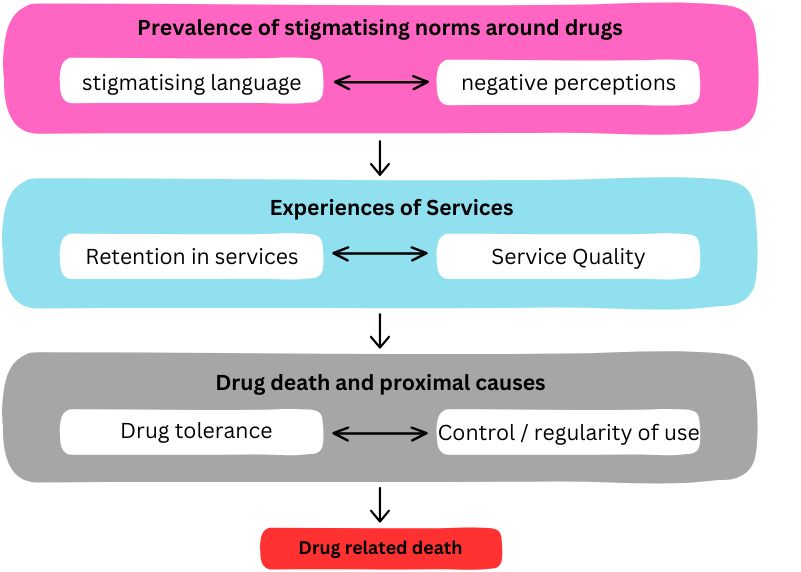
Flowchart illustrating the connection between stigma, service experiences, and drug-related death, highlighting key factors involved.
Access to quality and consistent drug treatment has the strongest evidence-base in reducing DRD risk. Stigma compounds in effect across services, individuals within them, and risk of experiencing a DRD. This can be mitigated with appropriate and empowering treatment on a case-by-case basis. (10/17)
25.03.2025 12:20 —
👍 0
🔁 0
💬 1
📌 0

A circular diagram illustrating the cycle of stigmatizing attitudes towards drug users, highlighting key influences and factors.
The prevalence of stigmatising norms around drugs is characterised by feedback loops mentioned a few posts back. Factors reinforce one another and entrench these norms at the cultural level, making it harder to break the cycle and influence change. (9/17)
25.03.2025 12:20 —
👍 0
🔁 0
💬 1
📌 0

A diagram illustrating various factors related to experiencing a drug related death including stigma, social influences, and community well-being.
Let’s explore the subsystem of Public and workforce stigmatising attitudes.
Addressing stigma can’t happen through single intervention points. Targeting upstream and downstream factors—at same, and cross-level subsystems will allow for whole system change—it will change how our sky looks. (8/17)
25.03.2025 12:20 —
👍 0
🔁 0
💬 1
📌 0

A diagram outlining key concepts of systems thinking: purpose, boundaries, interrelationships, and perspectives, with guiding questions.
There’s a view that current UK strategy positions on stigma are “fundamentally incoherent”. Systems thinking can identify how stigma is experienced and reproduced in the real world. This method is currently used at a government level with DEFRA in mapping systems for environmental policy.(7/17)
25.03.2025 12:20 —
👍 0
🔁 0
💬 1
📌 0
When the relationships between causes and effect are unpredictable, we can identify how factors interact via relevant system characteristics. In the context of DRDs in Scotland, these can include:
🔁Feedback loops
💡Emergence
🤝Interdependencies
💪 Influence
(6/17)
25.03.2025 12:20 —
👍 0
🔁 0
💬 1
📌 0
What are some examples of subsystems identified as direct causes of experiencing a drug related death in Scotland?
⛔ Public and workforce stigmatising attitudes
🌱Life experiences
🗨️ Social Influences on drug harms
👩⚕️Experience of services
🔎Public perspectives on substance use
(5/17)
25.03.2025 12:20 —
👍 0
🔁 0
💬 1
📌 0
DRDs occur as part of a broader system, where policies, social environments, and individual behaviours are interconnected. Systems mapping helps us understand the social ecological system, showing cause-effect relationships and the need for multi-stakeholder solutions. (4/17) #systemsmapping
25.03.2025 12:20 —
👍 0
🔁 0
💬 1
📌 0
A diagram illustrating various factors related to experiencing a drug related death including stigma, social influences, and community well-being.
When thinking of a whole system, we can think of it as comprised of subsystems, or clusters of closely related factors. This may look confusing, but we can identify subsystems composed of upstream and downstream factors and their causal interconnections in this constellation. (3/17) #stopthedeaths
25.03.2025 12:20 —
👍 0
🔁 0
💬 1
📌 0

Black and white poster with three young men, text reads "You've got the choice. Choose life, not drugs - be all you can be."
In 1998, calls advocating for harsher drug laws and a “drug-free world” were supported by the UN. It is now said that we are seeing progress in viewing DRDs as a public health over criminal issue. In addressing Scottish DRDs, Dr Priyadarshi calls for a “whole package of treatment and care”. (2/17)
25.03.2025 12:20 —
👍 0
🔁 0
💬 1
📌 0

# STOP THE DEATHS, WE CAN PREVENT DRUG DEATHS" in bold white letters on a black background.
In 2023, Scotland saw 1,172 drug related deaths (DRDs). Approaches to death prevention are complex as solutions require coordinated action across different sectors. How can we explore how causes of DRDs interact in our health and social care system?
Let's use systems mapping!🧵 (1/17)
#systemscience
25.03.2025 12:20 —
👍 10
🔁 3
💬 1
📌 1

Would you recognise the signs of an overdose?
If a person is unresponsive & has any other sign like: Snoring, Shallow Breathing, Pale Skin, Blue Lips or Pinpoint Pupils, they could be experiencing an overdose. Call 999 & administer naloxone. We CAN prevent drug deaths www.StopTheDeaths.com
05.03.2025 17:00 —
👍 9
🔁 3
💬 0
📌 0

Screenshot from LinkedIn:
Susan McPherson
Deputy Director, Institute for Public Health
The Rt. Hon. Wes Streeting MP talked about "overdiagnosis" of mental health on #Kuenssberg today. Our research at University of Essex using Understanding Society data shows
"underdiagnosis" is a far bigger problem in the UK than"overdiagnosis".
There are also significant inequalities with
some groups (e.g. young people, disabled people) more likely to have undiagnosed mental health problems. Our team have more articles forthcoming on undiagnosed distress and inequalities using representative population data. Department of Health and Social Care please look at the evidence
journals.plos.org/plosone/arti...
17.03.2025 09:55 —
👍 10
🔁 4
💬 0
📌 0

‘All eyes are on Glasgow’: UK’s first legal drug consumption room ready to open
The Thistle will be available 365 days a year and provide a supervised space where drugs can be injected safely
The UK’s first legal drug consumption room opened in Glasgow on Monday morning.
Dr Saket Priyadarshi, Glasgow Alcohol and Drug Recovery Services: "It’s another part of a system of care, another piece of the jigsaw responding to a very complex problem.”
www.theguardian.com/society/2025...
15.01.2025 17:16 —
👍 3
🔁 2
💬 0
📌 0
YouTube video by ScottishDrugsForum
Polysubstance Use and Cocaine: Engaging and Supporting People (SDF Webinar)
Scottish Drugs Forum - Polysubstance Use and Cocaine: Engaging and Supporting People www.youtube.com/watch?v=KY9B...
06.03.2025 00:42 —
👍 2
🔁 1
💬 0
📌 0