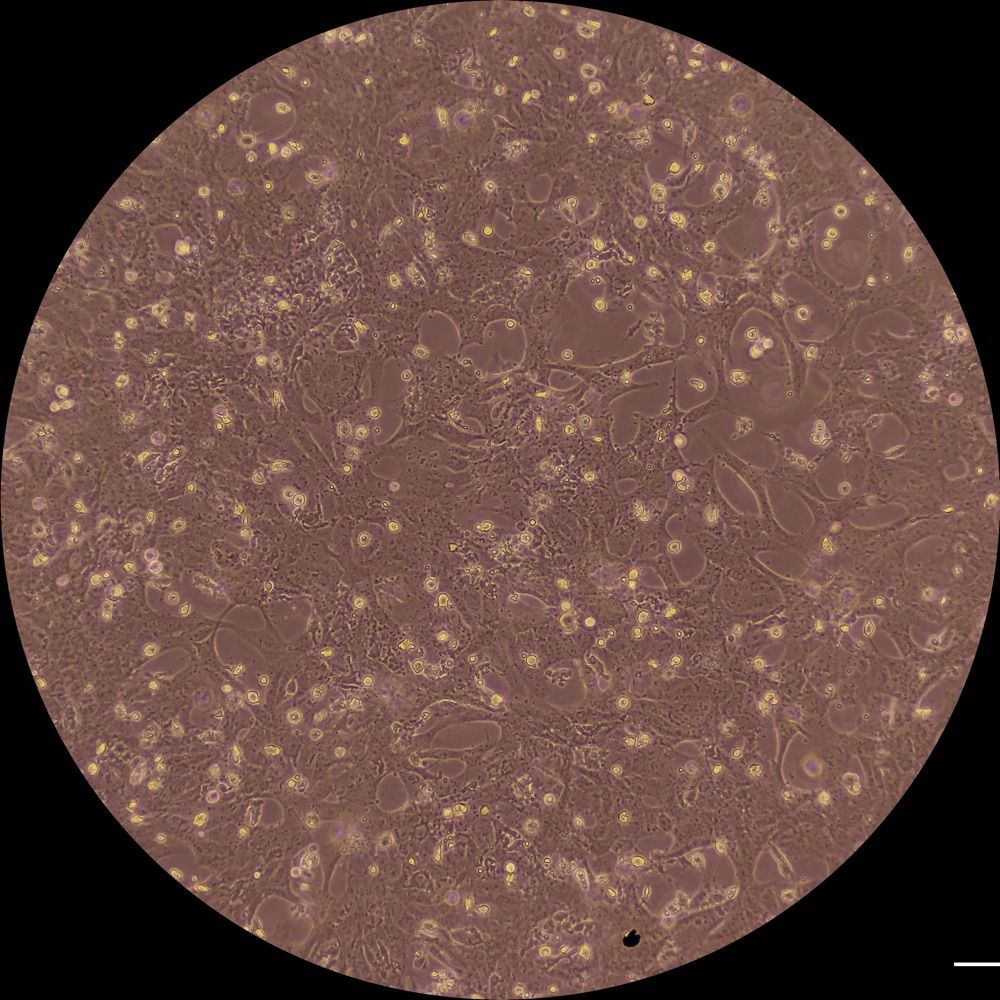
Is there a convergent mechanism for triggering PINK1-Parkin-dependent mitophagy?
Derek Narendra and coworkers find that diverse forms of mitochondrial damage are all sensed by a loss of mitochondrial membrane potential (MMP)
www.embopress.org/doi/full/10....
20.11.2025 19:00 — 👍 6 🔁 2 💬 0 📌 1
It’s not hard to read this and see this as a blue print for what they want to do for all federal granting institutions, including the NIH
15.11.2025 16:27 — 👍 25 🔁 16 💬 1 📌 1
🚨🚨 @jenna-m-norton.bsky.social is a force. Her voice carries power, truth, and courage—threats to the regime.
The only thing authoritarians fear more than a voice they cannot control is a chorus. So let’s give them one: speak up, speak loudly, and don’t stop. Stand with Jenna. ✊🇺🇸
13.11.2025 23:48 — 👍 52 🔁 22 💬 1 📌 5

New preprint 🥳! We made photoclickable HaloTag ligands to precisely control protein labeling on living cells. With it, we can do some cool multicolor stuff. Huge congrats to Franzi and all co-authors! Check it out 👇
www.biorxiv.org/content/10.1...
13.11.2025 16:20 — 👍 153 🔁 40 💬 0 📌 4

I guess I am hitting a nerve, because they just put me on admin leave.
TikTok video by Jenna
Trump’s HHS put me on “non-disciplinary” admin leave today. This was retaliation for speaking up. Moves like this are designed to silence us. Let’s not let.
www.tiktok.com/t/ZP8Dteoop/
13.11.2025 23:18 — 👍 439 🔁 190 💬 14 📌 17

N.I.H. Worker Who Criticized Trump Health Policies Says She Is on Administrative Leave
NEW: Jenna Norton, an NIH employee who is openly critical of Trump & RFK Jr, has been put on "non-disciplinary" administrative leave. She says the administration is trying to "scare and silence me." An HHS official, asked to comment, called her a radical leftist.
www.nytimes.com/2025/11/13/u...
14.11.2025 02:56 — 👍 369 🔁 161 💬 16 📌 15

No one knows the answer, and that’s the point — Harvard Gazette
“Genuinely Hard Problems” pilots novel approach to scientific education.
An remarkable new undergraduate course conceived and taught by our amazing colleague and Dean of Science Jeff Lichtman: "Genuinely Hard Problems" I wish I was an undergrad again!... 🤣🧪🧬🧠
@harvardmcb.bsky.social @harvardbrainsci.bsky.social @harvard.edu
news.harvard.edu/gazette/stor...
12.11.2025 12:14 — 👍 25 🔁 4 💬 0 📌 0

A table showing profit margins of major publishers. A snippet of text related to this table is below.
1. The four-fold drain
1.1 Money
Currently, academic publishing is dominated by profit-oriented, multinational companies for
whom scientific knowledge is a commodity to be sold back to the academic community who
created it. The dominant four are Elsevier, Springer Nature, Wiley and Taylor & Francis,
which collectively generated over US$7.1 billion in revenue from journal publishing in 2024
alone, and over US$12 billion in profits between 2019 and 2024 (Table 1A). Their profit
margins have always been over 30% in the last five years, and for the largest publisher
(Elsevier) always over 37%.
Against many comparators, across many sectors, scientific publishing is one of the most
consistently profitable industries (Table S1). These financial arrangements make a substantial
difference to science budgets. In 2024, 46% of Elsevier revenues and 53% of Taylor &
Francis revenues were generated in North America, meaning that North American
researchers were charged over US$2.27 billion by just two for-profit publishers. The
Canadian research councils and the US National Science Foundation were allocated US$9.3
billion in that year.

A figure detailing the drain on researcher time.
1. The four-fold drain
1.2 Time
The number of papers published each year is growing faster than the scientific workforce,
with the number of papers per researcher almost doubling between 1996 and 2022 (Figure
1A). This reflects the fact that publishers’ commercial desire to publish (sell) more material
has aligned well with the competitive prestige culture in which publications help secure jobs,
grants, promotions, and awards. To the extent that this growth is driven by a pressure for
profit, rather than scholarly imperatives, it distorts the way researchers spend their time.
The publishing system depends on unpaid reviewer labour, estimated to be over 130 million
unpaid hours annually in 2020 alone (9). Researchers have complained about the demands of
peer-review for decades, but the scale of the problem is now worse, with editors reporting
widespread difficulties recruiting reviewers. The growth in publications involves not only the
authors’ time, but that of academic editors and reviewers who are dealing with so many
review demands.
Even more seriously, the imperative to produce ever more articles reshapes the nature of
scientific inquiry. Evidence across multiple fields shows that more papers result in
‘ossification’, not new ideas (10). It may seem paradoxical that more papers can slow
progress until one considers how it affects researchers’ time. While rewards remain tied to
volume, prestige, and impact of publications, researchers will be nudged away from riskier,
local, interdisciplinary, and long-term work. The result is a treadmill of constant activity with
limited progress whereas core scholarly practices – such as reading, reflecting and engaging
with others’ contributions – is de-prioritized. What looks like productivity often masks
intellectual exhaustion built on a demoralizing, narrowing scientific vision.

A table of profit margins across industries. The section of text related to this table is below:
1. The four-fold drain
1.1 Money
Currently, academic publishing is dominated by profit-oriented, multinational companies for
whom scientific knowledge is a commodity to be sold back to the academic community who
created it. The dominant four are Elsevier, Springer Nature, Wiley and Taylor & Francis,
which collectively generated over US$7.1 billion in revenue from journal publishing in 2024
alone, and over US$12 billion in profits between 2019 and 2024 (Table 1A). Their profit
margins have always been over 30% in the last five years, and for the largest publisher
(Elsevier) always over 37%.
Against many comparators, across many sectors, scientific publishing is one of the most
consistently profitable industries (Table S1). These financial arrangements make a substantial
difference to science budgets. In 2024, 46% of Elsevier revenues and 53% of Taylor &
Francis revenues were generated in North America, meaning that North American
researchers were charged over US$2.27 billion by just two for-profit publishers. The
Canadian research councils and the US National Science Foundation were allocated US$9.3
billion in that year.

The costs of inaction are plain: wasted public funds, lost researcher time, compromised
scientific integrity and eroded public trust. Today, the system rewards commercial publishers
first, and science second. Without bold action from the funders we risk continuing to pour
resources into a system that prioritizes profit over the advancement of scientific knowledge.
We wrote the Strain on scientific publishing to highlight the problems of time & trust. With a fantastic group of co-authors, we present The Drain of Scientific Publishing:
a 🧵 1/n
Drain: arxiv.org/abs/2511.04820
Strain: direct.mit.edu/qss/article/...
Oligopoly: direct.mit.edu/qss/article/...
11.11.2025 11:52 — 👍 609 🔁 435 💬 8 📌 62
We are in the midst of an all-out attempt to exclude the global majority from science. Watson was clear about where he fell on that. I would trade every single dinner, meeting, seminar, fancy campus, and prestigious donor for my incredible friends to be safer. Their science is worth far more.
08.11.2025 17:24 — 👍 140 🔁 36 💬 1 📌 2
Jeremy, I have followed your science advocacy on this platform with respect, but I find this thread deeply hurtful and sad and I am going to tell you why. While my wife did her postdoc at CSHL, she and our many dear friends had to endure the racist rhetoric of this man, which did constant harm
08.11.2025 17:15 — 👍 291 🔁 88 💬 7 📌 10
PNAS
Proceedings of the National Academy of Sciences (PNAS), a peer reviewed journal of the National Academy of Sciences (NAS) - an authoritative source of high-impact, original research that broadly spans...
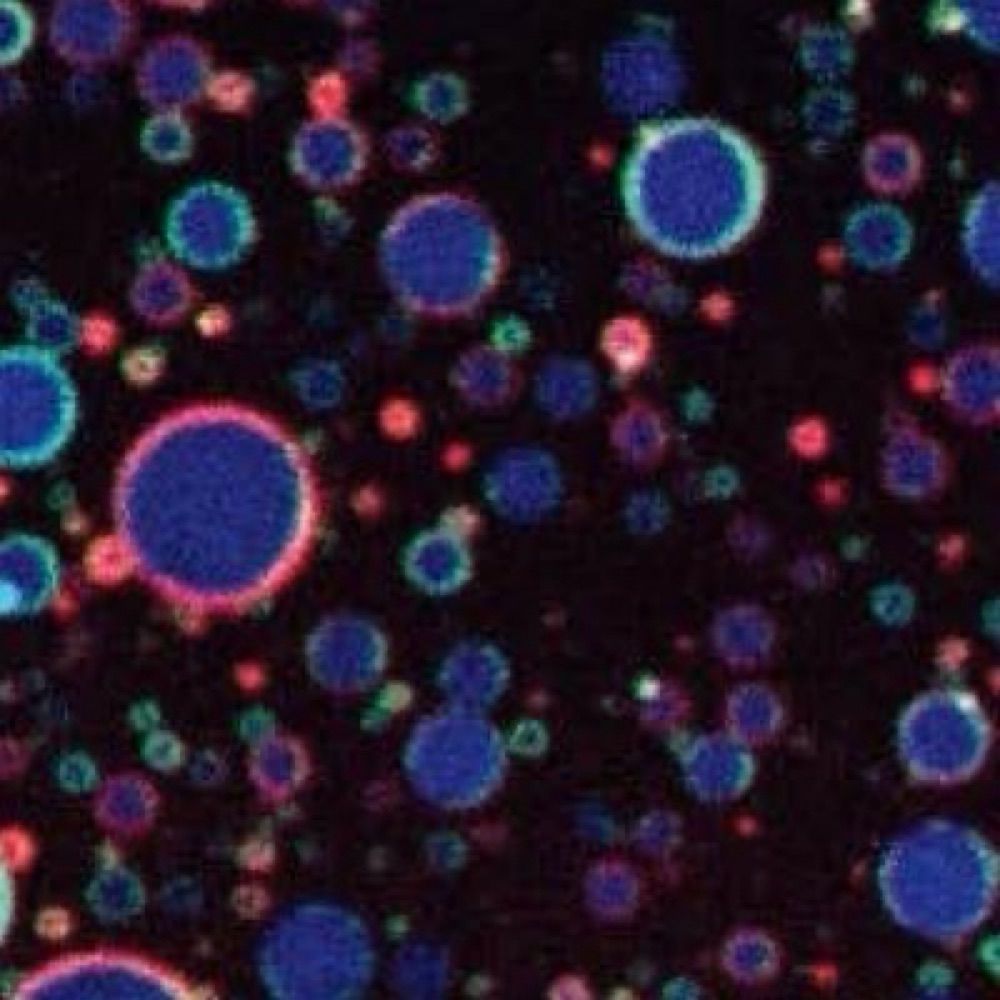
A new, nerdy paper. We figured out (some) of the rules underlying cell-permeability of probes and designed ligands that light up, grab, and move proteins around. Awesome @hhmijanelia.bsky.social x @uwmadison.bsky.social x @stjuderesearch.bsky.social collaboration! www.pnas.org/doi/10.1073/...
27.10.2025 21:43 — 👍 87 🔁 30 💬 0 📌 1
The cut rate labor business of grant funded academic science revealed in one tweet.
21.10.2025 18:32 — 👍 22 🔁 10 💬 1 📌 0

Donate to Paul Maddox for Congress in NC 11
Paul is running for Congress because there’s a sickness in Washington, and no one is working to cure it.
Dear all, A scientist from UNC Chapel Hill, Paul Maddox, is running for congress in NC for a seat currently held by a republican. If you care about science (and democracy) please consider donating to his campaign #Standupforscience secure.actblue.com/donate/paul-...
20.10.2025 17:51 — 👍 73 🔁 41 💬 6 📌 8
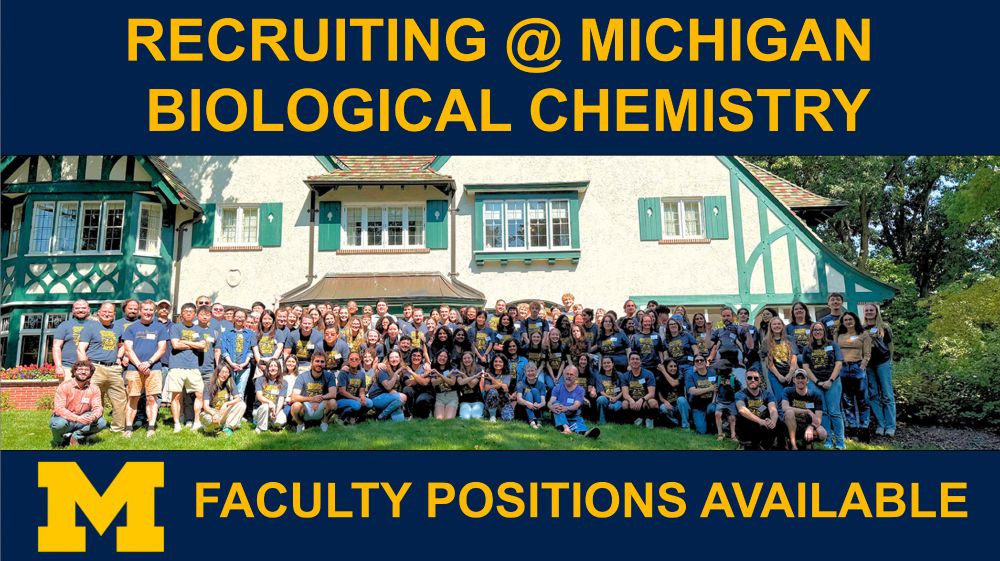
Collaborative. Creative. Impactful. Come join us in Ann Arbor! For more information and application link see jobs.sciencecareers.org/job/675674/f...
19.10.2025 17:53 — 👍 12 🔁 11 💬 0 📌 3

IT'S ALMOST HERE!!
#NoKingsDay is around the corner. Gonna be a BIG event at @nihvigils.bsky.social and @27unihted.bsky.social We're going to play TWO SETS - one at the beginning and one at the end.
#fucktrump #punk #punkrock #resist #FightFascism #AntiAuthoritarian #FuckICE #FightTheNazis
16.10.2025 15:15 — 👍 7 🔁 4 💬 1 📌 0
I don’t know who needs to hear this but the CDC is being eviscerated right now. America is not going to have any kind of outbreak response capacity after tonight. Americans’ health data is no longer secure. Say goodbye to federal public health in any capacity. It’s a disaster. We won’t recover.
11.10.2025 03:05 — 👍 13926 🔁 6174 💬 518 📌 394
NO TO ILLEGAL RIFS
TRUMP AND VOUGHT ARE HURTING AMERICA
Gather at the Office of Management and Budget (near WH, exact location to come)
Monday, October 13, 2pm
DM us if you were RIFed (or had coworkers who were RIFed) and would like to speak
11.10.2025 14:50 — 👍 43 🔁 17 💬 1 📌 0
Amazing
09.10.2025 02:36 — 👍 2 🔁 0 💬 0 📌 0

On the left - western blot of B16F10 cells wt and KO for CDK8. Our in house produced antibodies give a lot of unspecific bands. On the right same probes with antibodies preincubated with fixed CDK8 KO cells - there is a specific band and faint unspecific bands, which can be probably eliminated with increase of amount of KO cells.
Neat trick if you polycolonal ab's suck. Incubate them with fixed cells with a KO of your protein of interest, then spin. Protocol here: www.med.upenn.edu/markslab/ass...
I was amazed how well it worked on first try (I'm sure that I can completely eliminate unspecific bands)
#WesternBlot #cellsky
02.10.2025 17:11 — 👍 192 🔁 57 💬 7 📌 6
That’s a lot of science we left on the table.
03.10.2025 04:33 — 👍 24 🔁 10 💬 0 📌 0
This is sort of a classic prisoners' dilemma: If nobody defects, nobody has "priority". Which makes it essential that universities coordinate a united front.
02.10.2025 17:35 — 👍 225 🔁 61 💬 6 📌 2

Trump Administration Asks Colleges to Sign ‘Compact’ to Get Funding Preference
This is extortion. Faculty, students, staff, alumni across the country need to get to their Presidents & Trustees today. Just say no. This blackmail only works if most everyone folds. Capitulation now means the end of American higher education for a generation. www.nytimes.com/2025/10/02/u...
02.10.2025 09:55 — 👍 430 🔁 206 💬 20 📌 11
See this? This = implanting mouse embryo. Usually this happens inside its mother and is invisible to us, but we can actually watch implantation ex vivo with the hope of understanding why implantation goes awry in embryos of older women. A 🧵...
01.10.2025 18:20 — 👍 222 🔁 68 💬 11 📌 18

Civil Servants Demand an End to Executive Overreach
Join federal workers from across the federal government as we urge Congress to pass nothing less than a continuing resolution (CR) that reasserts Congress's constitutional powers, upholds our democrac...
More than 5,000 federal workers (current and former) have now signed this letter urging "Congress to pass nothing less than a continuing resolution (CR) that reasserts Congress's constitutional powers, upholds our democracy and protects the American people."
29.09.2025 17:11 — 👍 87 🔁 25 💬 2 📌 1
This is absolutely ridiculous, would devastate numerous academic fields, and would destroy the lives of people I love very much. Please, please join me in sending a comment in on this telling them so
29.09.2025 14:55 — 👍 259 🔁 130 💬 0 📌 2
Cozy random passages from Arnold Lobel's Frog and Toad books. Posts auto-delete.
Virologist | Microbe Enthusiast | Book lover | WOSO enthusiast | This a personal account.
@CNRS Research Director @ENS_ULM. Interested in Droplets, Metabolism, Organelles, Lipids, BioPhysics, Microfluidics & Co, 🇸🇳
"There are no answers; only choices."
– S. Lem
I choose one [o] or two-cell [8] organisms and dissonant music.
Professor of Biochemistry @ UW-Seattle. Any coincidence of my opinions with my employer's is coincidental.
The funder-researcher collaboration and open-access publisher for research in the life and biomedical sciences.
Follow @eLifeCommunity.bsky.social
Tell AFGE no bad budget in our name. ✊
https://actionnetwork.org/petitions/tell-afge-leadership-to-hold-the-line-we-need-a-budget-for-the-people
A couple of emergency managers resisting harmful policies, fighting disinfo & defending FEMA.
Not official FEMA. Views are our own and expressed in a personal capacity.
Proudly #AltGov
FEMA Employees or Tips? DM
Psychologist for the humans of tech. Author of The Psychology of Software Teams (2026). Founder: Catharsis Consulting (strategy * science). she/her 🏳️🌈 https://www.drcathicks.com/
Host at: https://www.changetechnically.fyi/
Your friendly local SSA agent just trying to survive. DMs are open. Yes there’s 2 of us (Hi Rogue SSA👋). We are #AltGov. Not affiliated with AltNPS. This account is not an official SSA account. FDT. Release the Epstein files. Preferred name: AltSSAssy ❤️
Venture of HHMI to make pre-commercial microscopes available to a broad audience. Learn more at https://www.aicjanelia.org/
Posting our lab life studying the neuronal cytoskeleton and chromatin with cool microscopes🔬Proud #GenX, #firstgen college, #intj @RITscience @stonybrooku Alum
Verified: https://orcid.org/0000-0001-8481-0403
Chemist at HHMI's Janelia Research Campus. Passionate about designing, building, and giving away fluorescent dyes to illuminate biological systems. Striving to be positive about all things chemistry (except ChemDraw).
ORCID: 0000-0002-0789-6343
The official resistance account of off-duty NPS rangers. Fighting for national parks and park employees! https://www.resistancerangers.org/
https://linktr.ee/resistanceranger?utm_source=linktree_profile_share<sid=8d19b18e-7568-4236-9d00-e6ea9c0c44ae
Carpenter and woodworker. Democracy and unions liker. Building and fixing things: capehenlopencarpentry.com. Writing and editing: aaronhuertas.com.
Fighter for Workers' Rights. President of SEIU-United Service Workers West and SEIU California. Lifelong Dodgers & Raiders fan
Professor & Chair, UM Biological Chemistry Dept. Investigate membrane & organelle biology. Building dynamic, inclusive community @UMich. Views my own.
Assistant Professor at UC Berkeley. Cytoskeleton and transport in glia. Prev: NIH, Stanford, UPenn, Caltech.
The primary news source for Ithaca, NY and Tompkins County. Always free, always local.
Support our mission here:
https://ithacavoice.org/support-our-publication/
Contact us at tips@ithacavoice.org.