Robert W. Staiger - Wikipedia
Professor Robert Staiger, the Roth Family Distinguished Professor in the Arts and Sciences and Professor of Economics at Dartmouth College, has been appointed as the new Chief Economist of the World Trade Organization. @wto.org
17.09.2025 09:43 —
👍 22
🔁 4
💬 3
📌 2

We’ve written a review on *New Industrial Policy* for the Oxford Research Encyclopedia.
It offers a unified framework for analyzing IP effects and survey evidence from both ex post event studies and ex ante model-based evaluations of IP.
🧵thread on key takeaways (link below)
29.08.2025 14:38 —
👍 4
🔁 1
💬 1
📌 0
The *ex ante* approach, of course, has its own limitations. However, it can map out the frontier of policy outcomes. Strikingly, in many cases, even optimally designed policies yield only modest gains, which is informative in itself.
link to article:
alashkar.pages.iu.edu/New_Industri...
29.08.2025 14:38 —
👍 0
🔁 0
💬 0
📌 0

13. We then clarify the logic behind *ex ante* policy evaluation, a growing yet misunderstood method.
At its core, this approach involves estimating elasticity parameters using in-sample price & quantity data, using them to simulate out-of-sample quantities under optimal prices
29.08.2025 14:38 —
👍 1
🔁 0
💬 1
📌 0

(b) Heterogeneous treatment effects
Industrial policy is justified because the marginal return to adding resources (VMPL) differs across units. Otherwise, there's no rationale for policy. Hence, contexts where industrial policy is warranted are inevitably characterized by HTE.
29.08.2025 14:38 —
👍 1
🔁 0
💬 1
📌 0

11. The identification challenges are twofold:
(a) SUTVA violation
By design, industrial policy reallocates factors to treated units by drawing them from non-treated units. So, spillover effects are inherent to the policy itself.
29.08.2025 14:38 —
👍 0
🔁 0
💬 1
📌 0

10. Design-based evaluations face two challenges: measurement and identification.
The measurement issue arises because VMPL is unobserved, while welfare evaluation boils down to whether the policy reallocates factors to high-VMPL sectors and firms or not
29.08.2025 14:38 —
👍 0
🔁 0
💬 1
📌 0

9. We review the empirical and quantitative examinations of industrial policy, classifying them into two groups:
a) *ex post* evaluations using design-based methods such as DiD
b) *ex ante* model-based evaluations of optimally designed policies
29.08.2025 14:38 —
👍 0
🔁 0
💬 1
📌 0

8. At a deeper level trade openness presents a dilemma for industrial policy effectiveness—a point more recently emphasized in the literature.
29.08.2025 14:38 —
👍 0
🔁 0
💬 1
📌 0

7. Another important but often-overlooked point is that trade measures, such as import restrictions or export promotion, are rarely an optimal or efficient form of industrial policy.
29.08.2025 14:38 —
👍 0
🔁 0
💬 1
📌 0

6. Open economies face additional challenges when designing IP:
a. Trade introduces a *siphoning effect* where taxes paid by domestic households are partially used to subsidize consumption abroad via exports.
b. Industrial policy distorts relative trade prices ---> disrupts the gains from trade
29.08.2025 14:38 —
👍 0
🔁 0
💬 1
📌 0

5. An economy-wide *optimal* policy is rarely implemented in practice. More often, a a few sectors are promoted in isolation (e.g., South Korea’s HCI drive).
In such cases, the *constrained-optimal* policy depends on the upstreamness of the targeted industries.
29.08.2025 14:38 —
👍 0
🔁 0
💬 1
📌 0


4. The *welfare gains* from optimal policy, however, depend on which sectors are promoted.
If industrial policy promotes upstream sectors operating below their efficient scale, it would generate larger gains.
29.08.2025 14:38 —
👍 0
🔁 0
💬 1
📌 0


3. We formalize this argument by deriving the optimal policy in a unified framework with various distortions and input-output networks.
Contrary to common instinct, the optimal policy is *newtrok-blind* and *demand-blind*. It only depends on the size of the distortion wedge.
29.08.2025 14:38 —
👍 0
🔁 0
💬 1
📌 0

2. We first outline the welfarist rationale for industrial policy: with externalities or market failures, the *value marginal product of labor (VMPL)* is different across sectors
---> Welfare can be improved by reallocating resources from low-VMPL to high-VMPL sectors.
29.08.2025 14:38 —
👍 0
🔁 0
💬 1
📌 0
We’ve written a review on *New Industrial Policy* for the Oxford Research Encyclopedia.
It offers a unified framework for analyzing IP effects and survey evidence from both ex post event studies and ex ante model-based evaluations of IP.
🧵thread on key takeaways (link below)
29.08.2025 14:38 —
👍 4
🔁 1
💬 1
📌 0

Our paper on the long-term effects of the Trump 2 tariffs is out in the Journal of International Economics.
We’ve made it open access:
doi.org/10.1016/j.ji...
13.08.2025 15:34 —
👍 7
🔁 2
💬 0
📌 0
Our paper on the long-term effects of the Trump 2 tariffs is out in the Journal of International Economics.
We’ve made it open access:
doi.org/10.1016/j.ji...
13.08.2025 15:34 —
👍 7
🔁 2
💬 0
📌 0

Developing a framework to examine how beneficial transport infrastructure investments are, as well as other transport policies, from Dave Donaldson https://www.nber.org/papers/w34096
10.08.2025 13:00 —
👍 10
🔁 5
💬 0
📌 0
Our paper is officially out 🎉
We argue that climate clubs show promise:
- A climate club with coordinated penalties could curb 68% of excess emissions from free-riding
-Unilateral carbon tariffs? Not nearly as effective
09.07.2025 20:10 —
👍 20
🔁 6
💬 0
📌 1
Our paper is officially out 🎉
We argue that climate clubs show promise:
- A climate club with coordinated penalties could curb 68% of excess emissions from free-riding
-Unilateral carbon tariffs? Not nearly as effective
09.07.2025 20:10 —
👍 20
🔁 6
💬 0
📌 1
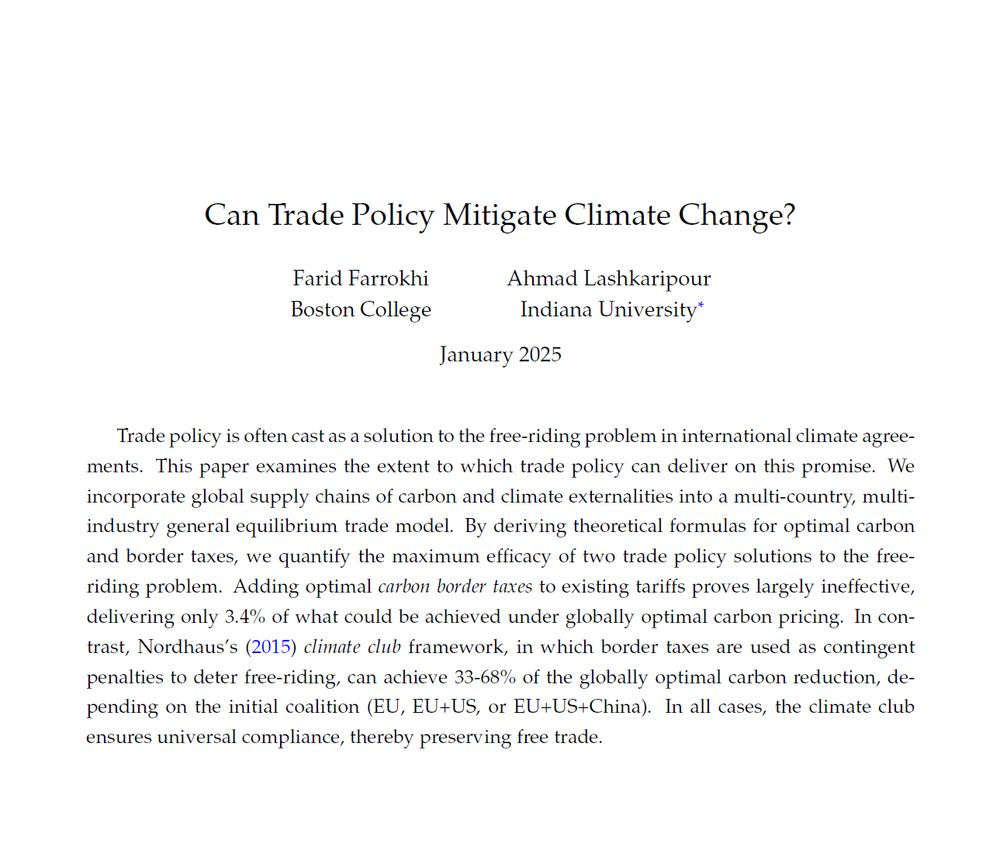
We study how trade policy can reduce global emissions. Unilateral carbon border taxes have limited efficacy at cutting foreign emissions. By contrast, coordinated trade penalties under a climate club prove highly effective. buff.ly/NEE3Uy8
07.07.2025 13:04 —
👍 22
🔁 12
💬 0
📌 1
New Paper Alert!📢
"Making America Great Again? The Economic Impacts of Liberation Day Tariffs"👨🦰
by Anna Ignatenko @lashkaripour.bsky.social Luca Macedoni @simonovska.bsky.social
This model estimates U.S. welfare and global employment under optimal tariff retaliation📉:
www.ifo.de/en/cesifo/pu...
04.06.2025 06:55 —
👍 5
🔁 5
💬 0
📌 0
A new version of our trade war paper is out at the NBER this week.
Key update: factoring in tariffs on intermediate inputs nearly wipes out any terms-of-trade gains from reciprocal tariffs and greatly amplifies the cost of retaliation for the US economy.
14.05.2025 14:35 —
👍 5
🔁 2
💬 0
📌 0
A new version of our trade war paper is out at the NBER this week.
Key update: factoring in tariffs on intermediate inputs nearly wipes out any terms-of-trade gains from reciprocal tariffs and greatly amplifies the cost of retaliation for the US economy.
14.05.2025 14:35 —
👍 5
🔁 2
💬 0
📌 0

Program content - Paris School of Economics
The International Trade program offers an in-depth exploration of key topics related to global trade and economic policy.
For PhD students and scholars interested in joining:
I will take part in teaching International Trade and the Environment at #PSESummerSchool (June 9-12).
www.parisschoolofeconomics.eu/en/summer-sc...
Below is a description (1/6)
15.04.2025 01:21 —
👍 10
🔁 5
💬 1
📌 0
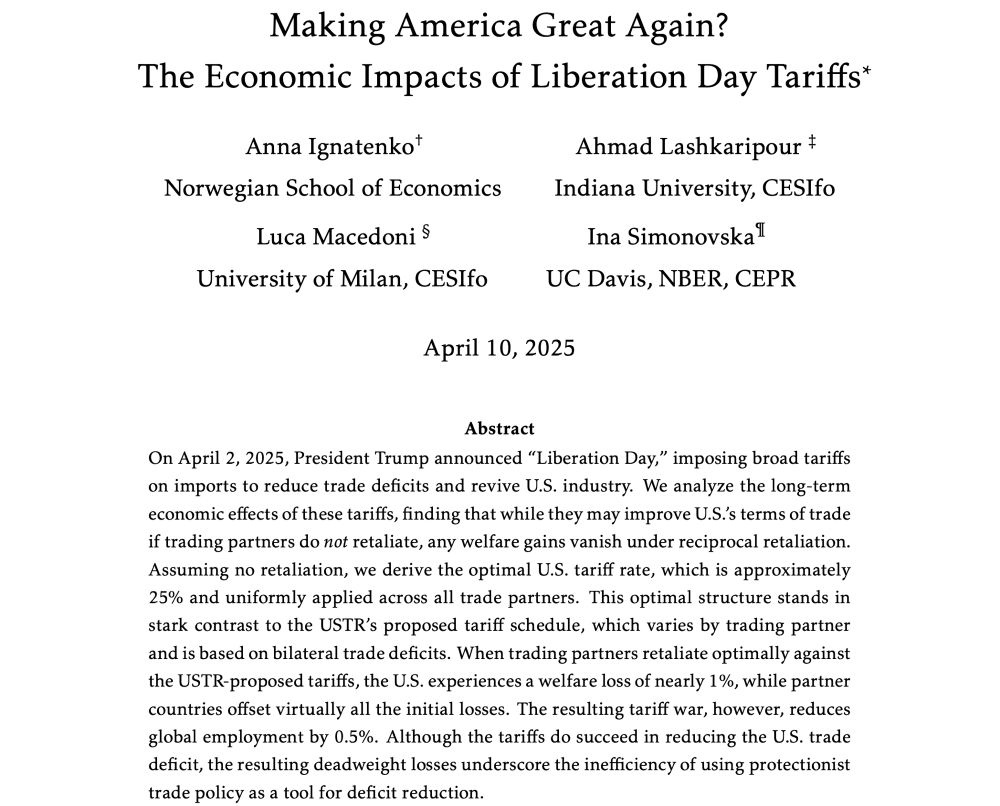
🚨 We just released a paper examining the long-terms economic impacts of "Liberation Day" tariffs.
In summary: while these tariffs may help reduce the trade deficit, they will impose significant costs on the U.S. economy after retaliation by trade partners.
10.04.2025 14:23 —
👍 80
🔁 19
💬 2
📌 3
Retaliation hurts! Check out our new paper to see how costly it can be for the U.S. economy.
10.04.2025 19:37 —
👍 14
🔁 3
💬 0
📌 0
We just posted a paper about the current tariffs.
bsky.app/profile/lash...
10.04.2025 14:31 —
👍 2
🔁 1
💬 1
📌 0