In this regard, the latest Dutch reform is a promising step forward. By combining a thorough evaluation process (similar to the pre-2015 system) with a mandatory requirement, it hopefully combines the best of both worlds to improve the information function of energy labels.
13.10.2025 11:38 — 👍 1 🔁 0 💬 1 📌 0
Our work has important implications for policymakers. We recommend that energy labels should not be relied upon as the sole tool for informing the public or influencing behavior. Instead, they should be part of a larger system.
13.10.2025 11:38 — 👍 0 🔁 0 💬 1 📌 0
One should note that our study covers a period of relatively stable energy prices in the Netherlands. The value homebuyers place on energy efficiency may be different in today’s market with higher and more volatile prices.
13.10.2025 11:38 — 👍 0 🔁 0 💬 1 📌 0
— Conclusion: A significant part of the “green premium” cannot be attributed to the energy labels themselves but is linked to underlying energy efficiency and other factors the market already priced in.
13.10.2025 11:38 — 👍 0 🔁 0 💬 1 📌 0
— Mandatory Labels (since 2015) show a more complex picture. While better-labeled homes sold for more, we found they already attracted a price premium before they obtained energy labels.
13.10.2025 11:38 — 👍 0 🔁 0 💬 1 📌 0
Key Findings:
— Voluntary Labels (2008–2014) had limited information value. Our Regression Discontinuity Design showed no significant price premium for homes that barely qualified for a better label grade.
13.10.2025 11:38 — 👍 0 🔁 0 💬 1 📌 0
We investigated whether energy labels provide new, valuable information to homebuyers or simply confirm what’s already observable. Using administrative data on all Dutch housing transactions from 2000 to 2017, we analyzed two systems: a complex voluntary one and a simple mandatory one.
13.10.2025 11:38 — 👍 1 🔁 0 💬 1 📌 0

Screenshot of the first page of the article, including the journal name, title, authors, keywords, and abstract.
I am super happy that the paper by Sjors van Wickeren, Lu Zhang, and me, titled “The information value of energy labels: Evidence from the Dutch residential housing market,” has been published in Ecological Economics.
13.10.2025 11:38 — 👍 2 🔁 0 💬 1 📌 0

Lennart on the stairs of the Academy Building in Groningen, holding his PhD diploma and being flanked by his paranymphs. Behind him, one can see his supervisor’s, the committee, and the beadle.
As the PhD journey comes to an end, I am grateful for the supervision and guidance of Noemi Peter and @asoetevent.bsky.social over the past years.
Finally, a special thank you to Lotte Swank and Mark Van Oldeniel for their wonderful support as my paranymphs.
26.06.2025 13:34 — 👍 0 🔁 0 💬 1 📌 0

Lennart during the defense, answering a question from the committee.
I extend my gratitude to the members of the reading committee (@marcohaan.nl, @menuschkhadjavi.bsky.social, and Jason Shachat) and the wider committee (@dedreu.bsky.social, @harrygarretsen.bsky.social, Pim Heijnen, and Gijsbert Zwart) for their engagement with my work.
26.06.2025 13:33 — 👍 1 🔁 0 💬 1 📌 0

Lennart with the session’s chair, holding his diploma. On the right, one can see his supervisors.
One week ago today, I successfully defended my PhD thesis!
I appreciate the stimulating discourse with the opposition, which allowed me to elaborate on how information, expectations, and group dynamics shape our decisions about climate action.
26.06.2025 13:28 — 👍 4 🔁 0 💬 1 📌 0
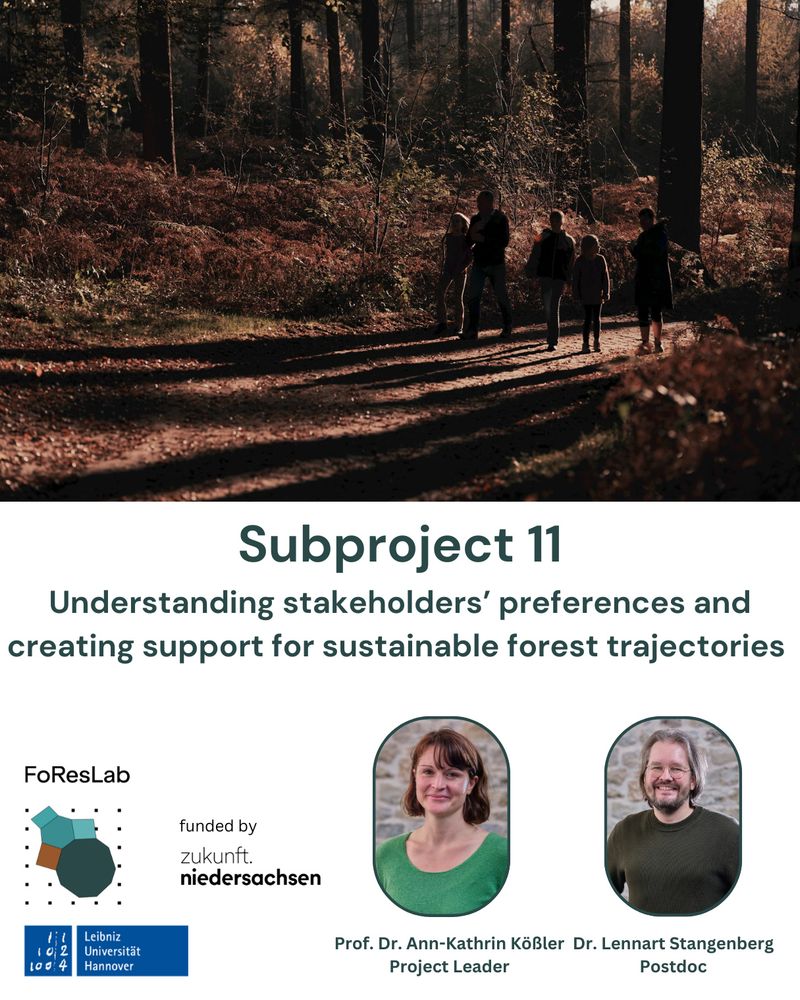
🌳💬Ann-Kathrin Kößler and @stangenberg.bsky.social (Leibniz University Hannover) analyze key stakeholders and their interests in resilient forests in Lower Saxony. Using interviews, workshops, and experiments, they develop evidence-based strategies to strengthen societal support and cooperation.
10.06.2025 12:53 — 👍 3 🔁 1 💬 0 📌 0

🌿Today marks the start of the first Green Nudges in Agriculture & Forestry Conference in Brussels
Exploring how behavioral science can support the Green Deal & CAP27 through real action in agri & forestry🌱
🤝Thanks to all participants!
#GreenNudges #PRUDENT #EESCPartnership #EuProjects
21.05.2025 10:42 — 👍 4 🔁 1 💬 0 📌 0
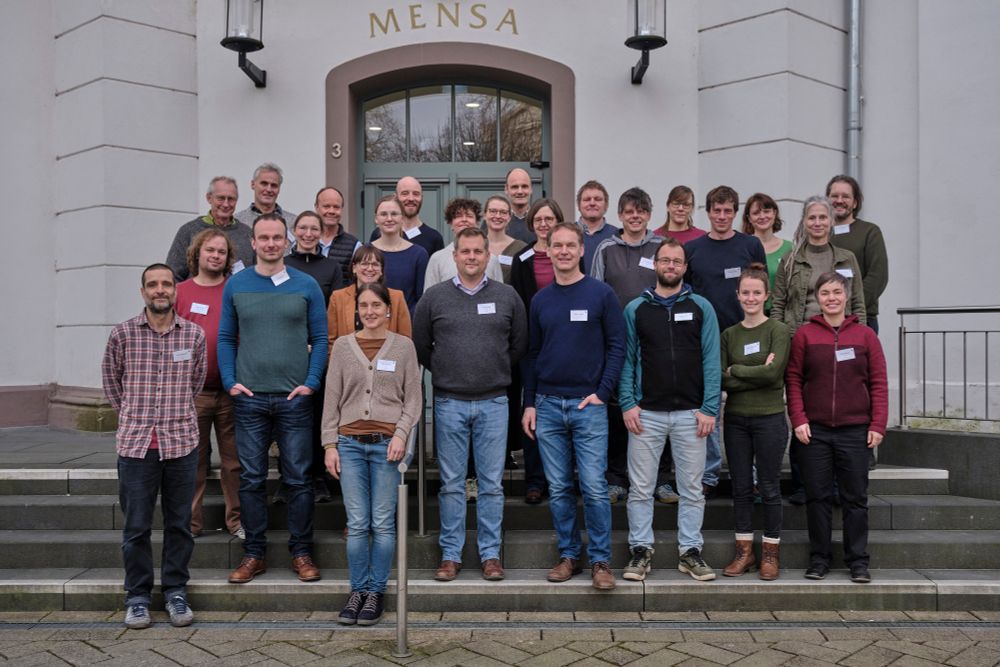
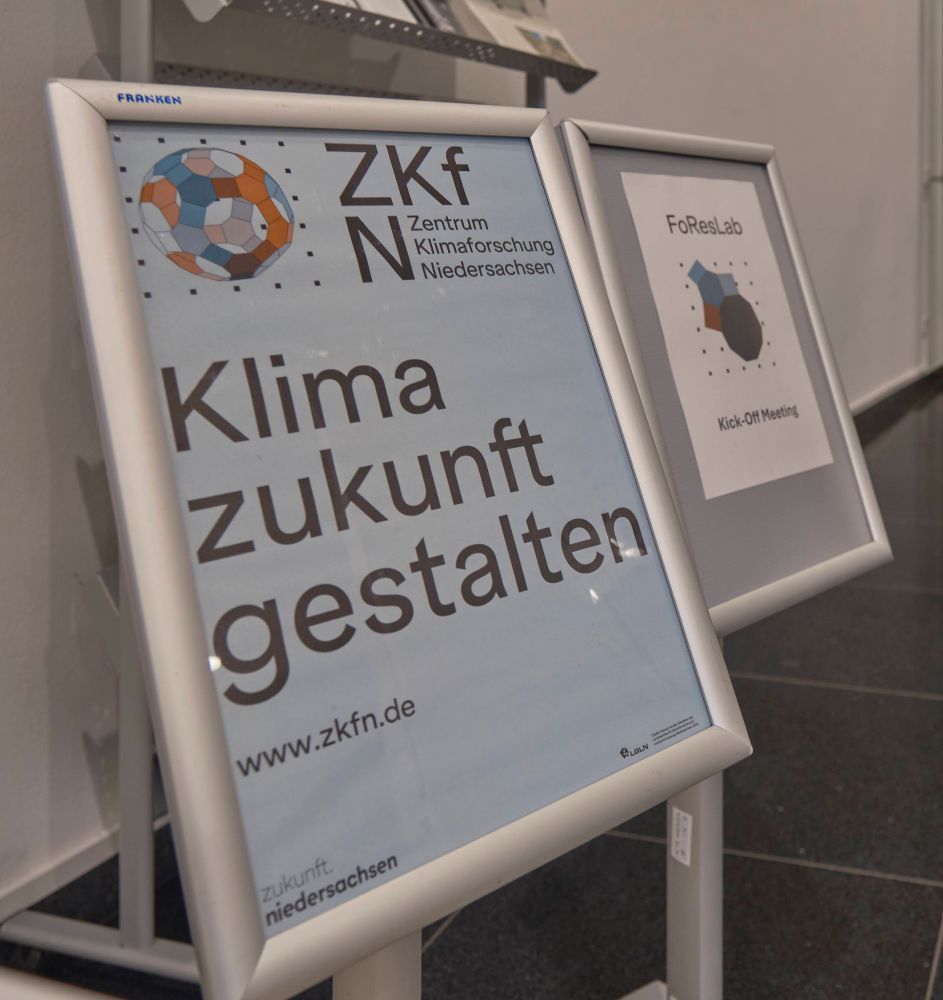
We kicked-off our climate future lab #FoResLab this month! In 13 subprojects, we will investigate how forests can be made resilient to climate change under current and future conditions. It was great getting to know each other at the meeting and discussing the next steps.
24.02.2025 09:50 — 👍 3 🔁 1 💬 0 📌 1
At the kickoff meeting in Göttingen, researchers from the 13 subprojects as well as practice partners got to know each other and exchanged ideas for future collaboration.
20.02.2025 15:27 — 👍 0 🔁 0 💬 0 📌 0
#FoResLab, a future lab towards forests resilient to climate change, combines many fields and disciplines. Within our subproject, Ann-Kathrin Koessler and I work on understanding stakeholders’ preferences and creating support for sustainable forest trajectories.
20.02.2025 15:27 — 👍 0 🔁 0 💬 1 📌 0

A photo of researchers from the FoResLab project standing on the stairs of Alte Mensa in Göttingen.
This month, I started my new position as Postdoctoral Researcher at Leibniz University Hannover!
20.02.2025 15:27 — 👍 3 🔁 0 💬 1 📌 0
I just pre-ordered it!
06.06.2024 11:25 — 👍 0 🔁 0 💬 0 📌 0
Stangenberg_Soetevent_24_Dont_Wait_On_The_World_To_Change.pdf
🌻 DON’T WAIT ON THE WORLD TO CHANGE 🤝
In our new working paper, @asoetevent.bsky.social and I show that hoping for future climate tech hinders collective action now.
📄: drive.google.com/file/d/1gNyt...
06.06.2024 11:23 — 👍 7 🔁 0 💬 0 📌 0
Das Institut für sozial-ökologische Forschung (ISOE) gehört zu den führenden unabhängigen Instituten der Nachhaltigkeitsforschung.
#Transdisziplinarität #SozialeÖkologie #Transformation
Postdoctoral researcher at Leuphana University working on social-ecological systems | environmental social scientist | cold water enthusiast 🌊 https://romanisaac.my.canva.site/
The latest working papers from RePEc. NEP report EXP (Experimental Economics)
https://nep.repec.org/
The National Bureau of Economic Research is dedicated to conducting and disseminating nonpartisan economic research.
nber.org
Political Scientist at Institute for Social Sciences, University of Oldenburg: Political Theory, Experimental Political Science | formerly at Cologne Center for Comparative Politics
Psychologist, Researcher @IUP, Leibniz University Hannover
Interests: Biodiversity, Nature Conservation, Human-Nature Relationships, Community Engagement, Sustainable Living
Von Artenschutz bis zukunftsfähiger Konsum: Wir wollen mit dir #zusammenverändern! 🌍 Impressum: https://www.bund.net/impressum/impressum-bluesky/
Wir sind, was wir tun! Seit 125 Jahren schützt der NABU mit mehr als 960.000 Mitgliedern und Fördernden aktiv die Natur. Macht mit, für Mensch und Natur! www.NABU.de
WirStiftenWissen – auch hier auf BlueSky. Folgt uns für spannende Förderangebote, mutige Forschungsprojekte und faszinierende Veranstaltungen.
🌐 www.volkswagenstiftung.de
📣 The Whistleblower: juliecruse.com
📚 The Story: goodreads.com/juliecruse
🛍️ The Shop: amazon.com/author/juliecruse
🥞 The Stack: substack.com/@juliecruse
📊 The Data: academicabuse.com/data
🌐 The Hub: academicabuse.com
Global denken, interdisziplinär forschen: Leibniz leben! Offizieller Account der Leibniz Universität Hannover #LUH. http://go.lu-h.de/netiquette | http://go.lu-h.de/impressum
Hier postet das Team der ZKfN-Geschäftsstelle.
Impressum: https://zkfn.de/impressum/
Bildnachweis Titelbild: Auszug aus den Geodaten des Landesamtes für Geoinformation und Landesvermessung Niedersachsen, 2024; Unsplash
Behavioral scientist @rug.nl; curious about mechanisms and functions of cooperation, conflict and creativity in (non)human animals.
Spinoza Laureate | Humboldt Forschungspreis. Professor at Univ. of Groningen, affiliated with German Primate Center
I'm an Entomologist and Integrated Pest Management (IPM) enthusiast working at ADAS in the UK.
Interested in the science of crop protection and the philosophy of IPM.
All views my own.
We encourage sustainable agriculture and forestry by using subtle behavioral prompts known as Green Nudges, which gently guide people toward more sustainable and environmentally friendly practices.
Für das Thünen-Institut, Bundesforschungsinstitut für Ländliche Räume, Wald und Fischerei, postet die Pressestelle.
Impressum: thuenen.de/de/impressum Datenschutz: thuenen.de/de/datenschutzerklaerung
Curious about trees, water, ecophysiology, stable isotopes, species interactions, dataviz & fieldwork food. Postdoctoral researcher at Göttingen University DE, part of @enricounigoe.bsky.social and @foreslab.bsky.social