
Volcanos & fossils🌋🌲🌳🍂
Woodcock & al in press | The #fossil localities of the Piedra Chamana Fossil Forest (Eocene, #Peru): a prospectus for research and conservation | Acta Palaeobotanica: acpa.botany.pl/The-fossil-l...
#FossilFriday :)
Volcanos & fossils🌋🌲🌳🍂
Woodcock & al in press | The #fossil localities of the Piedra Chamana Fossil Forest (Eocene, #Peru): a prospectus for research and conservation | Acta Palaeobotanica: acpa.botany.pl/The-fossil-l...
#FossilFriday :)

Polished section of a fossil fern showing the internal structure of the trunk. There is a thick mantle of small roots (R) surrounding the trunk. The vascular tissues of several leaf bases are visible. Paläontologisches Museum München public exhibit.
Of course the best fossils are always ✨Paleozoic plants✨ This is a polished section of a Psaronius tree fern from the early Permian (~290 million years) of the Czech Republic 🌿⛏️ We can see the root mantle (R) and the base of several leaves (arrows). Happy #FossilFriday & #FernFriday! #paleobotany
06.03.2026 08:59 — 👍 58 🔁 21 💬 2 📌 0
A large block of rock, roughly circular in cross section.
#FossilFriday: a lump of lycopod. Part of the trunk of a large Carboniferous tree in sandstone, situated outside The Sill, the Northumberland National Park visitor centre.
06.03.2026 08:29 — 👍 45 🔁 15 💬 0 📌 0
Yes sorry I didn't put scales. You can see the whole slab here, which is 14 x 14 cm :
freunde-bspg.de/2024/01/libe...

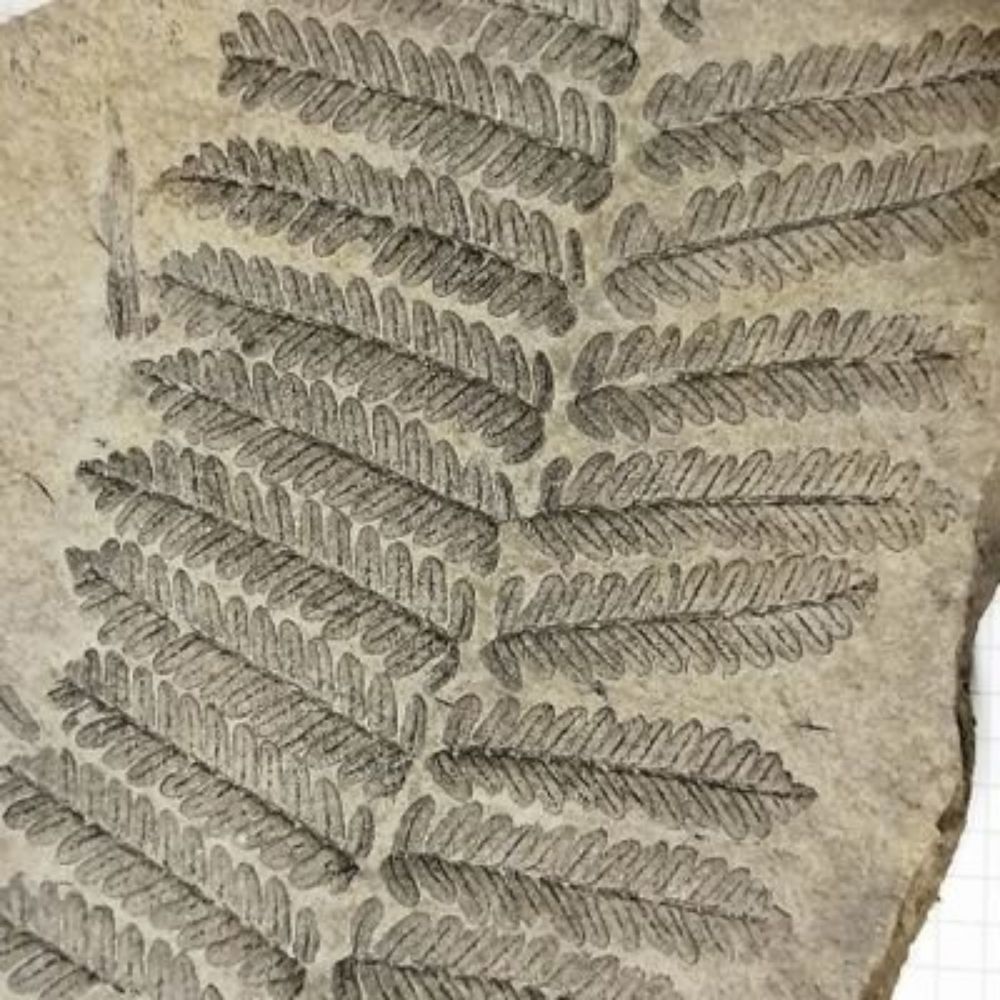
Pterocoma pennata, a comatulid ("feather star") from the Jurassic of Germany

Ginkgoites huttoni, a ginkgo from the Jurassic of England.

Cymatophlebia longialata, a dragonfly from the Jurassic of Germany

Pterodactylus antiquus, a pterosaur from the Jurassic of Germany.
Look at all these beautiful flattened Jurassic friends! ⛏️🤓 All from the Paläontologisches Museum München public exhibit -names in alt-text #fossil #paleontology #paleobotany
05.03.2026 17:33 — 👍 104 🔁 27 💬 2 📌 1
Excited to share a new paper written by a AAAS Policy Fellow I mentor, Dr. Lisa Walsh.
“This review synthesizes literature on fieldwork safety across scientific disciplines, highlighting four facets of safety for leaders and researchers to address: physical, social, financial, and psychological.”

Redwood tree - polished slab of a silicified Sequoia sp. stem Neogene: Miocene, c. 16 million years old Central Oregon, USA Redwoods of the conifer family Cupressaceae (Sequoia, Sequoiadendron, and Metasequoia) are the largest plants on Earth today, and fossil remains of their ancient relatives, such as the stem slab on display here, demonstrate most impressively that they, too, attained considerable sizes. The diameter of the slab on display measures 182 cm (the slab is 9 cm thick and weighs 450 kg). On closer inspection, you will notice that there are some 250 growth rings, indicating that this tree lived for at least 250 years before it became embedded and subsequently silicified.
And here are the details on this specimen (I guess it also counts as a #ThickTrunkTuesday post!) 🌲⛏️
03.03.2026 08:09 — 👍 5 🔁 1 💬 0 📌 0
The whole slice of fossil trunk. It's about 1.8 meters in diameter - taller than me. (There's also part of a fossil palm tree trunk on the right)

Close up of the fossil trunk showing the center on the left and the growth rings (there are ~250 rings in total)
I'm at the Paläontologisches Museum München this week, working on some long-overdue projects 🙃 They have cool #fossils in the exhibit hall but this is my favorite: a giant slice from the trunk of a redwood #tree (Sequoia sp. ) that was growing in the US ~16 million years ago. 🌲⛏️ #paleobotany
03.03.2026 07:54 — 👍 20 🔁 4 💬 1 📌 0
We invite contributions for our open session at ATBC2026:
Education and outreach initiatives for tropical biodiversity.
🍃We are seeking researchers & students at all career stages to present outreach initiatives related to tropical biodiversity & conservation.🍃
forms.gle/PmQSkXvk8kMc...
#ATBC2026

Drawing showing biodiversity from the Carboniferous of Puertollano, which includes plants, arthropods, fish and tetrapods. From left to right, top to bottom: - The giant millipede Arthropleura walking through the forest floor, next to an amphibian (maker of the Puertollanopus tracks) and insects - General view of the swamp landscape, with a volcano erupting in the background - A early synapsid, maker of possible Dimetropus tracks - Pecopteris monyi, leaves of a tree fern - A pair of Acanthodes swimming through vegetation and smaller fish - The temnospondyl Iberospondylus schultzei swimming next to some platysomid fish - Small clam shrimp Euestheria - Two lycophytes Omphalophloios puertollanense next to some swamp creatures - The xenacanth Orthacanthus hunting in the murky waters - Juvenile shark Lissodus hiding from the fish Progyrolepis speciosus - Puertollanichthys richtei, a small fish, swimming through the vegetation
🌴🦈Carboniferous Puertollano🐸🌋
In the lands of La Mancha, fossils from the Late Carboniferous known from old coal mines reveal a tropical coastal swamp ecosystem, rich in aquatic and plant life
#paleoart #FossilFriday #Carboniferous #Puertollano
🧵Thread for additional explanation


Thrilled to announce that the University of Lomé #Togo 🇹🇬 inaugurated the first Palaeontology Collection building of the country last week! This was an exciting moment, which was made possible by the support of #UNESCO and the University of Lomé.
#fossils #conservation #geoheritage

Gorgeously preserved stalks of horsetail criss-crossing over one another on a rock slab on display behind glass

A well-preserved conifer branches ending with circular cones at the end of those branches on the right. The stone slab is sepia-colored; the branches are a darker reddish-brown.
#FossilFriday
Horsetail (Asterophyllites sp.) 323 - 307 mya, #Kentucky
& conifer branch & cones (Sequoia affinis) 41 - 34 mya, #Montana
Yale Peabody Museum #paleobotany #palaeobotany
Yes, NSF does this. And some agencies in non-English-speaking countries strongly recommend writing proposals in English so that experts from other countries can review them.
25.02.2026 18:24 — 👍 2 🔁 0 💬 0 📌 0
Capture d'écran de l'en-tête de l'article : Plant–fungi interactions in Marchantia polymorpha are associated with horizontal gene transfer and terpene metabolism. Les interactions plantes-champignons chez Marchantia polymorpha sont associées avec un transfert de gène horizontal et le métabolisme des terpènes. Paru dans PNAS le 4 février 2026. Par Karima El Mahboubi, Chloé Beaulieu, Baptiste Castel, Cyril Libourel, Nathanaël Jariais, Emilie Amblard, Fabian van Beveren, Jean Keller, Yves Martinez, Jessica M. Nelson, Maxime Bonhomme, Christophe Jacquet, and Pierre-Marc Delaux. https://doi.org/10.1073/pnas.2532723123
Le saviez-vous ? Les plantes possèdent leurs propres mécanismes immunitaires de défense contre les infections !
Ils sont surtout étudiés chez les plantes à fleurs mais c’est chez une cousine des mousses que des scientifiques du @lrsv-toulouse.bsky.social ont fait une découverte fascinante.
🔽

Background image represents the so called "star-rings", vascular bundles in the pith transporting water to the apex and the leaf primordia. Within the parenchymatous tissues surrounding them, there are also the mucilage cavities (white globular areas).
🌿Check the newly published article “Shoot apical meristem and initial vascular development of a late Palaeozoic spermatophyte (order Medullosales)” in @annbot.bsky.social by Lydéric Portailler & Ludwig Luthardt. (1/9)
👉https://doi.org/qr8r
#Paleobotany #PlantEvolution #FossilPlants #Botany

www.cell.com/current-biol... Our new quick guide to Prototaxites is out in @currentbiology.bsky.social !
23.02.2026 18:25 — 👍 52 🔁 24 💬 2 📌 4

First paper by Cristi for her PhD thesis:
Velasco-Flores & al. in press | Life-position succulent #Euphorbia L. fossils buried in #Pleistocene explosive volcanic deposits from #Tenerife, Canary Islands, #Spain | RPP: doi.org/10.1016/j.re...
#openaccess #Palaeobotany
#Peloria, the term used to describe an unusual change in flower symmetry. The term derives from the Greek "pelōros", meaning "monster", "portent" or "prodigy".
👀 Later this year, a book on #VegetableMonstrosity will be out - by Nathan Smith and yours, truly 😉
(the image below is from Wikipedia)

Photo of a larger, off-white lichen on the left, growing over a smaller, round, grey and black lichen on the right. About half the round lichen had been over grown, half is visible. These are crustose lichens growing flat on brownish rock.
Two worlds collide. Leconara sp lichen (on left) overgrows a Rhizocarpon sp lichen (on the right). NWT, Canada. #lichen #fungi #fungifriends
22.02.2026 11:40 — 👍 190 🔁 21 💬 1 📌 0
Close up of rosemary (Salvia rosmarinus) flowers

Close up of almond tree (Prunus dulcis) flowers

Close up of a wild daffodil flower (Narcissus sp)

Close up of "giant orchis" flowers (Himantoglossum robertianum)
We've had a Very Rainy winter in Montpellier but the sun is finally out and flowers too ☀️ with some classics: rosemary, almond tree, wild daffodil & "giant orchis" (Himantoglossum robertianum ) #botany
22.02.2026 12:09 — 👍 12 🔁 1 💬 1 📌 0
Fig. 1 Morphology of extant conifer seed cones.
#TansleyReview: Homology and heterochrony in the evolution of #conifer #SeedCones
Kelly K. S. Matsunaga
👇
📖 nph.onlinelibrary.wiley.com/doi/10.1111/...
#LatestIssue
There will be official news and a web site in the coming weeks.
19.02.2026 17:29 — 👍 1 🔁 0 💬 0 📌 0
small red vaguely bell-shaped flowers with translucent fused sepals of the species Florissantia quilchenensis face downwards towards the camera, the branch they're growing from is seen to the right while the leaves of the branch are behind the flowers. behind in the background is a blurry branch showing more flowers and leaves Florissantia quilchenensis is a species of Eocene, Canadian malvacean (mallow family) bisexual reproductive organ who's growth-form and whole-plant appearance is unknown. here I have reconstructed it as a tree similar to other plants in the subfamily Sterculioideae, of which it is nested in. it had an androgynophore with five petals fused into a corolla in alternation with the calyx, the style was longer than the stamens, there were five stamens that bifricated at their tips into two anthers giving it a total of ten anthers per flower, as mentioned previously the sepals of this plant were fused into the distinctive bell-shaped cup

at night after a brief shower of rain, an artificial light illuminates the branches of a tree showing very small pink flowers of the genus Lovellea, small blobs of water cling to the waxy cutiles of the leaves, another two blurry branches (though, without flowers) can be seen in the background Lovellea is a kind of small and basal laurale reproductive organ who's growth-form and whole-plant appearance is unknown. Here i have reconstructed it after a more basal condition with a singular flower to each leaf growing from the axillary bud. the flower was shaped like a radially symmetrical pear with an opening at the top in which small pollinators could crawl in for pollination, the ovaries surrounded by a thick layer of overlapping tepals

a kritosaurin hadrosaur has plucked a branch off of a legume tree that's growing fruit of the species Leguminocarpum olmensis, the branches themselves are partially in fruit and partially in flower still kritosaurin hadrosaurs are a group of "duck billed" dinosaurs from Mexico with tall robust nasals but no nasal crests like those found in saurolophines Leguminocarpum olmensis is a species of Late Cretaceous, Mexican fabacean (bean family) fruit of uncertain taxonomic affinities to other fabaceans, and who's growth-form and whole-plant appearance is unknown. here i have reconstructed it as a cercidoidean with racemose infloresence and alternate distichous bilobed leaves

tri-paired three follicles in the genus Sagaria are seen growing on a plant with two pink flowers below them, each internode grows from a three-lobed leaf's axillary bud. trichomes coat the entire plant, catching drops of water, a soft orange light glows behind the plant Sagaria is a genus of Albian, Italian ranunculacean (buttercup family) fruit who's growth-form and whole-plant appearance is unknown. here i have reconstructed its flowers as closer to buttercups with six overlapping petals forming a cup-like shape and many anthers in its centre. follicles are a kind of fruit that splits down a central seam when ripe to release its seeds
this week's #Paleostream was a Valentine's Day special where we drew fossil angiosperms! this week we drew Florissantia (i drew F. quilchenensis), Lovellea, Leguminocarpum olmensis, and Sagaria #paleobotany #palaeobotany #paleoart #botany #sciart
15.02.2026 18:26 — 👍 81 🔁 20 💬 0 📌 1
From paper: Co-occurrence of endophytic oviposition and Asteronomus maeandriformis in Autunia conferta. (a) Mass occurrence of oviposition scars, which likely housed unhatched eggs (NHMS Ap 37/5). (b) Sketch of (a) showing the distribution of the oviposition scars on the pinnule. (c–e) Oviposition scars with ovipositor slits (arrows) (NHMS Ap 37/5). (f) Oviposition and leaf mining on small Autunia conferta pinnules (MB.Pb.1979/0012). (g) Enlargement of the area in (f). Note the callus tissue surrounding the oviposition sites. (h) Leaf mines and oviposition scars on Autunia conferta (MB.Pb.1979/0014). (i) Irregularly distributed oviposition scars on Autunia conferta (MB.Pb.1979/0020).

From paper: Thin sections of Asteronomus maeandriformis in Autunia conferta from Crock, Thuringian Forest Basin, Germany. (a) Section through an Autunia conferta leaf (MB.Pb.1979/0188) with frass trail (box). The scrolled margins indicate the upper side of the pinnule. (b) Section through the frass trail in (a). Note the upper epidermis (arrow), which covers the tunnel. (c) Another example of a compressed tunnel in the upper parenchyma covered by the upper epidermis (arrow) (MB.Pb.1979/0179). (d) Transverse and longitudinal sections through endophytic frass trails in Autunia conferta (MB.Pb.1979/0188). (e, f) Longitudinal section through a frass trail (MB.Pb.1979/0069). Note the calcite-filled cracks and the thin calcite cover on the upper side of the leaves from shrinkage of the organic matter in (arrows in f).
Wow!
2025: Host-specific leaf-mining behaviour of holometabolous insect larvae in the early #Permian
#ichnology #paleobotany #palaeobotany
Michael Laaß, Ludwig Luthardt, Steffen Trümper, Angelika Leipner, Norbert Hauschke & Ronny Rößler

Top left: Map of Chile and Argentina with the study location indicated in red. Top right: two thin section photographs showing internal structures within new wood species Sahnioxylon chubutensis (MPEF-Pb 13152): on the left a general view of the pith and primary and secondary xylem (scale bar 500 microns); on the right tracheids with scalariform and araucarian pits (scale bar 100 microns). At the bottom, a photograph showing two growth rings within Sahnioxylon and plots to the right showing cumulative sum of deviation from the mean radial tracheid diameter for those rings. On the plots, the proportions of earlywood and latewood correspond to yellow and red shaded areas respectively. Bottom right corner: cover image for journal Papers in Palaeontology.
First record of Sahnioxylon from South America onlinelibrary.wiley.com/doi/10.1002/... #PapersinPalaeontology
17.02.2026 16:05 — 👍 8 🔁 5 💬 0 📌 1
Several different lichens and some mods on the branch of an oak
Best branch 💚🌳
15.02.2026 13:26 — 👍 17 🔁 2 💬 1 📌 0
4 photos showing different types of lichens.

4 other photos with more different types of lichens
How many different #lichens on a single #tree? 🌳 I don't know but this is just a selection from the upper branches of a single oak (Quercus robur or petraea) uprooted this week by storm Nils 🌪️🌳 #botany
15.02.2026 11:07 — 👍 47 🔁 8 💬 2 📌 0Hi. It's not fossil wood and looks more like marine invertebrate pieces to me. Maybe @nhmbryozoa.bsky.social can help?
15.02.2026 08:17 — 👍 1 🔁 0 💬 1 📌 0
text says "hold me like marchantia holds water", the pic is a lecture slide show marchantia archegoniophore holding water

text says "my love for you is as abundant as rubisco", with a protein structure of rubisco

text says "my love for you is liek apical meristems.. it keeps on growing", pic shows shoot and root apical meristem

text says "call me a xylem cell, because i would die for you"
Asked my Intro Plant Bio students to make Valentine's day plant meme using what they learned in class so far, and dang, it gives me SO MUCH joy seeing all the submissions.
Some of my favs here: #valentinesday #ib103 #iamabotanist #plantjoy @botsocamerica.bsky.social l @plantteaching.bsky.social

A Marchantia lawn beside the Life Sci building at University of Nottingham
Nice weather for liverworts
💚☔💚☔💚