As winter comes to an end ❄️➡️🌱
The snow begins to retreat across the high plains, and one of the most profitable prey species for the Himalayan wolf — the Himalayan marmot — starts to emerge from its hibernation burrows.
For months, Himalayan wolves have endured scarcity and extreme clime.
24.02.2026 07:30 — 👍 0 🔁 0 💬 0 📌 0

This photo was taken as winter began creeping across the Tibetan plateau and the plains of northwestern Nepal. Logistics grow harder in our expeditions, temperatures drop fast, and wildlife shifts into harsh winter mode.
16.02.2026 07:45 — 👍 1 🔁 0 💬 0 📌 0

Image of Limi Valley in Upper Humla (Nepal). The Himalayan range and the Tibetan Plateau are among the most climate-vulnerable regions on Earth. Glacial systems that have shaped these landscapes for millennia are now facing record temperatures, accelerating ice loss and altering water cycles.
13.02.2026 07:45 — 👍 0 🔁 0 💬 0 📌 0


Happy International Day of Women and Girls in Science 🔬Women have persisted in a world not built with them in mind. They have claimed their space and they have fought forward, reaching excellence.
Science is not built in a single day. It is built every day.
And every day, women are building it.
11.02.2026 16:09 — 👍 0 🔁 0 💬 0 📌 0

The Himalayan wolf is not only a striking animal. As an apex predator, it regulates prey populations, influences grazing dynamics, and contributes to the stability of fragile mountain food webs.
Himalayan wolves belonged to our ancestors and must be inherited by our descendants.
#HimalayanWolf
05.02.2026 07:30 — 👍 0 🔁 0 💬 0 📌 0

The versatility of the Himalayan wolf 🐺🏔️
Himalayan wolves can optimize their use of space in environments shared with other predators and shaped by human presence. Adaptability at fine spatial scales may be one of the keys to their persistence in complex mountain ecosystems.
03.02.2026 13:38 — 👍 0 🔁 0 💬 0 📌 0

A rare encounter: the Pallas’s cat (Otocolobus manul) 🐾
This is an exceptional record. The Pallas’s cat, also known as the manul, is one of the most elusive and difficult-to-detect carnivores in Upper Humla, Nepal. Every confirmed observation extremely valuable.
23.01.2026 08:00 — 👍 1 🔁 1 💬 0 📌 0

The Himalayan dzo 🐄🏔️
Also known as jhoppa, the chowri is a hybrid between domestic cattle and yak. For many pastoral communities across the Himalayas, these animals represent far more than livestock. They are a primary form of wealth, savings, and economic security.
20.01.2026 08:40 — 👍 0 🔁 0 💬 0 📌 0

Seeing wildlife in the dark 🌙🐺
Camera traps are an essential tool for studying wildlife — even in complete darkness. They allow us to understand how animals use space, how they move across the landscape, and how their activity changes throughout the day and night.
13.01.2026 08:15 — 👍 1 🔁 0 💬 0 📌 0
A video-narrative of the journey in relation to the wild yak rediscovery in Nepal and beyond
Script and cinematography
Naresh Kusi and Geraldine Werhahn
Additional footage
Raju Acharya
Research…
The Black Giants
The mysterious wild yak 🦬
Take a look at this short documentary filmed by our team in one of the most remote places on the planet and discover the world of this remarkable high-altitude species.
🎥 Watch the full video here: youtu.be/YVFFEI7M2sY?...
#WildYak #HighAltitudeWildlife #TibetanPlateau
11.01.2026 08:30 — 👍 0 🔁 0 💬 0 📌 0

Surviving the Himalayan winter ❄️🐺
Winter imposes some of the harshest conditions on Himalayan wolves. As temperatures drop and prey becomes scarcer, pack dynamics shift. Understanding how wolves respond to winter constraints is essential for interpreting their ecology and conservation needs.
09.01.2026 10:14 — 👍 0 🔁 0 💬 0 📌 0

When nature sets the limits ❄️🏔️
At times, extreme weather conditions prevent us from accessing our camera traps for routine maintenance. On this occasion, heavy snowfall left one of our cameras deeply buried and completely inaccessible. It will have to wait until spring to be checked again.
28.12.2025 16:30 — 👍 0 🔁 0 💬 0 📌 0

The golden jackal 🐾 is the most widespread and common canid species in Nepal. Highly adaptable and opportunistic In recent years, their presence has begun to be detected in isolated high-altitude Himalayan locations, where environmental conditions are far more extreme as the Himalayan range
25.12.2025 10:00 — 👍 1 🔁 1 💬 0 📌 0


Camera trap check in progress 📸🏔️
Our collaborators Prakash Adhikari and Som Gurung are carrying out routine monitoring of camera traps deployed in the Annapurna Conservation Area.
This project is carried out in collaboration with the BRI (CSIC–University of Oviedo) and(ACAP–NTNC)
22.12.2025 07:30 — 👍 1 🔁 0 💬 0 📌 0

Did you know? 🐺❄️
Around 25,000 years ago, during the Last Glacial Maximum—the coldest phase of the last Ice Age—the modern grey wolf expanded widely across Eurasia, The Himalayan wolf diverged from the common ancestor of Eurasian wolves an astonishing ~750,000 years ago, adapting to high-altitude
18.12.2025 07:01 — 👍 0 🔁 0 💬 0 📌 0

The Snow Leopard — Ghost of the Mountains 👑❄️
This apex predator is a keystone of Himalayan ecosystems.
Our camera traps play a crucial role in monitoring species distribution and behaviour. Their infrared flash technology allows us to capture wildlife activity even under complete darkness 🐺🐆⛰️
15.12.2025 08:00 — 👍 0 🔁 0 💬 0 📌 0

🦌✨ Sharing the highlands with the wild Goa — also known as the Tibetan gazelle (Procapra picticaudata) — is another iconic resident of the Tibetan Plateau. At the southern edge of their global range, small groups occasionally venture into north-western Nepal.
#TibetanGazelle #Goa
11.12.2025 10:00 — 👍 0 🔁 0 💬 0 📌 0

In this photo, Ven. Gueshe Lobzang Yeshe holds our book The Web of Life, a family-friendly introduction to the food webs of the Himalayan Range and the Tibetan Plateau.
Ven. Gueshe Lobzang served as the reviewer of the Tibetan text, contributing with great enthusiasm and care.
#TheWebOfLife
03.12.2025 08:00 — 👍 1 🔁 0 💬 0 📌 0

The Himalayan wolf has roamed the high-altitude pastures of the Tibetan Plateau and the greater Himalayan range for hundreds of thousands of years. 🐺❄️
Nomadic yak herders have lived, migrated, and worked across these mountains while coexisting with the wildlife around them.#HimalayanWolf
01.12.2025 14:06 — 👍 0 🔁 0 💬 0 📌 0

Brown bears of Limi Valley are now officially on the map — and the full article is now OPEN ACCESS! 🐻📖 [link in the bio]
Last year, we shared the exciting news of our unexpected brown bear records from Limi Valley, one of the most remote and least-studied regions of north-western Nepal.
27.11.2025 10:00 — 👍 0 🔁 0 💬 0 📌 0
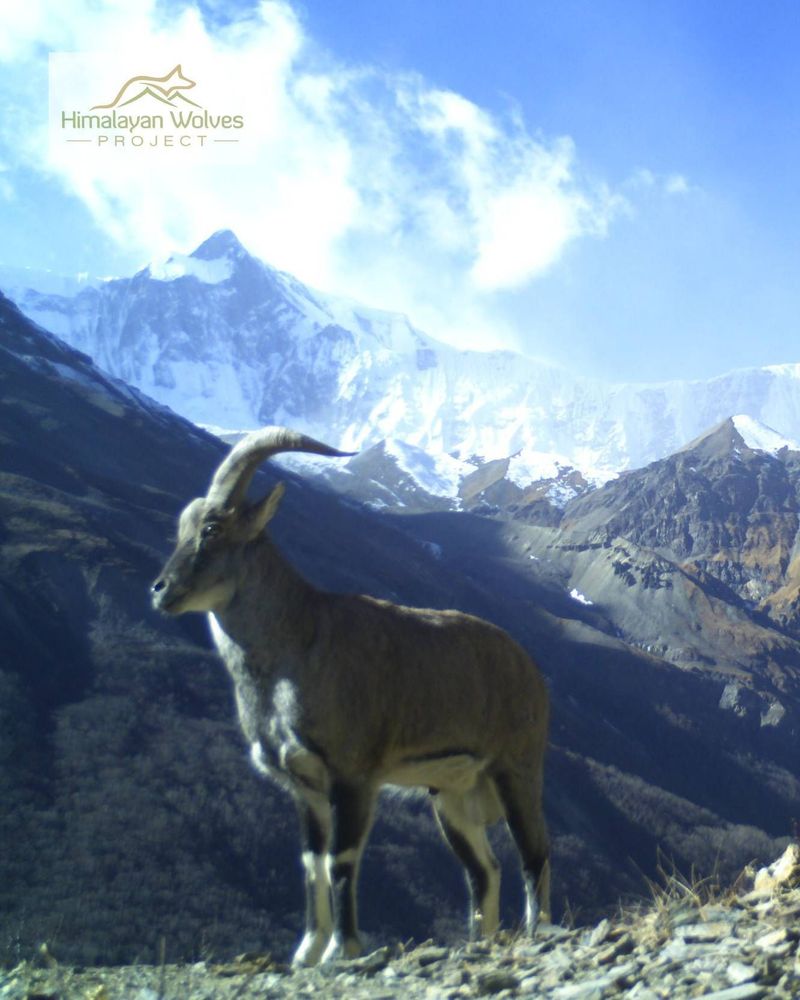
The blue sheep — one of the true icons of the Himalayan landscape. 🐏🏔️
In this photo, a young but already majestic male with impressive horns stands in the Annapurna Conservation Area, with Annapurna I in the background.
#BlueSheep #HimalayanWildlife #AnnapurnaConservationArea #SnowLeopardPrey
25.11.2025 10:00 — 👍 0 🔁 0 💬 0 📌 0

🦌 The mysterious musk deer
This is a musk deer, one of the most fascinating herbivores of the Himalayan region. During our fieldwork in the 📍Annapurna Conservation Area, we often record them in lower forested zones, Males are easily recognized by their long, fang-like tusks for fighting rival males
18.11.2025 08:30 — 👍 0 🔁 0 💬 0 📌 0
A video-narrative of the journey in relation to the wild yak rediscovery in Nepal and beyond
Script and cinematography
Naresh Kusi and Geraldine Werhahn
Additional footage
Raju Acharya
Research…
The Black Giants
🎥The wild yak, the black giant, Take a look at this short documentary to discover more about our expeditions and our encounters wild yaks. Including the first scientifically documented encounter in Nepal for about 50 years, as it was believed locally extinct.
🎥 [https://youtu.be/YVFFEI7M2sY]
14.11.2025 08:36 — 👍 0 🔁 0 💬 0 📌 0

🐻 In this image, you can see the entrance of a Himalayan marmot burrow 🦫 disturbed by the intense diggingof a brown bear. Check if you can find the claw marks! The brown bear is another elusive top predator that roams the valleys of Upper Humla, Nepal, searching for food in this rugged landscape.
13.11.2025 11:27 — 👍 2 🔁 1 💬 0 📌 0
📌 We will continue supporting efforts that promote coexistence and keep genetic connectivity across landscapes.
10.11.2025 09:22 — 👍 0 🔁 0 💬 0 📌 0
• The actual economic impact of livestock predation is very low, and conflicts drop significantly when herders use proper livestock guarding and other preventive methods.
Wolves play a vital role in healthy European ecosystems — science must guide conservation decisions.
10.11.2025 09:22 — 👍 0 🔁 0 💬 1 📌 0
• The biggest threat to wolves in Europe is over-hunting and the fragmentation of populations, which reduces genetic connectivity.
• Lethal removal has proven ineffective as a long-term wildlife management strategy.
10.11.2025 09:22 — 👍 1 🔁 0 💬 1 📌 0
In a new Science Letters publication, an international team of researchers — including our project director Geraldine Werhahn — explains why this decision puts wolf conservation at risk:
10.11.2025 09:21 — 👍 0 🔁 0 💬 1 📌 0
On June 5th, the Council of Europe approved the European Commission’s proposal to downgrade wolves from “Strictly Protected” to simply “Protected” under the Habitats Directive.
10.11.2025 09:21 — 👍 0 🔁 0 💬 1 📌 0

📰 New update on wolf protection in Europe
Photo credit: Josip Kusak
A recent decision has changed the protection level of wolves in the European Union.
Explanation on the first comment.
10.11.2025 09:19 — 👍 0 🔁 0 💬 1 📌 0