Infographic titled “Let’s take action against clubroot”. Stop the spread by cleaning equipment, scouting field entrances and low or wet areas, controlling volunteer brassicas, monitoring soil drainage and reducing compaction. Reduce the inoculum by extending crop rotation (more clubroot = longer rotation), planting resistant cultivars, planting bait crops such as daikon radish and perennial ryegrass, and raising soil pH using soil amendments like hydrated lime.

Infographic titled “Antimicrobial resistance and pets: protecting families”. Microbes can be shared between pets and their household members. Resistant bacteria can potentially circulate among the entire household. Inappropriate antimicrobial use is the main driver of antimicrobial resistance. Antimicrobials should only be used at the right dose, for the right duration, and for the right reason.

An infographic titled ”How does blockchain technology ensure transparency in the organic strawberry supply chain? Blockchain secures every step.” A diagram depicts blockchain ledger in the centre of a circle, with bidirectional arrows pointing outwards to each of the following stages of strawberry production: organic farming, organic certification, shipment processing, shipment distribution, retailer, and consumer tracking the product using a QR code. Why is a blockchain-based OrgBerryChain better? Rapid decontamination response, prevention of fraud and mislabeling, automation and efficiency, and sustainability verification.
25.11.2025 20:59 —
👍 0
🔁 0
💬 0
📌 0

This infographic shows phytoplankton as the cornerstone of marine food webs. Phytoplankton are microscopic plant-like aquatic organisms that perform photosynthesis, just like plants on land! Nearly every ocean creature depends on phytoplankton, either directly as food or indirectly by eating something that eats phytoplankton. A food web diagram depicts phytoplankton being a source food for zooplankton, which in turn are a source food for whales and fish. The fish are the source food for sharks, humans, and marine mammals. Phytoplankton absorb carbon dioxide, which helps fight climate change, and produce over 50% of the world’s oxygen. Rising ocean temperatures disrupt phytoplankton growth, putting the entire marine food chain at risk!

Infographic titled “Understanding neurocysticercosis (NCC), the leading cause of preventable epilepsy (recurring seizures) in low- and middle-income countries. NCC is an infection caused by larvae of a parasitic pork tapeworm. Humas get NCC when the tapeworm eggs turn into larvae in the pic, then larvae are transferred to the human through consuming pork meat, then larvae grow into tapeworms in the human and release eggs in fecal matter, which are then transferred to pigs through ingestion of feces while grazing, and the cycle begins again. NCC can take years to make humans sick. The most common symptom is seizures, from cysts developing in the brain. Most people don’t know they have NCC until they have a seizure. The diagnosis can be confirmed through imaging (CT/MRI) and blood tests. NCC can be prevented by washing hands and cooking meat to a safe temperature. Antiparasitic treatment can treat cysts and anti-seizure medications can help prevent seizures.

Infographic titled “Rat Poison Bites Back.” Explains how rodenticides harm wildlife and pets. It describes a sequence showing that when a rat eats poison, the toxin remains in its body; when predators such as hawks, coyotes, lynx, dogs, and cats eat the poisoned rat, they are also poisoned. Each animal is shown with a skull and crossbones to indicate poisoning. Text explains that predators and pets can suffer internal bleeding, seizures, or death after eating poisoned rodents. The infographic ends with safer solutions: sealing entry points, securing food and garbage, and using snap traps instead of poison. The design uses blue and beige tones with black silhouettes and credits the National Park Service and Wolf Conservation Center at the bottom.
25.11.2025 20:57 —
👍 1
🔁 0
💬 1
📌 0

“Coral Reefs and Climate Change” shows how human activities increase greenhouse gases that warm and acidify oceans, stressing coral reefs. It explains five main impacts: coral bleaching from warming, sedimentation from rising sea levels, polluted runoff from increased rainfall, reef damage from stronger storms, and slower coral growth from ocean acidification. The bottom section lists actions to help, such as reducing plastic use, saving energy, using public transit, supporting renewable energy, and choosing sustainable seafood.

This infographic is titled “How do aquatic insects help us evaluate human impact in nature?”. Subtitle reads “Caddisflies, mayflies, and stoneflies are aquatic insects whose larvae are highly sensitive to changes in water quality. To help these species thrive, we need more high-quality, minimally disturbed streams. By monitoring the presence, diversity, and abundance of these sensitive bugs, we can identify and prioritize areas for conservation”. The number and diversity of aquatic insects increases from only a few in areas labelled high runoff of pesticide contaminants from farms, to more in mixed conditions that are neither pristine nor heavily contaminated, to lots in forested areas with trees that slow the impacts of the runoff.

This infographic depicts a winding stream with many aquatic creatures in it. This poster discusses the best practices for maintaining stream health and quality. In terms of negative impacts, a snow plow is seen dumping toxic compounds into the stream, causing there to be a dead fish in front of the truck. There is also a mass of plastic waste floating in the stream, with a “no littering” graphic on top. There are also hands reaching out to grab rocks and fish from the stream, which is also discouraged by a crossed out red circle. Example images of endangered (Redside Dace) and invasive (Round Goby) species found in the Credit River are highlighted, along with lots of aquatic vegetation both within and outside the stream. This infographic outlines the “do’s” and “don’t’s” that any member of the public can follow to protect local stream biodiversity.
Thank you to the students who participated in the F25 Infographics in Practice program! Here are the final projects created by graduate students.
Learn more about this program and see last year's projects at uoguel.ph/InfographicsInPractice
@@uofgresearch.bsky.social
25.11.2025 20:56 —
👍 1
🔁 0
💬 1
📌 0

A person in a hat and gloves moves mesh bags filled with beans into piles on top of storage bins.
Thousands of beans grown for #UofG research will help feed the community through donations to the Guelph Food Bank. The project gives unused beans from breeding trials a new purpose while reducing waste and supporting local food security.
Learn more: uoguel.ph/a8107
27.10.2025 20:18 —
👍 1
🔁 4
💬 0
📌 0

U of G Bean Breeders to Make Food Bank Donations
Discarded dry beans used in University of Guelph breeding trials to be sent to Guelph Food Bank
Thousands of beans grown by #UofG plant researchers will provide nutritious meals to the Guelph community through donations to the local food bank.
“Rather than letting them go unused, we’re giving them a new purpose.”
news.uoguelph.ca/2025/10/u-of...
27.10.2025 13:03 —
👍 2
🔁 4
💬 0
📌 0

The dos and don'ts for reducing nutrient runoff from fertilizer on farms. Harmful algal blooms occur in high nutrient areas. Harmful algal blooms can produce toxins and create low oxygen zones where they decompose that kills aquatic life. Fertilizer runoff is a major contributor of nutrients in aquatic systems. Don't apply fertilizer on frozen soil so it is not lost as runoff when frozen fields melt. Don't clear cut shoreline. Avoid removing all plants on shorelines to decrease nutrient runoff. Don't overapply fertilizer. Test your soil before applying fertilizer to prevent unneeded application. Do conservation tillage. Leave crop residues on your fields after harvest. Do reduce irrigation. Choose drip irrigation and try irrigating only when necessary. Do keep a natural shoreline. Keep a planted shoreline to help absorb nutrients in runoff.
Wrapping up #ONTAgWeek with one more #UofG student infographic!
Jessica Collier, BSc student in Integrative Biology, shares some tips for preventing algal blooms fed by runoff from farm fields 🌱 🐟
@uofgresearch.bsky.social @uofgcbs.bsky.social
10.10.2025 14:00 —
👍 2
🔁 1
💬 0
📌 0

Event Promotion for Groundwater Science-Policy Workshop. Nov 12-14, 2025 in Guelph Ontario.
As a critical resource for ecosystems, agriculture, and drinking water, groundwater is central to global sustainability.
Be part of the conversation as we share insights and spark meaningful collaboration.
Register: uoguel.ph/4d8d1
Groundwater, food & policy intersect at the Science-Policy Interface Workshop Nov 12–14 @uofguelph.bsky.social
🎤 Global experts
🔬 Hands-on demonstrations
💬 Interactive discussions
📄 Real-world case studies
Register now to secure your spot! uoguel.ph/4d8d1
09.10.2025 18:00 —
👍 3
🔁 0
💬 0
📌 0

Dr. Silvia Sarapura-Escobar is an associate professor in the Department of Environmental Design and Rural Development, Ontario Veterinary College, University of Guelph. The seminar is organized by the One Health Institute at the University of Guelph.
Our next One Health seminar is Wed. Oct. 22, 12:30 in McLaughlin Library Room 384 or on Teams!
Dr. Silvia Sarapura-Escobar will speak on "Braiding Food Systems project for food security and food sovereignty."
More info: uoguel.ph/s1osr
Free pizza!
09.10.2025 14:59 —
👍 2
🔁 2
💬 0
📌 0

How does rotational grazing benefit the environment? Rotational grazing is a management practice that requires cattle to be moved frequently between different paddocks. This helps to prevent overgrazing by allowing plants and the land to rest and recover. Plant health: rest periods allow for vegetation regrowth and more developed root systems, increases plant nutrient uptake, and increases forage availability for cattle. Soil health: improves soil structure and organic matter, reduces soil erosion, and increases carbon sequestration which reduces greenhouse gas emissions. Water quality and wildlife: improves water quality by reducing runoff, manure contamination, and sediment in water, helps maintain riparian areas and provide habitat for wildlife, and reduces bank erosion around rivers, streams, and bodies of water.
Another day of #ONTAgWeek! We're celebrating by sharing infographics developed by #UofG students to share agri-food and biodiversity research 🔬
Megan St Martin (MSc in Animal BioSciences) shares info about rotational grazing 🐄 🌱
@uofgresearch.bsky.social
09.10.2025 14:00 —
👍 2
🔁 1
💬 0
📌 0

Our unsung agricultural heroes. Flower flies, also known as hover flies, are amazing bee and wasp mimics - and the best part? They can't sting! Flower flies provide multiple important ecosystem services including pollination as adults and pest control or nutrient cycling in their larval form. Fun fact! Some species of flower flies even migrate up to 3000 km, transporting billions of grains of pollen, nutrients, and energy across continents!
Another day of #ONTAgWeek! We're celebrating by sharing infographics developed by #UofG students to share agri-food and biodiversity research 🔬
Samantha Reynolds, PhD student in Environmental Sciences, wants everyone to give a shout-out to flower flies 🐝 🌻
@uofgresearch.bsky.social
08.10.2025 14:00 —
👍 2
🔁 2
💬 0
📌 0

European Corn Borer (ECB) was a major pest throughout the 20th century before new varieties of modified corn were able to highly suppress it for the past two decades. ECB has started developing resistance. Greater than 80% of Canadian corn is now vulnerable to ECB. Scouting for ECB is critical for pest monitoring and control. Learn to recognize ECB and limit its spread. Signs of infestation include broken tassel, reddening of upper leaves, shot-gun feeding on leaves, window-pane feeding on leaves, feeding or tunnelling in mid-rib, egg mass on underside of leaf, bore holes with frass (white to brown colour) at entrance, and look for overwintering larvae in the cut corn stalks. What's the harm? Yield loss, mold, and quality loss. Use pheromone traps to monitor for ECB throughout the season. Two traps per field, E-strain or Z-strain pheromone lures. Replace pheromone lure every 2 weeks. Place on top of weeds adjacent to corn field. Upload your trap counts and see what others are catching.
It's #ONTAgWeek! We're celebrating by sharing infographics developed by #UofG students to share agri-food and biodiversity research 🔬
Josee Kelly, Environmental Sciences PhD student, is raising awareness about European Corn Borers 🌽 🐛
@uofgresearch.bsky.social
07.10.2025 14:00 —
👍 0
🔁 0
💬 0
📌 0

Treatment and prevention. S. suis is a bacteria mainly found in pigs and has the ability to cause severe health problems. Infection of S. suis not only poses animal welfare concerns but also reduces productivity and increases mortality in affected herds. How does it spread? Pig to pig direct and indirect contact, and pig to human via consumption of raw pork products and direct contact through open wounds. Symptoms in pigs include fever, joint pain and lameness, loss of appetite, death, and neurological disorders. Risk factors include poor environmental conditions that increase the risk of disease transmission, stress and other infections that can weaken the immune system, and piglets not receiving enough antibodies from their mother's milk. Treatment with antimicrobials increase the risk of antimicrobial resistance. Alternative treatments include probiotics that optimize suitable gut microbiome to fight infection and bacteriophages that are highly specific to targeting to S. suis. Preventative measures include controlling co-infections, biosecurity measures, and proper environmental conditions.
It's #ONTAgWeek! We're celebrating by sharing infographics developed by #UofG students to share agri-food and biodiversity research 🔬
Check out this infographic about pig health by pathobiology MSc student Elieah Robertson 🐖
@ontvetcollege.bsky.social
@uofgresearch.bsky.social
06.10.2025 14:00 —
👍 1
🔁 0
💬 1
📌 0

We are looking for graduate students to create infographics about: climate smart agriculture; biodiversity & ecosystem management; pathogens & pandemic preparedness; resilient supply chains; agricultural technologies. Select a topic and complete the application survey by Sept 26th. Develop your infographic with support from the organizing team. Submit your first draft by Oct 17th and final draft by Oct 31st. Receive a $150 honorarium and compete for an additional $100 bonus award.
Attention U of G grad students - the Infographics in Practice Program is back! Check out last year's final infographics and this year's application instructions at uoguel.ph/InfographicsInPractice. Apply by September 26th 📅
@uofgresearch.bsky.social @uofgcbs.bsky.social @ontvetcollege.bsky.social
15.09.2025 14:17 —
👍 3
🔁 1
💬 1
📌 0

Hear "Water is Food - Emerging Knowledge" with Evan Fraser, Lawrence Goodridge, Tongzhe Li, Hugh Simpson by
@arrellfoodinst.bsky.social
(rewind from 2024)
💻🎧Listen:
buff.ly/42Y0KwV
Or on:
📻CFRU 93.3
📅Aug 7
⏰10am
#foodsecurity #cdnag
@feeding9billion.bsky.social
@theontarion.bsky.social
06.08.2025 14:19 —
👍 0
🔁 1
💬 0
📌 0

Summer 2025: Dry Beans Call for License Proposals
Three 3 dry bean varieties are being offered for a licensing opportunity, which includes: OAC 23-1 navy bean, OAC 22-B1 black bean and OAC 23-D1 dark red kidney bean. The successful application will b...
#UofG Dry Bean Breeding and Computational Biology Program has 3 new varieties available for licensing. We’re accepting proposals from seed companies interested in commercializing until Aug 25, 2025.
🔗 www.uoguelph.ca/research/inn...
#CreatedAtGuelph #DryBeans #CanadianFarming #BeanFarmer
31.07.2025 17:54 —
👍 1
🔁 1
💬 0
📌 0

Grain Farmers of Ontario 2026 Grains Innovation Fund is open for applications.
🚨 Applications now open for the 2026 Grain Farmers of Ontario Grains Innovation Fund!
Up to $75K available for market-ready innovations using Ontario-grown barley, corn, oats, soybeans, or wheat.
Deadline: Oct 31, 2025
Details: gfo.ca/grains-innov...
#GrainInnovation #AgTech #OntarioAgriculture
28.07.2025 16:25 —
👍 1
🔁 1
💬 0
📌 0

A group of students gathered around a sustainability-themed display at an indoor event. Promotes a hiring opportunity for the Project SOY Plus Student Coordinator position, running from Summer 2025 to Spring 2026. Bold text states “We Are Hiring!” with logos for the University of Guelph, the Research Innovation Office, and Project SOY Plus at the bottom.
💚 We're hiring! Join our office as a Project SOY Plus Student Coordinator. Lead a sustainability competition empowering student innovation 🌱
🗓️ Starts July 2025
📌 Apply by June 19 on Experience Guelph
🔗 bit.ly/4l71Tbh
#UofG #StudentJobs #Sustainability
12.06.2025 15:15 —
👍 3
🔁 0
💬 0
📌 0
🏆 Innovation of the Year nominations are open! uoguelph.ca/research/inn...
This award celebrates #UofG innovations that have meaningful value for Canada, with a focus on demonstrated impact beyond academia through the change it has enabled, informed, or inspired
02.06.2025 18:44 —
👍 0
🔁 0
💬 0
📌 0

AgRobotics Demo Days scheduled in Ontario
Robotics solutions in different horticultural crops will be featured at two events – one in Bradford and another in Simcoe in July 2025.
Thanks to The Grower for highlighting our upcoming events! 🚜 🚜 🚜
📅 Register for July 8th in Bradford: blankclick%20here%20to%20register.
📅 Register for July 22nd in Simcoe: www.eventbrite.com/e/agrobotics...
thegrower.org/index.php/ne...
28.05.2025 13:23 —
👍 0
🔁 0
💬 0
📌 0

The Policy Fellowship Program brings together professionals in government, industry, and other sectors for a series of meetings to engage in deep conversations with research experts and bridge the gap between science and policy. This is the only program of its kind in North America.

Customized experience. Your Fellowship schedule is tailored to your priorities, key challenges, and interest areas, ensuring relevant and productive conversations with top experts.

Access to research. Learn about the latest research and innovations in agriculture, food, and biodiversity to support evidence-informed decisions and policies.

Strategic insight. Gain fresh perspectives and practical knowledge that can shape your programs, policies, and long-term planning.
The next University of Guelph Policy Fellowship cohort is themed #Biodiversity and #Ecosystem Management. Will you join the over 100 past program participants in bridging the gap between science and policy? Apply by May 30th at uogue.ph/policyfellowship
26.05.2025 16:29 —
👍 1
🔁 0
💬 0
📌 0

Innovation of the Year. Nominations open until July 18th at noon. Gold glittery background.
🏆 The Innovation of the Year award celebrates University of Guelph innovations that have created, or have the potential to create, meaningful value for Canada, with a focus on demonstrated impact beyond academia.
For more information, visit www.uoguelph.ca/research/inn...
21.05.2025 14:41 —
👍 0
🔁 0
💬 0
📌 0

U of G Researchers Explore Techniques to Transform Environmental Monitoring
Dr. Robert Hanner, University of Guelph, and Ecological and Regulatory Solutions are developing better environmental health assessments with eDNA metabarcoding.
Backed by more than $2.4M in funding from the Ontario Research Fund, NSERC and MITACS, #UofG researchers are partnering with Ecoreg Solutions to lead a large-scale effort to modernize environmental biomonitoring.
Learn more: uoguel.ph/vljr0
07.05.2025 16:15 —
👍 6
🔁 1
💬 0
📌 0
Only 12 seats left - reserve your spot now! 🚌🚌🚌https://www.eventbrite.ca/e/agrobotics-on-the-road-bus-trip-to-agrobotics-working-group-demo-day-tickets-1248300092179
05.05.2025 19:10 —
👍 2
🔁 0
💬 1
📌 0

World’s Largest DNA Library Collects 15 Millionth Specimen
A beetle from Costa Rica has become the 15 millionth specimen to enter a genetic reference library at the Centre for Biodiversity Genomics (CBG) at the University of Guelph
A #UofG project to build a genetic reference library of all life on Earth has reached a milestone.
The Centre for Biodiversity Genomics now has 15 million specimens, positioning it among the top natural history archives in the world.
@uofgcbs.bsky.social
news.uoguelph.ca/2025/04/worl...
30.04.2025 15:23 —
👍 7
🔁 5
💬 0
📌 0
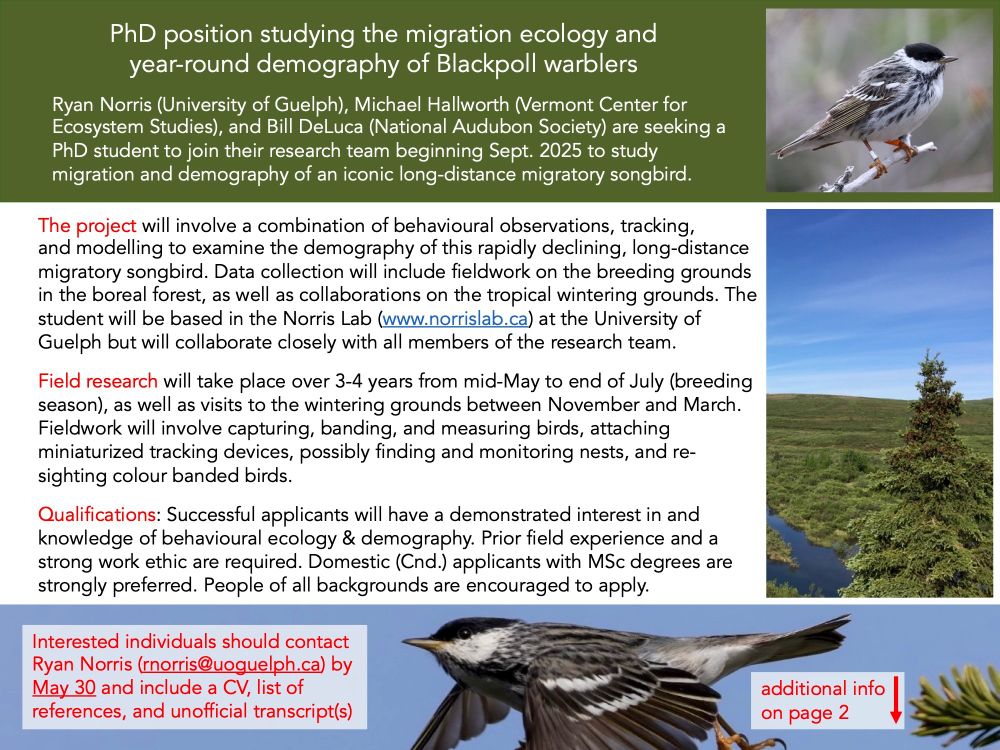
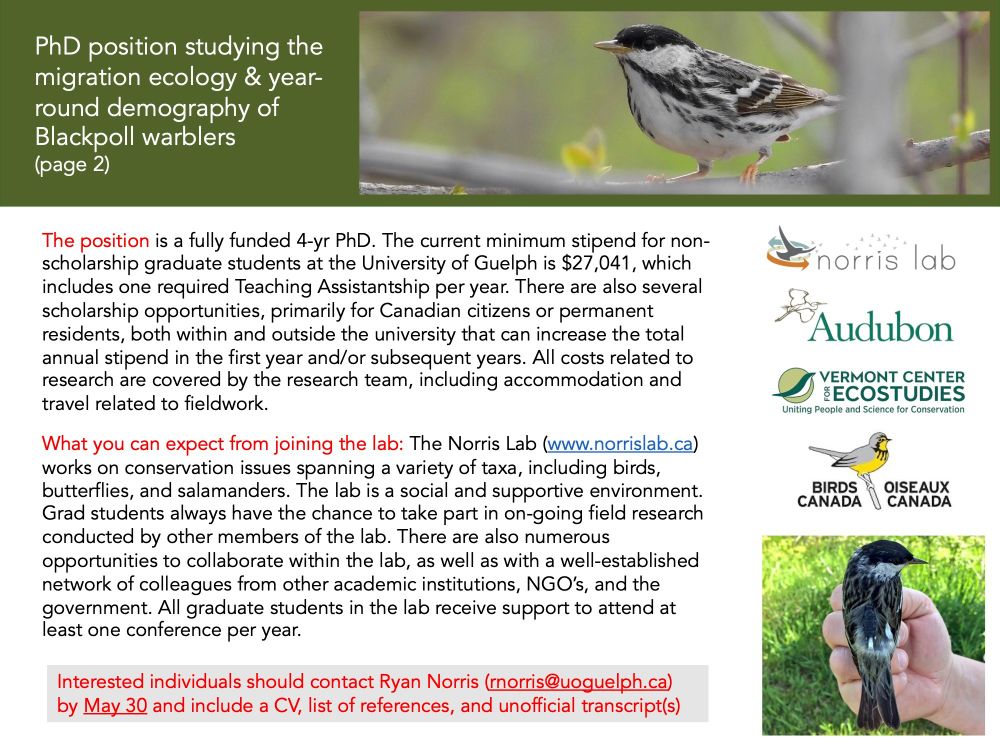
New PhD position available on blackpoll warblers with fieldwork in the boreal forest and tropics. @audubon.org @birdscanada.bsky.social @vtecostudies.bsky.social
28.04.2025 15:21 —
👍 17
🔁 22
💬 0
📌 2

Events — Ag Robotics Working Group
Connect with industry experts and explore the latest technologies to grow your farm at upcoming events. Don't miss out for a chance to connect with experts!
Event highlights include:
In-field demonstrations of autonomous solutions, technology, and more!
Complimentary lunch
Network with growers, ag. leaders, industry and government representatives
Sit back and relax in comfort and style on the luxury motor coach
Questions: researchinnovation@uoguelph.ca
25.04.2025 13:40 —
👍 0
🔁 0
💬 0
📌 0

AgRobotics on the Road: Bus Trip to AgRobotics Working Group Demo Day
Join the bus departing from UofG for the AgRobotics Working Group Demo Day at the Ontario Crops Research Centre - Simcoe Station.
Curious about a career in ag tech? Learn more at the Demo Day on July 22 at the Ontario Field Crops Research Station in Simcoe
Spots are limited—reserve your seat for complementary bus transportation from campus (U of G attendees only, event is open to the public)
www.eventbrite.ca/e/agrobotics...
25.04.2025 13:38 —
👍 0
🔁 0
💬 1
📌 1