
How much of the observed global warming was caused by humans? Science's best estimate: ALL OF IT
10.12.2025 21:07 — 👍 391 🔁 128 💬 6 📌 3How much of the observed global warming was caused by humans? Science's best estimate: ALL OF IT
10.12.2025 21:07 — 👍 391 🔁 128 💬 6 📌 320 calories of water, obviously
12.07.2025 16:58 — 👍 4 🔁 0 💬 0 📌 1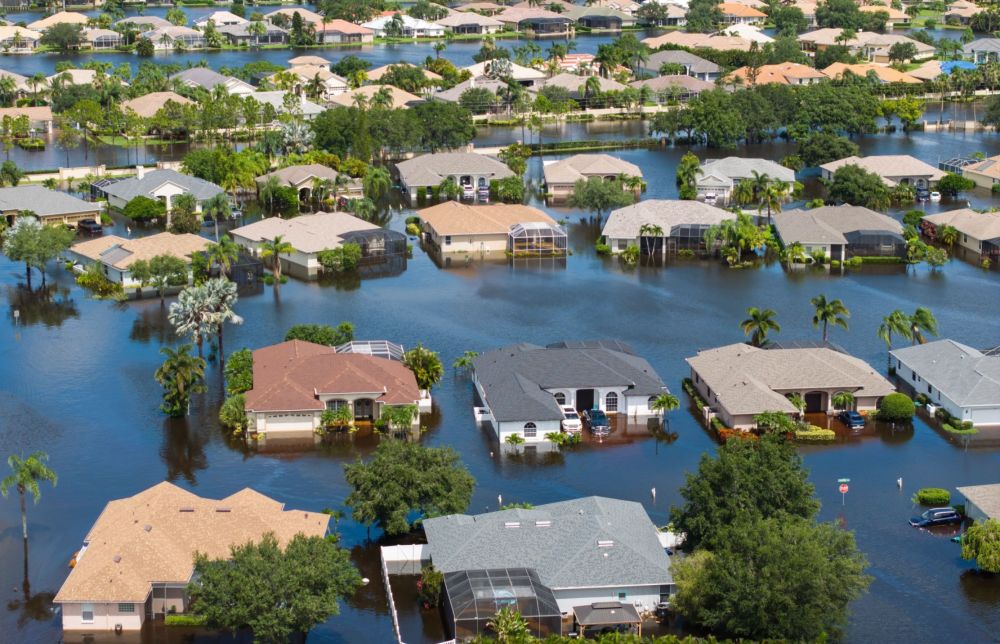
We've made an interactive map with data US Treasury collected that shows at the ZIP code level for 2018-2022 what US homeowners paid for insurance, what % of policies weren't renewed, and more. @brookings.edu Hutchins Center. www.brookings.edu/articles/hom...
18.06.2025 10:34 — 👍 103 🔁 33 💬 7 📌 7
Fascinating interactive. Thanks.
My premiums shot up 43% this year (Raleigh, NC), after hikes of 20% and 24% the past two years. Home insurance premiums may be one of the most direct ways that many Americans experience the impacts of climate change that has already occurred.
At 50% above the necessary volume.
11.06.2025 21:26 — 👍 1 🔁 0 💬 0 📌 0
This new state-led energy system modeling paper by @gmmouat.bsky.social @katiehjordan.bsky.social @paulijllo.bsky.social @jxjohnson.bsky.social is incredible, I literally want to sit down and have a cup of coffee with every figure. Let's take a tour shall we ☕? 1/🧵
HT @kevinjkircher.com
Thanks for sharing your thoughts on this!
30.05.2025 19:38 — 👍 1 🔁 0 💬 0 📌 0Wrong person tagged! That’s not my timeline.
30.05.2025 19:36 — 👍 1 🔁 0 💬 1 📌 0
🤣
thanks for sharing this!
🚨Job Alert🚨Johns Hopkins' Sustainable Energy Institute is hiring a fellow/post-doc (PhD, JD or equivalent experience) to support our work on interregional transmission, state engagement, and offshore wind planning! #energysky
Details & application available: apply.interfolio.com/168478
Lead author @gmmouat.bsky.social is on BlueSky! Follow this guy, post haste.
28.05.2025 15:08 — 👍 1 🔁 0 💬 0 📌 0Cc: @paulijllo.bsky.social @katiehjordan.bsky.social @natcomms.nature.com
27.05.2025 20:31 — 👍 0 🔁 0 💬 1 📌 0
Both scenarios get us half way to net-zero and result in little difference in overall energy system cost (only +0.7% to pursue State Action).
Even with little expectation of federal climate action in the near-term, states can still achieve substantial and cost-effective emissions cuts.

So emissions sneaking across borders can undercut state-level climate action.
In the absence of federal leadership, net-zero states will need to consider the embedded carbon of their electricity and biofuel imports.

Transmission and interregional trade can lead to leakage.
Under State Action, the North Central region imports fossil-based electricity from the unconstrained Central region.
But under State Action, California increases electricity imports from the Southwest and spurs out-of-region renewables.
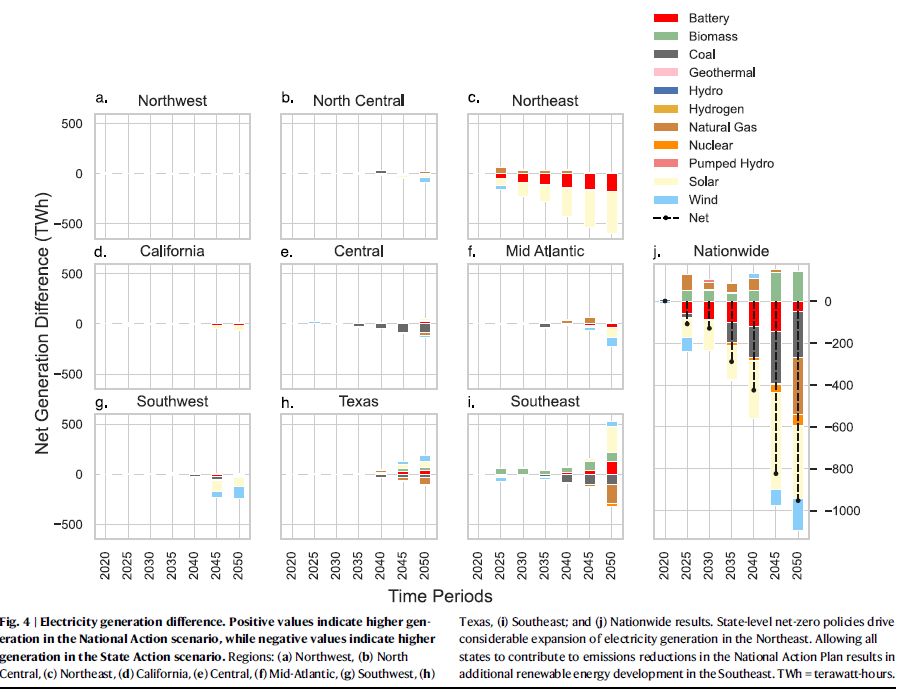
State-led action = more electrification.
Under State Action, we see more EVs, heat pumps, and electrified industry in participating states, requiring +900 TWh/year over National Action. But non-participating states retain a fair amount of natural gas and coal generation without a federal cap.

We modeled two scenarios using Temoa:
• State Action: net-zero by 2050 in 23 politically-willing states
• National Action: same CO₂-eq reduction but achieved with a nationwide cap
Both reduce emissions 46% by 2050, but with very different tech pathways.

New in Nature Communications: "State-led climate action can cut emissions at near-federal costs but favors different technologies"
We used an open-source energy system optimization model to explore what happens if 23 U.S. states pursue net-zero without federal coordination.
📄 doi.org/10.1038/s414...

“Given that there is little expectation the Trump administration will promote a national effort to reduce greenhouse gas emissions to address climate change, we think there is significant value in assessing what kind of difference state-led efforts could make.” @jxjohnson.bsky.social
22.05.2025 15:59 — 👍 0 🔁 1 💬 0 📌 0
🚨 NEW PAPER 🚨
In the largest multi-model study of U.S. decarbonization strategies to date, we explore technology and policy implications for reaching net-zero emissions using 14 energy-economic models. A thread of key takeaways in 10 charts...
Winter peaking of power systems would change planning and operations. Former PhD student Adi Keskar wrote a great paper on this topic a couple of years ago.
www.sciencedirect.com/science/arti...

Last week, the govt dismissed 400 researchers working on the US National Climate Assessment. I was one of them. Today, @agu.org & @ametsoc.org announced they are joining forces to sustain the momentum. It's not a replacement, it's a reminder that science is unstoppable. news.agu.org/press-releas...
02.05.2025 12:24 — 👍 1003 🔁 394 💬 20 📌 27cc: @iopp-environment.bsky.social
14.04.2025 12:59 — 👍 1 🔁 0 💬 0 📌 0I feel like this headline should be from 2010. From my experience, nuclear is not remotely controversial with most current college students.
10.04.2025 23:11 — 👍 4 🔁 0 💬 1 📌 0
The paper offers much more detail into the technology choices and system-wide abatement costs. Check it out!
Thanks to @sloanfoundation.bsky.social, Environmental Research: Energy @ioppublishing.bsky.social, and collaborators (@paulijllo.bsky.social @clameron.bsky.social @katiehjordan.bsky.social)

Graph showing power generation under different CO2 costs. Higher CO2 costs result in more overall generation, dominated by solar and wind power.
Electrification (think heat pumps and EVs) decisions were optimized within the model and varied based on carbon cost. At $400/t—sufficient to achieve net-zero emissions by 2050—U.S. electricity generation more than doubles compared to today to most cost-effectively reduce emissions.
05.03.2025 15:53 — 👍 0 🔁 0 💬 1 📌 0
Graphs showing marginal abatement costs of CO2 in US. The curve are concave up, with higher abatement yielding disproportionally higher costs.
Our marginal abatement cost curves reinforce this message.
Emissions abatement is increasingly costly as the energy system decarbonizes.
But, as technologies improve, there is greater opportunity for cost reductions in future years, resulting in more emissions reductions at comparable costs.

As we know, getting to net-zero is tough. We find that this occurs at costs near $400/t, and displacing those last emissions from industry, aviation, and buildings requires higher-cost carbon management solutions including like direct air capture.
05.03.2025 15:53 — 👍 0 🔁 0 💬 1 📌 0
Multi-panel chart showing CO2-eq emissions trajectories over time, under different costs of CO2.
Here are CO2eq emissions under discrete carbon costs.
$40/t cuts emissions 36% with more wind and solar, and some electrified space heating and transportation.
$100/t gets a 63% drop, near elimination of coal, substantial reductions in the industrial sector, and more widespread electrification.

Systems thinkers know that "you can't just do one thing."
The abatement cost of swapping gasoline for an EV is impacted by other mitigation measures like solar adoption.
In our new pub, an energy systems model captured such interactive effects to estimate marginal CO2 abatement cost in the US.