Thank you Julie! 😊
31.12.2025 17:26 — 👍 1 🔁 0 💬 0 📌 0

Peritore Lab | Microbial Infection & Immunity | Ohio State University Medical Center
Peritore Lab | Microbial Infection & Immunity | Ohio State University Medical Center
The Peritore Lab officially opens its doors in 2026!
I am seeking an organized, motivated technician to join our team focused on host-pathogen interaction research. For details on current research, check out: www.peritorelab.com
Job listing: osu.wd1.myworkdayjobs.com/OSUCareers/j...
#MicroSky
31.12.2025 16:44 — 👍 6 🔁 5 💬 2 📌 0
I love this thread by @glycoshape.org, this is @bsky.app at its best!
11.12.2025 16:25 — 👍 15 🔁 4 💬 1 📌 0
We used rabies virus 👾 to map how #psilocybin modifies long-range circuits 🧠, revealing network-specific reorganization that we didn’t expect.
The full study is now online at Cell. @cp-cell.bsky.social
Paper 👉 www.cell.com/cell/fulltex...
Thread for a synopsis 👉
bsky.app/profile/alex...
05.12.2025 16:29 — 👍 113 🔁 38 💬 8 📌 1

“I’m tired of being constantly confronted by the consequences of my (in)actions.”
05.12.2025 21:18 — 👍 45 🔁 6 💬 2 📌 0
Join us in Colorado next spring for the Keystone Symposia “Beyond #Antibiotics: Emerging Strategies Combating #BacterialInfection”. Registrations are now open! Details below ⬇️
19.11.2025 17:59 — 👍 5 🔁 5 💬 0 📌 0
20/20 This was a fun and important study, and it was a pleasure to collaborate between the @bordenlacy.bsky.social Lab and our brilliant colleagues at @astra-zeneca.bsky.social!
07.11.2025 19:11 — 👍 0 🔁 0 💬 0 📌 0
19/20 AZD5148 is currently in Phase I clinical trials (NCT06469151), and we are hopeful that this monoclonal antibody will help C. difficile patients in the future.
07.11.2025 19:11 — 👍 1 🔁 0 💬 1 📌 0
18/20 However, the main conclusion is that AZD5148 is a VERY promising, broadly neutralizing mAb that works by itself, in relatively low doses, to prevent severe outcomes of C. diff infection. There is a paucity of therapeutics to combat C. diff infection. And this is likely to be a valuable one.
07.11.2025 19:11 — 👍 0 🔁 0 💬 1 📌 0
17/20 But, from a broader view, we have three different toxin subtypes that cause, in my opinion, vastly different pathologies during infection. Is this due to differences in receptor binding? The substrate targeted? Cell types intoxicated? Or simply toxin titers? Lots of questions remain.
07.11.2025 19:11 — 👍 0 🔁 0 💬 1 📌 0
16/20 So interestingly, AZD5148 does not neutralize TcdB3 in vitro, but it protects in vivo. We believe that this is due to the effects TcdB3 has on adherent cells, where, instead of cytopathic rounding, the cells detach from the plate. So the in vitro finding is likely a byproduct of the assay.
07.11.2025 19:11 — 👍 0 🔁 0 💬 1 📌 0

Hematoxylin and eosin-stained ceca of mice infected with three independent C. difficile strains encoding TcdB3. There is little to no damage to the epithelial layer and the only appreciable pathology is severe edema and inflammatory infiltrate.
15/20 The lack of outward signs of disease and limited histopathology was curious, so we tested this with additional TcdB3+ strains and found that the mild disease with edema + inflammation being the most informative markers was consistent across ribotype 017 strains.
07.11.2025 19:11 — 👍 0 🔁 0 💬 1 📌 0
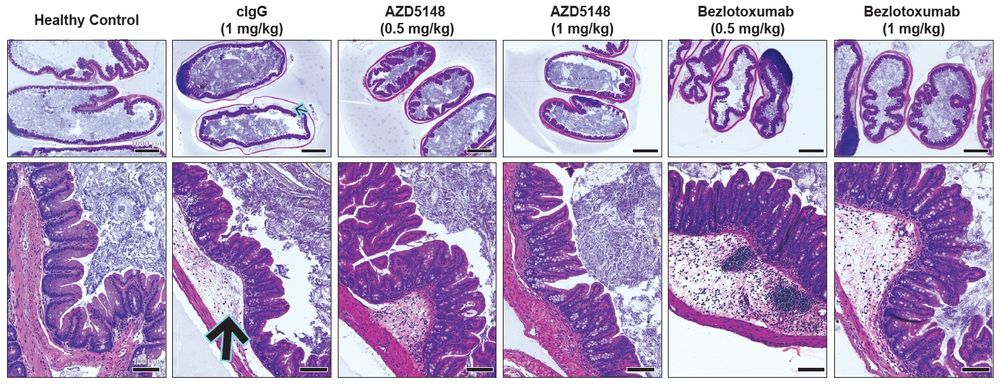
Hematoxylin and eosin-stained ceca of mice prophylactically administered antibodies, then infected with the TcdB3-encoding strain M68. Columns left-to right are: healthy control, isotype IgG control, 0.5 mg/kg AZD5148, 1 mg/kg AZD5148, 0.5 mg/kg bezlotoxumab, and 1 mg/kg bezlotoxumab. The healthy tissue has nicely formed crypts, not much space between the mucosa and the seromuscular layer, indicating that there is no edema. The control IgG group has significant expansion of the submucosa and inflammatory cells in this compartment as well as an expansion of gut-associated lymphoid tissue. The 0.5 mg/kg AZD5148 cecum images have less submucosal edema and inflammatory infiltrates compared to the control IgG group, but the 1 mg/kg AZD5148 images are near healthy. In contrast, both 0.5 and 1 mg/kg groups of bezlotoxumab have significant amounts of edema and inflammatory infiltrates.
14/20 Mice infected with the TcdB3+ strain develop no appreciable epithelial damage, but they do exhibit high amounts of inflammation and edema. Surprisingly, even though AZD5148 did not neutralize TcdB3 in vitro, it significantly protected against the inflammation and edema phenotypes in vivo!
07.11.2025 19:11 — 👍 0 🔁 0 💬 1 📌 0
13/20 Upon initial assessment, it seemed like this strain, despite being isolated from the clinic, did not cause C. difficile infection. There was no diarrhea and minimal weight loss around days 3-6 post-infection. But the tissue tells a different story.
07.11.2025 19:11 — 👍 0 🔁 0 💬 1 📌 0
12/20 What I was really excited about was building up the model of infection with a TcdB3+ strain. This TcdB subtype is typically found in ribotype 017 strains that lack TcdA and are endemic to East Asia. This subtype is also unique in that it preferentially targets Ras-like GTPases.
07.11.2025 19:11 — 👍 0 🔁 0 💬 1 📌 0

Hematoxylin and eosin staining of mouse cecum tissues prophylactically treated with anti-TcdB monoclonal antibodies or an isotype control. Columns left to right are control IgG, AZD5148, and Bezlotoxumab, all given at a dose of 2.5 mg/kg. The top row is a zoomed-out view showing a cross-section of the mouse ceca. There is a massive submucosal expansion, indicative of edema, and severe shedding of the epithelial layer. The bottom row shows a close-up image of the epithelium, which is highly inflamed, and is highly damaged and eroded in some areas.
11/20 What is baffling is that despite protecting against lethality and weight loss, mAb therapy did not have an impact on pathology. This could be due to systemic effects of neutralizing TcdB, or the prevention of further damage by directing more AZD5148 from the bloodstream to the tissue, or more.
07.11.2025 19:11 — 👍 0 🔁 0 💬 1 📌 0
10/20 AZD5148 was protective down to the low dose of 0.5 mg/kg, whereas bezlotoxumab was most protective at 2.5 mg/kg in our model.
We next tested prophylactic protection during infection with the highly pathogenic VPI 10463 (TcdB1+) strain, and again, AZD5148 outperformed bezlotoxumab.
07.11.2025 19:11 — 👍 0 🔁 0 💬 1 📌 0
9/20 Using AZD5148 in a prophylactic model, we found that AZD5148 alone was sufficient to protect against severe C. difficile infection with a TcdB2+ strain. The addition of a TcdA-neutralizing mAb, PA50, added no benefit over AZD5148 alone, which tracks with data from bezlotoxumab clinical trials.
07.11.2025 19:11 — 👍 0 🔁 0 💬 1 📌 0
8/20 In vitro, AZD5148 potently neutralized TcdB1 and TcdB2 with EC50 values 1,000- or 14,000-fold lower than those of bezlotoxumab, respectively. However, AZD5148 was unable to neutralize TcdB3 in vitro, which contains the Y323H mutation in AZD5148's epitope...
07.11.2025 19:11 — 👍 0 🔁 0 💬 1 📌 0
7/20 So we set off to test whether AZD5148 would protect against diverse C. difficile strains that encode TcdB1, TcdB2, and TcdB3 variants. We also compared its efficacy to bezlotoxumab (Zinplava), the existing mAb that was discontinued in January.
07.11.2025 19:11 — 👍 0 🔁 0 💬 1 📌 0
6/20 Around the same time, the field gained a deeper appreciation of divergence in TcdB sequences, with the TcdB1, TcdB2, and TcdB3 subtypes being the most clinically-relevant subtypes.
www.nature.com/articles/s42...
journals.plos.org/plospathogen...
07.11.2025 19:11 — 👍 0 🔁 0 💬 1 📌 0
5/20 But one of the key findings was that some strains encode a TcdB sequence variant that contains a mutation in AZD5148's epitope, which significantly decreased binding affinity...
07.11.2025 19:11 — 👍 0 🔁 0 💬 1 📌 0
4/20 Members of the @bordenlacy.bsky.social Lab then did some fantastic structural and mechanistic work to show that PA41/AZD5148 binds the TcdB enzymatic domain and blocks the translocation of this toxic cargo from the endosomal pore into the host cytosol. www.jbc.org/article/S002...
07.11.2025 19:11 — 👍 0 🔁 0 💬 1 📌 0
3/20 Past work generated the novel anti-TcdB antibody PA41 (now called AZD5148), which neutralized TcdB with picomolar affinity and protected hamsters against lethal infection when combined with an anti-TcdA neutralizing antibody, PA50. academic.oup.com/jid/article/...
07.11.2025 19:11 — 👍 0 🔁 0 💬 1 📌 0
2/20 C. difficile infection is driven by two protein toxins, TcdA and TcdB. However, years of work suggest that TcdB is the main virulence factor.
The only FDA-approved anti-TcdB mAb, bezlotoxumab (Zinplava) for the prevention of recurrent C. difficile infection, was discontinued earlier this year.
07.11.2025 19:11 — 👍 0 🔁 0 💬 1 📌 0
🧪Thrilled to share our new study "The monoclonal antibody AZD5148 confers broad protection against TcdB-diverse Clostridioides difficile strains in mice” in PLoS Pathogens! @bordenlacy.bsky.social
➡️We show that this mAb alone protects against infection with strains encoding TcdB variants. 1/20
07.11.2025 19:11 — 👍 2 🔁 1 💬 1 📌 0

Immune Aspects of Clostridioides difficile Infection and Vaccine Development
Excited to share our recent review in which @rcglover.bsky.social, @joeyzacks.bsky.social, @bordenlacy.bsky.social, and I discuss current advances in our understanding of immunity to C. difficile infection and what it will take to develop an effective vaccine 💉
www.sciencedirect.com/science/arti...
28.08.2025 21:27 — 👍 6 🔁 3 💬 1 📌 0
Imagine this: On the evening of March 8, you and your spouse unlock the door to your apartment building. As you step inside, two men—not in uniform—push their way in behind you. They tell you your visa has been revoked and that they are there to deport you.
12.03.2025 18:46 — 👍 16075 🔁 4453 💬 519 📌 465